

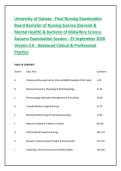
University of Galway - Final Nursing Examination
Board Bachelor of Nursing Science (General &
Mental Health) & Bachelor of Midwifery Science
Autumn Examination Session - 25 September 2026
Version 2.0 - Advanced Clinical & Professional
Practice
TABLE OF CONTENTS
Section Topic Area Questions
A Professional Nursing Practice, Ethics & NMBI Standards (2025 Code) 1-20
B Advanced Anatomy, Physiology & Pathophysiology 21-35
C Pharmacology, Medication Management & Prescribing 36-50
D Complex Medical-Surgical Nursing 51-70
E Mental Health Nursing & Psychopharmacology 71-85
F Maternal, Newborn & Women's Health 86-100
G Child Health & Paediatric Nursing 101-110
H Research, Evidence-Based Practice & Clinical Audit 111-125
I Leadership, Clinical Governance & Patient Safety 126-140
,Section Topic Area Questions
J Integrated Clinical Scenarios & Clinical Prioritisation 141-150
SECTION A: PROFESSIONAL NURSING PRACTICE, ETHICS & NMBI STANDARDS (2025 CODE)
A1. • The NMBI Code of Professional Conduct and Ethics (2025) introduced a significant
structural change from the previous 2014 and 2021 editions. Which of the following best
describes this change?
<font color="red">••</font> A) The Code now contains six interconnected principles—
Respect, Accountability, Competence, Trust, Collaboration and Leadership—each carrying
equal weight
B) The Code has been reduced to four principles to simplify professional guidance
C) The Code now separates registered nurses from registered midwives with distinct principle
sets
D) The Code has eliminated the principle of Competence in favour of a single "Safe Practice"
standard
Rationale: The NMBI Code (2025) represents a significant revision with six interconnected
principles that carry equal weight, replacing the previous five principles. This structural change
emphasises the holistic nature of professional practice.
A2. • A registered nurse working in a busy emergency department identifies a significant risk of
patient harm related to inadequate staffing levels on the night shift. According to the NMBI
Code of Professional Conduct and Ethics (2025), what is the nurse's professional obligation?
<font color="red">••</font> A) Escalate the risk to an appropriate authority and take
reasonable steps to minimise or reduce the identified risks
B) Document the concern in a personal diary but take no further action to avoid conflict
C) Inform the patients directly about the staffing shortage and advise them to complain
D) Refuse to work the night shift until staffing levels are addressed
Rationale: The NMBI Code (2025) explicitly states that nurses must "escalate risks they identify
to an appropriate authority and take reasonable steps to minimise or reduce the identified
risks". This reflects the principle of Accountability and the professional duty to protect patients
from harm.
,A3. • A nurse is caring for a patient with advanced dementia who lacks capacity to make
decisions about their care. The patient's previously expressed wishes are unknown, and there is
no appointed healthcare proxy. Which ethical framework should guide the nurse's decision-
making in this situation?
<font color="red">••</font> A) Best interests decision-making, involving the multidisciplinary
team and considering the patient's known values and beliefs
B) The nurse's professional judgement alone, as the nurse knows the patient best
C) The views of the patient's closest family member, who should have final say
D) A standardised protocol for all patients with dementia, regardless of individual circumstances
Rationale: When a patient lacks capacity, decisions must be made in their best interests. This
requires a collaborative, multidisciplinary approach that considers the patient's known values,
beliefs, and wishes where possible. No single person should make the decision alone, and
standardised protocols must be individualised.
A4. • A nursing student on clinical placement observes a registered nurse documenting a
medication administration that the student knows was not given because the patient refused it.
What is the student's professional obligation under the NMBI Code (2025)?
<font color="red">••</font> A) Raise the concern with the registered nurse and, if unresolved,
escalate to the clinical placement coordinator or nurse manager
B) Ignore the incident as the student is not yet registered and should not challenge qualified
staff
C) Document the observation in the patient's notes without confronting the nurse
D) Report the nurse anonymously to NMBI without attempting to address the issue locally first
Rationale: The NMBI Code requires all practitioners, including students, to act when they
observe unsafe or dishonest practice. Falsifying records is a serious breach of professional
standards. The appropriate pathway is to raise the concern locally first and escalate if
unresolved.
A5. • Which of the following correctly describes the relationship between the NMBI Code of
Professional Conduct and Ethics (2025) and the Scope of Practice framework?
<font color="red">••</font> A) The Code incorporates the Scope of Practice and Professional
Guidance, replacing the previous Scope of Nursing and Midwifery Practice Framework (2015)
, B) The Code and Scope of Practice are entirely separate documents with no relationship
C) The Scope of Practice framework takes precedence over the Code in all circumstances
D) The Code applies only to registered nurses, while the Scope of Practice applies to students
Rationale: The NMBI Code (2025) "incorporates the Scope of Practice and Professional
Guidance" and replaces the previous Scope of Nursing and Midwifery Practice Framework
(2015). This integration reflects the interconnection between ethical practice and scope of
practice determination.
A6. • A registered nurse is considering whether to undertake a new clinical procedure that is
not explicitly covered in their job description but is within their level of education and training.
According to the NMBI Scope of Practice framework, which of the following is the most
important consideration?
<font color="red">••</font> A) Whether the activity is within the nurse's individual
competence based on education, experience, knowledge, skills and judgement
B) Whether the activity is routinely performed by other nurses on the unit
C) Whether the activity is approved by the hospital's medical director
D) Whether the activity is economically efficient for the healthcare setting
Rationale: The NMBI Scope of Practice framework emphasises that individuals must work
within their scope of practice, "adhering to their level of their education, experience,
knowledge, skills and judgment to deliver safe and competent care". Individual competence is
the primary consideration.
A7. • A patient with capacity refuses a blood transfusion that is clinically indicated and
potentially life-saving. The nurse's colleague suggests that the nurse should override the
patient's decision. Which principle of the NMBI Code (2025) should guide the nurse's response?
<font color="red">••</font> A) Principle 1: Respect—the nurse must respect the patient's
autonomy and informed decision
B) Principle 2: Accountability—the nurse is accountable for preserving life and must override the
refusal
C) Principle 5: Collaboration—the nurse should consult colleagues to reach a consensus
D) Principle 6: Leadership—the nurse should lead by example and persuade the patient to
accept treatment
Board Bachelor of Nursing Science (General &
Mental Health) & Bachelor of Midwifery Science
Autumn Examination Session - 25 September 2026
Version 2.0 - Advanced Clinical & Professional
Practice
TABLE OF CONTENTS
Section Topic Area Questions
A Professional Nursing Practice, Ethics & NMBI Standards (2025 Code) 1-20
B Advanced Anatomy, Physiology & Pathophysiology 21-35
C Pharmacology, Medication Management & Prescribing 36-50
D Complex Medical-Surgical Nursing 51-70
E Mental Health Nursing & Psychopharmacology 71-85
F Maternal, Newborn & Women's Health 86-100
G Child Health & Paediatric Nursing 101-110
H Research, Evidence-Based Practice & Clinical Audit 111-125
I Leadership, Clinical Governance & Patient Safety 126-140
,Section Topic Area Questions
J Integrated Clinical Scenarios & Clinical Prioritisation 141-150
SECTION A: PROFESSIONAL NURSING PRACTICE, ETHICS & NMBI STANDARDS (2025 CODE)
A1. • The NMBI Code of Professional Conduct and Ethics (2025) introduced a significant
structural change from the previous 2014 and 2021 editions. Which of the following best
describes this change?
<font color="red">••</font> A) The Code now contains six interconnected principles—
Respect, Accountability, Competence, Trust, Collaboration and Leadership—each carrying
equal weight
B) The Code has been reduced to four principles to simplify professional guidance
C) The Code now separates registered nurses from registered midwives with distinct principle
sets
D) The Code has eliminated the principle of Competence in favour of a single "Safe Practice"
standard
Rationale: The NMBI Code (2025) represents a significant revision with six interconnected
principles that carry equal weight, replacing the previous five principles. This structural change
emphasises the holistic nature of professional practice.
A2. • A registered nurse working in a busy emergency department identifies a significant risk of
patient harm related to inadequate staffing levels on the night shift. According to the NMBI
Code of Professional Conduct and Ethics (2025), what is the nurse's professional obligation?
<font color="red">••</font> A) Escalate the risk to an appropriate authority and take
reasonable steps to minimise or reduce the identified risks
B) Document the concern in a personal diary but take no further action to avoid conflict
C) Inform the patients directly about the staffing shortage and advise them to complain
D) Refuse to work the night shift until staffing levels are addressed
Rationale: The NMBI Code (2025) explicitly states that nurses must "escalate risks they identify
to an appropriate authority and take reasonable steps to minimise or reduce the identified
risks". This reflects the principle of Accountability and the professional duty to protect patients
from harm.
,A3. • A nurse is caring for a patient with advanced dementia who lacks capacity to make
decisions about their care. The patient's previously expressed wishes are unknown, and there is
no appointed healthcare proxy. Which ethical framework should guide the nurse's decision-
making in this situation?
<font color="red">••</font> A) Best interests decision-making, involving the multidisciplinary
team and considering the patient's known values and beliefs
B) The nurse's professional judgement alone, as the nurse knows the patient best
C) The views of the patient's closest family member, who should have final say
D) A standardised protocol for all patients with dementia, regardless of individual circumstances
Rationale: When a patient lacks capacity, decisions must be made in their best interests. This
requires a collaborative, multidisciplinary approach that considers the patient's known values,
beliefs, and wishes where possible. No single person should make the decision alone, and
standardised protocols must be individualised.
A4. • A nursing student on clinical placement observes a registered nurse documenting a
medication administration that the student knows was not given because the patient refused it.
What is the student's professional obligation under the NMBI Code (2025)?
<font color="red">••</font> A) Raise the concern with the registered nurse and, if unresolved,
escalate to the clinical placement coordinator or nurse manager
B) Ignore the incident as the student is not yet registered and should not challenge qualified
staff
C) Document the observation in the patient's notes without confronting the nurse
D) Report the nurse anonymously to NMBI without attempting to address the issue locally first
Rationale: The NMBI Code requires all practitioners, including students, to act when they
observe unsafe or dishonest practice. Falsifying records is a serious breach of professional
standards. The appropriate pathway is to raise the concern locally first and escalate if
unresolved.
A5. • Which of the following correctly describes the relationship between the NMBI Code of
Professional Conduct and Ethics (2025) and the Scope of Practice framework?
<font color="red">••</font> A) The Code incorporates the Scope of Practice and Professional
Guidance, replacing the previous Scope of Nursing and Midwifery Practice Framework (2015)
, B) The Code and Scope of Practice are entirely separate documents with no relationship
C) The Scope of Practice framework takes precedence over the Code in all circumstances
D) The Code applies only to registered nurses, while the Scope of Practice applies to students
Rationale: The NMBI Code (2025) "incorporates the Scope of Practice and Professional
Guidance" and replaces the previous Scope of Nursing and Midwifery Practice Framework
(2015). This integration reflects the interconnection between ethical practice and scope of
practice determination.
A6. • A registered nurse is considering whether to undertake a new clinical procedure that is
not explicitly covered in their job description but is within their level of education and training.
According to the NMBI Scope of Practice framework, which of the following is the most
important consideration?
<font color="red">••</font> A) Whether the activity is within the nurse's individual
competence based on education, experience, knowledge, skills and judgement
B) Whether the activity is routinely performed by other nurses on the unit
C) Whether the activity is approved by the hospital's medical director
D) Whether the activity is economically efficient for the healthcare setting
Rationale: The NMBI Scope of Practice framework emphasises that individuals must work
within their scope of practice, "adhering to their level of their education, experience,
knowledge, skills and judgment to deliver safe and competent care". Individual competence is
the primary consideration.
A7. • A patient with capacity refuses a blood transfusion that is clinically indicated and
potentially life-saving. The nurse's colleague suggests that the nurse should override the
patient's decision. Which principle of the NMBI Code (2025) should guide the nurse's response?
<font color="red">••</font> A) Principle 1: Respect—the nurse must respect the patient's
autonomy and informed decision
B) Principle 2: Accountability—the nurse is accountable for preserving life and must override the
refusal
C) Principle 5: Collaboration—the nurse should consult colleagues to reach a consensus
D) Principle 6: Leadership—the nurse should lead by example and persuade the patient to
accept treatment


