

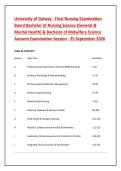
University of Galway - Final Nursing Examination
Board Bachelor of Nursing Science (General &
Mental Health) & Bachelor of Midwifery Science
Autumn Examination Session - 25 September 2026
TABLE OF CONTENTS
Section Topic Area Questions
A Professional Nursing Practice, Ethics & NMBI Standards 1-20
B Anatomy, Physiology & Pathophysiology 21-35
C Pharmacology & Medication Management 36-50
D Medical-Surgical Nursing 51-70
E Mental Health Nursing 71-85
F Maternal, Newborn & Women's Health 86-100
G Child Health & Paediatric Nursing 101-110
H Research, Evidence-Based Practice & Informatics 111-125
I Leadership, Clinical Governance & Transition to Practice 126-140
J Integrated Clinical Scenarios & Prioritisation 141-150
,SECTION A: PROFESSIONAL NURSING PRACTICE, ETHICS & NMBI STANDARDS
A1. • A registered nurse is caring for a patient who has capacity and refuses a life-saving blood
transfusion based on religious beliefs. The nurse's colleague suggests that the nurse should
override the patient's decision to save their life. According to the NMBI Code of Professional
Conduct and Ethics (2025), which principle should guide the nurse's actions?
<font color="red">••</font> A) Principle 1: Respect - the nurse must respect the patient's
autonomy and informed decision, even if it conflicts with the nurse's personal values
B) Principle 2: Accountability - the nurse is accountable for preserving life and must administer
the transfusion
C) Principle 3: Competence - the nurse should consult a more senior colleague to make the
decision
D) Principle 6: Leadership - the nurse should lead by example and persuade the patient to
accept treatment
Rationale: The NMBI Code (2025) Principle 1 (Respect) mandates that nurses respect patients'
dignity, culture, values, beliefs and rights. A patient with capacity has the right to refuse
treatment, and overriding this would constitute a breach of ethical and professional standards.
A2. • A final-year nursing student on clinical placement observes a registered nurse
administering medication without verifying the patient's identity using the recommended two-
patient identifiers. The student is concerned about patient safety. What is the most appropriate
action according to NMBI guidance and professional accountability?
<font color="red">••</font> A) Raise the concern immediately with the registered nurse and,
if unresolved, escalate to the clinical placement coordinator or nurse manager
B) Document the incident in the patient's notes after the shift to avoid confrontation
C) Ignore the observation as the student is not yet registered and should not challenge qualified
staff
D) Report the nurse anonymously to NMBI without attempting to address the issue locally first
Rationale: The NMBI Code emphasises accountability and competence, requiring all
practitioners to act when they observe unsafe practice. Students have a professional duty to
raise concerns, and escalation through appropriate channels is the correct approach.
A3. • A registered nurse is asked by a patient's family member to disclose confidential
information about the patient's diagnosis. The patient has not provided consent for this
,disclosure. Which of the following actions aligns with the NMBI Code of Professional Conduct
and Ethics?
<font color="red">••</font> A) Politely decline to disclose the information, explaining that
confidentiality prevents sharing without the patient's explicit consent
B) Disclose the information as the family member has a right to know
C) Disclose only non-identifying information to satisfy the family member's concern
D) Ask the family member to submit a formal written request before considering disclosure
Rationale: The NMBI Code mandates that nurses maintain confidentiality and only share
information with consent or when legally required. The nurse must protect the patient's right to
privacy and confidentiality.
A4. • Which legislation primarily governs the registration, regulation and professional conduct
of nurses and midwives in Ireland?
<font color="red">••</font> A) The Nurses and Midwives Act 2011
B) The Health Act 2007
C) The Medical Practitioners Act 2007
D) The Data Protection Act 2018
Rationale: The Nurses and Midwives Act 2011 is the primary legislation establishing NMBI and
governing nursing and midwifery regulation in Ireland.
A5. • A nurse is assigned to care for a patient from a culturally diverse background whose
dietary preferences conflict with the hospital menu. The patient's family has brought in
traditional food. According to the NMBI Code, which action demonstrates culturally competent
and respectful care?
<font color="red">••</font> A) Support the patient's choice to eat traditional food while
ensuring it does not pose a medical risk, and document the patient's preferences
B) Instruct the family to remove the food as it may interfere with the hospital's infection control
policies
C) Advise the patient to eat only the hospital-provided meals for consistency of care
D) Ignore the situation as dietary choices are not a nursing responsibility
Rationale: The NMBI Code Principle 1 (Respect) requires nurses to respect an individual's
dignity, culture, values, beliefs and rights. Supporting culturally appropriate care while
maintaining safety is fundamental to person-centred practice.
, A6. • A nurse administers an incorrect dose of medication to a patient. The patient experiences
no adverse effects. What is the nurse's professional obligation under the NMBI Code of
Professional Conduct and Ethics?
<font color="red">••</font> A) Immediately report the error, complete an incident report,
and inform the patient and medical team
B) Document the medication as administered correctly to avoid disciplinary action
C) Only report the error if the patient develops symptoms
D) Discuss the error with a colleague but do not document it to protect the patient from anxiety
Rationale: The NMBI Code emphasises accountability, transparency and honesty. Nurses must
report errors promptly, regardless of outcome, to maintain patient safety and professional
integrity.
A7. • According to the NMBI Scope of Practice framework, when determining whether a
particular activity falls within a nurse's scope of practice, the nurse should first consider which
of the following?
<font color="red">••</font> A) Whether the activity is within the nurse's individual
competence, education and training
B) Whether the activity is economically efficient for the healthcare setting
C) Whether the activity is routinely performed by other nurses on the unit
D) Whether the activity is approved by the hospital's medical director
Rationale: The NMBI Scope of Practice framework requires nurses to practice within their
individual competence, based on education, training and experience. The decision-making
framework guides nurses to determine their scope safely.
A8. • A registered nurse is caring for a patient at the end of life who has an advance care
directive refusing cardiopulmonary resuscitation (CPR). The patient's family requests that CPR
be attempted despite the directive. What is the most appropriate nursing action?
<font color="red">••</font> A) Respect the advance care directive as a legally binding
expression of the patient's wishes and explain this to the family
B) Agree to the family's request to avoid causing them distress
C) Compromise by performing a limited resuscitation attempt
D) Contact the hospital legal department before taking any action
Board Bachelor of Nursing Science (General &
Mental Health) & Bachelor of Midwifery Science
Autumn Examination Session - 25 September 2026
TABLE OF CONTENTS
Section Topic Area Questions
A Professional Nursing Practice, Ethics & NMBI Standards 1-20
B Anatomy, Physiology & Pathophysiology 21-35
C Pharmacology & Medication Management 36-50
D Medical-Surgical Nursing 51-70
E Mental Health Nursing 71-85
F Maternal, Newborn & Women's Health 86-100
G Child Health & Paediatric Nursing 101-110
H Research, Evidence-Based Practice & Informatics 111-125
I Leadership, Clinical Governance & Transition to Practice 126-140
J Integrated Clinical Scenarios & Prioritisation 141-150
,SECTION A: PROFESSIONAL NURSING PRACTICE, ETHICS & NMBI STANDARDS
A1. • A registered nurse is caring for a patient who has capacity and refuses a life-saving blood
transfusion based on religious beliefs. The nurse's colleague suggests that the nurse should
override the patient's decision to save their life. According to the NMBI Code of Professional
Conduct and Ethics (2025), which principle should guide the nurse's actions?
<font color="red">••</font> A) Principle 1: Respect - the nurse must respect the patient's
autonomy and informed decision, even if it conflicts with the nurse's personal values
B) Principle 2: Accountability - the nurse is accountable for preserving life and must administer
the transfusion
C) Principle 3: Competence - the nurse should consult a more senior colleague to make the
decision
D) Principle 6: Leadership - the nurse should lead by example and persuade the patient to
accept treatment
Rationale: The NMBI Code (2025) Principle 1 (Respect) mandates that nurses respect patients'
dignity, culture, values, beliefs and rights. A patient with capacity has the right to refuse
treatment, and overriding this would constitute a breach of ethical and professional standards.
A2. • A final-year nursing student on clinical placement observes a registered nurse
administering medication without verifying the patient's identity using the recommended two-
patient identifiers. The student is concerned about patient safety. What is the most appropriate
action according to NMBI guidance and professional accountability?
<font color="red">••</font> A) Raise the concern immediately with the registered nurse and,
if unresolved, escalate to the clinical placement coordinator or nurse manager
B) Document the incident in the patient's notes after the shift to avoid confrontation
C) Ignore the observation as the student is not yet registered and should not challenge qualified
staff
D) Report the nurse anonymously to NMBI without attempting to address the issue locally first
Rationale: The NMBI Code emphasises accountability and competence, requiring all
practitioners to act when they observe unsafe practice. Students have a professional duty to
raise concerns, and escalation through appropriate channels is the correct approach.
A3. • A registered nurse is asked by a patient's family member to disclose confidential
information about the patient's diagnosis. The patient has not provided consent for this
,disclosure. Which of the following actions aligns with the NMBI Code of Professional Conduct
and Ethics?
<font color="red">••</font> A) Politely decline to disclose the information, explaining that
confidentiality prevents sharing without the patient's explicit consent
B) Disclose the information as the family member has a right to know
C) Disclose only non-identifying information to satisfy the family member's concern
D) Ask the family member to submit a formal written request before considering disclosure
Rationale: The NMBI Code mandates that nurses maintain confidentiality and only share
information with consent or when legally required. The nurse must protect the patient's right to
privacy and confidentiality.
A4. • Which legislation primarily governs the registration, regulation and professional conduct
of nurses and midwives in Ireland?
<font color="red">••</font> A) The Nurses and Midwives Act 2011
B) The Health Act 2007
C) The Medical Practitioners Act 2007
D) The Data Protection Act 2018
Rationale: The Nurses and Midwives Act 2011 is the primary legislation establishing NMBI and
governing nursing and midwifery regulation in Ireland.
A5. • A nurse is assigned to care for a patient from a culturally diverse background whose
dietary preferences conflict with the hospital menu. The patient's family has brought in
traditional food. According to the NMBI Code, which action demonstrates culturally competent
and respectful care?
<font color="red">••</font> A) Support the patient's choice to eat traditional food while
ensuring it does not pose a medical risk, and document the patient's preferences
B) Instruct the family to remove the food as it may interfere with the hospital's infection control
policies
C) Advise the patient to eat only the hospital-provided meals for consistency of care
D) Ignore the situation as dietary choices are not a nursing responsibility
Rationale: The NMBI Code Principle 1 (Respect) requires nurses to respect an individual's
dignity, culture, values, beliefs and rights. Supporting culturally appropriate care while
maintaining safety is fundamental to person-centred practice.
, A6. • A nurse administers an incorrect dose of medication to a patient. The patient experiences
no adverse effects. What is the nurse's professional obligation under the NMBI Code of
Professional Conduct and Ethics?
<font color="red">••</font> A) Immediately report the error, complete an incident report,
and inform the patient and medical team
B) Document the medication as administered correctly to avoid disciplinary action
C) Only report the error if the patient develops symptoms
D) Discuss the error with a colleague but do not document it to protect the patient from anxiety
Rationale: The NMBI Code emphasises accountability, transparency and honesty. Nurses must
report errors promptly, regardless of outcome, to maintain patient safety and professional
integrity.
A7. • According to the NMBI Scope of Practice framework, when determining whether a
particular activity falls within a nurse's scope of practice, the nurse should first consider which
of the following?
<font color="red">••</font> A) Whether the activity is within the nurse's individual
competence, education and training
B) Whether the activity is economically efficient for the healthcare setting
C) Whether the activity is routinely performed by other nurses on the unit
D) Whether the activity is approved by the hospital's medical director
Rationale: The NMBI Scope of Practice framework requires nurses to practice within their
individual competence, based on education, training and experience. The decision-making
framework guides nurses to determine their scope safely.
A8. • A registered nurse is caring for a patient at the end of life who has an advance care
directive refusing cardiopulmonary resuscitation (CPR). The patient's family requests that CPR
be attempted despite the directive. What is the most appropriate nursing action?
<font color="red">••</font> A) Respect the advance care directive as a legally binding
expression of the patient's wishes and explain this to the family
B) Agree to the family's request to avoid causing them distress
C) Compromise by performing a limited resuscitation attempt
D) Contact the hospital legal department before taking any action


