

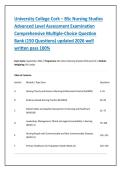
University College Cork – BSc Nursing Studies
Advanced Level Assessment Examination
Comprehensive Multiple-Choice Question
Bank (150 Questions) updated 2026 well
written pass 100%
Exam Cycle: September 2026 | Programme: BSc (Hons) Nursing Studies (NFQ Level 8) | Module
Weighting: 60 Credits
Table of Contents
Section Module / Topic Area Questions
A Nursing Theory and Science Informing Professional Practice (NU4001) 1–25
B Evidence-Based Nursing Practice (NU4016) 26–50
Patient Safety and Quality Improvement in Nursing and Healthcare
C 51–75
(NU4108)
Leadership, Management, Ethical and Legal Accountability in Nursing
D 76–100
(NU4111)
Nursing People with Communicable and Non-Communicable Diseases
E 101–125
(NU4112)
F Primary Healthcare for Population Health (NU4113) 126–150
,SECTION A: NURSING THEORY AND SCIENCE INFORMING PROFESSIONAL PRACTICE (NU4001)
Module descriptor: Theoretical foundations of concepts central to the discipline of nursing;
contributions of Carper, Benner, Watson and other nurse theorists; nursing diagnoses for clinical
nursing practice and nursing research.
Question 1
A registered nurse is caring for a postoperative patient who expresses fear about mobility
following hip replacement surgery. The nurse sits with the patient, actively listens to their
concerns, and provides reassurance while maintaining professional boundaries. This approach
primarily reflects which pattern of knowing as described by Carper?
A. Esthetic knowing
B. Empirical knowing
C. Personal knowing
D. Ethical knowing
Rationale: Esthetic knowing refers to the art of nursing—the expressive, creative, and
perceptual aspect of care that enables the nurse to perceive and respond to the patient's
immediate experience. Sitting with the patient, active listening, and providing reassurance while
maintaining boundaries exemplifies the esthetic pattern of knowing. Empirical knowing is the
science of nursing; personal knowing involves self-awareness and therapeutic use of self; ethical
knowing concerns moral obligations.
Question 2
According to Benner's novice-to-expert model, a nurse who has been practising for 18
months in an acute medical ward and can now recognise patterns in patient presentations
based on previous experience, but still relies on analytical thinking for complex situations, is
functioning at which level of proficiency?
A. Novice
B. Advanced beginner
C. Competent
D. Proficient
Rationale: The competent level (typically 2–3 years of practice) is characterised by the ability to
see patterns and develop plans based on prior experience, though the nurse still relies on
analytical thinking for complex or unfamiliar situations. The advanced beginner (1–2 years) can
,recognise recurrent situations but lacks deep pattern recognition. The proficient nurse (3–5
years) sees situations holistically, and the expert nurse operates from intuitive grasp.
Question 3
A nurse manager is implementing a new care delivery model on a medical-surgical unit. The
manager encourages staff to identify their own strengths and contributions to the change
process and emphasises the importance of self-awareness in professional development. This
approach is most consistent with which nursing theorist's framework?
A. Dorothea Orem
B. Patricia Benner
C. Jean Watson
D. Madeleine Leininger
Rationale: Jean Watson's Theory of Human Caring emphasises the importance of self-
awareness, personal growth, and the nurse's authentic presence in caring relationships.
Watson's carative factors include the cultivation of one's own spiritual practices and
transpersonal caring relationships. Orem's Self-Care Deficit Theory focuses on patients' self-care
abilities; Benner's work addresses skill acquisition; Leininger's theory addresses cultural care.
Question 4
In the context of nursing diagnosis, which statement correctly distinguishes a nursing
diagnosis from a medical diagnosis?
A. Nursing diagnoses are derived exclusively from laboratory findings
B. Nursing diagnoses describe human responses to health conditions and life processes
C. Nursing diagnoses are limited to physical health alterations only
D. Nursing diagnoses are formulated solely by physicians
Rationale: Nursing diagnoses describe human responses to health conditions and life
processes—the actual or potential health problems that nurses can independently treat. They
are derived from nursing assessment data and focus on the patient's response to illness, not just
the pathology itself. Medical diagnoses identify disease processes from a biomedical
perspective.
Question 5
A nursing student is preparing a care plan for a patient with chronic heart failure. The
, student identifies "Activity Intolerance" as a nursing diagnosis. According to the NANDA-I
taxonomy, this diagnosis would be classified under which domain?
A. Activity/Rest
B. Coping/Stress Tolerance
C. Elimination
D. Nutrition
Rationale: The NANDA-I taxonomy organises nursing diagnoses into domains. "Activity
Intolerance" falls under the Activity/Rest domain, which includes diagnoses related to the
production, conservation, or expenditure of energy. Coping/Stress Tolerance addresses
psychological responses; Elimination addresses excretory functions; Nutrition addresses
metabolic processes.
Question 6
A nurse reflects on a clinical situation and asks, "What should I have done differently to
better support this patient's autonomy?" This reflective question primarily engages which
pattern of knowing?
A. Esthetic knowing
B. Empirical knowing
C. Personal knowing
D. Ethical knowing
Rationale: Ethical knowing involves questions of obligation, what ought to be done, and moral
reasoning in nursing practice. The question about supporting patient autonomy reflects ethical
knowing, which addresses moral dilemmas and the nurse's ethical responsibilities. Esthetic
knowing is the art of nursing; empirical knowing is scientific knowledge; personal knowing is
self-awareness and therapeutic relationships.
Question 7
According to Watson's Theory of Human Caring, which of the following is a carative factor
that distinguishes nursing from other healthcare professions?
A. Administration of medications
B. Performance of physical assessments
C. Formation of a humanistic-altruistic value system
D. Documentation of patient progress
Advanced Level Assessment Examination
Comprehensive Multiple-Choice Question
Bank (150 Questions) updated 2026 well
written pass 100%
Exam Cycle: September 2026 | Programme: BSc (Hons) Nursing Studies (NFQ Level 8) | Module
Weighting: 60 Credits
Table of Contents
Section Module / Topic Area Questions
A Nursing Theory and Science Informing Professional Practice (NU4001) 1–25
B Evidence-Based Nursing Practice (NU4016) 26–50
Patient Safety and Quality Improvement in Nursing and Healthcare
C 51–75
(NU4108)
Leadership, Management, Ethical and Legal Accountability in Nursing
D 76–100
(NU4111)
Nursing People with Communicable and Non-Communicable Diseases
E 101–125
(NU4112)
F Primary Healthcare for Population Health (NU4113) 126–150
,SECTION A: NURSING THEORY AND SCIENCE INFORMING PROFESSIONAL PRACTICE (NU4001)
Module descriptor: Theoretical foundations of concepts central to the discipline of nursing;
contributions of Carper, Benner, Watson and other nurse theorists; nursing diagnoses for clinical
nursing practice and nursing research.
Question 1
A registered nurse is caring for a postoperative patient who expresses fear about mobility
following hip replacement surgery. The nurse sits with the patient, actively listens to their
concerns, and provides reassurance while maintaining professional boundaries. This approach
primarily reflects which pattern of knowing as described by Carper?
A. Esthetic knowing
B. Empirical knowing
C. Personal knowing
D. Ethical knowing
Rationale: Esthetic knowing refers to the art of nursing—the expressive, creative, and
perceptual aspect of care that enables the nurse to perceive and respond to the patient's
immediate experience. Sitting with the patient, active listening, and providing reassurance while
maintaining boundaries exemplifies the esthetic pattern of knowing. Empirical knowing is the
science of nursing; personal knowing involves self-awareness and therapeutic use of self; ethical
knowing concerns moral obligations.
Question 2
According to Benner's novice-to-expert model, a nurse who has been practising for 18
months in an acute medical ward and can now recognise patterns in patient presentations
based on previous experience, but still relies on analytical thinking for complex situations, is
functioning at which level of proficiency?
A. Novice
B. Advanced beginner
C. Competent
D. Proficient
Rationale: The competent level (typically 2–3 years of practice) is characterised by the ability to
see patterns and develop plans based on prior experience, though the nurse still relies on
analytical thinking for complex or unfamiliar situations. The advanced beginner (1–2 years) can
,recognise recurrent situations but lacks deep pattern recognition. The proficient nurse (3–5
years) sees situations holistically, and the expert nurse operates from intuitive grasp.
Question 3
A nurse manager is implementing a new care delivery model on a medical-surgical unit. The
manager encourages staff to identify their own strengths and contributions to the change
process and emphasises the importance of self-awareness in professional development. This
approach is most consistent with which nursing theorist's framework?
A. Dorothea Orem
B. Patricia Benner
C. Jean Watson
D. Madeleine Leininger
Rationale: Jean Watson's Theory of Human Caring emphasises the importance of self-
awareness, personal growth, and the nurse's authentic presence in caring relationships.
Watson's carative factors include the cultivation of one's own spiritual practices and
transpersonal caring relationships. Orem's Self-Care Deficit Theory focuses on patients' self-care
abilities; Benner's work addresses skill acquisition; Leininger's theory addresses cultural care.
Question 4
In the context of nursing diagnosis, which statement correctly distinguishes a nursing
diagnosis from a medical diagnosis?
A. Nursing diagnoses are derived exclusively from laboratory findings
B. Nursing diagnoses describe human responses to health conditions and life processes
C. Nursing diagnoses are limited to physical health alterations only
D. Nursing diagnoses are formulated solely by physicians
Rationale: Nursing diagnoses describe human responses to health conditions and life
processes—the actual or potential health problems that nurses can independently treat. They
are derived from nursing assessment data and focus on the patient's response to illness, not just
the pathology itself. Medical diagnoses identify disease processes from a biomedical
perspective.
Question 5
A nursing student is preparing a care plan for a patient with chronic heart failure. The
, student identifies "Activity Intolerance" as a nursing diagnosis. According to the NANDA-I
taxonomy, this diagnosis would be classified under which domain?
A. Activity/Rest
B. Coping/Stress Tolerance
C. Elimination
D. Nutrition
Rationale: The NANDA-I taxonomy organises nursing diagnoses into domains. "Activity
Intolerance" falls under the Activity/Rest domain, which includes diagnoses related to the
production, conservation, or expenditure of energy. Coping/Stress Tolerance addresses
psychological responses; Elimination addresses excretory functions; Nutrition addresses
metabolic processes.
Question 6
A nurse reflects on a clinical situation and asks, "What should I have done differently to
better support this patient's autonomy?" This reflective question primarily engages which
pattern of knowing?
A. Esthetic knowing
B. Empirical knowing
C. Personal knowing
D. Ethical knowing
Rationale: Ethical knowing involves questions of obligation, what ought to be done, and moral
reasoning in nursing practice. The question about supporting patient autonomy reflects ethical
knowing, which addresses moral dilemmas and the nurse's ethical responsibilities. Esthetic
knowing is the art of nursing; empirical knowing is scientific knowledge; personal knowing is
self-awareness and therapeutic relationships.
Question 7
According to Watson's Theory of Human Caring, which of the following is a carative factor
that distinguishes nursing from other healthcare professions?
A. Administration of medications
B. Performance of physical assessments
C. Formation of a humanistic-altruistic value system
D. Documentation of patient progress


