

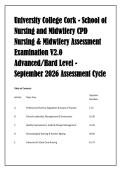
University College Cork - School of
Nursing and Midwifery CPD
Nursing & Midwifery Assessment
Examination V2.0
Advanced/Hard Level -
September 2026 Assessment Cycle
Table of Contents
Question
Section Topic Area
Numbers
A Professional Practice, Regulation & Scope of Practice 1-15
B Clinical Leadership, Management & Governance 16-30
C Quality Improvement, Audit & Change Management 31-45
D Gerontological Nursing & Positive Ageing 46-60
E Intensive & Critical Care Nursing 61-75
, Question
Section Topic Area
Numbers
F Nurse/Midwife Prescribing & Pharmacological Competence 76-90
Research Methodology, Evidence-Based Practice & Critical
G 91-105
Appraisal
H Ethics, Law, Professional Conduct & Decision-Making 106-120
I Patient Safety, Risk Assessment & Clinical Governance 121-135
J Communication, Reflection, Holistic Care & Wellbeing 136-150
SECTION A: PROFESSIONAL PRACTICE, REGULATION & SCOPE OF PRACTICE
Question 1
A registered nurse with 12 years of experience in a medical-surgical ward is temporarily
redeployed to an intensive care unit during a surge capacity event. The nurse has never worked
in critical care but has completed the UCC NU6171 Principles in Intensive Care Nursing module.
The nurse is asked to independently manage a patient requiring continuous renal replacement
therapy (CRRT)—a procedure not covered in the NU6171 curriculum. According to the NMBI
Scope of Nursing and Midwifery Practice Framework (2015), which of the following factors is the
MOST critical determinant of whether the nurse can perform this procedure?
A) The nurse's years of general nursing experience
B) The nurse's level of competence and education specific to CRRT
C) The availability of a medical practitioner to provide remote supervision
D) The hospital's policy on redeployment during emergency situations
Rationale: The NMBI Scope of Practice Framework defines scope as "the range of roles,
functions, responsibilities and activities which a registered nurse is educated, competent and
has authority to perform". Competence specific to the procedure is the critical determinant, not
general experience or supervision alone.
,Question 2
The NMBI Code of Professional Conduct and Ethics (2025) contains six principles that
underpin professional practice. Which of the following correctly lists ALL six principles as
published in the revised Code?
A) Respect, Accountability, Competence, Trust, Collaboration, and Leadership
B) Autonomy, Beneficence, Non-maleficence, Justice, Veracity, and Fidelity
C) Respect, Responsibility, Competence, Integrity, Partnership, and Excellence
D) Accountability, Advocacy, Confidentiality, Collaboration, Leadership, and Safety
Rationale: The revised NMBI Code (2025) contains six principles: Respect, Accountability,
Competence, Trust, Collaboration, and Leadership, an increase from the previous five principles.
Question 3
A nurse enrolled in the UCC module NU6125 Professional Practice Issues for Nurses and
Midwives is completing the 3,000-word written report component of the assessment. The
module's total marks are 200, with continuous assessment constituting the entirety. What is the
mark allocation for the E-tivities component of this module?
A) 10 marks
B) 20 marks
C) 30 marks
D) 40 marks
Rationale: NU6125 assessment comprises a 3,000-word written report worth 180 marks and E-
tivities worth 20 marks, with total continuous assessment of 200 marks.
Question 4
According to NMBI's Professional Competence Scheme requirements, a registered nurse
must complete a minimum number of CPD hours over a three-year period. However, the
scheme also mandates a minimum number of practice hours. What is the CORRECT
combination of CPD hours and practice hours required?
A) 60 hours CPD and 300 hours practice over 3 years
B) 60 hours CPD and 450 hours practice over 3 years
C) 45 hours CPD and 450 hours practice over 3 years
D) 90 hours CPD and 600 hours practice over 3 years
Rationale: NMBI requires a minimum of 60 hours of CPD activities over 3 years (average 20
hours per year) and a minimum of 450 practice hours over 3 years (average 150 hours per year).
, Question 5
An applicant for a UCC Nursing and Midwifery CPD module does not hold an up-to-date
IELTS certificate demonstrating the requisite Academic Board approved CM&H scores. Under
what condition may this applicant still be considered for admission?
A) The applicant may provide a letter of recommendation from their Director of Nursing
B) The applicant may demonstrate evidence of appropriate work experience within an English
language environment for at least the previous 2 years
C) The applicant may complete an internal UCC English language proficiency test
D) The applicant may provide a certificate of completion from an English language course
Rationale: UCC requires applicants for Nursing and Midwifery CPD modules who lack an up-to-
date IELTS certificate to demonstrate evidence of appropriate work experience within an English
language environment for at least the previous 2 years.
Question 6
A registered midwife is considering expanding her scope of practice to include a new
procedure that falls outside her traditional midwifery role. According to the NMBI Scope of
Nursing and Midwifery Practice Framework (2015), which of the following is a REQUIRED
consideration when determining whether to expand scope?
A) The midwife's personal preference and career aspirations
B) The availability of financial resources to support the expansion
C) Competence, responsibility, accountability, autonomy, and CPD
D) The midwife's years of experience in the current role
Rationale: The Framework specifies that considerations in determining scope include
competence, responsibility, accountability and autonomy, CPD, support for practice, delegation
and supervision, practice setting, collaborative practice, and expanded practice.
Question 7
The UCC CPD module NU6125 requires students to critically review professional conduct
issues and integrate theory and practice. Which of the following is a SPECIFIC learning outcome
of this module?
A) To perform comprehensive physical assessment independently
B) To critically reflect on contemporary nursing or midwifery care within the context of a
challenging healthcare environment
Nursing and Midwifery CPD
Nursing & Midwifery Assessment
Examination V2.0
Advanced/Hard Level -
September 2026 Assessment Cycle
Table of Contents
Question
Section Topic Area
Numbers
A Professional Practice, Regulation & Scope of Practice 1-15
B Clinical Leadership, Management & Governance 16-30
C Quality Improvement, Audit & Change Management 31-45
D Gerontological Nursing & Positive Ageing 46-60
E Intensive & Critical Care Nursing 61-75
, Question
Section Topic Area
Numbers
F Nurse/Midwife Prescribing & Pharmacological Competence 76-90
Research Methodology, Evidence-Based Practice & Critical
G 91-105
Appraisal
H Ethics, Law, Professional Conduct & Decision-Making 106-120
I Patient Safety, Risk Assessment & Clinical Governance 121-135
J Communication, Reflection, Holistic Care & Wellbeing 136-150
SECTION A: PROFESSIONAL PRACTICE, REGULATION & SCOPE OF PRACTICE
Question 1
A registered nurse with 12 years of experience in a medical-surgical ward is temporarily
redeployed to an intensive care unit during a surge capacity event. The nurse has never worked
in critical care but has completed the UCC NU6171 Principles in Intensive Care Nursing module.
The nurse is asked to independently manage a patient requiring continuous renal replacement
therapy (CRRT)—a procedure not covered in the NU6171 curriculum. According to the NMBI
Scope of Nursing and Midwifery Practice Framework (2015), which of the following factors is the
MOST critical determinant of whether the nurse can perform this procedure?
A) The nurse's years of general nursing experience
B) The nurse's level of competence and education specific to CRRT
C) The availability of a medical practitioner to provide remote supervision
D) The hospital's policy on redeployment during emergency situations
Rationale: The NMBI Scope of Practice Framework defines scope as "the range of roles,
functions, responsibilities and activities which a registered nurse is educated, competent and
has authority to perform". Competence specific to the procedure is the critical determinant, not
general experience or supervision alone.
,Question 2
The NMBI Code of Professional Conduct and Ethics (2025) contains six principles that
underpin professional practice. Which of the following correctly lists ALL six principles as
published in the revised Code?
A) Respect, Accountability, Competence, Trust, Collaboration, and Leadership
B) Autonomy, Beneficence, Non-maleficence, Justice, Veracity, and Fidelity
C) Respect, Responsibility, Competence, Integrity, Partnership, and Excellence
D) Accountability, Advocacy, Confidentiality, Collaboration, Leadership, and Safety
Rationale: The revised NMBI Code (2025) contains six principles: Respect, Accountability,
Competence, Trust, Collaboration, and Leadership, an increase from the previous five principles.
Question 3
A nurse enrolled in the UCC module NU6125 Professional Practice Issues for Nurses and
Midwives is completing the 3,000-word written report component of the assessment. The
module's total marks are 200, with continuous assessment constituting the entirety. What is the
mark allocation for the E-tivities component of this module?
A) 10 marks
B) 20 marks
C) 30 marks
D) 40 marks
Rationale: NU6125 assessment comprises a 3,000-word written report worth 180 marks and E-
tivities worth 20 marks, with total continuous assessment of 200 marks.
Question 4
According to NMBI's Professional Competence Scheme requirements, a registered nurse
must complete a minimum number of CPD hours over a three-year period. However, the
scheme also mandates a minimum number of practice hours. What is the CORRECT
combination of CPD hours and practice hours required?
A) 60 hours CPD and 300 hours practice over 3 years
B) 60 hours CPD and 450 hours practice over 3 years
C) 45 hours CPD and 450 hours practice over 3 years
D) 90 hours CPD and 600 hours practice over 3 years
Rationale: NMBI requires a minimum of 60 hours of CPD activities over 3 years (average 20
hours per year) and a minimum of 450 practice hours over 3 years (average 150 hours per year).
, Question 5
An applicant for a UCC Nursing and Midwifery CPD module does not hold an up-to-date
IELTS certificate demonstrating the requisite Academic Board approved CM&H scores. Under
what condition may this applicant still be considered for admission?
A) The applicant may provide a letter of recommendation from their Director of Nursing
B) The applicant may demonstrate evidence of appropriate work experience within an English
language environment for at least the previous 2 years
C) The applicant may complete an internal UCC English language proficiency test
D) The applicant may provide a certificate of completion from an English language course
Rationale: UCC requires applicants for Nursing and Midwifery CPD modules who lack an up-to-
date IELTS certificate to demonstrate evidence of appropriate work experience within an English
language environment for at least the previous 2 years.
Question 6
A registered midwife is considering expanding her scope of practice to include a new
procedure that falls outside her traditional midwifery role. According to the NMBI Scope of
Nursing and Midwifery Practice Framework (2015), which of the following is a REQUIRED
consideration when determining whether to expand scope?
A) The midwife's personal preference and career aspirations
B) The availability of financial resources to support the expansion
C) Competence, responsibility, accountability, autonomy, and CPD
D) The midwife's years of experience in the current role
Rationale: The Framework specifies that considerations in determining scope include
competence, responsibility, accountability and autonomy, CPD, support for practice, delegation
and supervision, practice setting, collaborative practice, and expanded practice.
Question 7
The UCC CPD module NU6125 requires students to critically review professional conduct
issues and integrate theory and practice. Which of the following is a SPECIFIC learning outcome
of this module?
A) To perform comprehensive physical assessment independently
B) To critically reflect on contemporary nursing or midwifery care within the context of a
challenging healthcare environment


