

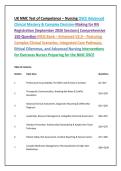
UK NMC Test of Competence – Nursing OSCE Advanced
Clinical Mastery & Complex Decision-Making for RN
Registration (September 2026 Sessions) Comprehensive
150-Question MCQ Bank – Enhanced V2.0 – Featuring
Complex Clinical Scenarios, Integrated Care Pathways,
Ethical Dilemmas, and Advanced Nursing Interventions
for Overseas Nurses Preparing for the NMC OSCE
Table of Contents
Section Topic Area Questions
1 Professional Accountability, The NMC Code & Duty of Candour Q1–Q15
Therapeutic Communication, Breaking Bad News & Conflict
2 Q16–Q30
Resolution
Advanced Clinical Assessment, Diagnostic Reasoning & Differential
3 Q31–Q45
Diagnosis
4 Leadership, Resource Management, Delegation & Clinical Governance Q46–Q55
Infection Prevention, Antimicrobial Stewardship & Aseptic Non-Touch
5 Q56–Q70
Technique
6 Patient Safety, Risk Assessment, Incident Reporting & Human Factors Q71–Q85
Complex Medicines Management, Pharmacokinetics & High-Alert
7 Q86–Q100
Medications
,Section Topic Area Questions
ABCDE Assessment, Sepsis Recognition & Acute Deterioration
8 Q101–Q115
Management
9 APIE Framework, Care Planning & Multidisciplinary Collaboration Q116–Q130
10 Evidence-Based Practice, Research Translation & Clinical Audit Q131–Q140
11 Mental Capacity Act, Deprivation of Liberty Safeguards & Consent Q141–Q150
SECTION 1: PROFESSIONAL ACCOUNTABILITY, THE NMC CODE & DUTY OF CANDOUR
Q1. • An internationally educated nurse is working in a UK hospital for the first time. A patient
from a minority ethnic background refuses a blood transfusion based on religious beliefs, but
the medical team insists the transfusion is life-saving. The nurse recognises that the patient has
capacity and fully understands the consequences. Which action is most consistent with The
NMC Code and UK legal principles?
• • A) Administer the transfusion covertly to save the patient's life, then document the action as
an emergency
• • B) Persuade the patient by explaining the legal consequences of refusing treatment
• C) Respect the patient's autonomous decision, document the refusal, and explore
alternative treatments with the medical team
• • D) Request a second opinion from another consultant to override the patient's decision
Correct Answer: C) Respect the patient's autonomous decision, document the refusal, and
explore alternative treatments with the medical team
Rationale: The NMC Code (2018) prioritises people and requires nurses to respect patients'
dignity and autonomy. Patients with capacity have the legal right to refuse treatment, even if it
is life-saving. The nurse must document the refusal accurately, ensure the patient understands
the consequences, and explore alternatives with the multidisciplinary team. Covert
administration is unlawful and unethical. The Mental Capacity Act 2005 reinforces that every
adult has the right to make their own decisions unless they lack capacity.
,Q2. • A nurse administers 10 mg of morphine instead of the prescribed 5 mg to a patient in
severe pain. The patient experiences respiratory depression but recovers after administration of
naloxone. The nurse is distraught and considers not reporting the error. What is the nurse's
professional obligation under the duty of candour?
• • A) Report the error only if the patient or family makes a complaint
• • B) Inform the patient but not document the error to avoid disciplinary action
• C) Report the error immediately, document it accurately, apologise to the patient, and
participate in the incident investigation
• • D) Discuss the error with a colleague and agree to keep it confidential
Correct Answer: C) Report the error immediately, document it accurately, apologise to the
patient, and participate in the incident investigation
Rationale: The professional duty of candour requires nurses to be open and honest with
patients when things go wrong. The nurse must report the error through the appropriate
incident reporting system, document it factually, and apologise to the patient. Failure to report
is a breach of The NMC Code and can result in fitness to practise proceedings. The incident
should be investigated to prevent recurrence.
Q3. • A nurse is caring for a patient who has disclosed that they are being physically abused by
their partner. The patient begs the nurse not to tell anyone. Which action is most appropriate?
• • A) Promise the patient that the information will remain confidential
• • B) Inform the partner that the patient has disclosed abuse
• C) Explain that confidentiality has legal limits, and safeguarding concerns must be
reported to the appropriate authorities
• • D) Document the disclosure but take no further action to maintain trust
Correct Answer: C) Explain that confidentiality has legal limits, and safeguarding concerns
must be reported to the appropriate authorities
Rationale: The NMC Code requires nurses to respect confidentiality but also recognises that
disclosure is required in certain circumstances, such as safeguarding concerns. The nurse must
explain the limits of confidentiality to the patient, report the concern to the safeguarding team,
and support the patient. The nurse must act in the patient's best interest while following legal
and professional obligations.
, Q4. • A nurse is asked by a ward manager to delegate the administration of intravenous
antibiotics to a healthcare assistant (HCA) because the ward is short-staffed. The HCA has not
received training in IV administration. What should the nurse do?
• • A) Delegate the task to the HCA and supervise closely
• • B) Refuse to delegate but administer the medication themselves
• C) Refuse to delegate, explain that it is outside the HCA's scope of practice, and
escalate the concern to senior management
• • D) Delegate the task and document that the HCA was supervised
Correct Answer: C) Refuse to delegate, explain that it is outside the HCA's scope of practice,
and escalate the concern to senior management
Rationale: The NMC Code requires nurses to delegate only tasks that are within the delegatee's
competence and scope of practice. IV antibiotic administration requires specialist training and is
not within the HCA's scope. The nurse must refuse and escalate the concern. The nurse remains
accountable for the delegation and patient safety.
Q5. • A nurse has been working 12-hour shifts for five consecutive days. The nurse feels
exhausted and recognises that their clinical judgement is impaired. What is the most
appropriate action?
• • A) Continue working and take a short break when possible
• • B) Request to be assigned to less complex patients
• C) Inform the ward manager of the situation and request a change in duty rota or time
off
• • D) Ask a colleague to double-check all clinical decisions
Correct Answer: C) Inform the ward manager of the situation and request a change in duty
rota or time off
Rationale: The NMC Code requires nurses to maintain their health and fitness to practise.
Working when exhausted can compromise patient safety. The nurse must be honest about their
fitness to practise and request appropriate rest or a change in duties. The nurse has a
responsibility to preserve safety.
Q6. • A nurse witnesses a colleague administering medication to a patient without performing
the identity check. The patient was not harmed. What is the nurse's most appropriate initial
action?
Clinical Mastery & Complex Decision-Making for RN
Registration (September 2026 Sessions) Comprehensive
150-Question MCQ Bank – Enhanced V2.0 – Featuring
Complex Clinical Scenarios, Integrated Care Pathways,
Ethical Dilemmas, and Advanced Nursing Interventions
for Overseas Nurses Preparing for the NMC OSCE
Table of Contents
Section Topic Area Questions
1 Professional Accountability, The NMC Code & Duty of Candour Q1–Q15
Therapeutic Communication, Breaking Bad News & Conflict
2 Q16–Q30
Resolution
Advanced Clinical Assessment, Diagnostic Reasoning & Differential
3 Q31–Q45
Diagnosis
4 Leadership, Resource Management, Delegation & Clinical Governance Q46–Q55
Infection Prevention, Antimicrobial Stewardship & Aseptic Non-Touch
5 Q56–Q70
Technique
6 Patient Safety, Risk Assessment, Incident Reporting & Human Factors Q71–Q85
Complex Medicines Management, Pharmacokinetics & High-Alert
7 Q86–Q100
Medications
,Section Topic Area Questions
ABCDE Assessment, Sepsis Recognition & Acute Deterioration
8 Q101–Q115
Management
9 APIE Framework, Care Planning & Multidisciplinary Collaboration Q116–Q130
10 Evidence-Based Practice, Research Translation & Clinical Audit Q131–Q140
11 Mental Capacity Act, Deprivation of Liberty Safeguards & Consent Q141–Q150
SECTION 1: PROFESSIONAL ACCOUNTABILITY, THE NMC CODE & DUTY OF CANDOUR
Q1. • An internationally educated nurse is working in a UK hospital for the first time. A patient
from a minority ethnic background refuses a blood transfusion based on religious beliefs, but
the medical team insists the transfusion is life-saving. The nurse recognises that the patient has
capacity and fully understands the consequences. Which action is most consistent with The
NMC Code and UK legal principles?
• • A) Administer the transfusion covertly to save the patient's life, then document the action as
an emergency
• • B) Persuade the patient by explaining the legal consequences of refusing treatment
• C) Respect the patient's autonomous decision, document the refusal, and explore
alternative treatments with the medical team
• • D) Request a second opinion from another consultant to override the patient's decision
Correct Answer: C) Respect the patient's autonomous decision, document the refusal, and
explore alternative treatments with the medical team
Rationale: The NMC Code (2018) prioritises people and requires nurses to respect patients'
dignity and autonomy. Patients with capacity have the legal right to refuse treatment, even if it
is life-saving. The nurse must document the refusal accurately, ensure the patient understands
the consequences, and explore alternatives with the multidisciplinary team. Covert
administration is unlawful and unethical. The Mental Capacity Act 2005 reinforces that every
adult has the right to make their own decisions unless they lack capacity.
,Q2. • A nurse administers 10 mg of morphine instead of the prescribed 5 mg to a patient in
severe pain. The patient experiences respiratory depression but recovers after administration of
naloxone. The nurse is distraught and considers not reporting the error. What is the nurse's
professional obligation under the duty of candour?
• • A) Report the error only if the patient or family makes a complaint
• • B) Inform the patient but not document the error to avoid disciplinary action
• C) Report the error immediately, document it accurately, apologise to the patient, and
participate in the incident investigation
• • D) Discuss the error with a colleague and agree to keep it confidential
Correct Answer: C) Report the error immediately, document it accurately, apologise to the
patient, and participate in the incident investigation
Rationale: The professional duty of candour requires nurses to be open and honest with
patients when things go wrong. The nurse must report the error through the appropriate
incident reporting system, document it factually, and apologise to the patient. Failure to report
is a breach of The NMC Code and can result in fitness to practise proceedings. The incident
should be investigated to prevent recurrence.
Q3. • A nurse is caring for a patient who has disclosed that they are being physically abused by
their partner. The patient begs the nurse not to tell anyone. Which action is most appropriate?
• • A) Promise the patient that the information will remain confidential
• • B) Inform the partner that the patient has disclosed abuse
• C) Explain that confidentiality has legal limits, and safeguarding concerns must be
reported to the appropriate authorities
• • D) Document the disclosure but take no further action to maintain trust
Correct Answer: C) Explain that confidentiality has legal limits, and safeguarding concerns
must be reported to the appropriate authorities
Rationale: The NMC Code requires nurses to respect confidentiality but also recognises that
disclosure is required in certain circumstances, such as safeguarding concerns. The nurse must
explain the limits of confidentiality to the patient, report the concern to the safeguarding team,
and support the patient. The nurse must act in the patient's best interest while following legal
and professional obligations.
, Q4. • A nurse is asked by a ward manager to delegate the administration of intravenous
antibiotics to a healthcare assistant (HCA) because the ward is short-staffed. The HCA has not
received training in IV administration. What should the nurse do?
• • A) Delegate the task to the HCA and supervise closely
• • B) Refuse to delegate but administer the medication themselves
• C) Refuse to delegate, explain that it is outside the HCA's scope of practice, and
escalate the concern to senior management
• • D) Delegate the task and document that the HCA was supervised
Correct Answer: C) Refuse to delegate, explain that it is outside the HCA's scope of practice,
and escalate the concern to senior management
Rationale: The NMC Code requires nurses to delegate only tasks that are within the delegatee's
competence and scope of practice. IV antibiotic administration requires specialist training and is
not within the HCA's scope. The nurse must refuse and escalate the concern. The nurse remains
accountable for the delegation and patient safety.
Q5. • A nurse has been working 12-hour shifts for five consecutive days. The nurse feels
exhausted and recognises that their clinical judgement is impaired. What is the most
appropriate action?
• • A) Continue working and take a short break when possible
• • B) Request to be assigned to less complex patients
• C) Inform the ward manager of the situation and request a change in duty rota or time
off
• • D) Ask a colleague to double-check all clinical decisions
Correct Answer: C) Inform the ward manager of the situation and request a change in duty
rota or time off
Rationale: The NMC Code requires nurses to maintain their health and fitness to practise.
Working when exhausted can compromise patient safety. The nurse must be honest about their
fitness to practise and request appropriate rest or a change in duties. The nurse has a
responsibility to preserve safety.
Q6. • A nurse witnesses a colleague administering medication to a patient without performing
the identity check. The patient was not harmed. What is the nurse's most appropriate initial
action?


