

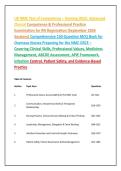
UK NMC Test of Competence – Nursing OSCE: Advanced
Clinical Competence & Professional Practice
Examination for RN Registration (September 2026
Sessions) Comprehensive 150-Question MCQ Bank for
Overseas Nurses Preparing for the NMC OSCE –
Covering Clinical Skills, Professional Values, Medicines
Management, ABCDE Assessment, APIE Framework,
Infection Control, Patient Safety, and Evidence-Based
Practice
Table of Contents
Section Topic Area Questions
1 Professional Values, Accountability & The NMC Code Q1–Q15
Communication, Interpersonal Skills & Therapeutic
2 Q16–Q30
Relationships
3 Nursing Practice, Clinical Decision-Making & Critical Thinking Q31–Q45
4 Leadership, Management, Delegation & Team Working Q46–Q55
5 Infection Prevention and Control & Aseptic Technique Q56–Q70
6 Patient Safety, Clinical Governance & Risk Management Q71–Q85
,Section Topic Area Questions
7 Medicines Management & Safe Administration Q86–Q100
8 ABCDE Assessment & Recognising Deterioration Q101–Q115
APIE Framework (Assessment, Planning, Implementation,
9 Q116–Q130
Evaluation)
Evidence-Based Practice, Research Appraisal & Professional
10 Q131–Q145
Development
11 Mental Capacity Act, Safeguarding & Consent Q146–Q150
SECTION 1: PROFESSIONAL VALUES, ACCOUNTABILITY & THE NMC CODE
Q1. • A newly registered nurse is caring for a patient who refuses a prescribed medication. The
nurse respects the patient's decision and documents the refusal accurately. Which principle of
The NMC Code is the nurse primarily demonstrating?
• • A) Practise effectively
• • B) Preserve safety
• C) Prioritise people
• • D) Promote professionalism and trust
CorreCt Answer: C) Prioritise people
Rationale: The NMC Code is structured around four themes: prioritise people, practise
effectively, preserve safety, and promote professionalism and trust. Respecting a patient's
refusal of treatment and documenting it accurately demonstrates putting the patient's wishes
first, which is central to "prioritise people." This principle requires nurses to treat patients as
individuals, respect their dignity, and involve them in decisions about their care.
,Q2. • A nurse discovers that a colleague has been administering medication without checking
the patient's identity. What is the nurse's most appropriate initial action in accordance with The
NMC Code?
• • A) Ignore the incident to maintain team harmony
• • B) Report the colleague to the nursing manager immediately
• C) Speak to the colleague privately and raise concerns
• • D) Document the incident in the patient's notes without discussing it
CorreCt Answer: C) Speak to the colleague privately and raise concerns
Rationale: The NMC Code requires nurses to act immediately if they believe a patient is at risk
and to raise concerns openly and honestly. The professional duty of candour means nurses must
be open and transparent, but the initial approach should be to discuss the concern with the
colleague directly, unless the situation is an emergency or poses immediate risk. If the concern
is not resolved, it should then be escalated appropriately.
Q3. • A nurse is caring for a patient who has disclosed a serious safeguarding concern. The
patient asks the nurse not to tell anyone. What should the nurse do?
• • A) Respect the patient's confidentiality and keep the information secret
• • B) Inform the patient's family to ensure their safety
• C) Explain that confidentiality has limits and safeguarding concerns must be reported
• • D) Document the disclosure but take no further action
CorreCt Answer: C) Explain that confidentiality has limits and safeguarding concerns must
be reported
Rationale: The NMC Code emphasises that patient confidentiality must be respected, but it also
recognises that there are circumstances where disclosure is required, such as safeguarding
concerns. Nurses must be open and honest with patients about the limits of confidentiality and
act in the patient's best interest while following legal and professional obligations.
Q4. • A nurse is asked to perform a clinical procedure that is outside their scope of practice.
Which action is most consistent with professional accountability?
• • A) Perform the procedure to gain experience
• • B) Ask another nurse to supervise without formal training
• C) Refuse to perform the procedure and explain the reasons
• • D) Perform the procedure but document that it was done under pressure
, CorreCt Answer: C) Refuse to perform the procedure and explain the reasons
Rationale: The NMC Code requires nurses to work within their scope of practice and recognise
the limits of their competence. Refusing to perform a procedure outside one's competence is a
demonstration of professional accountability and patient safety. Nurses must be able to justify
their decisions and actions.
Q5. • A nurse has made a medication error but the patient has not been harmed. What is the
nurse's professional obligation?
• • A) Correct the error without documenting it to avoid repercussions
• • B) Inform the patient only if they ask about it
• C) Report the error, document it accurately, and inform the patient
• • D) Discuss the error with colleagues but not with the patient
CorreCt Answer: C) Report the error, document it accurately, and inform the patient
Rationale: The professional duty of candour requires nurses to be open and honest with
patients when things go wrong. The nurse must report the error, document it accurately, and
apologise to the patient. This promotes transparency, learning, and patient safety.
Q6. • A nurse is caring for a patient from a different cultural background who refuses a blood
transfusion on religious grounds. What is the most appropriate action?
• • A) Attempt to persuade the patient to accept the transfusion
• • B) Administer the transfusion covertly to save the patient's life
• C) Respect the patient's decision and explore alternative treatments
• • D) Request a second opinion from another healthcare professional
CorreCt Answer: C) Respect the patient's decision and explore alternative treatments
Rationale: The NMC Code requires nurses to prioritise people, respect their dignity, and involve
them in decisions about their care. Patients have the right to refuse treatment based on their
beliefs, and nurses must respect this while ensuring the patient understands the consequences.
Q7. • A nurse witnesses a colleague using social media to post identifiable information about a
patient. What should the nurse do?
• • A) Ignore it as it does not directly involve the nurse
• • B) Report the colleague to the police immediately
Clinical Competence & Professional Practice
Examination for RN Registration (September 2026
Sessions) Comprehensive 150-Question MCQ Bank for
Overseas Nurses Preparing for the NMC OSCE –
Covering Clinical Skills, Professional Values, Medicines
Management, ABCDE Assessment, APIE Framework,
Infection Control, Patient Safety, and Evidence-Based
Practice
Table of Contents
Section Topic Area Questions
1 Professional Values, Accountability & The NMC Code Q1–Q15
Communication, Interpersonal Skills & Therapeutic
2 Q16–Q30
Relationships
3 Nursing Practice, Clinical Decision-Making & Critical Thinking Q31–Q45
4 Leadership, Management, Delegation & Team Working Q46–Q55
5 Infection Prevention and Control & Aseptic Technique Q56–Q70
6 Patient Safety, Clinical Governance & Risk Management Q71–Q85
,Section Topic Area Questions
7 Medicines Management & Safe Administration Q86–Q100
8 ABCDE Assessment & Recognising Deterioration Q101–Q115
APIE Framework (Assessment, Planning, Implementation,
9 Q116–Q130
Evaluation)
Evidence-Based Practice, Research Appraisal & Professional
10 Q131–Q145
Development
11 Mental Capacity Act, Safeguarding & Consent Q146–Q150
SECTION 1: PROFESSIONAL VALUES, ACCOUNTABILITY & THE NMC CODE
Q1. • A newly registered nurse is caring for a patient who refuses a prescribed medication. The
nurse respects the patient's decision and documents the refusal accurately. Which principle of
The NMC Code is the nurse primarily demonstrating?
• • A) Practise effectively
• • B) Preserve safety
• C) Prioritise people
• • D) Promote professionalism and trust
CorreCt Answer: C) Prioritise people
Rationale: The NMC Code is structured around four themes: prioritise people, practise
effectively, preserve safety, and promote professionalism and trust. Respecting a patient's
refusal of treatment and documenting it accurately demonstrates putting the patient's wishes
first, which is central to "prioritise people." This principle requires nurses to treat patients as
individuals, respect their dignity, and involve them in decisions about their care.
,Q2. • A nurse discovers that a colleague has been administering medication without checking
the patient's identity. What is the nurse's most appropriate initial action in accordance with The
NMC Code?
• • A) Ignore the incident to maintain team harmony
• • B) Report the colleague to the nursing manager immediately
• C) Speak to the colleague privately and raise concerns
• • D) Document the incident in the patient's notes without discussing it
CorreCt Answer: C) Speak to the colleague privately and raise concerns
Rationale: The NMC Code requires nurses to act immediately if they believe a patient is at risk
and to raise concerns openly and honestly. The professional duty of candour means nurses must
be open and transparent, but the initial approach should be to discuss the concern with the
colleague directly, unless the situation is an emergency or poses immediate risk. If the concern
is not resolved, it should then be escalated appropriately.
Q3. • A nurse is caring for a patient who has disclosed a serious safeguarding concern. The
patient asks the nurse not to tell anyone. What should the nurse do?
• • A) Respect the patient's confidentiality and keep the information secret
• • B) Inform the patient's family to ensure their safety
• C) Explain that confidentiality has limits and safeguarding concerns must be reported
• • D) Document the disclosure but take no further action
CorreCt Answer: C) Explain that confidentiality has limits and safeguarding concerns must
be reported
Rationale: The NMC Code emphasises that patient confidentiality must be respected, but it also
recognises that there are circumstances where disclosure is required, such as safeguarding
concerns. Nurses must be open and honest with patients about the limits of confidentiality and
act in the patient's best interest while following legal and professional obligations.
Q4. • A nurse is asked to perform a clinical procedure that is outside their scope of practice.
Which action is most consistent with professional accountability?
• • A) Perform the procedure to gain experience
• • B) Ask another nurse to supervise without formal training
• C) Refuse to perform the procedure and explain the reasons
• • D) Perform the procedure but document that it was done under pressure
, CorreCt Answer: C) Refuse to perform the procedure and explain the reasons
Rationale: The NMC Code requires nurses to work within their scope of practice and recognise
the limits of their competence. Refusing to perform a procedure outside one's competence is a
demonstration of professional accountability and patient safety. Nurses must be able to justify
their decisions and actions.
Q5. • A nurse has made a medication error but the patient has not been harmed. What is the
nurse's professional obligation?
• • A) Correct the error without documenting it to avoid repercussions
• • B) Inform the patient only if they ask about it
• C) Report the error, document it accurately, and inform the patient
• • D) Discuss the error with colleagues but not with the patient
CorreCt Answer: C) Report the error, document it accurately, and inform the patient
Rationale: The professional duty of candour requires nurses to be open and honest with
patients when things go wrong. The nurse must report the error, document it accurately, and
apologise to the patient. This promotes transparency, learning, and patient safety.
Q6. • A nurse is caring for a patient from a different cultural background who refuses a blood
transfusion on religious grounds. What is the most appropriate action?
• • A) Attempt to persuade the patient to accept the transfusion
• • B) Administer the transfusion covertly to save the patient's life
• C) Respect the patient's decision and explore alternative treatments
• • D) Request a second opinion from another healthcare professional
CorreCt Answer: C) Respect the patient's decision and explore alternative treatments
Rationale: The NMC Code requires nurses to prioritise people, respect their dignity, and involve
them in decisions about their care. Patients have the right to refuse treatment based on their
beliefs, and nurses must respect this while ensuring the patient understands the consequences.
Q7. • A nurse witnesses a colleague using social media to post identifiable information about a
patient. What should the nurse do?
• • A) Ignore it as it does not directly involve the nurse
• • B) Report the colleague to the police immediately


