

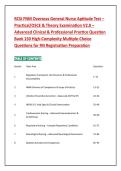
RCSI FNM Overseas General Nurse Aptitude Test –
Practical/OSCE & Theory Examination V2.0 –
Advanced Clinical & Professional Practice Question
Bank 150 High-Complexity Multiple-Choice
Questions for RN Registration Preparation
Section Topic Area Questions
Regulatory Framework, Test Structure & Professional
1 1–12
Accountability
2 NMBI Domains of Competence & Scope of Practice 13–22
3 Infection Prevention & Control – Advanced ANTT & IPC 23–34
4 INEWS V2, Vital Signs & Clinical Deterioration 35–48
Cardiovascular Nursing – Advanced Haemodynamics &
5 49–60
Arrhythmias
6 Respiratory Nursing – Complex Respiratory Conditions 61–72
7 Neurological Nursing – Advanced Neurological Assessment 73–84
8 Diabetes & Endocrine Emergencies 85–94
,Section Topic Area Questions
9 Wound Care, Pressure Injury Prevention & Tissue Viability 95–104
10 Medication Administration, Calculations & Pharmacology 105–116
11 Fluid Balance, Nutrition & MUST – Advanced Clinical Application 117–124
12 Perioperative & Post-operative Care – Complex Surgical Nursing 125–132
13 Palliative Care, End-of-Life & Ethical Decision-Making 133–140
14 Safeguarding Vulnerable Adults & Mental Capacity 141–146
15 Deconditioning, Delirium, Dementia & Frailty in Older Adults 147–150
SECTION 1: REGULATORY FRAMEWORK, TEST STRUCTURE &
Question 1
• The RCSI FNM Aptitude Test for Overseas General Nurses is designed to assess an applicant's
suitability for registration with the NMBI. Which of the following statements BEST describes the
relationship between the theory test and the practical/OSCE component?
A) The theory test and OSCE are independent assessments; either can be taken first
B) The theory test must be successfully completed before the practical/OSCE component can be
attempted, and failure of the theory test requires a full retake of the entire test
C) The theory test must be successfully completed before the practical/OSCE component can be
attempted, but the practical component can be retaken independently if failed
D) Both components must be passed on the same day; failure in either requires a full retake
,•• CorreCt Answer: C) The theory test must be successfully completed
before the practical/OSCE component can be attempted, but the
practical component can be retaken independently if failed
Rationale: The theory test must be successfully completed before part 2 (practical/OSCE)
can be attempted. An applicant who fails at the first attempt of the practical part/OSCEs will be
required to resit the OSCE station/s failed. Two attempts (including one repeat) are allowed for
each part.
Question 2
• The RCSI FNM Aptitude Test practical component utilises 14 OSCE stations. Which of the
following statements about the OSCE station format is CORRECT?
A) Each station is 15 minutes long with a 5-minute reading time before each station
B) Each station is 10 minutes long, and the assessment ends precisely when the time is up
regardless of completion status
C) Each station is 10 minutes long, but applicants are granted an additional 2 minutes if they are
actively performing a procedure
D) Each station is 8 minutes long with 2 minutes for feedback from the assessor
•• CorreCt Answer: B) Each station is 10 minutes long, and the
assessment ends precisely when the time is up regardless of
completion status
Rationale: Applicants spend 10 minutes at each station carrying out the care as per the
station descriptor. When the time is up, the assessment ends, regardless of whether or not the
applicant has finished.
Question 3
• Which of the following is a requirement for eligibility to apply for the RCSI FNM Aptitude Test?
A) A valid Irish work visa and a letter of employment from an HSE-affiliated hospital
B) An in-date NMBI decision letter stating that the General Nurses Division applies and that a
compensation measure is required
C) A minimum of three years of post-registration experience in the applicant's country of origin
D) Successful completion of an IELTS Academic test with a minimum score of 7.0 in all bands
, •• CorreCt Answer:
General Nurses Division applies and that a compensation measure is
required
Rationale: To be eligible to apply, applicants must have an in-date NMBI decision letter
stating that the General Nurses Division applies to their application and that they need to
successfully complete a compensation measure.
Question 4
• The OSCE assessors in the RCSI FNM Aptitude Test are experienced nurses. Which of the
following statements about the assessors is CORRECT?
A) Assessors are NMBI employees who rotate through assessment duties
B) Assessors are experienced nurses who hold a postgraduate qualification and have been
trained by RCSI as OSCE assessors
C) Assessors are senior medical consultants who volunteer their time
D) Assessors are recently qualified nurses who have completed the aptitude test themselves
•• CorreCt Answer: B) Assessors are experienced nurses who hold a
postgraduate qualification and have been trained by RCSI as OSCE
assessors
Rationale: The OSCE assessors are experienced nurses, from a wide range of healthcare
facilities, who hold a postgraduate qualification and have been trained by RCSI as OSCE
assessors.
Question 5
• An applicant who fails the practical/OSCE component at the first attempt is permitted to resit
the failed stations. Which of the following accurately describes the resit policy?
A) The applicant must resit all 14 stations regardless of which stations were failed
B) The applicant must resit only the OSCE station/s that were failed
C) The applicant must wait 12 months before resitting any stations
D) The applicant is not permitted to resit and must reapply for the entire test from the
beginning
Practical/OSCE & Theory Examination V2.0 –
Advanced Clinical & Professional Practice Question
Bank 150 High-Complexity Multiple-Choice
Questions for RN Registration Preparation
Section Topic Area Questions
Regulatory Framework, Test Structure & Professional
1 1–12
Accountability
2 NMBI Domains of Competence & Scope of Practice 13–22
3 Infection Prevention & Control – Advanced ANTT & IPC 23–34
4 INEWS V2, Vital Signs & Clinical Deterioration 35–48
Cardiovascular Nursing – Advanced Haemodynamics &
5 49–60
Arrhythmias
6 Respiratory Nursing – Complex Respiratory Conditions 61–72
7 Neurological Nursing – Advanced Neurological Assessment 73–84
8 Diabetes & Endocrine Emergencies 85–94
,Section Topic Area Questions
9 Wound Care, Pressure Injury Prevention & Tissue Viability 95–104
10 Medication Administration, Calculations & Pharmacology 105–116
11 Fluid Balance, Nutrition & MUST – Advanced Clinical Application 117–124
12 Perioperative & Post-operative Care – Complex Surgical Nursing 125–132
13 Palliative Care, End-of-Life & Ethical Decision-Making 133–140
14 Safeguarding Vulnerable Adults & Mental Capacity 141–146
15 Deconditioning, Delirium, Dementia & Frailty in Older Adults 147–150
SECTION 1: REGULATORY FRAMEWORK, TEST STRUCTURE &
Question 1
• The RCSI FNM Aptitude Test for Overseas General Nurses is designed to assess an applicant's
suitability for registration with the NMBI. Which of the following statements BEST describes the
relationship between the theory test and the practical/OSCE component?
A) The theory test and OSCE are independent assessments; either can be taken first
B) The theory test must be successfully completed before the practical/OSCE component can be
attempted, and failure of the theory test requires a full retake of the entire test
C) The theory test must be successfully completed before the practical/OSCE component can be
attempted, but the practical component can be retaken independently if failed
D) Both components must be passed on the same day; failure in either requires a full retake
,•• CorreCt Answer: C) The theory test must be successfully completed
before the practical/OSCE component can be attempted, but the
practical component can be retaken independently if failed
Rationale: The theory test must be successfully completed before part 2 (practical/OSCE)
can be attempted. An applicant who fails at the first attempt of the practical part/OSCEs will be
required to resit the OSCE station/s failed. Two attempts (including one repeat) are allowed for
each part.
Question 2
• The RCSI FNM Aptitude Test practical component utilises 14 OSCE stations. Which of the
following statements about the OSCE station format is CORRECT?
A) Each station is 15 minutes long with a 5-minute reading time before each station
B) Each station is 10 minutes long, and the assessment ends precisely when the time is up
regardless of completion status
C) Each station is 10 minutes long, but applicants are granted an additional 2 minutes if they are
actively performing a procedure
D) Each station is 8 minutes long with 2 minutes for feedback from the assessor
•• CorreCt Answer: B) Each station is 10 minutes long, and the
assessment ends precisely when the time is up regardless of
completion status
Rationale: Applicants spend 10 minutes at each station carrying out the care as per the
station descriptor. When the time is up, the assessment ends, regardless of whether or not the
applicant has finished.
Question 3
• Which of the following is a requirement for eligibility to apply for the RCSI FNM Aptitude Test?
A) A valid Irish work visa and a letter of employment from an HSE-affiliated hospital
B) An in-date NMBI decision letter stating that the General Nurses Division applies and that a
compensation measure is required
C) A minimum of three years of post-registration experience in the applicant's country of origin
D) Successful completion of an IELTS Academic test with a minimum score of 7.0 in all bands
, •• CorreCt Answer:
General Nurses Division applies and that a compensation measure is
required
Rationale: To be eligible to apply, applicants must have an in-date NMBI decision letter
stating that the General Nurses Division applies to their application and that they need to
successfully complete a compensation measure.
Question 4
• The OSCE assessors in the RCSI FNM Aptitude Test are experienced nurses. Which of the
following statements about the assessors is CORRECT?
A) Assessors are NMBI employees who rotate through assessment duties
B) Assessors are experienced nurses who hold a postgraduate qualification and have been
trained by RCSI as OSCE assessors
C) Assessors are senior medical consultants who volunteer their time
D) Assessors are recently qualified nurses who have completed the aptitude test themselves
•• CorreCt Answer: B) Assessors are experienced nurses who hold a
postgraduate qualification and have been trained by RCSI as OSCE
assessors
Rationale: The OSCE assessors are experienced nurses, from a wide range of healthcare
facilities, who hold a postgraduate qualification and have been trained by RCSI as OSCE
assessors.
Question 5
• An applicant who fails the practical/OSCE component at the first attempt is permitted to resit
the failed stations. Which of the following accurately describes the resit policy?
A) The applicant must resit all 14 stations regardless of which stations were failed
B) The applicant must resit only the OSCE station/s that were failed
C) The applicant must wait 12 months before resitting any stations
D) The applicant is not permitted to resit and must reapply for the entire test from the
beginning


