

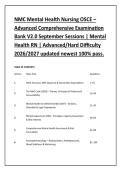
NMC Mental Health Nursing OSCE –
Advanced Comprehensive Examination
Bank V2.0 September Sessions | Mental
Health RN | Advanced/Hard Difficulty
2026/2027 updated newest 100% pass.
TABLE OF CONTENTS
Section Topic Area Questions
1 OSCE Structure, APIE Sequence & Examination Expectations 1–15
The NMC Code (2018) – Themes, Principles & Professional
2 16–30
Accountability
Mental Health Act 1983 (Amended 2007) – Sections,
3 31–45
Detention & Legal Frameworks
Mental Capacity Act 2005 – Principles, Capacity Assessment
4 46–60
& Best Interests
Comprehensive Mental Health Assessment & Risk
5 61–80
Formulation
Psychopharmacology – Antipsychotics, Antidepressants,
6 81–100
Mood Stabilisers & Monitoring
,Section Topic Area Questions
Physical Health Monitoring, Nutritional Assessment &
7 101–115
NEWS2
Therapeutic Communication, De-escalation & Talking
8 116–130
Therapies
Professional Values, Evidence-Based Practice & Silent Written
9 131–140
Stations
Complex Integrated Scenarios – Comorbidity, Capacity, Legal
10 141–150
& Ethical Dilemmas
SECTION 1: OSCE STRUCTURE, APIE SEQUENCE & EXAMINATION EXPECTATIONS
Questions 1–15
• 1. The NMC Test of Competence OSCE for mental health nursing consists of how many stations
in total, and how are they distributed?
A. 8 stations: 4 APIE, 2 skills, 2 written
B. 10 stations: 4 APIE, 4 skills (two pairs of linked stations), 2 written (PV and EBP)
C. 10 stations: 6 APIE, 2 skills, 2 written
D. 12 stations: 4 APIE, 6 skills, 2 written
Rationale: The NMC Mental Health OSCE comprises 10 stations: four APIE stations (Assessment,
Planning, Implementation, Evaluation), four skills stations arranged as two pairs of linked
stations, and two silent written stations (Professional Values and Evidence-Based Practice).
Options A, C, and D misrepresent the correct station distribution. The APIE stations are
delivered in sequence with no stations in between.
• 2. In the APIE sequence, which statement BEST describes the relationship between the four
stations?
, A. Each station is independent and can be completed in any order
B. The stations are linked together around a single patient scenario and must be
delivered in the sequence: Assessment, Planning, Implementation, Evaluation
C. The stations are all written assessments completed simultaneously
D. Only the Assessment and Evaluation stations are linked; Planning and Implementation are
standalone
Rationale: The APIE stations are linked together around a single patient scenario and must be
delivered in the sequence of Assessment, Planning, Implementation, and Evaluation, with no
stations in between. This reflects the nursing process and ensures continuity of care. Options A,
C, and D are incorrect as they misrepresent the integrated nature of the APIE stations.
• 3. The two silent written stations in the mental health OSCE assess which domains?
A. Clinical skills and medication administration
B. Professional values and behaviours (PV) and evidence-based practice (EBP)
C. Physical health assessment and nutritional screening
D. Risk assessment and care planning
Rationale: The two silent written stations specifically assess professional values and behaviours
(PV) and evidence-based practice (EBP). These stations are distinct from the clinical skills and
APIE stations. Options A, C, and D describe other station types or components within stations.
• 4. According to the NMC OSCE format, how are the four skills stations organised?
A. Four individual standalone skills stations
B. Two pairs of linked skills stations, each pair lasting up to 20 minutes total with no
break between paired skills
C. One long integrated skills station lasting 40 minutes
D. Four skills stations delivered consecutively with 10-minute breaks between each
Rationale: The four skills stations are organised as two pairs of linked stations, with each pairing
lasting up to 20 minutes total (including reading time) and no break between each paired skill.
This format allows for integrated assessment of related clinical skills. Options A, C, and D
misrepresent the organisational structure.
, • 5. The NMC Code (2018) is structured around how many themes, and which theme requires
nurses to "treat people as individuals and uphold their dignity"?
A. Three themes; "Preserve safety"
B. Four themes; "Prioritise people"
C. Four themes; "Practise effectively"
D. Five themes; "Promote professionalism and trust"
Rationale: The NMC Code (2018) has four themes: Prioritise people, Practise effectively,
Preserve safety, and Promote professionalism and trust. The requirement to "treat people as
individuals and uphold their dignity" falls under the "Prioritise people" theme. Options A, C, and
D incorrectly identify the number of themes or the theme to which this requirement belongs.
• 6. In the OSCE, which action is REQUIRED at every patient contact according to the NMC
Code?
A. Perform a full physical examination
B. Introduce yourself to the patient
C. Document the interaction immediately
D. Obtain a second opinion
Rationale: The NMC Code requires nurses to introduce themselves to the patient at every
contact. This is a fundamental professional standard that demonstrates respect and establishes
therapeutic rapport. Options A, C, and D are not required at every contact.
• 7. The evidence-based practice (EBP) station in the OSCE specifically assesses:
A. The candidate's ability to perform clinical procedures
B. Critical appraisal of research and evidence and associated decision-making
C. The candidate's communication skills with patients
D. The candidate's ability to administer medications safely
Rationale: The EBP station specifically assesses critical appraisal of research and evidence and
associated decision-making. It is a silent written station focused on applying evidence to clinical
practice. Options A, C, and D describe other station types or components.
• 8. The professional values (PV) station in the OSCE specifically assesses:
Advanced Comprehensive Examination
Bank V2.0 September Sessions | Mental
Health RN | Advanced/Hard Difficulty
2026/2027 updated newest 100% pass.
TABLE OF CONTENTS
Section Topic Area Questions
1 OSCE Structure, APIE Sequence & Examination Expectations 1–15
The NMC Code (2018) – Themes, Principles & Professional
2 16–30
Accountability
Mental Health Act 1983 (Amended 2007) – Sections,
3 31–45
Detention & Legal Frameworks
Mental Capacity Act 2005 – Principles, Capacity Assessment
4 46–60
& Best Interests
Comprehensive Mental Health Assessment & Risk
5 61–80
Formulation
Psychopharmacology – Antipsychotics, Antidepressants,
6 81–100
Mood Stabilisers & Monitoring
,Section Topic Area Questions
Physical Health Monitoring, Nutritional Assessment &
7 101–115
NEWS2
Therapeutic Communication, De-escalation & Talking
8 116–130
Therapies
Professional Values, Evidence-Based Practice & Silent Written
9 131–140
Stations
Complex Integrated Scenarios – Comorbidity, Capacity, Legal
10 141–150
& Ethical Dilemmas
SECTION 1: OSCE STRUCTURE, APIE SEQUENCE & EXAMINATION EXPECTATIONS
Questions 1–15
• 1. The NMC Test of Competence OSCE for mental health nursing consists of how many stations
in total, and how are they distributed?
A. 8 stations: 4 APIE, 2 skills, 2 written
B. 10 stations: 4 APIE, 4 skills (two pairs of linked stations), 2 written (PV and EBP)
C. 10 stations: 6 APIE, 2 skills, 2 written
D. 12 stations: 4 APIE, 6 skills, 2 written
Rationale: The NMC Mental Health OSCE comprises 10 stations: four APIE stations (Assessment,
Planning, Implementation, Evaluation), four skills stations arranged as two pairs of linked
stations, and two silent written stations (Professional Values and Evidence-Based Practice).
Options A, C, and D misrepresent the correct station distribution. The APIE stations are
delivered in sequence with no stations in between.
• 2. In the APIE sequence, which statement BEST describes the relationship between the four
stations?
, A. Each station is independent and can be completed in any order
B. The stations are linked together around a single patient scenario and must be
delivered in the sequence: Assessment, Planning, Implementation, Evaluation
C. The stations are all written assessments completed simultaneously
D. Only the Assessment and Evaluation stations are linked; Planning and Implementation are
standalone
Rationale: The APIE stations are linked together around a single patient scenario and must be
delivered in the sequence of Assessment, Planning, Implementation, and Evaluation, with no
stations in between. This reflects the nursing process and ensures continuity of care. Options A,
C, and D are incorrect as they misrepresent the integrated nature of the APIE stations.
• 3. The two silent written stations in the mental health OSCE assess which domains?
A. Clinical skills and medication administration
B. Professional values and behaviours (PV) and evidence-based practice (EBP)
C. Physical health assessment and nutritional screening
D. Risk assessment and care planning
Rationale: The two silent written stations specifically assess professional values and behaviours
(PV) and evidence-based practice (EBP). These stations are distinct from the clinical skills and
APIE stations. Options A, C, and D describe other station types or components within stations.
• 4. According to the NMC OSCE format, how are the four skills stations organised?
A. Four individual standalone skills stations
B. Two pairs of linked skills stations, each pair lasting up to 20 minutes total with no
break between paired skills
C. One long integrated skills station lasting 40 minutes
D. Four skills stations delivered consecutively with 10-minute breaks between each
Rationale: The four skills stations are organised as two pairs of linked stations, with each pairing
lasting up to 20 minutes total (including reading time) and no break between each paired skill.
This format allows for integrated assessment of related clinical skills. Options A, C, and D
misrepresent the organisational structure.
, • 5. The NMC Code (2018) is structured around how many themes, and which theme requires
nurses to "treat people as individuals and uphold their dignity"?
A. Three themes; "Preserve safety"
B. Four themes; "Prioritise people"
C. Four themes; "Practise effectively"
D. Five themes; "Promote professionalism and trust"
Rationale: The NMC Code (2018) has four themes: Prioritise people, Practise effectively,
Preserve safety, and Promote professionalism and trust. The requirement to "treat people as
individuals and uphold their dignity" falls under the "Prioritise people" theme. Options A, C, and
D incorrectly identify the number of themes or the theme to which this requirement belongs.
• 6. In the OSCE, which action is REQUIRED at every patient contact according to the NMC
Code?
A. Perform a full physical examination
B. Introduce yourself to the patient
C. Document the interaction immediately
D. Obtain a second opinion
Rationale: The NMC Code requires nurses to introduce themselves to the patient at every
contact. This is a fundamental professional standard that demonstrates respect and establishes
therapeutic rapport. Options A, C, and D are not required at every contact.
• 7. The evidence-based practice (EBP) station in the OSCE specifically assesses:
A. The candidate's ability to perform clinical procedures
B. Critical appraisal of research and evidence and associated decision-making
C. The candidate's communication skills with patients
D. The candidate's ability to administer medications safely
Rationale: The EBP station specifically assesses critical appraisal of research and evidence and
associated decision-making. It is a silent written station focused on applying evidence to clinical
practice. Options A, C, and D describe other station types or components.
• 8. The professional values (PV) station in the OSCE specifically assesses:


