

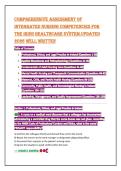
Comprehensive Assessment of
integrAted nursing CompetenCies for
the irish heAlthCAre system.updAted
2026 well written
1.
2.
3.
4.
5.
6. Community, Public Health, and Gerontological Nursing in Ireland
7.
administering a controlled drug that the nurse knows was not given. According
to the NMBI Code of Professional Conduct and Ethics, what is the nurse's
PRIMARY responsibility?
A) Confront the colleague directly and demand they correct the record.
B) Report the concern to the ward manager or designated safeguarding officer.
C) Document their suspicion in the patient's nursing notes.
D) Ignore the situation to avoid conflict within the team.
•• CorreCt Answer:
,Rationale: The NMBI Code places a primary responsibility on nurses to act to protect patient
safety. If a nurse has a genuine concern about a colleague's conduct, they must report it
through the appropriate channels (e.g., line manager, designated officer). Direct confrontation
(A) could compromise the investigation, documenting suspicions in the patient's notes (C) is
inappropriate, and ignoring the issue (D) is a dereliction of duty.
healthcare law. Which statement BEST reflects the core principle of this Act?
A) A person's capacity is a fixed attribute; once deemed to lack capacity, they cannot make any
decisions.
B) A person is presumed to have capacity to make a decision unless it is shown that they lack
capacity to make that specific decision at that specific time.
C) Healthcare professionals are always the best judges of what is in a patient's best interest.
D) The Act primarily concerns financial decisions and has little relevance to day-to-day nursing
care.
•• CorreCt Answer:
Rationale: The ADM Act 2015 is based on a functional and time-specific assessment of
capacity. It presumes capacity and requires all practicable steps to be taken to help a person
make a decision before they are deemed unable to do so. This underpins the move from a
paternalistic "best interests" model to a "will and preferences" model. Option A is incorrect as
capacity is time and decision-specific. Option C is outdated and contrary to the Act. Option D is
incorrect as the Act has profound implications for all healthcare decisions.
Directive (AHD) refusing dialysis. His family is distressed and demands that
treatment be started. What is the legally correct action for the nurse?
A) Commence dialysis as the family's wishes take precedence in Irish law.
B) Suspend the AHD temporarily until the family can come to terms with the situation.
C) Respect the AHD, as it is a legally binding document, and provide palliative care as outlined.
D) Ask the medical consultant to override the AHD on compassionate grounds.
•• CorreCt Answer:
,Rationale: Once an AHD is verified as valid and applicable to the current clinical situation, it is
legally binding on healthcare professionals in Ireland. The patient's autonomous wishes,
expressed when they had capacity, must be respected. The nurse's role is to advocate for the
patient's documented wishes while providing compassionate support and explanation to the
family. The wishes of the family (A) do not supersede the legal document.
surgery. The patient appears confused and says, "I'm not sure what this is for,
but the doctor said I need it." What is the nurse's most appropriate action?
A) Co-sign the form as a witness, as the patient has signed it voluntarily.
B) Explain the surgical procedure in detail to the patient to obtain informed consent.
C) Document that the patient is confused in the notes and proceed with pre-operative care.
D) Stop the process, inform the medical team that the patient does not appear to have the
capacity or information to give valid consent, and advocate for a reassessment.
•• CorreCt Answer:
Rationale: Valid consent must be given by a person with capacity, who has received adequate
information, and is acting voluntarily. The nurse's role in witnessing a signature is only to attest
that the patient signed the form, not that they understood it. The nurse has a professional duty
to advocate for the patient and raise concerns if they suspect consent is not informed or the
patient lacks capacity. Explaining the procedure (B) is the doctor's responsibility.
Irish law and the NMBI Code?
A) Discussing a patient's wound care plan with the physiotherapist in the nurse's station.
B) A public health nurse liaising with a GP about a shared patient's new medication.
C) A nurse telling her partner over dinner that a famous local personality was admitted to her
ward.
D) Reporting a suspected case of child abuse to Tusla, the Child and Family Agency.
•• CorreCt Answer:
Rationale: Sharing patient information with anyone not directly involved in the patient's care,
without the patient's explicit consent, is a clear breach of confidentiality. Options A and B are
, part of multidisciplinary team care. Option D is a legally mandated exception to confidentiality,
where the duty to report a risk of harm overrides the duty of confidentiality.
have never been taught. According to the NMBI Scope of Practice Framework,
what is the student's most appropriate response?
A) Perform the procedure carefully, using the ward's policy as a guide.
B) Decline to perform the procedure, stating they are not competent to do so.
C) Ask another student who has performed the procedure to supervise them.
D) Insist that the preceptor talks them through every step while they perform it.
•• CorreCt Answer:
Rationale: A fundamental principle of professional practice is to recognise the limits of one's
own competence. Performing a procedure without appropriate education and training is unsafe
and outside the student's scope of practice. The student must clearly state they are not
competent, and the preceptor should then either perform the procedure themselves or provide
the necessary teaching and supervision.
report criticising a nursing home for poor care standards. What is the PRIMARY
function of HIQA in this context?
A) To provide direct clinical care to residents in failing nursing homes.
B) To act as the professional regulatory body for nurses working in the care of the older person.
C) To set standards for quality and safety and to inspect and regulate health and social care
services.
D) To investigate individual complaints made by patients against a specific nurse.
•• CorreCt Answer:
Rationale: HIQA is the independent authority established to drive continuous improvement
and to monitor safety and quality in Ireland's health and social care services. It sets standards,
inspects services, and publishes reports. The professional regulator for nurses is the NMBI (B).
Investigating individual complaints against a nurse is the role of the employer and the NMBI's
Fitness to Practise process (D).
integrAted nursing CompetenCies for
the irish heAlthCAre system.updAted
2026 well written
1.
2.
3.
4.
5.
6. Community, Public Health, and Gerontological Nursing in Ireland
7.
administering a controlled drug that the nurse knows was not given. According
to the NMBI Code of Professional Conduct and Ethics, what is the nurse's
PRIMARY responsibility?
A) Confront the colleague directly and demand they correct the record.
B) Report the concern to the ward manager or designated safeguarding officer.
C) Document their suspicion in the patient's nursing notes.
D) Ignore the situation to avoid conflict within the team.
•• CorreCt Answer:
,Rationale: The NMBI Code places a primary responsibility on nurses to act to protect patient
safety. If a nurse has a genuine concern about a colleague's conduct, they must report it
through the appropriate channels (e.g., line manager, designated officer). Direct confrontation
(A) could compromise the investigation, documenting suspicions in the patient's notes (C) is
inappropriate, and ignoring the issue (D) is a dereliction of duty.
healthcare law. Which statement BEST reflects the core principle of this Act?
A) A person's capacity is a fixed attribute; once deemed to lack capacity, they cannot make any
decisions.
B) A person is presumed to have capacity to make a decision unless it is shown that they lack
capacity to make that specific decision at that specific time.
C) Healthcare professionals are always the best judges of what is in a patient's best interest.
D) The Act primarily concerns financial decisions and has little relevance to day-to-day nursing
care.
•• CorreCt Answer:
Rationale: The ADM Act 2015 is based on a functional and time-specific assessment of
capacity. It presumes capacity and requires all practicable steps to be taken to help a person
make a decision before they are deemed unable to do so. This underpins the move from a
paternalistic "best interests" model to a "will and preferences" model. Option A is incorrect as
capacity is time and decision-specific. Option C is outdated and contrary to the Act. Option D is
incorrect as the Act has profound implications for all healthcare decisions.
Directive (AHD) refusing dialysis. His family is distressed and demands that
treatment be started. What is the legally correct action for the nurse?
A) Commence dialysis as the family's wishes take precedence in Irish law.
B) Suspend the AHD temporarily until the family can come to terms with the situation.
C) Respect the AHD, as it is a legally binding document, and provide palliative care as outlined.
D) Ask the medical consultant to override the AHD on compassionate grounds.
•• CorreCt Answer:
,Rationale: Once an AHD is verified as valid and applicable to the current clinical situation, it is
legally binding on healthcare professionals in Ireland. The patient's autonomous wishes,
expressed when they had capacity, must be respected. The nurse's role is to advocate for the
patient's documented wishes while providing compassionate support and explanation to the
family. The wishes of the family (A) do not supersede the legal document.
surgery. The patient appears confused and says, "I'm not sure what this is for,
but the doctor said I need it." What is the nurse's most appropriate action?
A) Co-sign the form as a witness, as the patient has signed it voluntarily.
B) Explain the surgical procedure in detail to the patient to obtain informed consent.
C) Document that the patient is confused in the notes and proceed with pre-operative care.
D) Stop the process, inform the medical team that the patient does not appear to have the
capacity or information to give valid consent, and advocate for a reassessment.
•• CorreCt Answer:
Rationale: Valid consent must be given by a person with capacity, who has received adequate
information, and is acting voluntarily. The nurse's role in witnessing a signature is only to attest
that the patient signed the form, not that they understood it. The nurse has a professional duty
to advocate for the patient and raise concerns if they suspect consent is not informed or the
patient lacks capacity. Explaining the procedure (B) is the doctor's responsibility.
Irish law and the NMBI Code?
A) Discussing a patient's wound care plan with the physiotherapist in the nurse's station.
B) A public health nurse liaising with a GP about a shared patient's new medication.
C) A nurse telling her partner over dinner that a famous local personality was admitted to her
ward.
D) Reporting a suspected case of child abuse to Tusla, the Child and Family Agency.
•• CorreCt Answer:
Rationale: Sharing patient information with anyone not directly involved in the patient's care,
without the patient's explicit consent, is a clear breach of confidentiality. Options A and B are
, part of multidisciplinary team care. Option D is a legally mandated exception to confidentiality,
where the duty to report a risk of harm overrides the duty of confidentiality.
have never been taught. According to the NMBI Scope of Practice Framework,
what is the student's most appropriate response?
A) Perform the procedure carefully, using the ward's policy as a guide.
B) Decline to perform the procedure, stating they are not competent to do so.
C) Ask another student who has performed the procedure to supervise them.
D) Insist that the preceptor talks them through every step while they perform it.
•• CorreCt Answer:
Rationale: A fundamental principle of professional practice is to recognise the limits of one's
own competence. Performing a procedure without appropriate education and training is unsafe
and outside the student's scope of practice. The student must clearly state they are not
competent, and the preceptor should then either perform the procedure themselves or provide
the necessary teaching and supervision.
report criticising a nursing home for poor care standards. What is the PRIMARY
function of HIQA in this context?
A) To provide direct clinical care to residents in failing nursing homes.
B) To act as the professional regulatory body for nurses working in the care of the older person.
C) To set standards for quality and safety and to inspect and regulate health and social care
services.
D) To investigate individual complaints made by patients against a specific nurse.
•• CorreCt Answer:
Rationale: HIQA is the independent authority established to drive continuous improvement
and to monitor safety and quality in Ireland's health and social care services. It sets standards,
inspects services, and publishes reports. The professional regulator for nurses is the NMBI (B).
Investigating individual complaints against a nurse is the role of the employer and the NMBI's
Fitness to Practise process (D).


