

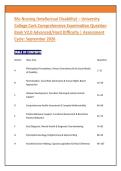
BSc Nursing (Intellectual Disability) – University
College Cork Comprehensive Examination Question
Bank V2.0 Advanced/Hard Difficulty | Assessment
Cycle: September 2026
Section Topic Area Questions
Philosophical Foundations, Person-Centredness & the Social Model
A 1–15
of Disability
Normalisation, Social Role Valorisation & Human Rights-Based
B 16–30
Approaches
Lifespan Development, Transition Planning & Family-Centred
C 31–45
Support
D Comprehensive Health Assessment & Complex Multimorbidity 46–60
Positive Behaviour Support, Functional Assessment & Restrictive
E 61–75
Practice Reduction
F Dual Diagnosis, Mental Health & Diagnostic Overshadowing 76–85
G Psychopharmacology, Polypharmacy & Deprescribing 86–95
H Assisted Decision-Making, Capacity Legislation & Ethical Dilemmas 96–105
,Section Topic Area Questions
Palliative Care, Advance Care Directives & End-of-Life Decision-
I 106–115
Making
J Evidence-Based Practice, Research Ethics & Critical Appraisal 116–125
K Interdisciplinary Collaboration, Leadership & Governance 126–135
L NMBI Standards, Clinical Competency & Internship Requirements 136–145
M Contemporary Policy, Safeguarding & Quality Regulation 146–150
1. The UCC BSc (Hons) Intellectual Disability Nursing programme is offered in partnership
with which Cork-based organisation, and upon completion enables graduates to apply for
registration with which regulatory body?
2. A 28-year-old woman with moderate intellectual disability is admitted to an acute
medical ward following a seizure. She becomes increasingly distressed when shift changes occur
and multiple unfamiliar staff approach her bed. The RNID, applying the philosophical principles
underpinning the UCC programme's NU1050 module, should prioritise which of the following
interventions?
3. The social model of disability, which fundamentally shapes contemporary intellectual
disability nursing education at UCC, posits that:
, 4. A 52-year-old man with Down syndrome and early-stage dementia is living in a
community residential setting. His family requests that he be moved to a nursing home for
"safety reasons." The RNID, applying person-centred principles as articulated in the UCC
curriculum, should:
5. The concept of "person-centredness" in intellectual disability nursing, as distinguished
from "patient-centredness" in general nursing, specifically requires the RNID to:
6. A 19-year-old man with severe intellectual disability and complex communication needs
is admitted for a dental procedure under general anaesthetic. The RNID's responsibility in
ensuring effective consent and communication, consistent with UCC's foundational teaching,
includes all of the following EXCEPT:
7. The UCC BSc Intellectual Disability Nursing programme requires students to study
modules that are:
8. A 34-year-old woman with intellectual disability and a history of trauma-related distress
is admitted for routine gynaecological care. She becomes visibly distressed when asked to
undress. The RNID's trauma-informed response, reflecting the programme's emphasis on
holistic, person-centred care, should be to:
9. The concept of "inclusion" as taught in the UCC Intellectual Disability Nursing
programme extends beyond physical presence in community settings to encompass:
10. A 23-year-old man with mild intellectual disability expresses a desire to live
independently. His parents are concerned about his safety and decision-making capacity. The
RNID's response, grounded in the principles of empowerment and self-determination, should be
to:
11. The UCC BSc Intellectual Disability Nursing programme's curriculum structure includes
core modules shared with other nursing branches and discipline-specific modules. This structure
reflects the recognition that:
12. A 47-year-old woman with intellectual disability living in a residential setting has been
increasingly withdrawn and refusing to participate in activities she previously enjoyed. The
RNID's comprehensive, person-centred assessment should prioritise:
, 13. The philosophical shift from a "deficit-based" to a "strengths-based" approach in
intellectual disability nursing, as emphasised in the UCC programme, requires the RNID to:
14. A 31-year-old man with intellectual disability and significant communication difficulties
is admitted to hospital with pneumonia. The RNID's role in ensuring equitable access to
healthcare includes all of the following EXCEPT:
15. The UCC BSc Intellectual Disability Nursing programme leads to an award at which level
on the National Framework of Qualifications (NFQ), and what is the duration of the
programme?
SECTION B: NORMALISATION, SOCIAL ROLE VALORISATION & HUMAN
16. The principle of normalisation, as a foundational concept in intellectual disability
nursing, requires that:
17. Social Role Valorisation (SRV) theory, which evolved from the principle of
normalisation, asserts that:
18. A 42-year-old woman with intellectual disability has been placed in a segregated day
programme despite expressing a strong desire to participate in community-based employment.
The RNID's advocacy response, grounded in SRV principles, should prioritise:
19. The concept of "advocacy" in intellectual disability nursing encompasses which of the
following distinct but interrelated dimensions?
20. A 58-year-old man with intellectual disability who has lived in a large congregated
residential setting for over 30 years is being considered for transition to community living. The
RNID, applying normalisation principles and contemporary Irish policy direction, should:
College Cork Comprehensive Examination Question
Bank V2.0 Advanced/Hard Difficulty | Assessment
Cycle: September 2026
Section Topic Area Questions
Philosophical Foundations, Person-Centredness & the Social Model
A 1–15
of Disability
Normalisation, Social Role Valorisation & Human Rights-Based
B 16–30
Approaches
Lifespan Development, Transition Planning & Family-Centred
C 31–45
Support
D Comprehensive Health Assessment & Complex Multimorbidity 46–60
Positive Behaviour Support, Functional Assessment & Restrictive
E 61–75
Practice Reduction
F Dual Diagnosis, Mental Health & Diagnostic Overshadowing 76–85
G Psychopharmacology, Polypharmacy & Deprescribing 86–95
H Assisted Decision-Making, Capacity Legislation & Ethical Dilemmas 96–105
,Section Topic Area Questions
Palliative Care, Advance Care Directives & End-of-Life Decision-
I 106–115
Making
J Evidence-Based Practice, Research Ethics & Critical Appraisal 116–125
K Interdisciplinary Collaboration, Leadership & Governance 126–135
L NMBI Standards, Clinical Competency & Internship Requirements 136–145
M Contemporary Policy, Safeguarding & Quality Regulation 146–150
1. The UCC BSc (Hons) Intellectual Disability Nursing programme is offered in partnership
with which Cork-based organisation, and upon completion enables graduates to apply for
registration with which regulatory body?
2. A 28-year-old woman with moderate intellectual disability is admitted to an acute
medical ward following a seizure. She becomes increasingly distressed when shift changes occur
and multiple unfamiliar staff approach her bed. The RNID, applying the philosophical principles
underpinning the UCC programme's NU1050 module, should prioritise which of the following
interventions?
3. The social model of disability, which fundamentally shapes contemporary intellectual
disability nursing education at UCC, posits that:
, 4. A 52-year-old man with Down syndrome and early-stage dementia is living in a
community residential setting. His family requests that he be moved to a nursing home for
"safety reasons." The RNID, applying person-centred principles as articulated in the UCC
curriculum, should:
5. The concept of "person-centredness" in intellectual disability nursing, as distinguished
from "patient-centredness" in general nursing, specifically requires the RNID to:
6. A 19-year-old man with severe intellectual disability and complex communication needs
is admitted for a dental procedure under general anaesthetic. The RNID's responsibility in
ensuring effective consent and communication, consistent with UCC's foundational teaching,
includes all of the following EXCEPT:
7. The UCC BSc Intellectual Disability Nursing programme requires students to study
modules that are:
8. A 34-year-old woman with intellectual disability and a history of trauma-related distress
is admitted for routine gynaecological care. She becomes visibly distressed when asked to
undress. The RNID's trauma-informed response, reflecting the programme's emphasis on
holistic, person-centred care, should be to:
9. The concept of "inclusion" as taught in the UCC Intellectual Disability Nursing
programme extends beyond physical presence in community settings to encompass:
10. A 23-year-old man with mild intellectual disability expresses a desire to live
independently. His parents are concerned about his safety and decision-making capacity. The
RNID's response, grounded in the principles of empowerment and self-determination, should be
to:
11. The UCC BSc Intellectual Disability Nursing programme's curriculum structure includes
core modules shared with other nursing branches and discipline-specific modules. This structure
reflects the recognition that:
12. A 47-year-old woman with intellectual disability living in a residential setting has been
increasingly withdrawn and refusing to participate in activities she previously enjoyed. The
RNID's comprehensive, person-centred assessment should prioritise:
, 13. The philosophical shift from a "deficit-based" to a "strengths-based" approach in
intellectual disability nursing, as emphasised in the UCC programme, requires the RNID to:
14. A 31-year-old man with intellectual disability and significant communication difficulties
is admitted to hospital with pneumonia. The RNID's role in ensuring equitable access to
healthcare includes all of the following EXCEPT:
15. The UCC BSc Intellectual Disability Nursing programme leads to an award at which level
on the National Framework of Qualifications (NFQ), and what is the duration of the
programme?
SECTION B: NORMALISATION, SOCIAL ROLE VALORISATION & HUMAN
16. The principle of normalisation, as a foundational concept in intellectual disability
nursing, requires that:
17. Social Role Valorisation (SRV) theory, which evolved from the principle of
normalisation, asserts that:
18. A 42-year-old woman with intellectual disability has been placed in a segregated day
programme despite expressing a strong desire to participate in community-based employment.
The RNID's advocacy response, grounded in SRV principles, should prioritise:
19. The concept of "advocacy" in intellectual disability nursing encompasses which of the
following distinct but interrelated dimensions?
20. A 58-year-old man with intellectual disability who has lived in a large congregated
residential setting for over 30 years is being considered for transition to community living. The
RNID, applying normalisation principles and contemporary Irish policy direction, should:


