CGFM Test 3 Exam Questions & Complete A+ Graded Answers | Government Accounting, Internal Controls, Data Analytics, Forensic Audit | Updated 2026 | Instant Download
Prepare for CGFM Test 3 with this comprehensive exam-focused study resource covering government financial management, government spending purposes, present value analysis, time value of money, federal financial management legislation, internal controls, ICOFR, capital budgeting, flowcharting, Earned Value Management, regression analysis, correlation coefficients, data analytics, data mining, predictive analytics, forensic auditing, Benford's Digital Analysis, and competitive source analysis.
This resource brings together high-yield CGFM Test 3 concepts in an organized format designed to support exam preparation, active recall, terminology review, and focused revision. It is particularly useful for students and professionals reviewing government financial management, federal financial reporting, internal control frameworks, analytical methods, and government performance and sourcing concepts.
KEY CGFM TEST 3 TOPICS INCLUDED:
GOVERNMENT SPENDING
• Three broad purposes of government spending
• Current operations
• Capital outlays
• Debt service
• Government expenditure classification
• Government financial management
• Capital spending
• Operating expenditures
• Debt-service expenditures
• Government budgeting concepts
PRESENT VALUE ANALYSIS
• Present Value Analysis
• Determining what money received in the future is worth today
• Time value of money
• Inflation component
• Year-over-year loss in value
• Enterprise component
• Inherent risk
• Unique component
• Present value considerations
• Capital budgeting applications
TIME VALUE OF MONEY
• Time Value of Money
• Present Value Analysis
• Future Value Analysis
• Payback Analysis
• Capital budgeting
• Investment evaluation
• Government capital planning
• Financial decision-making
• Future cash flows
• Present worth of future amounts
FEDERAL FINANCIAL MANAGEMENT LEGISLATION
The material reviews several important federal laws and acts associated with government financial management, auditing, internal controls, and financial reporting, including:
• Budget Accounting and Procedures Act of 1950
• Federal Managers Financial Integrity Act of 1982 (FMFIA)
• Single Audit Act of 1984
• 1996 amendments to the Single Audit Act
• Sarbanes-Oxley Act of 2002
• Chief Financial Officers Act of 1990
• Government Management Reform Act (GMRA)
• Internal Controls Over Financial Reporting (ICOFR)
BUDGET ACCOUNTING AND PROCEDURES ACT OF 1950
• Federal financial management requirements
• Agency internal controls
• Responsibilities of federal agency heads
• Establishment and maintenance of internal controls
• Government accounting procedures
• Federal budget and accounting oversight
FEDERAL MANAGERS FINANCIAL INTEGRITY ACT
• Federal Managers Financial Integrity Act of 1982
• FMFIA
• Annual evaluation of internal controls
• Reporting internal control weaknesses
• Corrective action plans
• Federal agency management responsibilities
• Internal control assessment
• Federal financial integrity
• Green Book connection
SINGLE AUDIT ACT
• Single Audit Act of 1984
• 1996 amendments
• State and local government audits
• Nonprofit organization audits
• Federal funding
• Federal award recipients
• Government grant auditing
• Single Audit requirements
• Government financial accountability
SARBANES-OXLEY ACT
• Sarbanes-Oxley Act of 2002
• SOX
• Enron scandal
• Publicly traded companies
• Corporate governance
• Internal control reporting
• Management responsibility for internal controls
• Financial reporting controls
• Annual reporting
• Internal Controls Over Financial Reporting
INTERNAL CONTROLS OVER FINANCIAL REPORTING
• ICOFR
• Internal Controls Over Financial Reporting
• Financial reporting controls
• Internal control objectives
• Management responsibility
• Financial statement reliability
• Control evaluation
• Control weaknesses
• Corrective action
• Internal control reporting
CHIEF FINANCIAL OFFICERS ACT
• Chief Financial Officers Act of 1990
• CFO Act
• Federal financial reporting
• Audited annual financial reports
• Internal control reporting
• Federal agencies
• CFO responsibilities
• Expansion under the Government Management Reform Act
• Federal financial management reform
INTERNAL CONTROLS
• Definition of internal controls
• Management systems and techniques
• Reasonable assurance
• Agency objectives
• Effective operations
• Efficient operations
• Compliance with laws and regulations
• Safeguarding assets
• Prevention of problems
• Detection of problems
• Corrective action
• Control activities
• Management responsibilities
• Internal control effectiveness
PREVENTIVE AND DETECTIVE CONTROLS
• Preventive controls
• Detective controls
• Controls designed to prevent problems
• Controls designed to detect problems
• Controls that may both prevent and detect problems
• Control awareness
• Internal control implementation
• Control objectives
• Risk management through controls
FLOWCHARTING
• Flowcharting
• Internal control evaluation
• Process documentation
• Process analysis
• Decision points
• Iterative development
• Process evaluation
• Internal control effectiveness
• Systems and procedures
• Control-flow documentation
EARNED VALUE MANAGEMENT
• Earned Value Management
• EVM
• Project management
• Schedule performance
• Cost performance
• Project performance measurement
• Budget performance
• Expected project results
• On-time project delivery
• Project budget compliance
• Government project management
REGRESSION ANALYSIS
• Regression analysis
• Predicting relationships between variables
• Direct linear regression
• Indirect linear regression
• Nonlinear regression
• No relationship
• Independent variables
• Dependent variables
• Predictive relationships
• Forecasting
• Regression limitations
CORRELATION COEFFICIENT
• Correlation coefficient
• Degree of correlation
• Predictive accuracy
• Relationship between variables
• Perfect correlation
• Correlation coefficient interpretation
• Forecasting reliability
• Multiple-variable analysis
• Correlation and prediction
MULTIPLE REGRESSION
• Multiple regression analysis
• Multiple independent variables
• Predictor variables
• Correlation coefficients
• Identifying strongest predictors
• Predictive modeling
• Statistical analysis
• Forecasting
• Variable relationships
LIMITS OF REGRESSION ANALYSIS
• Relevant data ranges
• Sample-size limitations
• Population projections
• Data quality
• High correlation requirements
• Garbage in, garbage out
• Correlation does not equal causation
• Limitations of predictive models
• Data interpretation
• Causal relationships versus statistical relationships
DATA ANALYTICS
• Data analytics
• Inspecting data
• Cleaning data
• Transforming data
• Modeling data
• Finding useful information
• Drawing conclusions
• Supporting decision-making
• Data-driven government programs
• Analytical decision support
DATA MINING
• Data mining
• Predictive data analysis
• Large datasets
• Data filtering
• Algorithms
• Relationship identification
• Pattern recognition
• Predictive analysis
• Government data analysis
• Data-driven decision-making
DATA MINING STRENGTHS AND WEAKNESSES
Strengths include:
• Reviewing complete datasets
• Linking multiple data sources
• Identifying relationships
• Large-scale data analysis
• Cross-source data analysis
Weaknesses include:
• Requirement for quality data
• Need for understanding program requirements
• Understanding how program requirements are represented in data
• Data interpretation challenges
• Data quality limitations
PREDICTIVE ANALYTICS
• Predictive analytics
• Current and historical data
• Forecasting future events
• Predictive modeling
• Government data analysis
• Historical trends
• Future-event prediction
• Data-driven forecasting
• Decision support
• Analytical techniques
STARTING A DATA ANALYTICS PROGRAM
• Collaboration among agencies
• Data collection
• Data sharing
• Return on investment (ROI)
• Analytics program development
• Leadership support
• Clear and concise analysis
• Data-driven programs
• Employee access to data
• Data utilization at all organizational levels
• Management support
• Targeted employee training
• On-the-job analytics training
FORENSIC AUDITING
• Forensic auditing
• Financial information examination
• Financial crime investigations
• Fraud-related financial analysis
• Investigation and prosecution
• Legal principles
• Discovery standards
• Forensic accounting concepts
• Financial evidence
• Investigative auditing
STEPS FOR FORENSIC AUDITING
• Data collection
• Data preparation
• Data analysis
• Reporting
• Forensic data workflow
• Financial evidence analysis
• Investigative reporting
• Fraud examination
• Analytical procedures
BENFORD'S DIGITAL ANALYSIS
• Benford's Digital Analysis
• Benford's Law concepts
• Expected distribution of leading digits
• Number-frequency patterns
• Fraud detection
• Potentially fraudulent transactions
• Financial transaction analysis
• Anomaly detection
• Data analysis for fraud
• Forensic auditing techniques
COMPETITIVE SOURCE ANALYSIS
• Competitive Source Analysis
• Government service sourcing
• Private-sector contracting
• In-house versus contract costs
• Government outsourcing decisions
• Management study
• Performance Work Statement
• PWS
• Expected outputs and results
• Cost projection
• Contract cost analysis
• In-house cost analysis
• Alternative selection
• Performance versus price
COMPETITIVE SOURCING PROCESS
The supplied material reviews a four-step competitive source analysis process:
1. Conduct a management study.
2. Prepare a Performance Work Statement defining expected outputs or results.
3. Project in-house and contract costs.
4. Select the best alternative based on the combination of performance and price.
This section is useful for reviewing government procurement, sourcing, contracting, cost comparison, and performance evaluation concepts.
HIGH-YIELD CGFM TEST 3 CONCEPTS
This resource emphasizes important relationships and distinctions, including:
• Current operations versus capital outlays versus debt service
• Present value versus future value
• Present value versus payback analysis
• Inflation versus risk components
• FMFIA versus the Single Audit Act
• CFO Act versus Sarbanes-Oxley Act
• Internal controls versus internal controls over financial reporting
• Preventive controls versus detective controls
• Regression versus correlation
• Correlation versus causation
• Simple regression versus multiple regression
• Data analytics versus data mining
• Predictive analytics versus descriptive analysis
• Forensic auditing versus conventional auditing
• Benford analysis and fraud-risk identification
• In-house service delivery versus private-sector contracting
• Performance versus price in sourcing decisions
EXAM PREPARATION USES
This CGFM Test 3 study resource is useful for:
• CGFM Test 3 exam preparation
• Certified Government Financial Manager preparation
• Government financial management review
• Government accounting revision
• Federal financial management studies
• Government auditing preparation
• Internal control review
• Federal legislation review
• Data analytics revision
• Forensic auditing preparation
• Capital budgeting review
• Regression analysis review
• Government performance management
• Practice-question review
• Quiz preparation
• Chapter examination preparation
• Last-minute revision
• Active recall
• Self-testing
• Comprehensive exam review
IMPORTANT CGFM TERMS COVERED
CGFM, CGFM Test 3, government financial management, government spending, current operations, capital outlays, debt service, present value, future value, payback analysis, time value of money, FMFIA, Single Audit Act, Sarbanes-Oxley Act, CFO Act, GMRA, ICOFR, internal controls, Green Book, flowcharting, Earned Value Management, regression analysis, correlation coefficient, multiple regression, data analytics, data mining, predictive analytics, forensic auditing, Benford's Digital Analysis, competitive source analysis, Performance Work Statement, government contracting, and cost analysis.
This resource is designed to provide a concentrated review of the supplied CGFM Test 3 material and can be used to reinforce terminology, concepts, analytical methods, legislation, internal control requirements, and government financial management principles.
.
Content preview
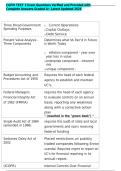
CGFM TEST 3 Exam Questions Verified and Provided with
Complete Answers Graded A+ Latest Updated 2026
Three Broad Government 1) Current Operations
Spending Purposes 2) Capital Outlays
3) Debt Service
Present Value Analysis - Determines what $$ Rec'd in Future
Three Components is Worth Today
1) inflation component - year over
year loss in value
2) enterprise component - inherent
risk
3) unique component -
Budget Accounting and Requires the head of each federal
Procedures Act of 1950 agency to establish and maintain
I/C's.
Federal Managers requires the head of each agency
Financial Integrity Act to evaluate controls on an annual
of 1982 (FMFIA) basis, reporting any weakness
along with a corrective action
plan
* (resulted in the "green book") *
Single Audit Act of 1984 requires the audit of state and local
(amended in 1996) governments and npo's receiving
federal funding
Sarbanes Oxley Act of Placed restrictions on publicly
2002 traded companies following Enron
scandal. Requires mgmt to report on
I/C's for financial reporting in its
annual report.
(ICOFR) Internal Controls Over Financial
, Reporting
Chief Financial Officers required 10 federal agencies to
Act of 1990 (CFO Act): produce audited annual financial
reports that included a report on
internal control.
expanded in 1994 by GMRA
INTERNAL CONTROLS systems and techniques managers
use to provide reasonable assurance
that agency objectives met in an
effective/efficient manner, in
compliance with laws/regulations,
and to safeguard assets.
Implemented to accomplish certain
results, prevent problems, or detect
problems that have occurred.
Some controls can both detect and
prevent problems (but only if their
existence is known).
TIME VALUE OF MONEY Used in consideration of capital
budgeting
1) Present Value Analysis
2) Future Value Analysis
3) Payback Analysis
Flowcharting Iterative process requiring changes
throughout development, each step
represents a decision, also used
to evaluate processes for
effective
internal controls
, Earned Value project mgmt system that weighs
Management (EVM) both schedule and cost
performance to determine if a
project is delivering expected
results on time and within
budget
Regression Analysis Predicts the relationship between
variables:
1) Direct Linear Regression
2) Indirect Linerar Regression
3) Non-linear Regression
4) No Relationship
** See Limits of Regression Analysis
Correlation Coefficient Determines the degree of accuracy
the analysis (variables) can be used
to predict results (1=perfect
correlation
.85 considered reliable for
forecasting)
Multiple Regressions analyzes multiple IV's and look for
items with the highest correlation
coefficient as being the most like
predictors
Limits of Regression Data ranges must be relevant (e.g.,
Analysis sample size might be too small to
project on a larger population)
Difficult to find data sets with
high correlation coefficients
Bad data = bad results
(garbage in, garbage out)