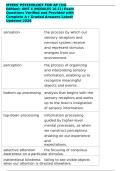
MYERS' PSYCHOLOGY FOR AP (3rd Edition): UNIT 4 MODULES 16-21 EXAM QUESTIONS & COMPLETE A+ GRADED ANSWERS | SENSATION, PERCEPTION, VISION, HEARING, PSYCHOPHYSICS & SENSORY SYSTEMS | LATEST UPDATED 2026 | INSTANT DOWNLOAD
Prepare for Myers' Psychology for AP 3rd Edition Unit 4 Modules 16-21 with a comprehensive, content-rich study resource covering sensation, perception, psychophysics, sensory thresholds, attention, visual perception, color vision, Gestalt principles, depth perception, auditory processing, hearing loss, pain, body senses, sensory interaction, embodied cognition, and olfaction.
This resource organizes the key terminology and concepts supplied for Unit 4 Modules 16-21 into an extensive review designed to support AP Psychology exam preparation, module tests, quizzes, classroom review, and study sessions.
SENSATION & PERCEPTION
Review the foundational distinction between sensation and perception:
• Sensation – the process through which sensory receptors and the nervous system receive and represent stimulus energies.
• Perception – the process of organizing and interpreting sensory information so we can recognize meaningful objects and events.
The material also covers bottom-up processing and top-down processing, helping distinguish data-driven sensory analysis from perception influenced by experience, expectations, and higher-level mental processes.
ATTENTION & PERCEPTUAL AWARENESS
Key attention concepts include:
• Selective attention
• Inattentional blindness
• Change blindness
• Perceptual set
• Top-down processing
• Bottom-up processing
Selective attention involves focusing conscious awareness on a particular stimulus.
Inattentional blindness describes failing to notice visible objects when attention is directed elsewhere, while change blindness involves failing to detect changes in the environment.
PERCEPTUAL PROCESSING & TRANSDUCTION
Transduction is covered as the conversion of stimulus energy into neural signals that the brain can process and interpret.
The resource also reviews sensory receptors and their role in detecting environmental stimulation.
Important concepts include:
• Transduction
• Sensory receptors
• Neural impulses
• Sensory processing
• Bottom-up processing
• Top-down processing
PSYCHOPHYSICS & SENSORY THRESHOLDS
Review the psychological study of relationships between physical characteristics of stimuli and subjective sensory experiences.
Key concepts include:
• Psychophysics
• Absolute threshold
• Difference threshold
• Just noticeable difference (JND)
• Signal detection theory
• Subliminal stimulation
• Priming
• Weber's Law
Absolute threshold refers to the minimum stimulus energy needed to detect a stimulus approximately 50 percent of the time.
Difference threshold refers to the minimum difference between two stimuli needed to detect a difference approximately 50 percent of the time.
Signal detection theory examines how people detect faint signals in the presence of background noise.
Weber's Law addresses the relationship between stimulus intensity and the minimum proportional difference required to perceive two stimuli as different.
SENSORY ADAPTATION & PRIMING
The material reviews sensory adaptation as reduced sensitivity resulting from constant stimulation.
Priming is also covered as the often-unconscious activation of associations that can influence perception, memory, or responses.
EXTRASENSORY PERCEPTION & PARAPSYCHOLOGY
Review the concepts of:
• Extrasensory perception (ESP)
• Telepathy
• Clairvoyance
• Precognition
• Parapsychology
• Psychokinesis
ESP is presented as a controversial claim that perception can occur without ordinary sensory input. Parapsychology concerns the study of purported paranormal phenomena.
VISION & VISUAL SENSATION
The visual system is a major focus of Unit 4. Review how light energy enters the eye and is transformed into neural information.
Important visual concepts include:
• Wavelength
• Hue
• Intensity
• Pupil
• Iris
• Lens
• Retina
• Accommodation
• Rods
• Cones
• Optic nerve
• Blind spot
• Fovea
• Cornea
• Feature detectors
• Parallel processing
WAVELENGTH, HUE & INTENSITY
Understand the relationship between physical properties of light and visual experience.
• Wavelength is associated with perceived hue or color.
• Intensity is related to the amount of energy in a light wave and influences perceived brightness.
• Hue refers to the dimension of color associated with wavelength.
EYE STRUCTURES & FUNCTIONS
The resource covers the major structures of the eye:
• Cornea – clear protective outer layer of the eye.
• Pupil – adjustable opening through which light enters.
• Iris – colored muscular structure controlling pupil size.
• Lens – transparent structure that changes shape to focus images.
• Retina – light-sensitive surface containing rods and cones.
• Fovea – central retinal area with a high concentration of cones.
• Optic nerve – carries neural impulses from the eye to the brain.
• Blind spot – location where the optic nerve exits the eye and no receptor cells are present.
RODS & CONES
Review the differences between rods and cones.
Rods are sensitive to low levels of light, movement, and peripheral vision and are important for twilight vision.
Cones function best in brighter conditions and are responsible for detailed and color vision.
ACCOMMODATION
Accommodation refers to the eye lens changing shape to focus near or distant objects on the retina.
FEATURE DETECTORS & PARALLEL PROCESSING
Feature detectors are specialized neurons in the visual cortex that respond to particular features such as shape, angle, and movement.
Parallel processing describes the brain's ability to process multiple aspects of visual information simultaneously.
COLOR VISION
Review the major theories explaining color perception:
• Young-Helmholtz trichromatic theory
• Trichromatic theory
• Opponent-process theory
The trichromatic theory proposes three types of color receptors whose combined activity allows perception of different colors.
Opponent-process theory proposes opposing color processes, including red-green, blue-yellow, and white-black systems.
GESTALT PSYCHOLOGY & PERCEPTUAL ORGANIZATION
The material covers Gestalt psychology and the principle that people tend to organize sensory information into meaningful wholes.
Important concepts include:
• Gestalt
• Figure-ground
• Grouping
• Perceptual organization
• Perceptual set
Figure-ground organization involves distinguishing objects that stand out from their surrounding background.
Grouping refers to the tendency to organize stimuli into coherent and meaningful groups.
DEPTH PERCEPTION
Review depth perception and how humans perceive three-dimensional space despite receiving two-dimensional retinal images.
Key concepts include:
• Depth perception
• Visual cliff
• Binocular cues
• Retinal disparity
• Monocular cues
• Interposition
• Linear perspective
The visual cliff is a laboratory apparatus used to study depth perception in infants and young animals.
BINOCULAR & MONOCULAR CUES
Binocular cues depend on information from both eyes.
Retinal disparity is a major binocular depth cue.
Monocular cues can provide depth information using either eye alone and include concepts such as interposition and linear perspective.
PERCEPTUAL CONSTANCY & ADAPTATION
Review how perception remains stable even when sensory input changes.
• Perceptual constancy
• Color constancy
• Perceptual adaptation
Perceptual constancy allows familiar objects to be perceived as maintaining consistent characteristics despite changes in lighting or retinal images.
Color constancy allows familiar objects to maintain perceived color despite changes in illumination.
Perceptual adaptation refers to the ability to adjust to altered sensory input, including artificially displaced or inverted visual information.
PHI PHENOMENON
The phi phenomenon is covered as an illusion of movement created when adjacent lights flash on and off in rapid succession.
This concept is important for understanding apparent motion and perceptual organization.
AUDITION & HEARING
The material provides extensive coverage of audition, including sound waves, pitch, the ear, hearing loss, and theories of auditory perception.
Key concepts include:
• Audition
• Frequency
• Pitch
• Middle ear
• Cochlea
• Inner ear
• Sensorineural hearing loss
• Conduction hearing loss
• Cochlear implant
• Place theory
• Frequency theory
FREQUENCY & PITCH
Frequency refers to the number of complete wavelengths passing a point within a given period.
Pitch refers to the perceived highness or lowness of a tone and is associated with frequency.
EAR STRUCTURES
Review the major components of the auditory system.
The middle ear contains the eardrum-related mechanical structures and three tiny bones that transmit and concentrate vibrations toward the cochlea.
The cochlea is a coiled, fluid-filled structure of the inner ear in which sound-related vibrations trigger neural impulses.
The inner ear contains the cochlea, semicircular canals, and vestibular structures.
HEARING LOSS
Compare:
• Sensorineural hearing loss
• Conduction hearing loss
Sensorineural hearing loss results from damage involving cochlear receptor cells or auditory nerves.
Conduction hearing loss involves damage to the mechanical system that conducts sound toward the cochlea.
COCHLEAR IMPLANTS
Review cochlear implants as devices that convert sounds into electrical signals and stimulate the auditory nerve through electrodes positioned in the cochlea.
THEORIES OF HEARING
The resource covers:
• Place theory
• Frequency theory
• Temporal theory
Place theory connects perceived pitch with the location of stimulation along the cochlear membrane.
Frequency theory explains pitch in relation to the rate of neural impulses traveling along the auditory nerve.
PAIN PERCEPTION
Gate-control theory is included as an important explanation of pain perception.
The theory proposes that neurological mechanisms in the spinal cord can influence whether pain signals are blocked or allowed to travel toward the brain.
BODY SENSES
Review the senses involved in body position, movement, and balance:
• Kinesthesia
• Vestibular sense
• Movement sense
• Balance
• Body position
Kinesthesia provides information about the position and movement of individual body parts.
The vestibular sense contributes to awareness of body movement, orientation, and balance.
SENSORY INTERACTION
Sensory interaction explains how one sensory system can influence another.
A common example is the influence of smell on taste.
Review the relationship among:
• Sensory interaction
• Smell
• Taste
• Multisensory perception
• Cross-sensory influence
EMBODIED COGNITION
Embodied cognition is covered as the influence of bodily sensations, gestures, and physical states on cognitive preferences and judgments.
OLFACTION
Olfaction refers to the sense of smell and is included among the major sensory systems covered in Unit 4.
UNIT 4 MODULES 16-21 EXAM REVIEW
This study resource provides broad coverage of the major sensation and perception concepts associated with Myers' Psychology for AP 3rd Edition Unit 4 Modules 16-21.
Major areas include:
Sensation and perception
Bottom-up processing
Top-down processing
Selective attention
Inattentional blindness
Change blindness
Transduction
Psychophysics
Absolute threshold
Signal detection theory
Subliminal stimulation
Priming
Difference threshold
Weber's Law
Sensory adaptation
Perceptual set
Extrasensory perception
Parapsychology
Wavelength
Hue
Intensity
Eye structures
Retina
Rods and cones
Optic nerve
Blind spot
Fovea
Feature detectors
Parallel processing
Color vision theories
Gestalt principles
Figure-ground
Grouping
Depth perception
Visual cliff
Binocular and monocular cues
Retinal disparity
Phi phenomenon
Perceptual constancy
Color constancy
Perceptual adaptation
Audition
Frequency
Pitch
Cochlea
Hearing loss
Cochlear implants
Place theory
Frequency theory
Gate-control theory
Kinesthesia
Vestibular sense
Sensory interaction
Embodied cognition
Olfaction
KEY COMPARISONS TO MASTER
Use the material to review important AP Psychology distinctions such as:
• Sensation vs. perception
• Bottom-up vs. top-down processing
• Absolute threshold vs. difference threshold
• Sensory adaptation vs. habituation
• Rods vs. cones
• Pupil vs. iris
• Retina vs. fovea
• Binocular vs. monocular cues
• Retinal disparity vs. other depth cues
• Trichromatic theory vs. opponent-process theory
• Sensorineural vs. conduction hearing loss
• Place theory vs. frequency theory
• Kinesthesia vs. vestibular sense
• Perceptual constancy vs. perceptual adaptation
• Figure-ground vs. grouping
• Inattentional blindness vs. change blindness
IDEAL FOR AP PSYCHOLOGY STUDY & TEST PREPARATION
This resource can be used alongside lectures, class notes, textbooks, flashcards, and other study materials to reinforce key concepts from Myers' Psychology for AP 3rd Edition Unit 4 Modules 16-21.
It is useful for:
• AP Psychology Unit 4 exams
• Myers' Psychology for AP module tests
• Psychology quizzes
• Sensation and perception assessments
• Psychology vocabulary review
• AP Psychology test preparation
• Unit 4 study sessions
• Sensation and perception chapter review
• Psychology final exam preparation
• Classroom revision
LATEST UPDATED 2026 | INSTANT DOWNLOAD
Content preview
MYERS' PSYCHOLOGY FOR AP (3rd
Edition): UNIT 4 (MODULES 16-21) Exam
Questions Verified and Provided with
Complete A+ Graded Answers Latest
Updated 2026
sensation the process by which our
sensory receptors and
nervous system receive
and represent stimulus
energies from our
environment.
perception the process of organizing
and interpreting sensory
information, enabling us to
recognize meaningful
objects and events.
bottom-up processing analysis that begins with the
sensory receptors and works
up to the brain's integration
of sensory information.
top-down processing information processing
guided by higher-level
mental processes, as when
we construct perceptions
drawing on our experience
and
expectations.
selective attention the focusing of conscious
awareness on a particular stimulus.
inattentional blindness failing to see visible objects
when our attention is directed elsewhere.
, change blindness failing to notice changes in
the environment; a form of
inattentional blindness.
transduction conversion of one form of energy
into another. In sensation, the
transforming of stimulus
energies, such as sights,
sounds, and smells, into neural
impulses our brains can
interpret.
psychophysics the study of relationships
between the physical
characteristics of stimuli, such
as their intensity, and our
psychological experience of
them.
absolute threshold the minimum stimulus energy
needed to detect a particular
stimulus 50 percent of the
time.
signal detection theory a theory predicting how and
when we detect the
presence of a faint stimulus
(signal) amid background
stimulation (noise).
subliminal below one's absolute threshold
for conscious awareness.
priming the activation, often
unconsciously, of certain
associations, thus