
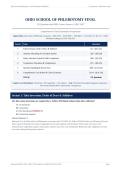
Ohio School of Phlebotomy - Final Examination 2026/2027 131 Questions | 100% Answer Key
OHIO SCHOOL OF PHLEBOTOMY FINAL
131 Questions with 100% Correct Answers |
Comprehensive Final Examination Preparation
Aligned With: Ohio School of Phlebotomy Curriculum | NHA (CPT) | ASCP (PBT) | AMT (RPT) | CLSI GP41-A6 / H21-A5 | OSHA
Bloodborne Pathogens 29 CFR 1910.1030
Section Topic Questions
1 Tube Inversions, Order of Draw & Additives Q1 - Q25 (25)
2 Anatomy, Physiology & Circulatory System Q26 - Q45 (20)
3 Safety, Infection Control & OSHA Compliance Q46 - Q70 (25)
4 Venipuncture Procedures & Complications Q71 - Q95 (25)
5 Specimen Handling & Special Tests Q96 - Q113 (18)
6 Comprehensive Case Studies & Clinical Scenarios Q114 - Q131 (18)
TOTAL 131 Questions
Cognitive Level Distribution: 35% Recall | 50% Application | 15% Analysis Style: 70% Direct Knowledge & Regulatory Application |
30% Scenario-Based (OSHA / Patient Safety / Emergencies)
Section 1: Tube Inversions, Order of Draw & Additives
Q1: How many inversions are required for a Yellow SPS (blood culture) tube after collection?
A. 3-4 inversions
B. 5 inversions
C. 8-10 inversions [CORRECT]
D. 0 inversions required
Correct Answer: C
Rationale: Per the Ohio School of Phlebotomy curriculum and CLSI GP41-A6, Yellow SPS/ACD tubes and all heparin (Green)
tubes require 8-10 gentle inversions to adequately mix the anticoagulant with the blood. Three to four inversions is the
requirement for Light Blue (sodium citrate) tubes, and five inversions is the standard for Red/serum tubes. Skipping inversions
can cause clotting and specimen rejection.
Aligned with NHA / ASCP / AMT | CLSI Guidelines | OSHA 29 CFR 1910.1030 Page 1
,Ohio School of Phlebotomy - Final Examination 2026/2027 131 Questions | 100% Answer Key
Q2: A phlebotomist collects a Green-top (heparin) tube for a STAT electrolyte panel. How many inversions
must be performed?
A. 3-4 inversions
B. 5 inversions
C. 8-10 inversions [CORRECT]
D. 12-15 inversions
Correct Answer: C
Rationale: Green-top tubes containing sodium, lithium, or ammonium heparin require 8-10 gentle inversions per CLSI GP41.
Insufficient mixing can produce partial clotting and falsely elevated or decreased analyte values. Twelve to fifteen inversions is
excessive and may cause mechanical hemolysis; 3-4 and 5 are the inversion requirements for Light Blue and Red tubes
respectively.
Q3: How many inversions are required for a Light Blue (sodium citrate) coagulation tube?
A. 3-4 inversions [CORRECT]
B. 5 inversions
C. 8-10 inversions
D. 1-2 inversions
Correct Answer: A
Rationale: Light Blue (sodium citrate) tubes require only 3-4 gentle inversions per CLSI H21-A5 to avoid platelet activation,
which can falsely prolong coagulation results. Excessive inversion can activate platelets and alter PT/INR or aPTT values, while
under-inversion can allow microclots. The 1:9 anticoagulant-to-blood ratio must also be precisely maintained.
Q4: After collecting a Red-top (no additive) tube for serum chemistry, how many inversions should be
performed?
A. 3-4 inversions
B. 5 inversions [CORRECT]
C. 8-10 inversions
D. 0 inversions
Correct Answer: B
Rationale: Red-top tubes containing a silica clot activator require 5 gentle inversions per CLSI standards to distribute the
activator and promote complete clotting within 30-60 minutes. The Ohio School of Phlebotomy curriculum emphasizes that
under-inversion may delay clotting and produce fibrin strands that interfere with testing. Three to four inversions is for Light
Blue, 8-10 is for heparin/SPS tubes.
Q5: Which anticoagulant is contained in a Lavender-top tube?
A. Sodium citrate
B. K2 EDTA [CORRECT]
C. Sodium heparin
D. No additive
Correct Answer: B
Rationale: Lavender-top tubes contain K2 EDTA (or K3 EDTA), which chelates calcium to prevent clotting and preserve cell
morphology for hematology. Per CLSI H21, EDTA is the anticoagulant of choice for complete blood counts (CBC) and CBC with
differential. Sodium citrate is in Light Blue, heparin in Green, and Red tubes have no additive.
Aligned with NHA / ASCP / AMT | CLSI Guidelines | OSHA 29 CFR 1910.1030 Page 2
,Ohio School of Phlebotomy - Final Examination 2026/2027 131 Questions | 100% Answer Key
Q6: A Green-top tube is being used for an arterial blood gas analysis. What anticoagulant does it contain?
A. K2 EDTA
B. Sodium citrate
C. Heparin [CORRECT]
D. Sodium fluoride
Correct Answer: C
Rationale: Green-top tubes contain heparin (sodium, lithium, or ammonium) which inhibits thrombin to prevent clotting while
preserving labile analytes. The Ohio School of Phlebotomy curriculum specifies that lithium heparin is preferred for most
chemistry testing. EDTA is in Lavender tubes, sodium citrate in Light Blue, and sodium fluoride in Gray tubes.
Q7: What additive is found in a Light Blue coagulation tube?
A. K2 EDTA
B. Sodium citrate (3.2%) [CORRECT]
C. Lithium heparin
D. Potassium oxalate
Correct Answer: B
Rationale: Light Blue tubes contain 3.2% (or 3.8%) sodium citrate, which binds calcium to prevent clotting and is the only
acceptable anticoagulant for PT/INR, aPTT, and fibrinogen testing. CLSI H21-A5 mandates a strict 1:9 anticoagulant-to-blood
ratio; underfilling alters this ratio and invalidates results. EDTA is in Lavender, heparin in Green, and potassium oxalate in
Gray tubes.
Q8: What additive is contained in a plain Red-top blood collection tube?
A. Sodium heparin
B. Sodium citrate
C. No additives (Serum) [CORRECT]
D. Sodium fluoride
Correct Answer: C
Rationale: Plain Red-top tubes contain no anticoagulant or additive; blood clots naturally, and the resulting serum is separated
by centrifugation. Per the Ohio School of Phlebotomy curriculum, Red tubes are used for chemistry tests requiring serum such as
therapeutic drug monitoring and certain serology tests. Heparin is in Green, citrate in Light Blue, and fluoride in Gray tubes.
Q9: Which additive is found in an Orange-top tube used for STAT chemistry testing?
A. Sodium citrate
B. K2 EDTA
C. Thrombin clot activator [CORRECT]
D. Sodium fluoride
Correct Answer: C
Rationale: Orange-top tubes contain thrombin clot activator with silica, which accelerates clotting to produce serum within 5
minutes for STAT chemistry. CLSI GP41 recognizes Orange tubes for rapid turnaround tests such as cardiac markers and STAT
electrolytes. Sodium citrate is in Light Blue, EDTA in Lavender, and fluoride in Gray tubes.
Aligned with NHA / ASCP / AMT | CLSI Guidelines | OSHA 29 CFR 1910.1030 Page 3
, Ohio School of Phlebotomy - Final Examination 2026/2027 131 Questions | 100% Answer Key
Q10: A Gray-top tube is typically used for which of the following tests?
A. Therapeutic drug monitoring
B. Lactate and glucose testing [CORRECT]
C. Trace metals (lead, mercury)
D. Blood typing
Correct Answer: B
Rationale: Gray-top tubes contain potassium oxalate (anticoagulant) and sodium fluoride (glycolytic inhibitor), making them the
required tube for lactate and glucose testing. The Ohio School of Phlebotomy curriculum notes that sodium fluoride prevents
RBC metabolism from lowering glucose after collection. Trace metals require Royal Blue tubes; blood typing uses Pink or
Lavender tubes.
Q11: According to CLSI order of draw, which tube should be drawn FIRST when multiple tubes are
collected?
A. Light Blue (coagulation)
B. Lavender (EDTA)
C. Sterile Yellow SPS (blood culture) [CORRECT]
D. Red (serum)
Correct Answer: C
Rationale: CLSI GP41-A6 specifies that sterile tubes (Yellow SPS, blood culture bottles) are drawn first to minimize the risk of
bacterial contamination from the site preparation process. Blood cultures require the cleanest site possible before other tubes
are collected. Light Blue follows blood culture; Red and Lavender come later in the sequence.
Q12: After a sterile blood culture, which tube is collected next in the CLSI order of draw?
A. Red or Tiger (serum)
B. Light Blue (sodium citrate) [CORRECT]
C. Green (heparin)
D. Lavender (EDTA)
Correct Answer: B
Rationale: After sterile Yellow SPS tubes, the Light Blue (sodium citrate) tube is collected next because coagulation testing is
extremely sensitive to tissue factor and additive carryover from other tubes. CLSI GP41-A6 places coagulation tubes second in
the order of draw. Red/Tiger serum tubes follow, then Green, then Lavender, then Gray.
Q13: Why is the Light Blue (sodium citrate) tube collected before serum and EDTA tubes in the order of
draw?
A. It has the smallest vacuum and must be filled first
B. It is sensitive to tissue factor carryover and additive contamination [CORRECT]
C. It must be inverted before all other tubes
D. It is the most common test ordered
Correct Answer: B
Rationale: Coagulation testing (PT, PTT) is highly sensitive to tissue thromboplastin carryover and to EDTA or heparin
contamination from previously drawn tubes. CLSI GP41-A6 places Light Blue second, immediately after sterile tubes, to
minimize this risk. Tube vacuum, inversion order, and frequency of testing are not the rationale for this position.
Aligned with NHA / ASCP / AMT | CLSI Guidelines | OSHA 29 CFR 1910.1030 Page 4
OHIO SCHOOL OF PHLEBOTOMY FINAL
131 Questions with 100% Correct Answers |
Comprehensive Final Examination Preparation
Aligned With: Ohio School of Phlebotomy Curriculum | NHA (CPT) | ASCP (PBT) | AMT (RPT) | CLSI GP41-A6 / H21-A5 | OSHA
Bloodborne Pathogens 29 CFR 1910.1030
Section Topic Questions
1 Tube Inversions, Order of Draw & Additives Q1 - Q25 (25)
2 Anatomy, Physiology & Circulatory System Q26 - Q45 (20)
3 Safety, Infection Control & OSHA Compliance Q46 - Q70 (25)
4 Venipuncture Procedures & Complications Q71 - Q95 (25)
5 Specimen Handling & Special Tests Q96 - Q113 (18)
6 Comprehensive Case Studies & Clinical Scenarios Q114 - Q131 (18)
TOTAL 131 Questions
Cognitive Level Distribution: 35% Recall | 50% Application | 15% Analysis Style: 70% Direct Knowledge & Regulatory Application |
30% Scenario-Based (OSHA / Patient Safety / Emergencies)
Section 1: Tube Inversions, Order of Draw & Additives
Q1: How many inversions are required for a Yellow SPS (blood culture) tube after collection?
A. 3-4 inversions
B. 5 inversions
C. 8-10 inversions [CORRECT]
D. 0 inversions required
Correct Answer: C
Rationale: Per the Ohio School of Phlebotomy curriculum and CLSI GP41-A6, Yellow SPS/ACD tubes and all heparin (Green)
tubes require 8-10 gentle inversions to adequately mix the anticoagulant with the blood. Three to four inversions is the
requirement for Light Blue (sodium citrate) tubes, and five inversions is the standard for Red/serum tubes. Skipping inversions
can cause clotting and specimen rejection.
Aligned with NHA / ASCP / AMT | CLSI Guidelines | OSHA 29 CFR 1910.1030 Page 1
,Ohio School of Phlebotomy - Final Examination 2026/2027 131 Questions | 100% Answer Key
Q2: A phlebotomist collects a Green-top (heparin) tube for a STAT electrolyte panel. How many inversions
must be performed?
A. 3-4 inversions
B. 5 inversions
C. 8-10 inversions [CORRECT]
D. 12-15 inversions
Correct Answer: C
Rationale: Green-top tubes containing sodium, lithium, or ammonium heparin require 8-10 gentle inversions per CLSI GP41.
Insufficient mixing can produce partial clotting and falsely elevated or decreased analyte values. Twelve to fifteen inversions is
excessive and may cause mechanical hemolysis; 3-4 and 5 are the inversion requirements for Light Blue and Red tubes
respectively.
Q3: How many inversions are required for a Light Blue (sodium citrate) coagulation tube?
A. 3-4 inversions [CORRECT]
B. 5 inversions
C. 8-10 inversions
D. 1-2 inversions
Correct Answer: A
Rationale: Light Blue (sodium citrate) tubes require only 3-4 gentle inversions per CLSI H21-A5 to avoid platelet activation,
which can falsely prolong coagulation results. Excessive inversion can activate platelets and alter PT/INR or aPTT values, while
under-inversion can allow microclots. The 1:9 anticoagulant-to-blood ratio must also be precisely maintained.
Q4: After collecting a Red-top (no additive) tube for serum chemistry, how many inversions should be
performed?
A. 3-4 inversions
B. 5 inversions [CORRECT]
C. 8-10 inversions
D. 0 inversions
Correct Answer: B
Rationale: Red-top tubes containing a silica clot activator require 5 gentle inversions per CLSI standards to distribute the
activator and promote complete clotting within 30-60 minutes. The Ohio School of Phlebotomy curriculum emphasizes that
under-inversion may delay clotting and produce fibrin strands that interfere with testing. Three to four inversions is for Light
Blue, 8-10 is for heparin/SPS tubes.
Q5: Which anticoagulant is contained in a Lavender-top tube?
A. Sodium citrate
B. K2 EDTA [CORRECT]
C. Sodium heparin
D. No additive
Correct Answer: B
Rationale: Lavender-top tubes contain K2 EDTA (or K3 EDTA), which chelates calcium to prevent clotting and preserve cell
morphology for hematology. Per CLSI H21, EDTA is the anticoagulant of choice for complete blood counts (CBC) and CBC with
differential. Sodium citrate is in Light Blue, heparin in Green, and Red tubes have no additive.
Aligned with NHA / ASCP / AMT | CLSI Guidelines | OSHA 29 CFR 1910.1030 Page 2
,Ohio School of Phlebotomy - Final Examination 2026/2027 131 Questions | 100% Answer Key
Q6: A Green-top tube is being used for an arterial blood gas analysis. What anticoagulant does it contain?
A. K2 EDTA
B. Sodium citrate
C. Heparin [CORRECT]
D. Sodium fluoride
Correct Answer: C
Rationale: Green-top tubes contain heparin (sodium, lithium, or ammonium) which inhibits thrombin to prevent clotting while
preserving labile analytes. The Ohio School of Phlebotomy curriculum specifies that lithium heparin is preferred for most
chemistry testing. EDTA is in Lavender tubes, sodium citrate in Light Blue, and sodium fluoride in Gray tubes.
Q7: What additive is found in a Light Blue coagulation tube?
A. K2 EDTA
B. Sodium citrate (3.2%) [CORRECT]
C. Lithium heparin
D. Potassium oxalate
Correct Answer: B
Rationale: Light Blue tubes contain 3.2% (or 3.8%) sodium citrate, which binds calcium to prevent clotting and is the only
acceptable anticoagulant for PT/INR, aPTT, and fibrinogen testing. CLSI H21-A5 mandates a strict 1:9 anticoagulant-to-blood
ratio; underfilling alters this ratio and invalidates results. EDTA is in Lavender, heparin in Green, and potassium oxalate in
Gray tubes.
Q8: What additive is contained in a plain Red-top blood collection tube?
A. Sodium heparin
B. Sodium citrate
C. No additives (Serum) [CORRECT]
D. Sodium fluoride
Correct Answer: C
Rationale: Plain Red-top tubes contain no anticoagulant or additive; blood clots naturally, and the resulting serum is separated
by centrifugation. Per the Ohio School of Phlebotomy curriculum, Red tubes are used for chemistry tests requiring serum such as
therapeutic drug monitoring and certain serology tests. Heparin is in Green, citrate in Light Blue, and fluoride in Gray tubes.
Q9: Which additive is found in an Orange-top tube used for STAT chemistry testing?
A. Sodium citrate
B. K2 EDTA
C. Thrombin clot activator [CORRECT]
D. Sodium fluoride
Correct Answer: C
Rationale: Orange-top tubes contain thrombin clot activator with silica, which accelerates clotting to produce serum within 5
minutes for STAT chemistry. CLSI GP41 recognizes Orange tubes for rapid turnaround tests such as cardiac markers and STAT
electrolytes. Sodium citrate is in Light Blue, EDTA in Lavender, and fluoride in Gray tubes.
Aligned with NHA / ASCP / AMT | CLSI Guidelines | OSHA 29 CFR 1910.1030 Page 3
, Ohio School of Phlebotomy - Final Examination 2026/2027 131 Questions | 100% Answer Key
Q10: A Gray-top tube is typically used for which of the following tests?
A. Therapeutic drug monitoring
B. Lactate and glucose testing [CORRECT]
C. Trace metals (lead, mercury)
D. Blood typing
Correct Answer: B
Rationale: Gray-top tubes contain potassium oxalate (anticoagulant) and sodium fluoride (glycolytic inhibitor), making them the
required tube for lactate and glucose testing. The Ohio School of Phlebotomy curriculum notes that sodium fluoride prevents
RBC metabolism from lowering glucose after collection. Trace metals require Royal Blue tubes; blood typing uses Pink or
Lavender tubes.
Q11: According to CLSI order of draw, which tube should be drawn FIRST when multiple tubes are
collected?
A. Light Blue (coagulation)
B. Lavender (EDTA)
C. Sterile Yellow SPS (blood culture) [CORRECT]
D. Red (serum)
Correct Answer: C
Rationale: CLSI GP41-A6 specifies that sterile tubes (Yellow SPS, blood culture bottles) are drawn first to minimize the risk of
bacterial contamination from the site preparation process. Blood cultures require the cleanest site possible before other tubes
are collected. Light Blue follows blood culture; Red and Lavender come later in the sequence.
Q12: After a sterile blood culture, which tube is collected next in the CLSI order of draw?
A. Red or Tiger (serum)
B. Light Blue (sodium citrate) [CORRECT]
C. Green (heparin)
D. Lavender (EDTA)
Correct Answer: B
Rationale: After sterile Yellow SPS tubes, the Light Blue (sodium citrate) tube is collected next because coagulation testing is
extremely sensitive to tissue factor and additive carryover from other tubes. CLSI GP41-A6 places coagulation tubes second in
the order of draw. Red/Tiger serum tubes follow, then Green, then Lavender, then Gray.
Q13: Why is the Light Blue (sodium citrate) tube collected before serum and EDTA tubes in the order of
draw?
A. It has the smallest vacuum and must be filled first
B. It is sensitive to tissue factor carryover and additive contamination [CORRECT]
C. It must be inverted before all other tubes
D. It is the most common test ordered
Correct Answer: B
Rationale: Coagulation testing (PT, PTT) is highly sensitive to tissue thromboplastin carryover and to EDTA or heparin
contamination from previously drawn tubes. CLSI GP41-A6 places Light Blue second, immediately after sterile tubes, to
minimize this risk. Tube vacuum, inversion order, and frequency of testing are not the rationale for this position.
Aligned with NHA / ASCP / AMT | CLSI Guidelines | OSHA 29 CFR 1910.1030 Page 4


