NGN NCLEX RN Exam 2026/2027 - Post Test Exam Top Rated - Genuine & Complete
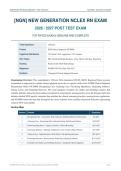
[NGN] NEW GENERATION NCLEX RN EXAM
POST TEST EXAM
TOP RATED EXAM • GENUINE AND COMPLETE
Total Questions 150 Items
Format NGN Clinical Judgment (NCJMM)
Cognitive Distribution 15% Recall / 50% Application / 35% Analysis
Item Types MC, Extended Multiple Response, Cloze, Matrix, Hot Spot, Drag-Drop
Scoring Partial Credit (NGN Methodology)
Alignment NCSBN NGN Test Plan 2026-2027
Sections 7 Integrated Clinical Judgment Domains
Examination Overview: This comprehensive 150-item Next-Generation NCLEX (NGN) Registered Nurse post-test
examination is engineered to evaluate clinical judgment across the six cognitive skills of the NCSBN Clinical Judgment
Measurement Model (NCJMM): Recognizing Cues, Analyzing Cues, Prioritizing Hypotheses, Generating Solutions,
Taking Action, and Evaluating Outcomes. The exam integrates extended case studies and unfolding scenarios that
simulate authentic clinical decision-making encountered in contemporary nursing practice across the lifespan. Each item
includes detailed NGN-specific rationales that articulate the clinical reasoning principles, nursing process application,
and NCJMM framework steps that distinguish the correct response from carefully constructed distractors representing
common NGN exam pitfalls.
Section Map:
Section Domain Questions
1 Recognizing Cues - Assessment, Data Collection, Identifying Relevant Information Q1-Q25
2 Analyzing Cues - Interpreting Data, Linking Findings, Identifying Problems Q26-Q50
3 Prioritizing Hypotheses - Urgency, Priorities, Clinical Reasoning Q51-Q70
4 Generating Solutions - Planning, Collaborative Care, Evidence-Based Practice Q71-Q90
5 Taking Action - Implementation, Client Safety, Nursing Responsiveness Q91-Q110
6 Evaluating Outcomes - Reassessment, Monitoring, Ongoing Evaluation Q111-Q125
7 Extended Case Studies and Unfolding Scenarios - Integrated Clinical Judgment Q126-Q150
NCSBN NGN Test Plan - Clinical Judgment Measurement Model (NCJMM) Page 1
,NGN NCLEX RN Exam 2026/2027 - Post Test Exam Top Rated - Genuine & Complete
SECTION 1: Recognizing Cues (Assessment, Data
Collection, & Identifying Relevant Information)
Questions 1-25 | NGN Clinical Judgment Skill 1: Identify relevant client data, differentiate relevant from irrelevant information, and
recognize clinical significance.
NGN Item Type: Multiple Choice (NGN Standard)
Q1: A 68-year-old male is admitted with community-acquired pneumonia. The nurse reviews the admission
data: Temperature 38.6 C (101.5 F), HR 102, RR 26, BP 96/64, SpO2 91% on room air, productive cough with
rust-colored sputum, oriented to person only, capillary refill 4 seconds. Family reports confusion began this
morning. Which finding is the most critical cue requiring immediate escalation of care?
A. Temperature of 38.6 C (101.5 F) with rust-colored sputum
B. Heart rate of 102 beats per minute
C. New-onset confusion with capillary refill of 4 seconds and BP 96/64 [CORRECT]
D. Respiratory rate of 26 breaths per minute with SpO2 91%
Correct Answer: C
Rationale: Recognizing Cues in the NCJMM requires differentiating relevant from irrelevant information and identifying
clinical significance. The combination of new-onset confusion, capillary refill of 4 seconds, and BP 96/64 in an elderly
pneumonia patient strongly suggests sepsis with impending septic shock and impaired cerebral perfusion. While the fever,
tachycardia, tachypnea, and hypoxemia are all relevant cues, they are expected manifestations of pneumonia. The neurological
change and signs of hypoperfusion represent a deterioration beyond the expected disease trajectory and meet Systemic
Inflammatory Response Syndrome (SIRS) and qSOFA criteria, signaling the need for immediate sepsis bundle activation. The
nurse must recognize that altered mental status in infection is a red-flag cue, not an expected finding of aging or hospitalization.
NGN Item Type: Extended Multiple Response (Select All That Apply)
Q2: A 54-year-old female with type 2 diabetes presents to the emergency department with fatigue, polyuria, and
abdominal pain for the past 3 days. Vitals: HR 118, RR 28 deep and rapid, BP 104/68. Fingerstick glucose is 612
mg/dL. Which findings should the nurse recognize as cues consistent with diabetic ketoacidosis (DKA)? Select
all that apply.
A. Fruity breath odor [CORRECT]
B. Negative ketones in urine
C. Serum pH 7.28
D. Bicarbonate 14 mEq/L
E. Deep, rapid respirations (Kussmaul)
F. Hot, dry skin with poor turgor
Correct Answer: A
Rationale: Recognizing Cues for DKA requires identifying the cluster of metabolic acidosis, ketone production, and
compensatory respiratory alkalosis. Fruity breath (acetone), serum pH 7.28 (acidemia), bicarbonate 14 mEq/L (metabolic
acidosis), Kussmaul respirations (compensatory blowing off CO2), and signs of severe dehydration (hot dry skin, poor turgor)
are all hallmark cues of DKA. Negative urine ketones would be inconsistent with DKA, as ketonuria is expected. The nurse
applies the NCJMM recognizing cues step by clustering related findings (hyperglycemia + ketosis + acidosis + dehydration) to
form a preliminary impression that warrants immediate provider notification and DKA protocol activation. Failure to recognize
this cluster delays life-saving fluid, insulin, and electrolyte replacement.
NCSBN NGN Test Plan - Clinical Judgment Measurement Model (NCJMM) Page 2
,NGN NCLEX RN Exam 2026/2027 - Post Test Exam Top Rated - Genuine & Complete
NGN Item Type: Cloze Drop Down
Q3: A 72-year-old male post-op day 2 from hip arthroplasty becomes acutely dyspneic. The nurse identifies cues
and documents: RR 32, HR 128, BP 88/52, SpO2 86% on 2L NC. The most relevant [dropdown 1: adventitious /
normal / absent] breath sounds suggesting pulmonary embolism would be [dropdown 2: wheezing / fine
crackles bilaterally / unilateral decreased sounds], and the priority cue requiring escalation is [dropdown 3:
SpO2 86% / BP 88/52 / HR 128].
A. adventitious; wheezing; SpO2 86%
B. adventitious; fine crackles bilaterally; BP 88/52 [CORRECT]
C. normal; unilateral decreased sounds; HR 128
D. adventitious; fine crackles bilaterally; SpO2 86%
Correct Answer: B
Rationale: Recognizing Cues in suspected pulmonary embolism (PE) requires distinguishing the classic presentation from
mimics. In PE, breath sounds are often adventitious (not normal, not absent) and the most common auscultatory finding is fine
crackles bilaterally due to atelectasis and reduced surfactant from hypoxic vasoconstriction; wheezing is more typical of
bronchospasm (asthma/anaphylaxis) and unilateral decreased sounds suggest pleural effusion or pneumothorax. Among the vital
sign cues, BP 88/52 is the most critical escalation cue because it signals hemodynamic compromise indicating massive PE with
right heart strain and impending cardiovascular collapse. While SpO2 86% and HR 128 are concerning, hypotension in PE
represents obstruction of >50% of the pulmonary vascular bed and is a marker of high mortality requiring immediate activation
of the PE response team.
Q4: A pregnant client at 34 weeks gestation presents to the triage clinic with a blood pressure of 158/104,
headache, and "seeing spots." Which cue should the nurse recognize as the most significant indicator of disease
progression?
A. Blood pressure of 158/104 mmHg
B. Gestational age of 34 weeks
C. Visual disturbances ("seeing spots") [CORRECT]
D. Presence of headache
Correct Answer: C
Rationale: Recognizing Cues in preeclampsia with severe features requires distinguishing mild disease from severe
preeclampsia with end-organ involvement. While BP 158/104 meets severe range criteria (>=160 systolic or >=110 diastolic),
visual disturbances such as scotomata ("seeing spots") indicate CNS involvement with potential cerebral edema or impending
eclampsia, which is the most dangerous progression. Headache is also a severe feature but is more subjective and less specific
than visual changes. Gestational age of 34 weeks is relevant for delivery planning but is not a cue of disease severity. The
NCJMM recognizing cues step requires the nurse to weight cues by their predictive value for life-threatening complications;
visual symptoms warrant immediate provider notification, magnesium sulfate initiation for seizure prophylaxis, and
consideration of delivery.
NCSBN NGN Test Plan - Clinical Judgment Measurement Model (NCJMM) Page 3
, NGN NCLEX RN Exam 2026/2027 - Post Test Exam Top Rated - Genuine & Complete
NGN Item Type: Enhanced Hot Spot
Q5: A nurse is assessing a 6-month-old infant brought to the emergency department for decreased feeding and
lethargy. Identify the area on the assessment graphic where the finding most consistent with dehydration would
be located.
A. Anterior fontanelle - sunken and soft [CORRECT]
B. Anterior fontanelle - bulging and tense
C. Sclera - icteric
D. Capillary refill - 2 seconds
Correct Answer: A
Rationale: Recognizing Cues in pediatric dehydration requires knowledge of age-specific assessment findings. A sunken
anterior fontanelle is a classic cue of moderate to severe dehydration in infants under 18 months, reflecting intravascular volume
depletion. A bulging tense fontanelle suggests increased intracranial pressure (meningitis, hydrocephalus), not dehydration.
Icteric sclera indicates hepatic dysfunction. Capillary refill of 2 seconds is within normal limits (normal is <2 seconds). The
NCJMM recognizing cues step requires the nurse to differentiate normal developmental findings from pathologic cues; in the
dehydrated infant, the anterior fontanelle is a high-yield assessment location because it provides a direct window into hydration
status that is not available in older patients.
Q6: An 82-year-old female is admitted with a urinary tract infection. During assessment, the nurse notes the
client is pulling at her IV line, repeatedly asking "where am I," and has a CuO score fluctuating between alert
and drowsy. Which cue best supports a recognize-cues conclusion of acute delirium rather than dementia?
A. Repeated questioning about location
B. Fluctuating level of consciousness [CORRECT]
C. Age of 82 years
D. Pulling at IV line
Correct Answer: B
Rationale: Recognizing Cues distinguishing delirium from dementia hinges on the temporal pattern. Acute delirium is
characterized by a fluctuating level of consciousness and attention that waxes and wanes over hours to days, often with acute
onset. Dementia, in contrast, is a chronic progressive disorder with stable (though impaired) consciousness until late stages.
Repeated questioning and pulling at IV lines can occur in both conditions and are not distinguishing cues. Age 82 is a risk factor
but not diagnostic. The fluctuating CuO score is the pathognomonic cue of delirium in the NCJMM framework; recognizing
this cue prompts the nurse to search for reversible causes (infection, medications, dehydration, electrolyte imbalances) using the
DELIRIUMS or similar mnemonic, since UTI is a common precipitant in older adults.
NCSBN NGN Test Plan - Clinical Judgment Measurement Model (NCJMM) Page 4
[NGN] NEW GENERATION NCLEX RN EXAM
POST TEST EXAM
TOP RATED EXAM • GENUINE AND COMPLETE
Total Questions 150 Items
Format NGN Clinical Judgment (NCJMM)
Cognitive Distribution 15% Recall / 50% Application / 35% Analysis
Item Types MC, Extended Multiple Response, Cloze, Matrix, Hot Spot, Drag-Drop
Scoring Partial Credit (NGN Methodology)
Alignment NCSBN NGN Test Plan 2026-2027
Sections 7 Integrated Clinical Judgment Domains
Examination Overview: This comprehensive 150-item Next-Generation NCLEX (NGN) Registered Nurse post-test
examination is engineered to evaluate clinical judgment across the six cognitive skills of the NCSBN Clinical Judgment
Measurement Model (NCJMM): Recognizing Cues, Analyzing Cues, Prioritizing Hypotheses, Generating Solutions,
Taking Action, and Evaluating Outcomes. The exam integrates extended case studies and unfolding scenarios that
simulate authentic clinical decision-making encountered in contemporary nursing practice across the lifespan. Each item
includes detailed NGN-specific rationales that articulate the clinical reasoning principles, nursing process application,
and NCJMM framework steps that distinguish the correct response from carefully constructed distractors representing
common NGN exam pitfalls.
Section Map:
Section Domain Questions
1 Recognizing Cues - Assessment, Data Collection, Identifying Relevant Information Q1-Q25
2 Analyzing Cues - Interpreting Data, Linking Findings, Identifying Problems Q26-Q50
3 Prioritizing Hypotheses - Urgency, Priorities, Clinical Reasoning Q51-Q70
4 Generating Solutions - Planning, Collaborative Care, Evidence-Based Practice Q71-Q90
5 Taking Action - Implementation, Client Safety, Nursing Responsiveness Q91-Q110
6 Evaluating Outcomes - Reassessment, Monitoring, Ongoing Evaluation Q111-Q125
7 Extended Case Studies and Unfolding Scenarios - Integrated Clinical Judgment Q126-Q150
NCSBN NGN Test Plan - Clinical Judgment Measurement Model (NCJMM) Page 1
,NGN NCLEX RN Exam 2026/2027 - Post Test Exam Top Rated - Genuine & Complete
SECTION 1: Recognizing Cues (Assessment, Data
Collection, & Identifying Relevant Information)
Questions 1-25 | NGN Clinical Judgment Skill 1: Identify relevant client data, differentiate relevant from irrelevant information, and
recognize clinical significance.
NGN Item Type: Multiple Choice (NGN Standard)
Q1: A 68-year-old male is admitted with community-acquired pneumonia. The nurse reviews the admission
data: Temperature 38.6 C (101.5 F), HR 102, RR 26, BP 96/64, SpO2 91% on room air, productive cough with
rust-colored sputum, oriented to person only, capillary refill 4 seconds. Family reports confusion began this
morning. Which finding is the most critical cue requiring immediate escalation of care?
A. Temperature of 38.6 C (101.5 F) with rust-colored sputum
B. Heart rate of 102 beats per minute
C. New-onset confusion with capillary refill of 4 seconds and BP 96/64 [CORRECT]
D. Respiratory rate of 26 breaths per minute with SpO2 91%
Correct Answer: C
Rationale: Recognizing Cues in the NCJMM requires differentiating relevant from irrelevant information and identifying
clinical significance. The combination of new-onset confusion, capillary refill of 4 seconds, and BP 96/64 in an elderly
pneumonia patient strongly suggests sepsis with impending septic shock and impaired cerebral perfusion. While the fever,
tachycardia, tachypnea, and hypoxemia are all relevant cues, they are expected manifestations of pneumonia. The neurological
change and signs of hypoperfusion represent a deterioration beyond the expected disease trajectory and meet Systemic
Inflammatory Response Syndrome (SIRS) and qSOFA criteria, signaling the need for immediate sepsis bundle activation. The
nurse must recognize that altered mental status in infection is a red-flag cue, not an expected finding of aging or hospitalization.
NGN Item Type: Extended Multiple Response (Select All That Apply)
Q2: A 54-year-old female with type 2 diabetes presents to the emergency department with fatigue, polyuria, and
abdominal pain for the past 3 days. Vitals: HR 118, RR 28 deep and rapid, BP 104/68. Fingerstick glucose is 612
mg/dL. Which findings should the nurse recognize as cues consistent with diabetic ketoacidosis (DKA)? Select
all that apply.
A. Fruity breath odor [CORRECT]
B. Negative ketones in urine
C. Serum pH 7.28
D. Bicarbonate 14 mEq/L
E. Deep, rapid respirations (Kussmaul)
F. Hot, dry skin with poor turgor
Correct Answer: A
Rationale: Recognizing Cues for DKA requires identifying the cluster of metabolic acidosis, ketone production, and
compensatory respiratory alkalosis. Fruity breath (acetone), serum pH 7.28 (acidemia), bicarbonate 14 mEq/L (metabolic
acidosis), Kussmaul respirations (compensatory blowing off CO2), and signs of severe dehydration (hot dry skin, poor turgor)
are all hallmark cues of DKA. Negative urine ketones would be inconsistent with DKA, as ketonuria is expected. The nurse
applies the NCJMM recognizing cues step by clustering related findings (hyperglycemia + ketosis + acidosis + dehydration) to
form a preliminary impression that warrants immediate provider notification and DKA protocol activation. Failure to recognize
this cluster delays life-saving fluid, insulin, and electrolyte replacement.
NCSBN NGN Test Plan - Clinical Judgment Measurement Model (NCJMM) Page 2
,NGN NCLEX RN Exam 2026/2027 - Post Test Exam Top Rated - Genuine & Complete
NGN Item Type: Cloze Drop Down
Q3: A 72-year-old male post-op day 2 from hip arthroplasty becomes acutely dyspneic. The nurse identifies cues
and documents: RR 32, HR 128, BP 88/52, SpO2 86% on 2L NC. The most relevant [dropdown 1: adventitious /
normal / absent] breath sounds suggesting pulmonary embolism would be [dropdown 2: wheezing / fine
crackles bilaterally / unilateral decreased sounds], and the priority cue requiring escalation is [dropdown 3:
SpO2 86% / BP 88/52 / HR 128].
A. adventitious; wheezing; SpO2 86%
B. adventitious; fine crackles bilaterally; BP 88/52 [CORRECT]
C. normal; unilateral decreased sounds; HR 128
D. adventitious; fine crackles bilaterally; SpO2 86%
Correct Answer: B
Rationale: Recognizing Cues in suspected pulmonary embolism (PE) requires distinguishing the classic presentation from
mimics. In PE, breath sounds are often adventitious (not normal, not absent) and the most common auscultatory finding is fine
crackles bilaterally due to atelectasis and reduced surfactant from hypoxic vasoconstriction; wheezing is more typical of
bronchospasm (asthma/anaphylaxis) and unilateral decreased sounds suggest pleural effusion or pneumothorax. Among the vital
sign cues, BP 88/52 is the most critical escalation cue because it signals hemodynamic compromise indicating massive PE with
right heart strain and impending cardiovascular collapse. While SpO2 86% and HR 128 are concerning, hypotension in PE
represents obstruction of >50% of the pulmonary vascular bed and is a marker of high mortality requiring immediate activation
of the PE response team.
Q4: A pregnant client at 34 weeks gestation presents to the triage clinic with a blood pressure of 158/104,
headache, and "seeing spots." Which cue should the nurse recognize as the most significant indicator of disease
progression?
A. Blood pressure of 158/104 mmHg
B. Gestational age of 34 weeks
C. Visual disturbances ("seeing spots") [CORRECT]
D. Presence of headache
Correct Answer: C
Rationale: Recognizing Cues in preeclampsia with severe features requires distinguishing mild disease from severe
preeclampsia with end-organ involvement. While BP 158/104 meets severe range criteria (>=160 systolic or >=110 diastolic),
visual disturbances such as scotomata ("seeing spots") indicate CNS involvement with potential cerebral edema or impending
eclampsia, which is the most dangerous progression. Headache is also a severe feature but is more subjective and less specific
than visual changes. Gestational age of 34 weeks is relevant for delivery planning but is not a cue of disease severity. The
NCJMM recognizing cues step requires the nurse to weight cues by their predictive value for life-threatening complications;
visual symptoms warrant immediate provider notification, magnesium sulfate initiation for seizure prophylaxis, and
consideration of delivery.
NCSBN NGN Test Plan - Clinical Judgment Measurement Model (NCJMM) Page 3
, NGN NCLEX RN Exam 2026/2027 - Post Test Exam Top Rated - Genuine & Complete
NGN Item Type: Enhanced Hot Spot
Q5: A nurse is assessing a 6-month-old infant brought to the emergency department for decreased feeding and
lethargy. Identify the area on the assessment graphic where the finding most consistent with dehydration would
be located.
A. Anterior fontanelle - sunken and soft [CORRECT]
B. Anterior fontanelle - bulging and tense
C. Sclera - icteric
D. Capillary refill - 2 seconds
Correct Answer: A
Rationale: Recognizing Cues in pediatric dehydration requires knowledge of age-specific assessment findings. A sunken
anterior fontanelle is a classic cue of moderate to severe dehydration in infants under 18 months, reflecting intravascular volume
depletion. A bulging tense fontanelle suggests increased intracranial pressure (meningitis, hydrocephalus), not dehydration.
Icteric sclera indicates hepatic dysfunction. Capillary refill of 2 seconds is within normal limits (normal is <2 seconds). The
NCJMM recognizing cues step requires the nurse to differentiate normal developmental findings from pathologic cues; in the
dehydrated infant, the anterior fontanelle is a high-yield assessment location because it provides a direct window into hydration
status that is not available in older patients.
Q6: An 82-year-old female is admitted with a urinary tract infection. During assessment, the nurse notes the
client is pulling at her IV line, repeatedly asking "where am I," and has a CuO score fluctuating between alert
and drowsy. Which cue best supports a recognize-cues conclusion of acute delirium rather than dementia?
A. Repeated questioning about location
B. Fluctuating level of consciousness [CORRECT]
C. Age of 82 years
D. Pulling at IV line
Correct Answer: B
Rationale: Recognizing Cues distinguishing delirium from dementia hinges on the temporal pattern. Acute delirium is
characterized by a fluctuating level of consciousness and attention that waxes and wanes over hours to days, often with acute
onset. Dementia, in contrast, is a chronic progressive disorder with stable (though impaired) consciousness until late stages.
Repeated questioning and pulling at IV lines can occur in both conditions and are not distinguishing cues. Age 82 is a risk factor
but not diagnostic. The fluctuating CuO score is the pathognomonic cue of delirium in the NCJMM framework; recognizing
this cue prompts the nurse to search for reversible causes (infection, medications, dehydration, electrolyte imbalances) using the
DELIRIUMS or similar mnemonic, since UTI is a common precipitant in older adults.
NCSBN NGN Test Plan - Clinical Judgment Measurement Model (NCJMM) Page 4