

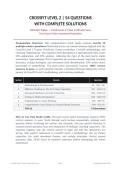
CROSSFIT LEVEL 2 | 54 QUESTIONS
WITH COMPLETE SOLUTIONS
2026/2027 Edition | CrossFit Level 2 Trainer Certificate Course
Post-Course Online Assessment Preparation
Examination Overview: This comprehensive study guide contains exactly 54
multiple-choice questions distributed across six content domains aligned with the
CrossFit Level 2 Trainer Certificate Course curriculum, CrossFit methodology, and
coaching competencies. The cognitive level distribution is approximately 20% recall,
50% application, and 30% analysis, reflecting the rigor of the post-course online
assessment. Approximately 70% of questions are scenario-based, requiring coaching
decisions, scaling strategies, and movement fault identification; 30% assess direct
knowledge of methodology. The post-course assessment requires 100% correct
answers to pass, so each question includes a detailed rationale linking the correct
answer to CrossFit Level 2 methodology and coaching standards.
Section Domain Questions
1 Methodology & Fundamentals Q1 - Q12 (12)
2 Effective Coaching & The Six Trainer Capacities Q13 - Q24 (12)
3 Movement Mechanics & Fault Correction Q25 - Q34 (10)
4 Scaling & Athlete Development Q35 - Q44 (10)
5 Programming & Lesson Planning Q45 - Q49 (5)
6 Comprehensive Case Studies & Scenario-Based Questions Q50 - Q54 (5)
TOTAL 54 Questions
How to Use This Study Guide: The post-course online assessment requires 100%
correct answers to pass. Work through each section sequentially, attempt each
question before reviewing the answer and rationale, and pay special attention to
scenario-based questions that test integration of multiple coaching capacities. The
rationale explains why the correct answer is right and why the distractors are
wrong, with explicit references to CrossFit Level 2 methodology, the six trainer
capacities, the eight movement themes, and scaling principles. Revisit missed
questions after 24-48 hours to reinforce retention before attempting the online
assessment.
CrossFit Level 2 Trainer Certificate Course Page 1 Confidential Study Guide
,CrossFit Level 2 Trainer Certificate Exam - 2026/2027 Edition Post-Course Online Assessment
Section 1: Methodology & Fundamentals
This section tests the foundational CrossFit methodology: the definition of fitness as
work capacity across broad time and modal domains; the program definition of
constantly varied, high-intensity, functional movement; the hopper model; and the
role of nutrition as the base of the CrossFit pyramid. These concepts underpin every
coaching decision made in the Level 2 course.
Q1: A new athlete asks the trainer to define CrossFit in a single sentence.
Which response most accurately reflects the official CrossFit program
definition?
A. A strength and conditioning program focused on Olympic weightlifting and
gymnastics only
B. Constantly varied, high-intensity, functional movement *[CORRECT]*
C. A workout program that uses kettlebells, pull-ups, and running to build endurance
D. A fitness regimen that prioritizes aerobic training over strength to maximize
cardiovascular health
Correct Answer: B
Rationale: CrossFit's official program definition is 'constantly varied, high-intensity,
functional movement.' This three-part definition captures the program's scope (CV), dosing
(HI), and movement selection (FM). Option A is too narrow, excluding the variance and
functional-movement intent. Option C lists implements rather than defining methodology.
Option D misrepresents CrossFit's balance of metabolic conditioning, gymnastics, and
weightlifting. The Level 2 curriculum expects trainers to articulate this definition verbatim
and explain each component's purpose.
CrossFit Level 2 Trainer Certificate Course Page 2 Confidential Study Guide
,CrossFit Level 2 Trainer Certificate Exam - 2026/2027 Edition Post-Course Online Assessment
Q2: During an intro session, an athlete asks, 'What does CrossFit mean by
fitness?' Which explanation best reflects the CrossFit definition of fitness as
taught in the Level 2 course?
A. The ability to run a 5K and deadlift body weight on the same day
B. Increased work capacity across broad time and modal domains
*[CORRECT]*
C. The ability to perform high-repetition gymnastics without fatigue
D. A favorable ratio of lean body mass to fat mass achieved through training
Correct Answer: B
Rationale: CrossFit defines fitness as 'increased work capacity across broad time and modal
domains.' This definition emphasizes the ability to perform more work (force x distance /
time) across short, medium, and long durations (broad time) and across the ten general
physical skills (broad modal). The other options describe specific expressions of fitness but
not the comprehensive definition. The Level 2 trainer must explain why this model is superior
to specialized definitions of fitness.
Q3: A trainer is explaining the 'hopper model' to a group of new athletes.
Which statement best captures the significance of the hopper model in
CrossFit methodology?
A. It is a random workout generator used to keep programming unpredictable for
athletes
B. It demonstrates that true fitness means being prepared to perform well at
any randomly selected physical task without specific preparation
*[CORRECT]*
C. It is a tournament bracket used to rank athletes head-to-head in competition
D. It is a programming template that prescribes a fixed ratio of metabolic,
gymnastics, and weightlifting work
Correct Answer: B
Rationale: The hopper model illustrates that fitness is best measured by performance across
randomly selected physical tasks, demonstrating preparedness for the unknown and
unknowable. The hopper is a conceptual model of fitness, not a literal programming tool or
tournament bracket. Option D confuses the hopper with the CrossFit template. The Level 2
course uses the hopper to justify constantly varied programming and to evaluate generalized
versus specialized fitness.
CrossFit Level 2 Trainer Certificate Course Page 3 Confidential Study Guide
, CrossFit Level 2 Trainer Certificate Exam - 2026/2027 Edition Post-Course Online Assessment
Q4: Which of the following best describes why CrossFit classifies functional
movements as 'universal motor recruitment patterns'?
A. Because they are commonly seen in commercial gyms and are familiar to most
athletes
B. Because they are natural, essential, universal motor recruitment patterns
that transfer to daily life and are found in everyday movement *[CORRECT]*
C. Because they exclusively use body weight and require no equipment
D. Because they were standardized by the National Strength and Conditioning
Association
Correct Answer: B
Rationale: Functional movements are natural, essential, and universal motor recruitment
patterns, meaning they are essential to daily life and found across all humans regardless of
culture. They move large loads over long distances quickly. Option A confuses 'common' with
'universal.' Option C is incorrect because functional movements often use load (deadlift,
squat, press). Option D misattributes the source. Level 2 trainers must explain why functional
movement is the foundation of the program's movement selection.
Q5: A trainer is asked why CrossFit emphasizes high intensity. Which
explanation best reflects the Level 2 course's rationale for high-intensity
training?
A. High intensity is required to burn the maximum number of calories per session
B. High intensity is the independent variable most commonly associated
with maximizing the rate of return on favorable adaptation *[CORRECT]*
C. High intensity ensures athletes become comfortable with discomfort and mental
toughness
D. High intensity is necessary to qualify for the CrossFit Games
Correct Answer: B
Rationale: Intensity (defined as power output, or work divided by time) is the independent
variable most associated with favorable adaptation. The Level 2 course stresses that intensity
is the dial that drives results, but it must be relative to the individual athlete's capacity.
Option A confuses intensity with caloric burn. Option C emphasizes psychological factors
rather than physiological adaptation. Option D is irrelevant to general fitness. Trainers must
understand intensity's role to prescribe and scale workouts appropriately.
CrossFit Level 2 Trainer Certificate Course Page 4 Confidential Study Guide
WITH COMPLETE SOLUTIONS
2026/2027 Edition | CrossFit Level 2 Trainer Certificate Course
Post-Course Online Assessment Preparation
Examination Overview: This comprehensive study guide contains exactly 54
multiple-choice questions distributed across six content domains aligned with the
CrossFit Level 2 Trainer Certificate Course curriculum, CrossFit methodology, and
coaching competencies. The cognitive level distribution is approximately 20% recall,
50% application, and 30% analysis, reflecting the rigor of the post-course online
assessment. Approximately 70% of questions are scenario-based, requiring coaching
decisions, scaling strategies, and movement fault identification; 30% assess direct
knowledge of methodology. The post-course assessment requires 100% correct
answers to pass, so each question includes a detailed rationale linking the correct
answer to CrossFit Level 2 methodology and coaching standards.
Section Domain Questions
1 Methodology & Fundamentals Q1 - Q12 (12)
2 Effective Coaching & The Six Trainer Capacities Q13 - Q24 (12)
3 Movement Mechanics & Fault Correction Q25 - Q34 (10)
4 Scaling & Athlete Development Q35 - Q44 (10)
5 Programming & Lesson Planning Q45 - Q49 (5)
6 Comprehensive Case Studies & Scenario-Based Questions Q50 - Q54 (5)
TOTAL 54 Questions
How to Use This Study Guide: The post-course online assessment requires 100%
correct answers to pass. Work through each section sequentially, attempt each
question before reviewing the answer and rationale, and pay special attention to
scenario-based questions that test integration of multiple coaching capacities. The
rationale explains why the correct answer is right and why the distractors are
wrong, with explicit references to CrossFit Level 2 methodology, the six trainer
capacities, the eight movement themes, and scaling principles. Revisit missed
questions after 24-48 hours to reinforce retention before attempting the online
assessment.
CrossFit Level 2 Trainer Certificate Course Page 1 Confidential Study Guide
,CrossFit Level 2 Trainer Certificate Exam - 2026/2027 Edition Post-Course Online Assessment
Section 1: Methodology & Fundamentals
This section tests the foundational CrossFit methodology: the definition of fitness as
work capacity across broad time and modal domains; the program definition of
constantly varied, high-intensity, functional movement; the hopper model; and the
role of nutrition as the base of the CrossFit pyramid. These concepts underpin every
coaching decision made in the Level 2 course.
Q1: A new athlete asks the trainer to define CrossFit in a single sentence.
Which response most accurately reflects the official CrossFit program
definition?
A. A strength and conditioning program focused on Olympic weightlifting and
gymnastics only
B. Constantly varied, high-intensity, functional movement *[CORRECT]*
C. A workout program that uses kettlebells, pull-ups, and running to build endurance
D. A fitness regimen that prioritizes aerobic training over strength to maximize
cardiovascular health
Correct Answer: B
Rationale: CrossFit's official program definition is 'constantly varied, high-intensity,
functional movement.' This three-part definition captures the program's scope (CV), dosing
(HI), and movement selection (FM). Option A is too narrow, excluding the variance and
functional-movement intent. Option C lists implements rather than defining methodology.
Option D misrepresents CrossFit's balance of metabolic conditioning, gymnastics, and
weightlifting. The Level 2 curriculum expects trainers to articulate this definition verbatim
and explain each component's purpose.
CrossFit Level 2 Trainer Certificate Course Page 2 Confidential Study Guide
,CrossFit Level 2 Trainer Certificate Exam - 2026/2027 Edition Post-Course Online Assessment
Q2: During an intro session, an athlete asks, 'What does CrossFit mean by
fitness?' Which explanation best reflects the CrossFit definition of fitness as
taught in the Level 2 course?
A. The ability to run a 5K and deadlift body weight on the same day
B. Increased work capacity across broad time and modal domains
*[CORRECT]*
C. The ability to perform high-repetition gymnastics without fatigue
D. A favorable ratio of lean body mass to fat mass achieved through training
Correct Answer: B
Rationale: CrossFit defines fitness as 'increased work capacity across broad time and modal
domains.' This definition emphasizes the ability to perform more work (force x distance /
time) across short, medium, and long durations (broad time) and across the ten general
physical skills (broad modal). The other options describe specific expressions of fitness but
not the comprehensive definition. The Level 2 trainer must explain why this model is superior
to specialized definitions of fitness.
Q3: A trainer is explaining the 'hopper model' to a group of new athletes.
Which statement best captures the significance of the hopper model in
CrossFit methodology?
A. It is a random workout generator used to keep programming unpredictable for
athletes
B. It demonstrates that true fitness means being prepared to perform well at
any randomly selected physical task without specific preparation
*[CORRECT]*
C. It is a tournament bracket used to rank athletes head-to-head in competition
D. It is a programming template that prescribes a fixed ratio of metabolic,
gymnastics, and weightlifting work
Correct Answer: B
Rationale: The hopper model illustrates that fitness is best measured by performance across
randomly selected physical tasks, demonstrating preparedness for the unknown and
unknowable. The hopper is a conceptual model of fitness, not a literal programming tool or
tournament bracket. Option D confuses the hopper with the CrossFit template. The Level 2
course uses the hopper to justify constantly varied programming and to evaluate generalized
versus specialized fitness.
CrossFit Level 2 Trainer Certificate Course Page 3 Confidential Study Guide
, CrossFit Level 2 Trainer Certificate Exam - 2026/2027 Edition Post-Course Online Assessment
Q4: Which of the following best describes why CrossFit classifies functional
movements as 'universal motor recruitment patterns'?
A. Because they are commonly seen in commercial gyms and are familiar to most
athletes
B. Because they are natural, essential, universal motor recruitment patterns
that transfer to daily life and are found in everyday movement *[CORRECT]*
C. Because they exclusively use body weight and require no equipment
D. Because they were standardized by the National Strength and Conditioning
Association
Correct Answer: B
Rationale: Functional movements are natural, essential, and universal motor recruitment
patterns, meaning they are essential to daily life and found across all humans regardless of
culture. They move large loads over long distances quickly. Option A confuses 'common' with
'universal.' Option C is incorrect because functional movements often use load (deadlift,
squat, press). Option D misattributes the source. Level 2 trainers must explain why functional
movement is the foundation of the program's movement selection.
Q5: A trainer is asked why CrossFit emphasizes high intensity. Which
explanation best reflects the Level 2 course's rationale for high-intensity
training?
A. High intensity is required to burn the maximum number of calories per session
B. High intensity is the independent variable most commonly associated
with maximizing the rate of return on favorable adaptation *[CORRECT]*
C. High intensity ensures athletes become comfortable with discomfort and mental
toughness
D. High intensity is necessary to qualify for the CrossFit Games
Correct Answer: B
Rationale: Intensity (defined as power output, or work divided by time) is the independent
variable most associated with favorable adaptation. The Level 2 course stresses that intensity
is the dial that drives results, but it must be relative to the individual athlete's capacity.
Option A confuses intensity with caloric burn. Option C emphasizes psychological factors
rather than physiological adaptation. Option D is irrelevant to general fitness. Trainers must
understand intensity's role to prescribe and scale workouts appropriately.
CrossFit Level 2 Trainer Certificate Course Page 4 Confidential Study Guide


