
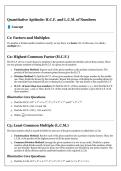
Quantitative Aptitude: H.C.F. and L.C.M. of Numbers
Concept
C1: Factors and Multiples
If a number 𝑎 divides another number 𝑏 exactly, we say that 𝑎 is a factor of 𝑏. In this case, 𝑏 is called a
multiple of 𝑎.
C2: Highest Common Factor (H.C.F.)
The H.C.F. of two or more than two numbers is the greatest number that divides each of them exactly. There
are two primary methods of finding the H.C.F. of a given set of numbers:
1. Factorization Method: Express each of the given numbers as the product of prime factors. The
product of the least powers of common prime factors gives the H.C.F.
2. Division Method: To find the H.C.F. of two given numbers, divide the larger number by the smaller
one. Then, divide the divisor by the remainder. Repeat this process of dividing the preceding divisor by
the remainder last obtained till zero is obtained as a remainder. The last divisor is the required H.C.F.
• H.C.F. of more than two numbers: To find the H.C.F. of three numbers 𝑥, 𝑦, 𝑧, first find the H.C.F.
of any two (say, 𝑥 and 𝑦). Then, the H.C.F. of this result and the third number 𝑧 gives the H.C.F. of all
three numbers.
Illustrative Core Questions
1. Find the H.C.F. of 23 × 32 × 5 × 74 , 22 × 35 × 52 × 73 , and 23 × 53 × 72 .
2. Find the H.C.F. of 42, 63 and 140.
3. Find the H.C.F. of 513, 1134 and 1215.
391
4. Reduce 667 to its lowest terms.
C3: Least Common Multiple (L.C.M.)
The least number which is exactly divisible by each one of the given numbers is called their L.C.M.
1. Factorization Method: Resolve each of the given numbers into a product of prime factors. Then, the
L.C.M. is the product of the highest powers of all the prime factors.
2. Common Division Method: Arrange the given numbers in a row in any order. Divide by a prime
number which divides exactly at least two of the given numbers and carry forward the numbers which
are not divisible. Repeat this process till no two of the numbers are divisible by any prime number. The
product of all the divisors and the undivided numbers is the required L.C.M.
Illustrative Core Questions
5. Find the L.C.M. of 22 × 33 × 5 × 72 , 23 × 32 × 52 × 74 , and 2 × 3 × 53 × 7 × 11.
, 6. Find the L.C.M. of:
(a) 87 and 145 (b) 72, 108 and 2100
7. Find the L.C.M. of 16,24,36 and 54.
C4: Fundamental Product Rule
For any two given numbers:
Product of two numbers = Product of their H.C.F. and L.C.M.
Illustrative Core Questions
8. The H.C.F. of two numbers is 11 and their L.C.M. is 693. If one of the numbers is 77, find the other.
C5: Co-primes
Two numbers are said to be co-primes if their H.C.F. is 1.
Illustrative Core Questions
9. Two numbers are in the ratio of 15: 11. If their H.C.F. is 13, find the numbers.
10. Two numbers are in the ratio of 3: 4. Their L.C.M. is 84. Find the numbers.
11. The sum of two numbers is 462 and their highest common factor is 22. What is the minimum number
of pairs that satisfy these conditions?
C6: H.C.F. and L.C.M. of Fractions
H.C.F. of Numerators
1. H.C.F. of Fractions =
L.C.M. of Denominators
L.C.M. of Numerators
2. L.C.M. of Fractions = H.C.F. of Denominators
Illustrative Core Questions
2 8 16 10
12. Find the H.C.F. and L.C.M. of 3, 9, 81 and 27.
C7: Decimal Fractions
To find the H.C.F. or L.C.M. of decimal fractions, make the same number of decimal places by annexing zeros
in some numbers, if necessary. Find the H.C.F. or L.C.M. of these numbers without decimal points, and then
mark off as many decimal places in the final result as there are in each of the equalized given numbers.
Illustrative Core Questions
13. Find the H.C.F. and L.C.M. of 0.63, 1.05 and 2.1.
C8: Comparison of Fractions
Concept
C1: Factors and Multiples
If a number 𝑎 divides another number 𝑏 exactly, we say that 𝑎 is a factor of 𝑏. In this case, 𝑏 is called a
multiple of 𝑎.
C2: Highest Common Factor (H.C.F.)
The H.C.F. of two or more than two numbers is the greatest number that divides each of them exactly. There
are two primary methods of finding the H.C.F. of a given set of numbers:
1. Factorization Method: Express each of the given numbers as the product of prime factors. The
product of the least powers of common prime factors gives the H.C.F.
2. Division Method: To find the H.C.F. of two given numbers, divide the larger number by the smaller
one. Then, divide the divisor by the remainder. Repeat this process of dividing the preceding divisor by
the remainder last obtained till zero is obtained as a remainder. The last divisor is the required H.C.F.
• H.C.F. of more than two numbers: To find the H.C.F. of three numbers 𝑥, 𝑦, 𝑧, first find the H.C.F.
of any two (say, 𝑥 and 𝑦). Then, the H.C.F. of this result and the third number 𝑧 gives the H.C.F. of all
three numbers.
Illustrative Core Questions
1. Find the H.C.F. of 23 × 32 × 5 × 74 , 22 × 35 × 52 × 73 , and 23 × 53 × 72 .
2. Find the H.C.F. of 42, 63 and 140.
3. Find the H.C.F. of 513, 1134 and 1215.
391
4. Reduce 667 to its lowest terms.
C3: Least Common Multiple (L.C.M.)
The least number which is exactly divisible by each one of the given numbers is called their L.C.M.
1. Factorization Method: Resolve each of the given numbers into a product of prime factors. Then, the
L.C.M. is the product of the highest powers of all the prime factors.
2. Common Division Method: Arrange the given numbers in a row in any order. Divide by a prime
number which divides exactly at least two of the given numbers and carry forward the numbers which
are not divisible. Repeat this process till no two of the numbers are divisible by any prime number. The
product of all the divisors and the undivided numbers is the required L.C.M.
Illustrative Core Questions
5. Find the L.C.M. of 22 × 33 × 5 × 72 , 23 × 32 × 52 × 74 , and 2 × 3 × 53 × 7 × 11.
, 6. Find the L.C.M. of:
(a) 87 and 145 (b) 72, 108 and 2100
7. Find the L.C.M. of 16,24,36 and 54.
C4: Fundamental Product Rule
For any two given numbers:
Product of two numbers = Product of their H.C.F. and L.C.M.
Illustrative Core Questions
8. The H.C.F. of two numbers is 11 and their L.C.M. is 693. If one of the numbers is 77, find the other.
C5: Co-primes
Two numbers are said to be co-primes if their H.C.F. is 1.
Illustrative Core Questions
9. Two numbers are in the ratio of 15: 11. If their H.C.F. is 13, find the numbers.
10. Two numbers are in the ratio of 3: 4. Their L.C.M. is 84. Find the numbers.
11. The sum of two numbers is 462 and their highest common factor is 22. What is the minimum number
of pairs that satisfy these conditions?
C6: H.C.F. and L.C.M. of Fractions
H.C.F. of Numerators
1. H.C.F. of Fractions =
L.C.M. of Denominators
L.C.M. of Numerators
2. L.C.M. of Fractions = H.C.F. of Denominators
Illustrative Core Questions
2 8 16 10
12. Find the H.C.F. and L.C.M. of 3, 9, 81 and 27.
C7: Decimal Fractions
To find the H.C.F. or L.C.M. of decimal fractions, make the same number of decimal places by annexing zeros
in some numbers, if necessary. Find the H.C.F. or L.C.M. of these numbers without decimal points, and then
mark off as many decimal places in the final result as there are in each of the equalized given numbers.
Illustrative Core Questions
13. Find the H.C.F. and L.C.M. of 0.63, 1.05 and 2.1.
C8: Comparison of Fractions


