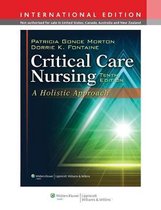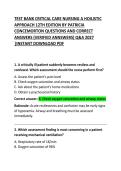
TEST BANK CRITICAL CARE NURSING A HOILISTIC
APPROACH 12TH EDITION BY PATRICIA
CONCEMORTON QUESTIONS AND CORRECT
ANSWERS (VERIFIED ANNSWERS) Q&A 2027
|INSTANT DOWNLOAD PDF
1. A critically ill patient suddenly becomes restless and
confused. Which assessment should the nurse perform first?
A. Assess the patient's pain level
B. Check oxygen saturation and airway status
C. Ask about the patient's home medications
D. Obtain a psychosocial history
Correct answer: B. Check oxygen saturation and airway status
Rationale: Acute restlessness and confusion may be early signs
of hypoxemia. Airway and breathing must be assessed
immediately.
2. Which assessment finding is most concerning in a patient
receiving mechanical ventilation?
A. Respiratory rate of 18/min
B. Oxygen saturation of 96%
,C. Sudden decrease in breath sounds on one side
D. Heart rate of 82/min
Correct answer: C. Sudden decrease in breath sounds on one
side
Rationale: Unilateral reduction in breath sounds can indicate
pneumothorax, a potentially life-threatening complication of
mechanical ventilation.
3. Which intervention is the priority when caring for a patient
with an artificial airway?
A. Provide oral care once daily
B. Maintain airway patency
C. Limit communication
D. Keep the patient completely supine
Correct answer: B. Maintain airway patency
Rationale: Airway patency is essential for ventilation and
oxygenation and takes priority over other interventions.
4. Which finding is characteristic of hypoxemia?
A. Bradycardia
B. Restlessness
C. Warm, dry skin
D. Increased appetite
,Correct answer: B. Restlessness
Rationale: Restlessness, anxiety, confusion, and changes in
level of consciousness may occur as oxygenation deteriorates.
5. A patient in the intensive care unit has a Glasgow Coma
Scale score of 7. What does this indicate?
A. Mild neurologic impairment
B. Moderate neurologic impairment
C. Severe impairment of consciousness
D. Normal neurologic function
Correct answer: C. Severe impairment of consciousness
Rationale: A GCS score of 8 or less generally indicates severe
impairment and raises concern about the patient's ability to
protect the airway.
6. Which action is most important before suctioning an
intubated patient?
A. Administer oral fluids
B. Assess the need for suctioning
C. Remove the endotracheal tube
D. Place the patient in Trendelenburg position
Correct answer: B. Assess the need for suctioning
, Rationale: Suctioning is an invasive procedure and should be
performed when clinically indicated rather than routinely.
7. Which finding suggests inadequate tissue perfusion?
A. Capillary refill of 2 seconds
B. Warm extremities
C. Decreased urine output
D. Normal mental status
Correct answer: C. Decreased urine output
Rationale: Reduced urine output can reflect decreased renal
perfusion and may be an early indicator of shock.
8. Which parameter is particularly useful when evaluating
renal perfusion in a critically ill patient?
A. Urine output
B. Pupil size
C. Bowel sounds
D. Skin temperature alone
Correct answer: A. Urine output
Rationale: Urine output provides a useful bedside indicator of
renal blood flow and overall perfusion.
APPROACH 12TH EDITION BY PATRICIA
CONCEMORTON QUESTIONS AND CORRECT
ANSWERS (VERIFIED ANNSWERS) Q&A 2027
|INSTANT DOWNLOAD PDF
1. A critically ill patient suddenly becomes restless and
confused. Which assessment should the nurse perform first?
A. Assess the patient's pain level
B. Check oxygen saturation and airway status
C. Ask about the patient's home medications
D. Obtain a psychosocial history
Correct answer: B. Check oxygen saturation and airway status
Rationale: Acute restlessness and confusion may be early signs
of hypoxemia. Airway and breathing must be assessed
immediately.
2. Which assessment finding is most concerning in a patient
receiving mechanical ventilation?
A. Respiratory rate of 18/min
B. Oxygen saturation of 96%
,C. Sudden decrease in breath sounds on one side
D. Heart rate of 82/min
Correct answer: C. Sudden decrease in breath sounds on one
side
Rationale: Unilateral reduction in breath sounds can indicate
pneumothorax, a potentially life-threatening complication of
mechanical ventilation.
3. Which intervention is the priority when caring for a patient
with an artificial airway?
A. Provide oral care once daily
B. Maintain airway patency
C. Limit communication
D. Keep the patient completely supine
Correct answer: B. Maintain airway patency
Rationale: Airway patency is essential for ventilation and
oxygenation and takes priority over other interventions.
4. Which finding is characteristic of hypoxemia?
A. Bradycardia
B. Restlessness
C. Warm, dry skin
D. Increased appetite
,Correct answer: B. Restlessness
Rationale: Restlessness, anxiety, confusion, and changes in
level of consciousness may occur as oxygenation deteriorates.
5. A patient in the intensive care unit has a Glasgow Coma
Scale score of 7. What does this indicate?
A. Mild neurologic impairment
B. Moderate neurologic impairment
C. Severe impairment of consciousness
D. Normal neurologic function
Correct answer: C. Severe impairment of consciousness
Rationale: A GCS score of 8 or less generally indicates severe
impairment and raises concern about the patient's ability to
protect the airway.
6. Which action is most important before suctioning an
intubated patient?
A. Administer oral fluids
B. Assess the need for suctioning
C. Remove the endotracheal tube
D. Place the patient in Trendelenburg position
Correct answer: B. Assess the need for suctioning
, Rationale: Suctioning is an invasive procedure and should be
performed when clinically indicated rather than routinely.
7. Which finding suggests inadequate tissue perfusion?
A. Capillary refill of 2 seconds
B. Warm extremities
C. Decreased urine output
D. Normal mental status
Correct answer: C. Decreased urine output
Rationale: Reduced urine output can reflect decreased renal
perfusion and may be an early indicator of shock.
8. Which parameter is particularly useful when evaluating
renal perfusion in a critically ill patient?
A. Urine output
B. Pupil size
C. Bowel sounds
D. Skin temperature alone
Correct answer: A. Urine output
Rationale: Urine output provides a useful bedside indicator of
renal blood flow and overall perfusion.