

Written by students who passed Immediately available after payment Read online or as PDF Wrong document? Swap it for free 4.6 TrustPilot
logo-home
Document preview thumbnail
Preview 2 out of 13 pages
Exam (elaborations)

NSG 3250 (NSG3250) Adult Health I – Exam 1 | Complete Questions & Answers Review | Latest 2026–2027, Galen.

Document preview thumbnail
Preview 2 out of 13 pages

NSG 3250 Adult Health I Exam 1 – Complete Q&A Study Guide | Galen College of Nursing | Updated 2026–2027 Below are **all 50 questions with multiple-choice options only** from the uploaded **NSG 3250: Adult Health I — Exam 1 Review Guide, Fall 2026**. Correct answers and rationales have been removed. 1. A patient newly admitted to a rehabilitation unit says, “I want to be able to care for myself again.” Which nursing goal best reflects the purpose of rehabilitation nursing? A. Assist the patient to attain and maintain optimum health as defined by the patient. B. Complete most self-care tasks for the patient to prevent fatigue. C. Focus primarily on correcting the patient’s physical impairment. D. Delay independence training until all medical problems have resolved. 2. Which activity is an instrumental activity of daily living (IADL) rather than a basic activity of daily living (ADL)? A. Bathing independently. B. Feeding oneself. C. Using the toilet. D. Managing household finances. 3. The nurse wants to measure a rehabilitation patient’s independence with ADLs, continence, toileting, transfers, and ambulation. Which assessment tool is most appropriate? A. PULSES profile. B. Barthel Index. C. Disability Rating Scale (DRS). D. Patient Evaluation Conference System (PECS). 4. A patient has intact skin over the sacrum with persistent nonblanchable redness. How should the nurse classify this pressure injury according to the uploaded material? A. Deep tissue injury. B. Stage 2 pressure injury. C. Stage 1 pressure injury. D. Unstageable pressure injury. 5. Which finding is most consistent with a Stage 4 pressure injury? A. Intact skin with nonblanchable redness. B. Partial-thickness loss of the dermis. C. Full-thickness tissue loss with exposed bone, tendon, or muscle. D. Purple or maroon localized discoloration without an open wound. 6. Before transferring a rehabilitation patient from bed to a wheelchair, which action is essential? A. Keep both wheelchair footrests in place during the transfer. B. Ask the patient to remain upright and avoid leaning forward. C. Place the transfer board entirely under the wheelchair cushion. D. Lock the wheelchair wheels before the transfer. 7. Which crutch gait is identified in the uploaded reading as appropriate for a patient who is non-weight-bearing and has good balance and arm strength? A. Four-point gait. B. Two-point gait. C. Three-point gait. D. Swing-to gait. 8. A patient uses a cane because of weakness in one leg. Which instruction is consistent with the uploaded material? A. Advance the cane at the same time as the affected leg moves forward. B. Move the cane only after both legs have advanced. C. Hold the cane behind the affected leg while stepping. D. Advance the unaffected leg and cane together first. 9. Which intervention is appropriate when developing a urinary continence plan for a rehabilitation patient? A. Restrict fluids to reduce episodes of incontinence. B. Maintain adequate fluid intake rather than restricting fluids. C. Use an indwelling urinary catheter whenever possible. D. Avoid bladder training until discharge. 10. When establishing a bowel program, which time is identified as a natural period for defecation? A. Immediately before bedtime. B. About 30 minutes after a meal, especially in the morning. C. Two hours before every meal. D. Only when the patient reports abdominal cramping. 11. The preoperative phase of care begins and ends at which points? A. It begins on admission to the PACU and ends at discharge. B. It begins when the decision for surgery is made and ends when the patient is transferred onto the OR bed. C. It begins with anesthesia induction and ends with wound closure. D. It begins when the patient signs consent and ends when anesthesia is stopped. 12. A surgical procedure is performed to relieve symptoms of a disease but is not expected to cure the disease. How is this surgery classified? A. Palliative surgery. B. Diagnostic surgery. C. Curative surgery. D. Restorative surgery. 13. Which age-related change increases perioperative risk in an older adult? A. Increased vital capacity. B. Increased cardiac reserve. C. Decreased renal blood flow and glomerular filtration rate. D. Increased subcutaneous fat. 14. Which preoperative history finding should the nurse report to the surgeon or anesthesia personnel? A. A myocardial infarction within the previous 6 months. B. A remote history of seasonal allergies without current symptoms. C. A preference for morning surgery. D. The patient’s usual bedtime routine. 15. During general anesthesia, which finding should make the nurse suspect malignant hyperthermia first according to the uploaded course notes? A. Mild postoperative nausea. B. Gradual constipation. C. Localized incisional itching. D. Sudden marked tachycardia. 16. Which medication is identified in the uploaded material as the antidote/treatment for malignant hyperthermia? A. Dantrolene sodium. B. Naloxone. C. Ondansetron. D. Enoxaparin. 17. Why is a patient typically instructed to remain NPO for 6 to 8 hours before surgery? A. To decrease the risk for aspiration. B. To prevent postoperative urinary retention. C. To improve platelet aggregation. D. To reduce the need for anesthesia monitoring. 18. A patient asks the nurse to explain the risks, benefits, and complications of a scheduled surgical procedure before signing consent. What is the nurse’s best action? A. Explain all procedural risks and then obtain the signature independently. B. Ask a family member to sign instead of the patient. C. Have the surgeon or procedure provider explain the procedure; the nurse may clarify information and witness the signature. D. Administer the preoperative sedative first so the patient is less anxious. 19. When must informed consent be signed for it to be valid in a nonemergent surgical patient? A. After the patient arrives in the PACU. B. After the first postoperative analgesic dose. C. Any time before discharge from the hospital. D. Before psychoactive preoperative medication is administered. 20. Which medication instruction is consistent with the uploaded preoperative notes? A. Take aspirin routinely on the morning of surgery. B. Continue all herbal products until transport to the OR. C. Hold every cardiac medication for 24 hours before surgery. D. Continue the beta-blocker as directed, often with a sip of water. 21. What is the purpose of the Universal Protocol “time-out” before a surgical procedure? A. Determine the patient’s discharge destination. B. Verify the correct patient, correct procedure, and correct surgical site. C. Select postoperative pain medication. D. Calculate the patient’s daily fluid requirement. 22. A patient develops a headache after spinal anesthesia. Which nursing action is supported by the uploaded materials? A. Place the patient upright and restrict fluids. B. Encourage immediate ambulation. C. Apply heat directly over the spinal insertion site. D. Keep the patient supine and provide IV fluids as ordered. 23. Which assessment is especially important during moderate/conscious sedation? A. Weekly weight and waist circumference. B. Continuous attention to heart rhythm and oxygen saturation while ensuring the patient remains responsive. C. Bowel sounds only after the procedure is complete. D. Daily visual acuity testing. 24. A patient has just arrived in the PACU. Which assessment should the nurse prioritize? A. Whether the patient remembers the surgeon’s name. B. The exact time of the next meal. C. Respiratory status and airway patency. D. The patient’s preferred discharge transportation. 25. When is it appropriate to remove an oral airway from a postoperative patient in the PACU? A. Immediately upon arrival in the PACU. B. When the gag reflex has returned and the patient can protect the airway. C. As soon as the patient reports pain. D. Only after the patient has eaten. 26. Which intervention is emphasized as the first measure for reducing postoperative DVT risk in the uploaded notes? A. Keeping the patient on strict bed rest. B. Early ambulation. C. Restricting oral fluids. D. Placing a pillow under the knees continuously. 27. A postoperative patient has shallow, rapid respirations, diminished breath sounds, and a low-grade temperature. Which complication should the nurse suspect? A. Urinary retention. B. Atelectasis. C. Wound evisceration. D. Hypoglycemia. 28. Which set of findings is most consistent with postoperative hypovolemia or hemorrhage? A. Hypertension, bounding pulse, warm dry skin, and bradypnea. B. Falling blood pressure, rapid weak pulse, cool moist skin, and rapid respirations. C. Stable blood pressure, strong pulse, normal skin color, and clear urine. D. Slow pulse, increased pulse pressure, and flushed dry skin. 29. A postoperative abdominal incision suddenly opens and abdominal contents protrude. What should the nurse do first according to the review guide? A. Attempt to push the organs back into the abdomen. B. Remove all dressings and leave the wound exposed to air. C. Place the patient in low Fowler position, cover the area with a wet sterile dressing, and contact the provider. D. Encourage the patient to walk to reduce abdominal pressure. 30. Which postoperative wound finding most strongly suggests infection? A. Well-approximated edges without drainage. B. Mild bruising that is not enlarging. C. Increasing incisional pain with warmth, swelling, drainage, fever, and elevated WBC count. D. Stable temperature with decreasing tenderness. 31. Which discharge instruction is appropriate after outpatient surgery with sedation or anesthesia? A. The patient may drive if pain is rated below 3/10. B. A responsible adult is unnecessary if vital signs are normal. C. The patient should not drive home or be discharged home alone. D. Written instructions are unnecessary if verbal teaching was provided. 32. Why is heparin administered intravenously or subcutaneously rather than orally? A. Heparin is only effective when mixed with insulin. B. Oral heparin causes immediate malignant hyperthermia. C. Heparin must be inhaled before it enters the circulation. D. The gastrointestinal tract does not absorb heparin. 33. Which condition is an indicated use for enoxaparin in the uploaded pharmacology notes? A. Prevention and management of deep vein thrombosis and pulmonary embolism. B. Treatment of malignant hyperthermia. C. Reversal of opioid-induced respiratory depression. D. Treatment of postoperative nausea as a first-line antiemetic. 34. A postoperative patient has moderate-to-severe nausea and vomiting. Which medication in the uploaded pharmacology material is specifically used to prevent or treat postoperative nausea and vomiting? A. Dantrolene. B. Heparin. C. Ondansetron. D. Naloxone. 35. A patient receiving an opioid becomes difficult to arouse and develops respiratory depression. Which medication from the uploaded material is used to reverse opioid-induced CNS and respiratory depression? A. Meloxicam. B. Hydroxyzine. C. Naloxone. D. Enoxaparin. 36. Which laboratory result meets the diagnostic threshold for diabetes in the uploaded course material? A. Hemoglobin A1C of 6.5% or greater. B. Hemoglobin A1C of 5.0%. C. Fasting glucose of 90 mg/dL. D. Random glucose of 110 mg/dL without symptoms. 37. Which statement best differentiates type 1 from type 2 diabetes according to the uploaded notes? A. Type 1 is caused only by obesity, while type 2 is always autoimmune. B. Type 1 involves autoimmune destruction with absent insulin production, while type 2 is characterized by insulin resistance and relative insulin deficiency. C. Type 1 occurs only after age 45, while type 2 occurs only in children. D. Type 1 never requires insulin, while type 2 always requires IV insulin. 38. Which assessment cluster represents the classic “three Ps” of diabetes? A. Polyuria, polydipsia, and polyphagia. B. Pallor, paresthesia, and paralysis. C. Pain, pressure, and palpitations. D. Polycythemia, proteinuria, and pruritus. 39. Which patient has the greatest risk for type 2 diabetes based on the uploaded risk-factor list? A. A 52-year-old with obesity, hypertension, a sedentary lifestyle, and a family history of diabetes. B. A 20-year-old who exercises regularly and has no family history. C. A 30-year-old with normal weight and no metabolic risk factors. D. A 40-year-old with no hypertension, no obesity, and no family history. 40. A patient with diabetes plans to exercise. The pre-exercise blood glucose is 72 mg/dL. Which instruction is supported by the uploaded material? A. Begin strenuous exercise immediately to increase the glucose level. B. Do not exercise yet; eat a carbohydrate/protein snack and reassess. C. Take extra rapid-acting insulin before exercising. D. Avoid all food until the exercise session is completed. 41. Which statement by a patient with diabetes shows correct foot-care teaching? A. “I will walk barefoot at home so I can feel the floor.” B. “I will use a heating pad if my feet feel cold.” C. “I will soak my feet daily and shave any calluses myself.” D. “I will wash my feet with lukewarm water, dry them well, inspect them daily, and wear well-fitting closed-toe shoes.” 42. Which instruction is most appropriate for a patient prescribed rapid-acting lispro (Humalog) insulin? A. Take it when food is available and the patient is actively eating because onset is rapid. B. Take it only at bedtime because it has no peak. C. Delay eating for several hours after the injection. D. Use it only as a long-acting basal insulin. 43. Which description matches NPH insulin in the uploaded notes? A. Intermediate-acting insulin with an effect beginning in about 2 to 4 hours and a peak over a broad 4- to 12-hour range. B. Rapid-acting insulin with onset in 10 to 15 minutes. C. Peakless very-long-acting insulin providing continuous basal coverage. D. Short-acting insulin identified as the only insulin category used in all patients. 44. Which statement best describes insulin glargine (Lantus) in the uploaded material? A. It is rapid acting and should be taken only while actively eating. B. It is a very-long-acting, essentially peakless insulin that provides a continuous source of insulin. C. It is the short-acting insulin used for sliding-scale IV administration. D. It peaks sharply 1 to 2 hours after administration. 45. A patient has a normal blood glucose at bedtime, becomes hypoglycemic around 2 to 3 AM, and then has high glucose in the morning. Which phenomenon is this? A. Somogyi effect. B. Dawn phenomenon. C. Latent autoimmune diabetes of adults. D. Hyperglycemic hyperosmolar syndrome. 46. Which pattern best describes the dawn phenomenon? A. Severe hypoglycemia after every meal followed by normal morning glucose. B. A continuous fall in glucose from bedtime until breakfast. C. Immediate hyperglycemia after taking a 15-g carbohydrate snack. D. Blood glucose remains relatively normal until about 3 AM and then begins to rise. 47. Which statement correctly describes the action of a biguanide such as metformin based on the uploaded diabetes notes? A. It directly stimulates the pancreas to secrete insulin as its primary action. B. It delays intestinal absorption of complex carbohydrates only. C. It replaces endogenous insulin in type 1 diabetes. D. It decreases hepatic glucose production and improves insulin sensitivity. 48. A conscious patient with diabetes is shaky, sweaty, hungry, and has a low blood glucose. Which initial action is supported by the uploaded material? A. Give a dose of long-acting insulin. B. Restrict oral intake for 2 hours. C. Begin vigorous exercise. D. Give about 15 g of a fast-acting concentrated carbohydrate. 49. A patient with diabetes is unconscious and cannot swallow because of severe hypoglycemia. Which emergency treatment is identified in the uploaded notes? A. Give orange juice by mouth immediately. B. Administer glargine insulin. C. Administer glucagon by subcutaneous or intramuscular route or give IV 50% dextrose as ordered. D. Place food in the patient’s mouth while supine. 50. Which assessment finding is most characteristic of diabetic ketoacidosis (DKA) in the uploaded material? A. Bradycardia with shallow respirations and no dehydration. B. Isolated joint pain with normal glucose. C. Nonblanchable sacral erythema without metabolic symptoms. D. Dehydration with deep rapid Kussmaul respirations and fruity-smelling breath.

Content preview

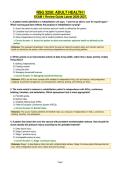
NSG 3250: ADULT HEALTH I
EXAM 1 Review Guide Latest 2026-2027.
1. A patient newly admitted to a rehabilitation unit says, “I want to be able to care for myself again.”
Which nursing goal best reflects the purpose of rehabilitation nursing?
A. Assist the patient to attain and maintain optimum health as defined by the patient.
B. Complete most self-care tasks for the patient to prevent fatigue.
C. Focus primarily on correcting the patient’s physical impairment.
D. Delay independence training until all medical problems have resolved.
✓ Correct Answer: A. Assist the patient to attain and maintain optimum health as defined by the
patient.
Rationale: The uploaded rehabilitation notes define the goal as helping the patient attain and maintain optimum
health as defined by the patient, while maximizing independence and using existing abilities.


2. Which activity is an instrumental activity of daily living (IADL) rather than a basic activity of daily
living (ADL)?
A. Bathing independently.
B. Feeding oneself.
C. Using the toilet.
D. Managing household finances.
✓ Correct Answer: D. Managing household finances.
Rationale: IADLs are the more complex skills needed for independent living, such as finances, meal preparation,
shopping, household management, and transportation. Bathing, feeding, and toileting are ADLs.


3. The nurse wants to measure a rehabilitation patient’s independence with ADLs, continence,
toileting, transfers, and ambulation. Which assessment tool is most appropriate?
A. PULSES profile.
B. Barthel Index.
C. Disability Rating Scale (DRS).
D. Patient Evaluation Conference System (PECS).
✓ Correct Answer: B. Barthel Index.
Rationale: The source material identifies the Barthel Index as a measure of independence in ADLs, continence,
toileting, transfers, and ambulation.


4. A patient has intact skin over the sacrum with persistent nonblanchable redness. How should the
nurse classify this pressure injury according to the uploaded material?
A. Deep tissue injury.
B. Stage 2 pressure injury.
C. Stage 1 pressure injury.
D. Unstageable pressure injury.
✓ Correct Answer: C. Stage 1 pressure injury.
Rationale: Stage 1 is described as intact skin with nonblanchable redness. Stage 2 involves partial-thickness dermal
loss, while unstageable injuries have a base obscured by slough.


Page 1

, 5. Which finding is most consistent with a Stage 4 pressure injury?
A. Intact skin with nonblanchable redness.
B. Partial-thickness loss of the dermis.
C. Full-thickness tissue loss with exposed bone, tendon, or muscle.
D. Purple or maroon localized discoloration without an open wound.
✓ Correct Answer: C. Full-thickness tissue loss with exposed bone, tendon, or muscle.
Rationale: The uploaded reading describes Stage 4 as full-thickness tissue loss with exposed bone, tendon, or
muscle.


6. Before transferring a rehabilitation patient from bed to a wheelchair, which action is essential?
A. Keep both wheelchair footrests in place during the transfer.
B. Ask the patient to remain upright and avoid leaning forward.
C. Place the transfer board entirely under the wheelchair cushion.
D. Lock the wheelchair wheels before the transfer.
✓ Correct Answer: D. Lock the wheelchair wheels before the transfer.
Rationale: Transfer teaching in the uploaded reading includes locking the wheels and removing detachable arm and
footrests before using a transfer board.


7. Which crutch gait is identified in the uploaded reading as appropriate for a patient who is non-
weight-bearing and has good balance and arm strength?
A. Four-point gait.
B. Two-point gait.
C. Three-point gait.
D. Swing-to gait.
✓ Correct Answer: C. Three-point gait.
Rationale: The reading describes the three-point gait as non-weight-bearing and requiring good balance and arm
strength.


8. A patient uses a cane because of weakness in one leg. Which instruction is consistent with the
uploaded material?
A. Advance the cane at the same time as the affected leg moves forward.
B. Move the cane only after both legs have advanced.
C. Hold the cane behind the affected leg while stepping.
D. Advance the unaffected leg and cane together first.
✓ Correct Answer: A. Advance the cane at the same time as the affected leg moves forward.
Rationale: The source specifically teaches advancing the cane at the same time the affected leg moves forward.


9. Which intervention is appropriate when developing a urinary continence plan for a rehabilitation
patient?
A. Restrict fluids to reduce episodes of incontinence.
B. Maintain adequate fluid intake rather than restricting fluids.
C. Use an indwelling urinary catheter whenever possible.
D. Avoid bladder training until discharge.
✓ Correct Answer: B. Maintain adequate fluid intake rather than restricting fluids.
Rationale: The uploaded notes state not to restrict fluids, recommend about 2 to 3 L daily when appropriate, and
advise avoiding indwelling catheters when possible.

Page 2

Document information

Uploaded on
September 7, 2026
Number of pages
13
Written in
2025/2026
Type
Exam (elaborations)
Contains
Questions & answers
$18.49

Wrong document? Swap it for free Within 14 days of purchase and before downloading, you can choose a different document. You can simply spend the amount again.
Written by students who passed
Immediately available after payment
Read online or as PDF

Seller avatar
Reputation scores are based on the amount of documents a seller has sold for a fee and the reviews they have received for those documents. There are three levels: Bronze, Silver and Gold. The better the reputation, the more your can rely on the quality of the sellers work.
MindCraft
3.8
(52)
Sold
445
Followers
10
Items
2892
Last sold
9 hours ago


Why students choose Stuvia

Created by fellow students, verified by reviews

Quality you can trust: written by students who passed their tests and reviewed by others who've used these notes.

Didn't get what you expected? Choose another document

No worries! You can instantly pick a different document that better fits what you're looking for.

Pay as you like, start learning right away

No subscription, no commitments. Pay the way you're used to via credit card and download your PDF document instantly.

Student with book image

“Bought, downloaded, and aced it. It really can be that simple.”

Alisha Student

Working on your references?

Create accurate citations in APA, MLA and Harvard with our free citation generator.

Working on your references?

Frequently asked questions

