
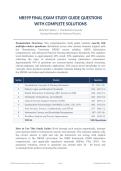
NR599 FINAL EXAM STUDY GUIDE QUESTIONS
WITH COMPLETE SOLUTIONS
2026/2027 Edition | Chamberlain University
Nursing Informatics for Advanced Practice
Examination Overview: This comprehensive study guide contains exactly 100
multiple-choice questions distributed across nine content domains aligned with
the Chamberlain University NR599 course syllabus, QSEN Informatics
Competencies, and Advanced Practice Nursing Informatics Standards. The cognitive
level distribution is approximately 20% recall, 50% application, and 30% analysis,
reflecting the rigor of advanced practice nursing informatics assessment.
Approximately 70% of questions are scenario-based, requiring clinical reasoning,
ethical judgment, and informatics application; 30% assess direct knowledge of core
concepts. Each question includes a detailed rationale linking the correct answer to
the NR599 curriculum and informatics standards.
Section Domain Questions
1 Foundational Concepts of Nursing Informatics Q1 - Q15 (15)
2 Ethical, Legal, and Bioethical Standards Q16 - Q27 (12)
3 Health Information Technology (HIT) Systems & EHR Q28 - Q42 (15)
4 Telehealth, Telemedicine, and mHealth Q43 - Q52 (10)
5 Clinical Decision Support Systems (CDSS) Q53 - Q64 (12)
6 Standardized Terminologies (SNOMED, LOINC, ICD, CPT) Q65 - Q74 (10)
7 Data Security, Privacy, Confidentiality, and HIPAA Q75 - Q86 (12)
8 Information Literacy and Knowledge Management Q87 - Q92 (6)
9 Workflow Analysis and Process Improvement Q93 - Q100 (8)
TOTAL 100 Questions
How to Use This Study Guide: Work through each section sequentially. Attempt
each question before reviewing the answer and rationale. The rationale explains why
the correct answer is right and why the distractors are wrong, with explicit
references to the NR599 curriculum, the DIKW framework, QSEN informatics
competencies, and applicable regulatory standards (HIPAA, FDA, ONC). For
maximum retention, return to questions you missed after 24 - 48 hours and
re-attempt them without reviewing the rationale.
NR599 Nursing Informatics for Advanced Practice Page 1 Confidential Study Guide
,NR599 Final Exam Study Guide - 2026/2027 Edition Chamberlain University
Section 1: Foundational Concepts of Nursing Informatics
This section covers the foundational definitions, scope, and competencies of nursing
informatics, including the DIKW framework (Data, Information, Knowledge, Wisdom)
and the role of the advanced practice nurse (APN) in informatics. Questions address
core concepts needed to build informatics competency for advanced nursing
practice.
Q1: An advanced practice nurse (APN) is working to integrate patient data
from multiple sources into a coherent plan of care. According to the DIKW
framework, when the APN interprets laboratory values in the context of a
patient's clinical presentation to make a diagnostic decision, the APN is
demonstrating which level of the framework?
A. Data collection
B. Information processing
C. Knowledge application *[CORRECT]*
D. Wisdom synthesis
Correct Answer: C
Rationale: Knowledge is the synthesis and application of information to create actionable
clinical understanding. Data refers to discrete facts (raw lab values), information is organized
data with context (lab trends), and wisdom is the judicious application of knowledge to make
ethically sound decisions. The DIKW framework is foundational to nursing informatics and is
emphasized in the NR599 curriculum as a means to differentiate the cognitive processes
involved in clinical judgment.
NR599 Nursing Informatics for Advanced Practice Page 2 Confidential Study Guide
,NR599 Final Exam Study Guide - 2026/2027 Edition Chamberlain University
Q2: Which statement best reflects the American Nurses Association (ANA)
definition of nursing informatics?
A. The use of computer systems to document nursing care in hospital settings
B. A specialty that integrates nursing science with information and
analytical sciences to identify, define, manage, and communicate data,
information, knowledge, and wisdom in nursing practice *[CORRECT]*
C. The application of telecommunication technologies to deliver remote nursing
services
D. The study of how nurses use electronic health records in their daily workflow
Correct Answer: B
Rationale: The ANA defines nursing informatics as a specialty integrating nursing science
with multiple information and analytical sciences to manage and communicate data,
information, knowledge, and wisdom in nursing practice. This definition emphasizes the
synthesis of disciplines rather than the mere use of technology. Options A, C, and D are too
narrow and describe specific applications rather than the integrated specialty scope defined
by the ANA Scope and Standards of Practice.
Q3: A nurse informaticist is implementing a new barcode medication
administration system. During the planning phase, the informaticist
observes that nurses on the unit are resistant because the new workflow
adds an extra step. According to the DIKW framework, the informaticist's
recognition that workflow resistance is a predictable human factor
represents which concept?
A. Data
B. Information
C. Knowledge *[CORRECT]*
D. Wisdom
Correct Answer: C
Rationale: Knowledge represents the synthesis of information through experience and
education, allowing the informaticist to recognize patterns and predict outcomes such as
workflow resistance. Data would be raw observations, information would be organized
observations, and wisdom would involve using that knowledge to make ethically sound
implementation decisions. The DIKW framework helps informaticists differentiate between
raw inputs and synthesized clinical and operational understanding.
NR599 Nursing Informatics for Advanced Practice Page 3 Confidential Study Guide
, NR599 Final Exam Study Guide - 2026/2027 Edition Chamberlain University
Q4: An advanced practice nurse is preparing to lead an interdisciplinary
team in selecting a new clinical documentation system. Which informatics
competency is most essential for the APN to demonstrate in this role?
A. The ability to write computer programming code for the new system
B. The ability to translate clinical workflow requirements into system
specifications and evaluate vendor solutions against clinical needs
*[CORRECT]*
C. The ability to perform surgical procedures using robotic technology
D. The ability to manage the hospital's network infrastructure and server
maintenance
Correct Answer: B
Rationale: The APN informatics competency emphasizes translating clinical practice needs
into technology requirements and evaluating systems against those needs. The APN serves as
a bridge between clinical practice and information technology, ensuring systems support
rather than hinder patient care. Programming, network management, and robotic surgery are
not within the scope of nursing informatics competencies as defined by QSEN and the TIGER
Initiative.
Q5: Which of the following scenarios best illustrates the concept of 'wisdom'
in the DIKW framework as applied to nursing informatics?
A. A nurse enters a patient's blood pressure reading of 150/95 mmHg into the EHR
B. The EHR generates an alert that the blood pressure reading is elevated above
normal limits
C. A clinical decision support system recommends initiating antihypertensive
therapy based on the elevated reading
D. An APN considers the patient's cultural beliefs, comorbidities, and
preferences before deciding to initiate lifestyle modifications prior to
pharmacotherapy *[CORRECT]*
Correct Answer: D
Rationale: Wisdom in the DIKW framework represents the judicious application of
knowledge to make ethically sound, patient-centered decisions that consider context, values,
and preferences. The APN's decision integrates clinical knowledge with patient-specific
factors, demonstrating wisdom. Data is the raw BP reading, information is the elevated alert,
and knowledge is the recommendation. Wisdom is unique in that it requires ethical judgment
and contextual understanding beyond what technology alone can provide.
NR599 Nursing Informatics for Advanced Practice Page 4 Confidential Study Guide
WITH COMPLETE SOLUTIONS
2026/2027 Edition | Chamberlain University
Nursing Informatics for Advanced Practice
Examination Overview: This comprehensive study guide contains exactly 100
multiple-choice questions distributed across nine content domains aligned with
the Chamberlain University NR599 course syllabus, QSEN Informatics
Competencies, and Advanced Practice Nursing Informatics Standards. The cognitive
level distribution is approximately 20% recall, 50% application, and 30% analysis,
reflecting the rigor of advanced practice nursing informatics assessment.
Approximately 70% of questions are scenario-based, requiring clinical reasoning,
ethical judgment, and informatics application; 30% assess direct knowledge of core
concepts. Each question includes a detailed rationale linking the correct answer to
the NR599 curriculum and informatics standards.
Section Domain Questions
1 Foundational Concepts of Nursing Informatics Q1 - Q15 (15)
2 Ethical, Legal, and Bioethical Standards Q16 - Q27 (12)
3 Health Information Technology (HIT) Systems & EHR Q28 - Q42 (15)
4 Telehealth, Telemedicine, and mHealth Q43 - Q52 (10)
5 Clinical Decision Support Systems (CDSS) Q53 - Q64 (12)
6 Standardized Terminologies (SNOMED, LOINC, ICD, CPT) Q65 - Q74 (10)
7 Data Security, Privacy, Confidentiality, and HIPAA Q75 - Q86 (12)
8 Information Literacy and Knowledge Management Q87 - Q92 (6)
9 Workflow Analysis and Process Improvement Q93 - Q100 (8)
TOTAL 100 Questions
How to Use This Study Guide: Work through each section sequentially. Attempt
each question before reviewing the answer and rationale. The rationale explains why
the correct answer is right and why the distractors are wrong, with explicit
references to the NR599 curriculum, the DIKW framework, QSEN informatics
competencies, and applicable regulatory standards (HIPAA, FDA, ONC). For
maximum retention, return to questions you missed after 24 - 48 hours and
re-attempt them without reviewing the rationale.
NR599 Nursing Informatics for Advanced Practice Page 1 Confidential Study Guide
,NR599 Final Exam Study Guide - 2026/2027 Edition Chamberlain University
Section 1: Foundational Concepts of Nursing Informatics
This section covers the foundational definitions, scope, and competencies of nursing
informatics, including the DIKW framework (Data, Information, Knowledge, Wisdom)
and the role of the advanced practice nurse (APN) in informatics. Questions address
core concepts needed to build informatics competency for advanced nursing
practice.
Q1: An advanced practice nurse (APN) is working to integrate patient data
from multiple sources into a coherent plan of care. According to the DIKW
framework, when the APN interprets laboratory values in the context of a
patient's clinical presentation to make a diagnostic decision, the APN is
demonstrating which level of the framework?
A. Data collection
B. Information processing
C. Knowledge application *[CORRECT]*
D. Wisdom synthesis
Correct Answer: C
Rationale: Knowledge is the synthesis and application of information to create actionable
clinical understanding. Data refers to discrete facts (raw lab values), information is organized
data with context (lab trends), and wisdom is the judicious application of knowledge to make
ethically sound decisions. The DIKW framework is foundational to nursing informatics and is
emphasized in the NR599 curriculum as a means to differentiate the cognitive processes
involved in clinical judgment.
NR599 Nursing Informatics for Advanced Practice Page 2 Confidential Study Guide
,NR599 Final Exam Study Guide - 2026/2027 Edition Chamberlain University
Q2: Which statement best reflects the American Nurses Association (ANA)
definition of nursing informatics?
A. The use of computer systems to document nursing care in hospital settings
B. A specialty that integrates nursing science with information and
analytical sciences to identify, define, manage, and communicate data,
information, knowledge, and wisdom in nursing practice *[CORRECT]*
C. The application of telecommunication technologies to deliver remote nursing
services
D. The study of how nurses use electronic health records in their daily workflow
Correct Answer: B
Rationale: The ANA defines nursing informatics as a specialty integrating nursing science
with multiple information and analytical sciences to manage and communicate data,
information, knowledge, and wisdom in nursing practice. This definition emphasizes the
synthesis of disciplines rather than the mere use of technology. Options A, C, and D are too
narrow and describe specific applications rather than the integrated specialty scope defined
by the ANA Scope and Standards of Practice.
Q3: A nurse informaticist is implementing a new barcode medication
administration system. During the planning phase, the informaticist
observes that nurses on the unit are resistant because the new workflow
adds an extra step. According to the DIKW framework, the informaticist's
recognition that workflow resistance is a predictable human factor
represents which concept?
A. Data
B. Information
C. Knowledge *[CORRECT]*
D. Wisdom
Correct Answer: C
Rationale: Knowledge represents the synthesis of information through experience and
education, allowing the informaticist to recognize patterns and predict outcomes such as
workflow resistance. Data would be raw observations, information would be organized
observations, and wisdom would involve using that knowledge to make ethically sound
implementation decisions. The DIKW framework helps informaticists differentiate between
raw inputs and synthesized clinical and operational understanding.
NR599 Nursing Informatics for Advanced Practice Page 3 Confidential Study Guide
, NR599 Final Exam Study Guide - 2026/2027 Edition Chamberlain University
Q4: An advanced practice nurse is preparing to lead an interdisciplinary
team in selecting a new clinical documentation system. Which informatics
competency is most essential for the APN to demonstrate in this role?
A. The ability to write computer programming code for the new system
B. The ability to translate clinical workflow requirements into system
specifications and evaluate vendor solutions against clinical needs
*[CORRECT]*
C. The ability to perform surgical procedures using robotic technology
D. The ability to manage the hospital's network infrastructure and server
maintenance
Correct Answer: B
Rationale: The APN informatics competency emphasizes translating clinical practice needs
into technology requirements and evaluating systems against those needs. The APN serves as
a bridge between clinical practice and information technology, ensuring systems support
rather than hinder patient care. Programming, network management, and robotic surgery are
not within the scope of nursing informatics competencies as defined by QSEN and the TIGER
Initiative.
Q5: Which of the following scenarios best illustrates the concept of 'wisdom'
in the DIKW framework as applied to nursing informatics?
A. A nurse enters a patient's blood pressure reading of 150/95 mmHg into the EHR
B. The EHR generates an alert that the blood pressure reading is elevated above
normal limits
C. A clinical decision support system recommends initiating antihypertensive
therapy based on the elevated reading
D. An APN considers the patient's cultural beliefs, comorbidities, and
preferences before deciding to initiate lifestyle modifications prior to
pharmacotherapy *[CORRECT]*
Correct Answer: D
Rationale: Wisdom in the DIKW framework represents the judicious application of
knowledge to make ethically sound, patient-centered decisions that consider context, values,
and preferences. The APN's decision integrates clinical knowledge with patient-specific
factors, demonstrating wisdom. Data is the raw BP reading, information is the elevated alert,
and knowledge is the recommendation. Wisdom is unique in that it requires ethical judgment
and contextual understanding beyond what technology alone can provide.
NR599 Nursing Informatics for Advanced Practice Page 4 Confidential Study Guide


