
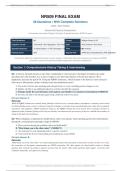
NR509 Final Exam | 88 Questions | Complete Solutions 2026/2027 Page 1
NR509 FINAL EXAM
88 Questions | With Complete Solutions
Edition
Advanced Physical Assessment
Chamberlain University College of Nursing | Graduate Nursing & APRN Program
Total Questions 88 Format Multiple Choice (A-D)
Cognitive Levels 15% Recall / 50% Application / 35% Analysis
Style 80% Scenario / 20% Direct
Special Inclusions 15 Case Studies / 12 PE Techniques / 8 Doc
Time
& Clinical Reasoning
180 minutes
Passing Score 80% Aligned With APRN Core Competencies & AHA 2026/2027
Instructions: Select the single best answer for each question. Rationales follow each question and reference NR509
curriculum content and Advanced Health Assessment standards (2026/2027).
Section 1: Comprehensive History Taking & Interviewing
Q1: A 68-year-old male presents to the clinic complaining of 'chest pressure' that began 45 minutes ago while
shoveling snow. He describes it as 'a heavy weight on my chest' that radiates to his left arm and jaw. He is
diaphoretic and rates the pain 8/10. Using the PQRST mnemonic, which element of his history is most critical to
elicit next to differentiate cardiac ischemia from musculoskeletal causes?
A. Provocative factors: does anything make the pain better or worse, including position changes or rest
B. Quality: ask him to use additional adjectives to better describe the sensation
C. Timing: clarify the exact duration, onset pattern, and whether it is constant or intermittent [CORRECT]
D. Severity: ask him to rate the pain again using a different scale for accuracy
Correct Answer: C
Rationale:
While all PQRST elements are essential, timing (duration >20 min at rest, crescendo pattern, intermittent vs constant) is most critical
for differentiating acute coronary syndrome (typically prolonged, crescendo) from musculoskeletal pain (often brief, positional,
reproduced with palpation). NR509 emphasizes timing as the PQRST element that most directly drives escalation decisions in
suspected cardiac ischemia. Quality and severity are already well-characterized; provocative factors are valuable but secondary to
timing in this high-risk presentation.
Q2: When initiating a comprehensive health history with a new patient, which opening question best demonstrates
therapeutic communication principles taught in NR509?
A. 'Have you been having any problems with your health lately?'
B. 'What brings you to the clinic today?' [CORRECT]
C. 'Are you here for your annual physical or a specific concern?'
D. 'Can you tell me if you've been taking your medications as prescribed?'
Correct Answer: B
Rationale:
'What brings you to the clinic today?' is an open-ended question that invites the patient to share their narrative in their own words,
the cornerstone of therapeutic communication per NR509 curriculum. The other options are closed-ended (yes/no) or leading
questions that constrain the patient's response and may bias the history. Open-ended questions build rapport, reveal the chief
complaint organically, and signal active listening.
NR509 Advanced Physical Assessment | Chamberlain University College of Nursing | 2026/2027 Edition
,NR509 Final Exam | 88 Questions | Complete Solutions 2026/2027 Page 2
Q3: Which sequence represents the correct standard order of components in a comprehensive adult health history
as taught in NR509?
A. Chief complaint, ROS, HPI, PMH, family history, social history
B. Chief complaint, HPI, PMH, ROS, family history, social history
C. Chief complaint, HPI, PMH, medications/allergies, family history, social history, ROS [CORRECT]
D. HPI, chief complaint, PMH, social history, family history, ROS
Correct Answer: C
Rationale:
The standard NR509 sequence is: identification/data, chief complaint, HPI, PMH (including medications, allergies), family
history, social history, and ROS last. This order moves from the patient's primary concern outward to broader context. ROS is
intentionally placed last because it is a closed-ended review that should not interrupt the patient's narrative, and putting it earlier
truncates the patient-centered history.
Q4: During a routine visit, a 34-year-old female repeatedly mentions that her partner 'has a temper' and once
pushed her during an argument. What is the most appropriate immediate response using trauma-informed
interviewing?
A. Document the disclosure verbatim and immediately call social services without further discussion
B. Validate the disclosure, ensure privacy, and ask: 'Are you safe right now? Is there anything you'd like to
talk about?' [CORRECT]
C. Pivot away from the topic to avoid making the patient uncomfortable and re-address it at the next visit
D. Tell the patient she must leave the relationship and offer to call a shelter immediately
Correct Answer: B
Rationale:
Trauma-informed interviewing in NR509 prioritizes safety, validation, patient autonomy, and avoidance of directives that strip
control from the patient. Validating the disclosure and asking about current safety opens the door for further disclosure while
preserving patient agency. Calling social services without consent violates autonomy unless there is imminent danger. Pivoting away
misses a critical intervention opportunity. Telling the patient what to do disempowers her.
Q5: An 82-year-old patient with mild cognitive impairment gives vague, circumstantial answers when asked about
her presenting symptoms. Which interviewing technique is most effective for obtaining a coherent HPI?
A. Interrupt gently but firmly to redirect the conversation back to the chief complaint
B. Use closed-ended, focused questions after the patient pauses, and summarize frequently [CORRECT]
C. Allow the patient to speak uninterrupted for the entire allotted visit time to build rapport
D. Discontinue the interview and rely exclusively on family members for the history
Correct Answer: B
Rationale:
For patients with cognitive impairment or vagueness, NR509 teaches shifting from open-ended to focused closed-ended questions
while using frequent summarization to verify accuracy. Interrupting abruptly damages rapport; total silence yields no useful data;
and relying entirely on family ignores the patient's voice and may introduce bias. Combining gentle structure with active listening
and summarization is the gold standard for the vague historian.
NR509 Advanced Physical Assessment | Chamberlain University College of Nursing | 2026/2027 Edition
, NR509 Final Exam | 88 Questions | Complete Solutions 2026/2027 Page 3
Q6: A patient reports 'a sharp pain in my stomach for 3 days, worse after eating.' Which SOAP note documentation
of the chief complaint (CC) and HPI is most accurate per NR509 standards?
A. CC: Abdominal pain. HPI: Patient has stomach pain that bothers her after meals.
B. CC: 3-day history of sharp epigastric pain, worse after eating. HPI: Patient is a 45-year-old female who
reports sharp epigastric pain x3 days, postprandial exacerbation, no radiation, denies N/V. [CORRECT]
C. CC: Pain. HPI: Patient complains of abdominal discomfort that started a few days ago.
D. CC: Abdominal pain x3 days. HPI: Per patient, she has been having stomach trouble after meals.
Correct Answer: B
Rationale:
NR509 documentation standards require the CC to be a brief, patient-centered phrase in the patient's own words (often quoted),
and the HPI to include demographics, onset, location, quality, severity, timing, modifying factors, and associated symptoms. Option
B demonstrates complete, organized, clinically useful documentation. Options A, C, and D lack key descriptors (onset, location,
modifying factors, associated symptoms) needed for clinical reasoning and reimbursement.
Q7: A 52-year-old immigrant from Mexico presents with fatigue, weight loss, and reports that he has been
suffering from 'susto' (fright illness) since a recent robbery. He has not sought care previously due to cost and lack
of insurance. Which approach best integrates cultural humility and social determinants of health into the history?
A. Explain that susto is not a recognized medical diagnosis and focus the interview on biomedical causes of weight
loss
B. Acknowledge the patient's explanatory model, ask how susto affects him, and screen for depression, food
insecurity, and access barriers while completing the biomedical workup [CORRECT]
C. Refer the patient to a curandero (traditional healer) and defer the biomedical workup until he has completed
traditional treatment
D. Document susto as a cultural belief only and proceed with the standard ROS without modification
Correct Answer: B
Rationale:
NR509 cultural humility curriculum teaches clinicians to acknowledge the patient's explanatory model, integrate it with biomedical
assessment, and screen for social determinants (food, housing, insurance) that influence health outcomes. Dismissing susto
damages rapport; deferring all biomedical care is unsafe; treating it as mere documentation misses the opportunity to screen for
depression and SDOH. The integrated approach respects culture while completing the diagnostic workup.
Q8: A 45-year-old female with asthma, poorly controlled due to missed inhaler doses, lives in public housing with
visible mold. Which statement best reflects how social determinants of health (SDOH) should shape the assessment
and plan?
A. SDOH are important context but should not change the medical management plan, which is based on clinical
guidelines
B. SDOH directly affect adherence and outcomes; the plan must include environmental assessment, housing
resources, and an asthma action plan tailored to her reality [CORRECT]
C. Address SDOH only if the patient brings them up; otherwise focus exclusively on pharmacologic management
D. Refer the patient to a social worker and proceed with standard guideline-based asthma care without modification
Correct Answer: B
Rationale:
NR509 emphasizes that SDOH (housing, environment, access) directly impact disease control and must inform the assessment and
plan. Mold exposure worsens asthma regardless of medication adherence; ignoring environmental triggers guarantees treatment
failure. Effective plans integrate environmental remediation referrals, housing advocacy, and tailored self-management.
Delegating SDOH entirely to social work or ignoring them unless the patient raises them violates comprehensive, patient-centered
care.
NR509 Advanced Physical Assessment | Chamberlain University College of Nursing | 2026/2027 Edition
NR509 FINAL EXAM
88 Questions | With Complete Solutions
Edition
Advanced Physical Assessment
Chamberlain University College of Nursing | Graduate Nursing & APRN Program
Total Questions 88 Format Multiple Choice (A-D)
Cognitive Levels 15% Recall / 50% Application / 35% Analysis
Style 80% Scenario / 20% Direct
Special Inclusions 15 Case Studies / 12 PE Techniques / 8 Doc
Time
& Clinical Reasoning
180 minutes
Passing Score 80% Aligned With APRN Core Competencies & AHA 2026/2027
Instructions: Select the single best answer for each question. Rationales follow each question and reference NR509
curriculum content and Advanced Health Assessment standards (2026/2027).
Section 1: Comprehensive History Taking & Interviewing
Q1: A 68-year-old male presents to the clinic complaining of 'chest pressure' that began 45 minutes ago while
shoveling snow. He describes it as 'a heavy weight on my chest' that radiates to his left arm and jaw. He is
diaphoretic and rates the pain 8/10. Using the PQRST mnemonic, which element of his history is most critical to
elicit next to differentiate cardiac ischemia from musculoskeletal causes?
A. Provocative factors: does anything make the pain better or worse, including position changes or rest
B. Quality: ask him to use additional adjectives to better describe the sensation
C. Timing: clarify the exact duration, onset pattern, and whether it is constant or intermittent [CORRECT]
D. Severity: ask him to rate the pain again using a different scale for accuracy
Correct Answer: C
Rationale:
While all PQRST elements are essential, timing (duration >20 min at rest, crescendo pattern, intermittent vs constant) is most critical
for differentiating acute coronary syndrome (typically prolonged, crescendo) from musculoskeletal pain (often brief, positional,
reproduced with palpation). NR509 emphasizes timing as the PQRST element that most directly drives escalation decisions in
suspected cardiac ischemia. Quality and severity are already well-characterized; provocative factors are valuable but secondary to
timing in this high-risk presentation.
Q2: When initiating a comprehensive health history with a new patient, which opening question best demonstrates
therapeutic communication principles taught in NR509?
A. 'Have you been having any problems with your health lately?'
B. 'What brings you to the clinic today?' [CORRECT]
C. 'Are you here for your annual physical or a specific concern?'
D. 'Can you tell me if you've been taking your medications as prescribed?'
Correct Answer: B
Rationale:
'What brings you to the clinic today?' is an open-ended question that invites the patient to share their narrative in their own words,
the cornerstone of therapeutic communication per NR509 curriculum. The other options are closed-ended (yes/no) or leading
questions that constrain the patient's response and may bias the history. Open-ended questions build rapport, reveal the chief
complaint organically, and signal active listening.
NR509 Advanced Physical Assessment | Chamberlain University College of Nursing | 2026/2027 Edition
,NR509 Final Exam | 88 Questions | Complete Solutions 2026/2027 Page 2
Q3: Which sequence represents the correct standard order of components in a comprehensive adult health history
as taught in NR509?
A. Chief complaint, ROS, HPI, PMH, family history, social history
B. Chief complaint, HPI, PMH, ROS, family history, social history
C. Chief complaint, HPI, PMH, medications/allergies, family history, social history, ROS [CORRECT]
D. HPI, chief complaint, PMH, social history, family history, ROS
Correct Answer: C
Rationale:
The standard NR509 sequence is: identification/data, chief complaint, HPI, PMH (including medications, allergies), family
history, social history, and ROS last. This order moves from the patient's primary concern outward to broader context. ROS is
intentionally placed last because it is a closed-ended review that should not interrupt the patient's narrative, and putting it earlier
truncates the patient-centered history.
Q4: During a routine visit, a 34-year-old female repeatedly mentions that her partner 'has a temper' and once
pushed her during an argument. What is the most appropriate immediate response using trauma-informed
interviewing?
A. Document the disclosure verbatim and immediately call social services without further discussion
B. Validate the disclosure, ensure privacy, and ask: 'Are you safe right now? Is there anything you'd like to
talk about?' [CORRECT]
C. Pivot away from the topic to avoid making the patient uncomfortable and re-address it at the next visit
D. Tell the patient she must leave the relationship and offer to call a shelter immediately
Correct Answer: B
Rationale:
Trauma-informed interviewing in NR509 prioritizes safety, validation, patient autonomy, and avoidance of directives that strip
control from the patient. Validating the disclosure and asking about current safety opens the door for further disclosure while
preserving patient agency. Calling social services without consent violates autonomy unless there is imminent danger. Pivoting away
misses a critical intervention opportunity. Telling the patient what to do disempowers her.
Q5: An 82-year-old patient with mild cognitive impairment gives vague, circumstantial answers when asked about
her presenting symptoms. Which interviewing technique is most effective for obtaining a coherent HPI?
A. Interrupt gently but firmly to redirect the conversation back to the chief complaint
B. Use closed-ended, focused questions after the patient pauses, and summarize frequently [CORRECT]
C. Allow the patient to speak uninterrupted for the entire allotted visit time to build rapport
D. Discontinue the interview and rely exclusively on family members for the history
Correct Answer: B
Rationale:
For patients with cognitive impairment or vagueness, NR509 teaches shifting from open-ended to focused closed-ended questions
while using frequent summarization to verify accuracy. Interrupting abruptly damages rapport; total silence yields no useful data;
and relying entirely on family ignores the patient's voice and may introduce bias. Combining gentle structure with active listening
and summarization is the gold standard for the vague historian.
NR509 Advanced Physical Assessment | Chamberlain University College of Nursing | 2026/2027 Edition
, NR509 Final Exam | 88 Questions | Complete Solutions 2026/2027 Page 3
Q6: A patient reports 'a sharp pain in my stomach for 3 days, worse after eating.' Which SOAP note documentation
of the chief complaint (CC) and HPI is most accurate per NR509 standards?
A. CC: Abdominal pain. HPI: Patient has stomach pain that bothers her after meals.
B. CC: 3-day history of sharp epigastric pain, worse after eating. HPI: Patient is a 45-year-old female who
reports sharp epigastric pain x3 days, postprandial exacerbation, no radiation, denies N/V. [CORRECT]
C. CC: Pain. HPI: Patient complains of abdominal discomfort that started a few days ago.
D. CC: Abdominal pain x3 days. HPI: Per patient, she has been having stomach trouble after meals.
Correct Answer: B
Rationale:
NR509 documentation standards require the CC to be a brief, patient-centered phrase in the patient's own words (often quoted),
and the HPI to include demographics, onset, location, quality, severity, timing, modifying factors, and associated symptoms. Option
B demonstrates complete, organized, clinically useful documentation. Options A, C, and D lack key descriptors (onset, location,
modifying factors, associated symptoms) needed for clinical reasoning and reimbursement.
Q7: A 52-year-old immigrant from Mexico presents with fatigue, weight loss, and reports that he has been
suffering from 'susto' (fright illness) since a recent robbery. He has not sought care previously due to cost and lack
of insurance. Which approach best integrates cultural humility and social determinants of health into the history?
A. Explain that susto is not a recognized medical diagnosis and focus the interview on biomedical causes of weight
loss
B. Acknowledge the patient's explanatory model, ask how susto affects him, and screen for depression, food
insecurity, and access barriers while completing the biomedical workup [CORRECT]
C. Refer the patient to a curandero (traditional healer) and defer the biomedical workup until he has completed
traditional treatment
D. Document susto as a cultural belief only and proceed with the standard ROS without modification
Correct Answer: B
Rationale:
NR509 cultural humility curriculum teaches clinicians to acknowledge the patient's explanatory model, integrate it with biomedical
assessment, and screen for social determinants (food, housing, insurance) that influence health outcomes. Dismissing susto
damages rapport; deferring all biomedical care is unsafe; treating it as mere documentation misses the opportunity to screen for
depression and SDOH. The integrated approach respects culture while completing the diagnostic workup.
Q8: A 45-year-old female with asthma, poorly controlled due to missed inhaler doses, lives in public housing with
visible mold. Which statement best reflects how social determinants of health (SDOH) should shape the assessment
and plan?
A. SDOH are important context but should not change the medical management plan, which is based on clinical
guidelines
B. SDOH directly affect adherence and outcomes; the plan must include environmental assessment, housing
resources, and an asthma action plan tailored to her reality [CORRECT]
C. Address SDOH only if the patient brings them up; otherwise focus exclusively on pharmacologic management
D. Refer the patient to a social worker and proceed with standard guideline-based asthma care without modification
Correct Answer: B
Rationale:
NR509 emphasizes that SDOH (housing, environment, access) directly impact disease control and must inform the assessment and
plan. Mold exposure worsens asthma regardless of medication adherence; ignoring environmental triggers guarantees treatment
failure. Effective plans integrate environmental remediation referrals, housing advocacy, and tailored self-management.
Delegating SDOH entirely to social work or ignoring them unless the patient raises them violates comprehensive, patient-centered
care.
NR509 Advanced Physical Assessment | Chamberlain University College of Nursing | 2026/2027 Edition


