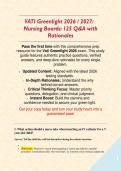
VATI Greenlight :
Nursing Boards: 125 Q&A with
Rationales
Pass the first time with this comprehensive prep
resource for the Vati Greenlight 2026 exam. This study
guide features authentic practice questions, verified
answers, and deep-dive rationales for every single
problem.
• Updated Content: Aligned with the latest 2026
testing standards.
• In-Depth Rationales; Understand the why
behind correct answers.
• Critical Thinking Focus: Master priority
questions, delegation, and clinical judgment.
• Instant Boost: Build the stamina and
confidence needed to secure your green light.
Get your copy today and turn your study hours into a
guaranteed pass!
1. What action should a nurse take when inserting an IV catheter for a 7-
year-old child?
Answer: Tell the child they will feel discomfort during the catheter insertion.
•
• Rationale: Honesty is crucial when preparing a school-age child for a painful
procedure. Avoid phrases like "this won't hurt," as it destroys trust. Instead, explain the
1
, sensation realistically (e.g., "a quick pinch" or "some discomfort") right before the
insertion so they can mentally prepare and utilize coping mechanisms.
•
2. What finding should a nurse report for a client with an arteriovenous
fistula?
Answer: Absence of a bruit.
•
• Rationale: An arteriovenous (AV) fistula must be regularly assessed for patency. A
positive finding includes a palpable thrill (vibration) and an audible bruit (swooshing
sound caused by turbulent blood flow). The absence of a bruit or thrill indicates a
potential occlusion or clot and must be reported immediately to prevent loss of vascular
access.
•
3. What statement indicates understanding of discharge teaching for a
client with an implantable cardioverter defibrillator?
Answer: I will wear loose clothing around my ICD.
•
• Rationale: Wearing loose clothing prevents tight friction or pressure over the device
generator site, minimizing the risk of skin breakdown or premature irritation of the
surgical wound. Clients should also avoid lifting the affected arm above the shoulder
until cleared by their provider.
•
4. What is an appropriate response for a nurse to make to a client at 14
weeks gestation who feels ambivalent about being pregnant?
Answer: Describe your feelings to me about being pregnant.
•
• Rationale: Ambivalence is a normal and common psychological response during the
first trimester and early second trimester of pregnancy. Using an open-ended therapeutic
2
, communication statement allows the client to express her feelings safely without fear of
judgment.
•
5. What should a nurse include in the care plan for a client on a bowel-
training program after a spinal cord injury?
Answer: Administer a rectal suppository 30 minutes prior to scheduled defecation times.
•
• Rationale: Neurogenic bowel management requires establishing a consistent routine.
Administering a chemical stimulant (like a bisacodyl suppository) roughly 30 minutes
before the designated toilet time utilizes the gastrocolic reflex to stimulate peristalsis and
promote predictable bowel evacuation.
•
6. What action should a nurse take for a client in active labor requesting
pain management?
Answer: Place the client in a warm shower.
•
• Rationale: Hydrotherapy is a highly effective non-pharmacological comfort measure
during active labor. Warm water promotes muscle relaxation, reduces the perception of
pain, and can help stimulate the release of natural endorphins without causing fetal
respiratory depression.
•
7. In triage after a disaster, which type of injury should a nurse assign
the highest priority?
Answer: 95% full-thickness body burn.
•
• Rationale: In mass casualty triage (using systems like START), clients with
catastrophic, non-survivable injuries like a 95% full-thickness body burn are classified as
"Expectant" (Black tag). However, if this is a standard daily emergency department triage
situation (not a mass disaster), a severe multi-system threat is highest. In a resource-
3
, limited disaster context, the highest priority for active treatment goes to the "Immediate"
(Red tag) category—such as airway obstructions or severe shock—where a patient has a
high chance of survival if treated immediately. (Note: If the question implies selecting the
highest priority out of an available emergency triage list, those with immediate life-
threatening but treatable injuries take precedence over expectant ones).
•
8. What guideline should a nurse include when updating protocols for
the use of belt restraints?
Answer: Document the client's condition every 15 minutes.
•
• Rationale: Due to safety hazards associated with mechanical restraints, strict
monitoring is legally required. A nurse must assess and document the client's safety,
behavioral status, physical alignment, skin integrity, and neurovascular status at least
every 15 minutes.
•
9. What characteristic should be included about effective nursing
leadership?
Answer: Acts as an advocate for the nursing unit.
•
• Rationale: Effective leaders champion the needs of their team and patients. By acting
as an advocate, the nurse leader secures necessary resources, fosters a healthy work
environment, and ensures that staff concerns are communicated to higher administration.
•
10. What laboratory finding indicates a need to revise the care plan for a
client with diabetes mellitus?
Answer: An HbA1c of 10%.
•
• Rationale: The target Glycated Hemoglobin (HbA1c) for most clients with diabetes
mellitus is typically under 7%. An HbA1c of 10% reflects sustained hyperglycemia and
4
Nursing Boards: 125 Q&A with
Rationales
Pass the first time with this comprehensive prep
resource for the Vati Greenlight 2026 exam. This study
guide features authentic practice questions, verified
answers, and deep-dive rationales for every single
problem.
• Updated Content: Aligned with the latest 2026
testing standards.
• In-Depth Rationales; Understand the why
behind correct answers.
• Critical Thinking Focus: Master priority
questions, delegation, and clinical judgment.
• Instant Boost: Build the stamina and
confidence needed to secure your green light.
Get your copy today and turn your study hours into a
guaranteed pass!
1. What action should a nurse take when inserting an IV catheter for a 7-
year-old child?
Answer: Tell the child they will feel discomfort during the catheter insertion.
•
• Rationale: Honesty is crucial when preparing a school-age child for a painful
procedure. Avoid phrases like "this won't hurt," as it destroys trust. Instead, explain the
1
, sensation realistically (e.g., "a quick pinch" or "some discomfort") right before the
insertion so they can mentally prepare and utilize coping mechanisms.
•
2. What finding should a nurse report for a client with an arteriovenous
fistula?
Answer: Absence of a bruit.
•
• Rationale: An arteriovenous (AV) fistula must be regularly assessed for patency. A
positive finding includes a palpable thrill (vibration) and an audible bruit (swooshing
sound caused by turbulent blood flow). The absence of a bruit or thrill indicates a
potential occlusion or clot and must be reported immediately to prevent loss of vascular
access.
•
3. What statement indicates understanding of discharge teaching for a
client with an implantable cardioverter defibrillator?
Answer: I will wear loose clothing around my ICD.
•
• Rationale: Wearing loose clothing prevents tight friction or pressure over the device
generator site, minimizing the risk of skin breakdown or premature irritation of the
surgical wound. Clients should also avoid lifting the affected arm above the shoulder
until cleared by their provider.
•
4. What is an appropriate response for a nurse to make to a client at 14
weeks gestation who feels ambivalent about being pregnant?
Answer: Describe your feelings to me about being pregnant.
•
• Rationale: Ambivalence is a normal and common psychological response during the
first trimester and early second trimester of pregnancy. Using an open-ended therapeutic
2
, communication statement allows the client to express her feelings safely without fear of
judgment.
•
5. What should a nurse include in the care plan for a client on a bowel-
training program after a spinal cord injury?
Answer: Administer a rectal suppository 30 minutes prior to scheduled defecation times.
•
• Rationale: Neurogenic bowel management requires establishing a consistent routine.
Administering a chemical stimulant (like a bisacodyl suppository) roughly 30 minutes
before the designated toilet time utilizes the gastrocolic reflex to stimulate peristalsis and
promote predictable bowel evacuation.
•
6. What action should a nurse take for a client in active labor requesting
pain management?
Answer: Place the client in a warm shower.
•
• Rationale: Hydrotherapy is a highly effective non-pharmacological comfort measure
during active labor. Warm water promotes muscle relaxation, reduces the perception of
pain, and can help stimulate the release of natural endorphins without causing fetal
respiratory depression.
•
7. In triage after a disaster, which type of injury should a nurse assign
the highest priority?
Answer: 95% full-thickness body burn.
•
• Rationale: In mass casualty triage (using systems like START), clients with
catastrophic, non-survivable injuries like a 95% full-thickness body burn are classified as
"Expectant" (Black tag). However, if this is a standard daily emergency department triage
situation (not a mass disaster), a severe multi-system threat is highest. In a resource-
3
, limited disaster context, the highest priority for active treatment goes to the "Immediate"
(Red tag) category—such as airway obstructions or severe shock—where a patient has a
high chance of survival if treated immediately. (Note: If the question implies selecting the
highest priority out of an available emergency triage list, those with immediate life-
threatening but treatable injuries take precedence over expectant ones).
•
8. What guideline should a nurse include when updating protocols for
the use of belt restraints?
Answer: Document the client's condition every 15 minutes.
•
• Rationale: Due to safety hazards associated with mechanical restraints, strict
monitoring is legally required. A nurse must assess and document the client's safety,
behavioral status, physical alignment, skin integrity, and neurovascular status at least
every 15 minutes.
•
9. What characteristic should be included about effective nursing
leadership?
Answer: Acts as an advocate for the nursing unit.
•
• Rationale: Effective leaders champion the needs of their team and patients. By acting
as an advocate, the nurse leader secures necessary resources, fosters a healthy work
environment, and ensures that staff concerns are communicated to higher administration.
•
10. What laboratory finding indicates a need to revise the care plan for a
client with diabetes mellitus?
Answer: An HbA1c of 10%.
•
• Rationale: The target Glycated Hemoglobin (HbA1c) for most clients with diabetes
mellitus is typically under 7%. An HbA1c of 10% reflects sustained hyperglycemia and
4