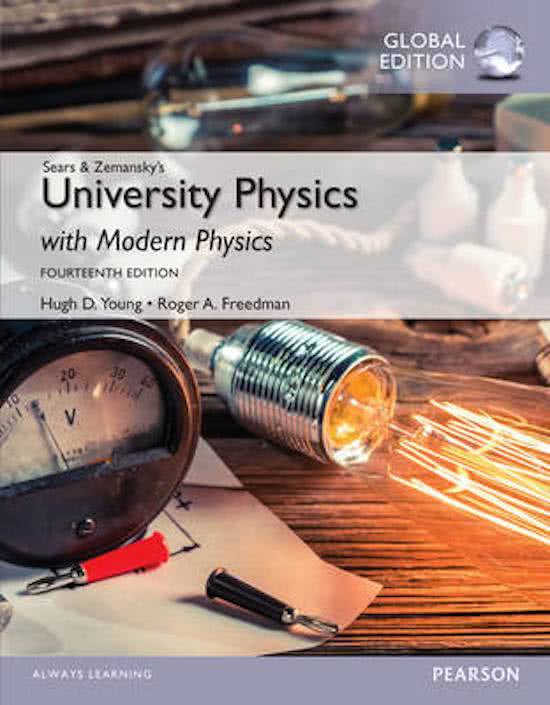
The Elite Universal
Test Bank: University
Physics with Modern
Physics (15th
Edition)
PART 0: Table of Contents
● PART I: The Preview
○ The Mission & Critical Axioms
● PART II: The Elite Test Bank
○ Tier 1: Foundational Syntax & Application (Questions 1–10)
■ Q1: 1D Kinematics & Force Concept Inventory
■ Q2: Newton's First Law & The Impetus Misconception
■ Q3: Newton's Third Law & The Dominance Principle
■ Q4: Work-Kinetic Energy Theorem
■ Q5: Rotational Dynamics & Moment of Inertia
■ Q6: Fluid Dynamics & Bernoulli's Principle
■ Q7: Mechanical Waves & Propagation Speed
■ Q8: Thermodynamics & Thermal Energy vs. Temperature
■ Q9: Electrostatics & Gauss's Law
■ Q10: Direct-Current Circuits & Steady-State Capacitance
○ Tier 2: Complex Application & Simulation (Questions 11–20)
■ Q11: Electromagnetism & Displacement Current
■ Q12: Faraday's Law & Electromagnetic Induction
■ Q13: Optics & Thin-Film Interference Phase Shifts
■ Q14: Thermodynamics & Entropy as Microstate Multiplicity
■ Q15: Special Relativity & Invariant Mass
■ Q16: Quantum Mechanics & Wavefunction Collapse
■ Q17: Quantum Tunneling & Scanning Tunneling Microscopy
■ Q18: Nuclear Physics & Binding Energy Q-Values
■ Q19: Statistical Mechanics & Quantum Distributions
■ Q20: Solid State Physics & Fermi Level Dynamics
○ Tier 3: Grandmaster Synthesis (Questions 21–30)
■ Q21: Lorentz Force & The Hall Effect
, ■ Q22: Thermodynamics & Adiabatic Work
■ Q23: Special Relativity & Spacetime Invariance
■ Q24: Quantum Mechanics & The EPR Paradox
■ Q25: Nuclear Physics & Reactor Thermodynamics
■ Q26: Solid State & Tunnel Field-Effect Transistors (TFETs)
■ Q27: Optics & Compton Scattering
■ Q28: Acoustics & Relativistic Doppler Shifts
■ Q29: Fluid Mechanics & Navier-Stokes Viscosity Limitations
■ Q30: Cosmology & Cosmic Microwave Background Thermodynamics
PART I: The Preview
Mastering this test bank translates directly to elite performance by systematically dismantling
persistent cognitive biases and enforcing the rigorous application of fundamental physical laws.
This document forges foundational academic theory into high-level analytical competence
across the vast domain of physics, replacing fragile rote memorization with absolute, structural
comprehension.
The "Critical Axioms" Cheat Sheet
● Newtonian Determinism: \sum \vec{F} = \frac{d\vec{p}}{dt}. Force dictates the
time-derivative of momentum, not the persistence of velocity; motion does not inherently
require a continuous active force.
● Thermodynamic Dispersal: \Delta S \ge 0. Entropy characterizes the multiplicity of
accessible microstates and energy dispersal, whereas temperature strictly quantifies
average translational kinetic energy—distinct from total thermal energy.
● The Maxwell-Ampère Synthesis: \oint \vec{B} \cdot d\vec{l} = \mu_0 \left( I_{enc} +
\varepsilon_0 \frac{d\Phi_E}{dt} \right). A time-varying electric flux generates a magnetic
field identically to a physical conduction current, ensuring the propagation of
electromagnetic waves.
● Relativistic Invariance: E^2 - (pc)^2 = (mc^2)^2. The rest mass m is a Lorentz scalar,
invariant across all inertial reference frames, entirely deprecating the obsolete conceptual
framework of "relativistic mass".
● Quantum Measurement: \vert{}\psi\rangle = \sum c_i \vert{}\phi_i\rangle. Quantum states
exist in linear superpositions; the act of measurement probabilistically collapses the
wavefunction into a definitive eigenstate of the observable operator.
PART II: The Elite Test Bank
Tier 1: Foundational Syntax & Application
Q1: A projectile of mass m is fired vertically upward in a perfect vacuum. As it reaches the exact
apex of its trajectory, its velocity becomes instantaneously zero before reversing direction.
Based on the principles of Newtonian Kinematics and Dynamics, which conclusion regarding
the net force acting on the projectile at the apex is the MOST ACCURATE? A) The net force is
instantaneously zero because the projectile has temporarily ceased motion and acceleration
requires a velocity vector. B) The net force is directed upward, representing the residual impetus
from the initial launch that perfectly balances the downward gravitational pull. C) The net force
remains a constant downward vector of magnitude mg, completely unaffected by the
, instantaneous kinematic state of the projectile. D) The net force decreases gradually to zero at
the apex and then exponentially increases in the downward direction as the object falls.
● Answer: C (The net force remains a constant downward vector of magnitude mg,
completely unaffected by the instantaneous kinematic state of the projectile.)
● Distractor Analysis:
○ A is incorrect: This reflects a heavily documented novice misconception within the
Force Concept Inventory (FCI) wherein students erroneously conflate velocity with
acceleration. Acceleration, and thus net force, dictates the change in velocity, not
the magnitude of velocity itself.
○ B is incorrect: This embodies the archaic "impetus theory" trap, falsely suggesting
an initial force is stored within the body and gradually consumed during ascent.
○ D is incorrect: Gravitational force near the Earth's surface is a uniform field. It does
not diminish, increase, or dynamically respond to the kinetic state of the projectile
navigating through it.
The Mentor's Analysis: Kinematic analysis requires isolating the state vector of velocity from
the time-derivative vector of acceleration. When facing vertical projectile motion, the immediate
priority is mapping the constant gravitational field independent of the object's instantaneous
speed. By utilizing Newton's Second Law (\vec{F}_{net} = m\vec{a}), scholars bypass the
common cognitive trap of associating zero instantaneous velocity with zero net force or zero
acceleration. Professional/Academic Intuition: Force dictates the rate of change of
momentum, absolutely independent of the instantaneous presence of velocity.
Q2: A deep-space probe is traveling at a constant velocity of 5,000 \text{ m/s} far from any
gravitational bodies or atmospheric drag. The probe's main thruster is suddenly deactivated,
cutting off all external thrust. Based on the principles of Newton's First Law of Motion, which
action/conclusion is the MOST ACCURATE? A) The probe will gradually decelerate as the
internal motive force from the thruster dissipates into the vacuum. B) The probe will immediately
come to rest because there is no longer an active force to sustain its forward momentum. C)
The probe will maintain a constant velocity of 5,000 \text{ m/s} indefinitely in a straight line, as
no unbalanced force acts upon it. D) The probe's velocity will remain constant, but its invariant
mass will decrease as it no longer expels chemical propellant.
● Answer: C (The probe will maintain a constant velocity of 5,000 \text{ m/s} indefinitely in
a straight line, as no unbalanced force acts upon it.)
● Distractor Analysis:
○ A is incorrect: This relies on the Aristotelian "impetus theory," a persistent cognitive
bias identified in physics education research assuming motion requires a stored
motive power that wears off over time without continuous input.
○ B is incorrect: This outcome is technically true only in highly viscous, drag-heavy
environments (like Earth's atmosphere) but is contextually inappropriate and
scientifically invalid in a frictionless vacuum.
○ D is incorrect: While mass conservation applies to the expelled propellant,
deactivating the thruster stops further mass loss; the probe's mass does not
spontaneously decrease simply because translational motion continues.
The Mentor's Analysis: Inertia represents an object's fundamental resistance to changes in its
state of motion, serving as the bedrock of classical mechanics. When facing constant velocity
scenarios in a vacuum, the immediate priority is identifying the absence of external unbalanced
forces. By utilizing the Principle of Inertia, analysts bypass the deeply ingrained human bias of
believing an active force is required to sustain continuous motion. Professional/Academic
Intuition: In the absence of a net external force, a velocity vector is indefinitely conserved
Test Bank: University
Physics with Modern
Physics (15th
Edition)
PART 0: Table of Contents
● PART I: The Preview
○ The Mission & Critical Axioms
● PART II: The Elite Test Bank
○ Tier 1: Foundational Syntax & Application (Questions 1–10)
■ Q1: 1D Kinematics & Force Concept Inventory
■ Q2: Newton's First Law & The Impetus Misconception
■ Q3: Newton's Third Law & The Dominance Principle
■ Q4: Work-Kinetic Energy Theorem
■ Q5: Rotational Dynamics & Moment of Inertia
■ Q6: Fluid Dynamics & Bernoulli's Principle
■ Q7: Mechanical Waves & Propagation Speed
■ Q8: Thermodynamics & Thermal Energy vs. Temperature
■ Q9: Electrostatics & Gauss's Law
■ Q10: Direct-Current Circuits & Steady-State Capacitance
○ Tier 2: Complex Application & Simulation (Questions 11–20)
■ Q11: Electromagnetism & Displacement Current
■ Q12: Faraday's Law & Electromagnetic Induction
■ Q13: Optics & Thin-Film Interference Phase Shifts
■ Q14: Thermodynamics & Entropy as Microstate Multiplicity
■ Q15: Special Relativity & Invariant Mass
■ Q16: Quantum Mechanics & Wavefunction Collapse
■ Q17: Quantum Tunneling & Scanning Tunneling Microscopy
■ Q18: Nuclear Physics & Binding Energy Q-Values
■ Q19: Statistical Mechanics & Quantum Distributions
■ Q20: Solid State Physics & Fermi Level Dynamics
○ Tier 3: Grandmaster Synthesis (Questions 21–30)
■ Q21: Lorentz Force & The Hall Effect
, ■ Q22: Thermodynamics & Adiabatic Work
■ Q23: Special Relativity & Spacetime Invariance
■ Q24: Quantum Mechanics & The EPR Paradox
■ Q25: Nuclear Physics & Reactor Thermodynamics
■ Q26: Solid State & Tunnel Field-Effect Transistors (TFETs)
■ Q27: Optics & Compton Scattering
■ Q28: Acoustics & Relativistic Doppler Shifts
■ Q29: Fluid Mechanics & Navier-Stokes Viscosity Limitations
■ Q30: Cosmology & Cosmic Microwave Background Thermodynamics
PART I: The Preview
Mastering this test bank translates directly to elite performance by systematically dismantling
persistent cognitive biases and enforcing the rigorous application of fundamental physical laws.
This document forges foundational academic theory into high-level analytical competence
across the vast domain of physics, replacing fragile rote memorization with absolute, structural
comprehension.
The "Critical Axioms" Cheat Sheet
● Newtonian Determinism: \sum \vec{F} = \frac{d\vec{p}}{dt}. Force dictates the
time-derivative of momentum, not the persistence of velocity; motion does not inherently
require a continuous active force.
● Thermodynamic Dispersal: \Delta S \ge 0. Entropy characterizes the multiplicity of
accessible microstates and energy dispersal, whereas temperature strictly quantifies
average translational kinetic energy—distinct from total thermal energy.
● The Maxwell-Ampère Synthesis: \oint \vec{B} \cdot d\vec{l} = \mu_0 \left( I_{enc} +
\varepsilon_0 \frac{d\Phi_E}{dt} \right). A time-varying electric flux generates a magnetic
field identically to a physical conduction current, ensuring the propagation of
electromagnetic waves.
● Relativistic Invariance: E^2 - (pc)^2 = (mc^2)^2. The rest mass m is a Lorentz scalar,
invariant across all inertial reference frames, entirely deprecating the obsolete conceptual
framework of "relativistic mass".
● Quantum Measurement: \vert{}\psi\rangle = \sum c_i \vert{}\phi_i\rangle. Quantum states
exist in linear superpositions; the act of measurement probabilistically collapses the
wavefunction into a definitive eigenstate of the observable operator.
PART II: The Elite Test Bank
Tier 1: Foundational Syntax & Application
Q1: A projectile of mass m is fired vertically upward in a perfect vacuum. As it reaches the exact
apex of its trajectory, its velocity becomes instantaneously zero before reversing direction.
Based on the principles of Newtonian Kinematics and Dynamics, which conclusion regarding
the net force acting on the projectile at the apex is the MOST ACCURATE? A) The net force is
instantaneously zero because the projectile has temporarily ceased motion and acceleration
requires a velocity vector. B) The net force is directed upward, representing the residual impetus
from the initial launch that perfectly balances the downward gravitational pull. C) The net force
remains a constant downward vector of magnitude mg, completely unaffected by the
, instantaneous kinematic state of the projectile. D) The net force decreases gradually to zero at
the apex and then exponentially increases in the downward direction as the object falls.
● Answer: C (The net force remains a constant downward vector of magnitude mg,
completely unaffected by the instantaneous kinematic state of the projectile.)
● Distractor Analysis:
○ A is incorrect: This reflects a heavily documented novice misconception within the
Force Concept Inventory (FCI) wherein students erroneously conflate velocity with
acceleration. Acceleration, and thus net force, dictates the change in velocity, not
the magnitude of velocity itself.
○ B is incorrect: This embodies the archaic "impetus theory" trap, falsely suggesting
an initial force is stored within the body and gradually consumed during ascent.
○ D is incorrect: Gravitational force near the Earth's surface is a uniform field. It does
not diminish, increase, or dynamically respond to the kinetic state of the projectile
navigating through it.
The Mentor's Analysis: Kinematic analysis requires isolating the state vector of velocity from
the time-derivative vector of acceleration. When facing vertical projectile motion, the immediate
priority is mapping the constant gravitational field independent of the object's instantaneous
speed. By utilizing Newton's Second Law (\vec{F}_{net} = m\vec{a}), scholars bypass the
common cognitive trap of associating zero instantaneous velocity with zero net force or zero
acceleration. Professional/Academic Intuition: Force dictates the rate of change of
momentum, absolutely independent of the instantaneous presence of velocity.
Q2: A deep-space probe is traveling at a constant velocity of 5,000 \text{ m/s} far from any
gravitational bodies or atmospheric drag. The probe's main thruster is suddenly deactivated,
cutting off all external thrust. Based on the principles of Newton's First Law of Motion, which
action/conclusion is the MOST ACCURATE? A) The probe will gradually decelerate as the
internal motive force from the thruster dissipates into the vacuum. B) The probe will immediately
come to rest because there is no longer an active force to sustain its forward momentum. C)
The probe will maintain a constant velocity of 5,000 \text{ m/s} indefinitely in a straight line, as
no unbalanced force acts upon it. D) The probe's velocity will remain constant, but its invariant
mass will decrease as it no longer expels chemical propellant.
● Answer: C (The probe will maintain a constant velocity of 5,000 \text{ m/s} indefinitely in
a straight line, as no unbalanced force acts upon it.)
● Distractor Analysis:
○ A is incorrect: This relies on the Aristotelian "impetus theory," a persistent cognitive
bias identified in physics education research assuming motion requires a stored
motive power that wears off over time without continuous input.
○ B is incorrect: This outcome is technically true only in highly viscous, drag-heavy
environments (like Earth's atmosphere) but is contextually inappropriate and
scientifically invalid in a frictionless vacuum.
○ D is incorrect: While mass conservation applies to the expelled propellant,
deactivating the thruster stops further mass loss; the probe's mass does not
spontaneously decrease simply because translational motion continues.
The Mentor's Analysis: Inertia represents an object's fundamental resistance to changes in its
state of motion, serving as the bedrock of classical mechanics. When facing constant velocity
scenarios in a vacuum, the immediate priority is identifying the absence of external unbalanced
forces. By utilizing the Principle of Inertia, analysts bypass the deeply ingrained human bias of
believing an active force is required to sustain continuous motion. Professional/Academic
Intuition: In the absence of a net external force, a velocity vector is indefinitely conserved