
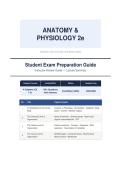
ANATOMY &
PHYSIOLOGY 2e
OpenStax | Rice University | 2nd Edition (2022)
Student Exam Preparation Guide
Instructor Answer Guide — Lecture Summary
Chapters Covered Verified MCQs Edition Academic Year
4 Chapters (Ch 100+ Questions
2nd Edition (2022) 2025-2026
1-4) with Answers
Ch Title Topics Covered
An Introduction to the Human Anatomy vs Physiology · Homeostasis · Feedback · Body
1
Body planes · Cavities · Medical imaging
The Chemical Level of Atoms & elements · Chemical bonds · Water & pH ·
2
Organization Organic macromolecules · ATP
The Cellular Level of Plasma membrane · Transport · Organelles · DNA
3
Organization replication · Transcription & Translation
The Tissue Level of Epithelial types · Connective tissue · Muscle tissue ·
4
Organization Nervous tissue · Membranes
,OpenStax Anatomy & Physiology 2e Student Exam Preparation Guide | 2025-2026
How to use this guide
Each chapter opens with a Key Concepts reference table — ideal for rapid review before
an exam. Chapter 1 also includes Interactive Link Questions drawn directly from the
instructor answer guide. Every chapter then contains Multiple-Choice Review Questions:
the correct answer option is pre-highlighted in green, and a clinical explanation box below
each question tells you WHY that answer is correct and what makes each distractor wrong.
To self-test: cover the green answer box, attempt the question, then reveal it.
Chapters 1-4 | Verified MCQs with Answers | Complete Exam Preparation Resource Page 2
,OpenStax Anatomy & Physiology 2e Student Exam Preparation Guide | 2025-2026
UNIT 1 · LEVELS OF ORGANIZATION Chapter 1
An Introduction to the Human Body
Anatomy · Physiology · Homeostasis · Anatomical Terminology · Medical Imaging
KEY CONCEPTS
Anatomy Scientific study of body structure and the physical relationships
among its parts.
Physiology Study of the functions of body structures — how the body works at
every level of organization.
Homeostasis Maintenance of a relatively stable internal environment within
normal physiological limits despite external changes.
Negative feedback Response that reverses a deviation, returning the variable to its
set point (e.g., thermoregulation, blood glucose regulation by
insulin/glucagon).
Positive feedback Response that amplifies a change further from the set point until a
definite endpoint occurs (e.g., childbirth contractions, blood
clotting cascade).
Gross anatomy Study of structures visible to the naked eye; includes regional and
systemic subdivisions.
Microscopic anatomy Study of structures requiring magnification — histology (tissues)
and cytology (cells).
Regional anatomy All structures examined within one body region together (e.g., all
structures of the ankle and foot).
Systemic anatomy Structure of each organ system examined as a whole (e.g., entire
cardiovascular system).
Sagittal plane Divides body into right and left portions; midsagittal = equal
halves; parasagittal = unequal halves.
Frontal / Coronal plane Divides body into anterior (front) and posterior (back) portions.
Transverse plane Divides body into superior (upper) and inferior (lower) portions;
also called a horizontal or cross-sectional plane.
Dorsal body cavity Posterior cavity housing the CNS: cranial cavity (brain) +
vertebral/spinal cavity (spinal cord).
Ventral body cavity Anterior cavity divided into thoracic (heart, lungs) and
abdominopelvic (digestive, urinary, reproductive organs).
Chapters 1-4 | Verified MCQs with Answers | Complete Exam Preparation Resource Page 3
,OpenStax Anatomy & Physiology 2e Student Exam Preparation Guide | 2025-2026
INTERACTIVE LINK QUESTIONS — CHAPTER 1
IQ1 What kind of catabolism occurs in the heart? (Metabolic processes animation)
Answer: Fatty acid catabolism. The heart preferentially oxidizes fatty acids (not
glucose) for ATP via aerobic metabolism, making it critically dependent on a
continuous oxygen supply.
IQ2 Which organ has primary control over the amount of water in the body? (Water
concentration video)
Answer: The kidneys. They regulate water balance by adjusting urine volume and
concentration in response to antidiuretic hormone (ADH) from the posterior
pituitary gland.
IQ3 What type of radiation does a CT scanner use? (CT/CAT scan video)
Answer: X-rays. The CT scanner rotates around the patient, acquiring images from
hundreds of angles; a computer reconstructs these into detailed
cross-sectional slices of the body.
IQ4 What is the function of magnets in an MRI? (MRI video)
Answer: The magnets cause hydrogen nuclei in tissue to emit radio signals;
differences in signal between tissue types are reconstructed into
high-contrast images — with no ionizing radiation.
IQ5 How is PET used in chemotherapy monitoring? (PET scan video)
Answer: PET detects metabolic activity (glucose uptake) in tissues. Tumors
responding to chemotherapy show decreased glucose uptake over time,
allowing clinicians to monitor treatment efficacy.
REVIEW QUESTIONS — MULTIPLE CHOICE
Chapters 1-4 | Verified MCQs with Answers | Complete Exam Preparation Resource Page 4
, OpenStax Anatomy & Physiology 2e Student Exam Preparation Guide | 2025-2026
Q6 Which specialty focuses on studying all structures of the ankle and foot
together?
A Gross anatomy
B Regional anatomy
C Microscopic anatomy
D Systemic anatomy
CHECK B. Regional anatomy
ANSWER
Regional anatomy examines every structure within one body region
simultaneously — bones, muscles, nerves, and vessels of the ankle and
foot are all studied together, regardless of which organ system they belong
to.
Q7 A scientist studying how the body uses foods and fluids during a
marathon is most likely a(n) ________.
A Molecular biologist
B Exercise physiologist
C Neurologist
D Histologist
CHECK B. Exercise physiologist
ANSWER
Exercise physiology examines how the body functions during physical
exertion — including energy substrate use, thermoregulation, fluid balance,
and cardiovascular and respiratory adaptations.
Chapters 1-4 | Verified MCQs with Answers | Complete Exam Preparation Resource Page 5
PHYSIOLOGY 2e
OpenStax | Rice University | 2nd Edition (2022)
Student Exam Preparation Guide
Instructor Answer Guide — Lecture Summary
Chapters Covered Verified MCQs Edition Academic Year
4 Chapters (Ch 100+ Questions
2nd Edition (2022) 2025-2026
1-4) with Answers
Ch Title Topics Covered
An Introduction to the Human Anatomy vs Physiology · Homeostasis · Feedback · Body
1
Body planes · Cavities · Medical imaging
The Chemical Level of Atoms & elements · Chemical bonds · Water & pH ·
2
Organization Organic macromolecules · ATP
The Cellular Level of Plasma membrane · Transport · Organelles · DNA
3
Organization replication · Transcription & Translation
The Tissue Level of Epithelial types · Connective tissue · Muscle tissue ·
4
Organization Nervous tissue · Membranes
,OpenStax Anatomy & Physiology 2e Student Exam Preparation Guide | 2025-2026
How to use this guide
Each chapter opens with a Key Concepts reference table — ideal for rapid review before
an exam. Chapter 1 also includes Interactive Link Questions drawn directly from the
instructor answer guide. Every chapter then contains Multiple-Choice Review Questions:
the correct answer option is pre-highlighted in green, and a clinical explanation box below
each question tells you WHY that answer is correct and what makes each distractor wrong.
To self-test: cover the green answer box, attempt the question, then reveal it.
Chapters 1-4 | Verified MCQs with Answers | Complete Exam Preparation Resource Page 2
,OpenStax Anatomy & Physiology 2e Student Exam Preparation Guide | 2025-2026
UNIT 1 · LEVELS OF ORGANIZATION Chapter 1
An Introduction to the Human Body
Anatomy · Physiology · Homeostasis · Anatomical Terminology · Medical Imaging
KEY CONCEPTS
Anatomy Scientific study of body structure and the physical relationships
among its parts.
Physiology Study of the functions of body structures — how the body works at
every level of organization.
Homeostasis Maintenance of a relatively stable internal environment within
normal physiological limits despite external changes.
Negative feedback Response that reverses a deviation, returning the variable to its
set point (e.g., thermoregulation, blood glucose regulation by
insulin/glucagon).
Positive feedback Response that amplifies a change further from the set point until a
definite endpoint occurs (e.g., childbirth contractions, blood
clotting cascade).
Gross anatomy Study of structures visible to the naked eye; includes regional and
systemic subdivisions.
Microscopic anatomy Study of structures requiring magnification — histology (tissues)
and cytology (cells).
Regional anatomy All structures examined within one body region together (e.g., all
structures of the ankle and foot).
Systemic anatomy Structure of each organ system examined as a whole (e.g., entire
cardiovascular system).
Sagittal plane Divides body into right and left portions; midsagittal = equal
halves; parasagittal = unequal halves.
Frontal / Coronal plane Divides body into anterior (front) and posterior (back) portions.
Transverse plane Divides body into superior (upper) and inferior (lower) portions;
also called a horizontal or cross-sectional plane.
Dorsal body cavity Posterior cavity housing the CNS: cranial cavity (brain) +
vertebral/spinal cavity (spinal cord).
Ventral body cavity Anterior cavity divided into thoracic (heart, lungs) and
abdominopelvic (digestive, urinary, reproductive organs).
Chapters 1-4 | Verified MCQs with Answers | Complete Exam Preparation Resource Page 3
,OpenStax Anatomy & Physiology 2e Student Exam Preparation Guide | 2025-2026
INTERACTIVE LINK QUESTIONS — CHAPTER 1
IQ1 What kind of catabolism occurs in the heart? (Metabolic processes animation)
Answer: Fatty acid catabolism. The heart preferentially oxidizes fatty acids (not
glucose) for ATP via aerobic metabolism, making it critically dependent on a
continuous oxygen supply.
IQ2 Which organ has primary control over the amount of water in the body? (Water
concentration video)
Answer: The kidneys. They regulate water balance by adjusting urine volume and
concentration in response to antidiuretic hormone (ADH) from the posterior
pituitary gland.
IQ3 What type of radiation does a CT scanner use? (CT/CAT scan video)
Answer: X-rays. The CT scanner rotates around the patient, acquiring images from
hundreds of angles; a computer reconstructs these into detailed
cross-sectional slices of the body.
IQ4 What is the function of magnets in an MRI? (MRI video)
Answer: The magnets cause hydrogen nuclei in tissue to emit radio signals;
differences in signal between tissue types are reconstructed into
high-contrast images — with no ionizing radiation.
IQ5 How is PET used in chemotherapy monitoring? (PET scan video)
Answer: PET detects metabolic activity (glucose uptake) in tissues. Tumors
responding to chemotherapy show decreased glucose uptake over time,
allowing clinicians to monitor treatment efficacy.
REVIEW QUESTIONS — MULTIPLE CHOICE
Chapters 1-4 | Verified MCQs with Answers | Complete Exam Preparation Resource Page 4
, OpenStax Anatomy & Physiology 2e Student Exam Preparation Guide | 2025-2026
Q6 Which specialty focuses on studying all structures of the ankle and foot
together?
A Gross anatomy
B Regional anatomy
C Microscopic anatomy
D Systemic anatomy
CHECK B. Regional anatomy
ANSWER
Regional anatomy examines every structure within one body region
simultaneously — bones, muscles, nerves, and vessels of the ankle and
foot are all studied together, regardless of which organ system they belong
to.
Q7 A scientist studying how the body uses foods and fluids during a
marathon is most likely a(n) ________.
A Molecular biologist
B Exercise physiologist
C Neurologist
D Histologist
CHECK B. Exercise physiologist
ANSWER
Exercise physiology examines how the body functions during physical
exertion — including energy substrate use, thermoregulation, fluid balance,
and cardiovascular and respiratory adaptations.
Chapters 1-4 | Verified MCQs with Answers | Complete Exam Preparation Resource Page 5


