
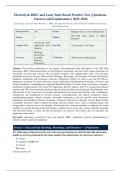
Electrolysis IBEC and Laser State Board Practice Test | Questions,
Answers and Explanations | 2025–2026
Electrology and Laser Hair Removal — IBEC (International Board of Electrologist Certification) and State
Board Preparation
Total Questions: 100 Format: Multiple Choice (A-D) with Rationales
2025-2026 State Board & IBEC
Sections: 5 Aligned:
Standards
30% Recall / 50%
Cognitive Mix: Application / 20% Item Mix: 75% Scenario / 25% Direct
Analysis
Histology,
Electrolysis,
Coverage: Laser/IPL, Verification: 100% Keyed with Rationales
Infection,
Regulations
Abstract. This practice examination is an original, non-confidential study aid aligned to the 2025-2026
Electrolysis IBEC (International Board of Electrologist Certification) and state board content blueprints for
electrology and laser hair removal. The instrument comprises 100 multiple-choice items with rationales
distributed across five sections: Skin and Hair Histology, Physiology, and Disorders (20 items); Electrolysis
Modalities, Equipment, and Techniques (Galvanic, Thermolysis, Blend) (25 items); Laser and IPL Physics,
Parameters, and Safety (25 items); Infection Control, Sterilization, and Bloodborne Pathogens (15 items); and
Client Consultation, Contraindications, and State Board Regulations (15 items). Items are keyed to a cognitive
distribution of approximately 30% recall, 50% application, and 20% analysis, with 75% scenario-based clinical
vignettes and 25% direct knowledge questions. Special inclusions address the Fitzpatrick Skin Phototype scale
and selection of the correct laser wavelength and parameters for varying skin and hair color combinations,
identification and management of adverse reactions, contraindications, and clinical emergencies (burns,
hyper/hypopigmentation, allergic reactions, pacemaker interference), and the specific tissue destruction
mechanisms distinguishing Galvanic electrolysis (chemical), Thermolysis (thermal), and the Blend method
(combined). Distractors reflect common electrology and laser student errors, such as confusing anagen with
telogen phases, mixing up laser wavelengths, selecting incorrect sanitation timelines, or applying the wrong
modality to a specific hair type. Each item includes a verified correct answer and a concise rationale explaining
why the keyed option is correct and why the distractors are incorrect. This artifact does not reproduce any
proprietary exam content.
Keywords: electrology; electrolysis; laser hair removal; IBEC; Fitzpatrick; selective photothermolysis;
infection control; state board regulations
Section 1: Skin and Hair Histology, Physiology, and Disorders — 20 Questions
Q1: Which phase of the hair growth cycle is the active growth phase in which the hair bulb and dermal
papilla are actively producing the hair shaft, making it the optimal target for electrolysis and laser?
A. Catagen
B. Anagen *[CORRECT]*
C. Telogen
D. Exogen
Correct Answer: B
,Rationale: Anagen is the active growth phase where melanin and the papilla are present, making hair most
vulnerable to permanent removal; catagen is regression, telogen is resting, and exogen is shedding.
Q2: A client presents for laser hair removal with thick, dark, visible hair. In which phase are most of
these hairs at any given time on the scalp?
A. Approximately 10% in anagen
B. Approximately 50% in catagen
C. Approximately 85-90% in anagen *[CORRECT]*
D. Approximately 100% in telogen
Correct Answer: C
Rationale: Approximately 85-90% of scalp hairs are in anagen at any time, which is why multiple laser sessions are
timed to catch successive anagen cycles; the other figures understate anagen or misassign phases.
Q3: Which skin layer contains the hair follicle, sebaceous glands, and sweat glands?
A. Epidermis
B. Hypodermis
C. Stratum corneum
D. Dermis *[CORRECT]*
Correct Answer: D
Rationale: The dermis contains follicles, sebaceous glands, and sweat glands; the epidermis is the outermost cellular
layer, the hypodermis is subcutaneous fat, and the stratum corneum is the dead outer epidermal layer.
Q4: The hair follicle structure that contains the matrix cells and melanocytes responsible for hair shaft
production is the:
A. Hair bulb *[CORRECT]*
B. Arrector pili muscle
C. Sebaceous gland
D. Outer root sheath
Correct Answer: A
Rationale: The hair bulb houses the matrix cells and melanocytes that produce the hair shaft; the arrector pili muscle
causes piloerection, the sebaceous gland produces sebum, and the outer root sheath is a follicle layer but not the
growth center.
Q5: A client asks why laser hair removal requires multiple sessions spaced 4-8 weeks apart. The best
explanation is:
A. Each session permanently removes all hair in one treatment
B. Hair grows in cycles, and only anagen hairs are effectively treated; staggered sessions target successive
follicles entering anagen over time *[CORRECT]*
C. Laser damages skin and needs time to heal only
D. Multiple sessions are purely for marketing
Correct Answer: B
Rationale: Because only anagen follicles respond well and not all hairs are in anagen simultaneously, multiple timed
sessions are needed; one session does not remove all hair, healing time is not the primary reason, and spacing is
clinically necessary.
Q6: Which structure must be destroyed to achieve permanent hair removal?
A. The hair shaft only
B. The sebaceous gland only
C. The dermal papilla and hair germ (bulge stem cells) *[CORRECT]*
, D. The arrector pili muscle
Correct Answer: C
Rationale: Permanent removal requires destruction of the dermal papilla and bulge stem cells that regenerate the
follicle; destroying the shaft, sebaceous gland, or arrector pili alone allows regrowth.
Q7: A client has folliculitis on the beard area. Which statement is most accurate regarding treatment?
A. Folliculitis is a normal finding and requires no precautions
B. Folliculitis is the same as pseudofolliculitis barbae
C. Folliculitis contraindicates all future treatment permanently
D. Folliculitis is an inflammation/infection of follicles often caused by bacterial infection; active pustular
folliculitis should be treated and resolved before electrolysis or laser to avoid spreading infection
*[CORRECT]*
Correct Answer: D
Rationale: Folliculitis is a bacterial follicle infection requiring resolution before treatment to prevent spread; it is not
a normal no-precaution finding, differs from pseudofolliculitis barbae (ingrown hairs), and does not permanently
contraindicate treatment.
Q8: Pseudofolliculitis barbae (razor bumps) is most common in which population and is caused by:
A. Curly-haired individuals (commonly Fitzpatrick IV-VI) where curved hairs re-enter the skin causing
inflammation *[CORRECT]*
B. Straight-haired light-skinned individuals only
C. Excessive sebum production
D. Fungal infection
Correct Answer: A
Rationale: Pseudofolliculitis barbae occurs mainly in curly-haired darker skin types when hairs curve back into the
skin; it is not limited to straight/light skin, not caused by sebum, and not fungal.
Q9: The arrector pili muscle is attached to the hair follicle and functions to:
A. Produce the hair shaft
B. Contract to cause piloerection (goosebumps) and assist sebum secretion *[CORRECT]*
C. Generate melanin
D. Anchor the follicle to bone
Correct Answer: B
Rationale: The arrector pili contracts for piloerection and sebum expression; it does not produce the shaft, generate
melanin, or anchor to bone.
Q10: Melanin in the hair shaft is produced by melanocytes located in the:
A. Sebaceous gland
B. Dermal papilla only
C. Hair bulb (matrix region) *[CORRECT]*
D. Epidermal stratum basale of the skin surface
Correct Answer: C
Rationale: Hair melanin is made by melanocytes in the hair bulb matrix; sebaceous glands produce sebum, the
dermal papilla nourishes but does not produce melanin, and surface epidermal melanocytes color skin, not hair.
Q11: Which hair color responds best to laser hair removal and why?
A. Blonde hair because it is finer
B. Red hair because of pheomelanin absorption
C. Gray hair because of lack of pigment
Answers and Explanations | 2025–2026
Electrology and Laser Hair Removal — IBEC (International Board of Electrologist Certification) and State
Board Preparation
Total Questions: 100 Format: Multiple Choice (A-D) with Rationales
2025-2026 State Board & IBEC
Sections: 5 Aligned:
Standards
30% Recall / 50%
Cognitive Mix: Application / 20% Item Mix: 75% Scenario / 25% Direct
Analysis
Histology,
Electrolysis,
Coverage: Laser/IPL, Verification: 100% Keyed with Rationales
Infection,
Regulations
Abstract. This practice examination is an original, non-confidential study aid aligned to the 2025-2026
Electrolysis IBEC (International Board of Electrologist Certification) and state board content blueprints for
electrology and laser hair removal. The instrument comprises 100 multiple-choice items with rationales
distributed across five sections: Skin and Hair Histology, Physiology, and Disorders (20 items); Electrolysis
Modalities, Equipment, and Techniques (Galvanic, Thermolysis, Blend) (25 items); Laser and IPL Physics,
Parameters, and Safety (25 items); Infection Control, Sterilization, and Bloodborne Pathogens (15 items); and
Client Consultation, Contraindications, and State Board Regulations (15 items). Items are keyed to a cognitive
distribution of approximately 30% recall, 50% application, and 20% analysis, with 75% scenario-based clinical
vignettes and 25% direct knowledge questions. Special inclusions address the Fitzpatrick Skin Phototype scale
and selection of the correct laser wavelength and parameters for varying skin and hair color combinations,
identification and management of adverse reactions, contraindications, and clinical emergencies (burns,
hyper/hypopigmentation, allergic reactions, pacemaker interference), and the specific tissue destruction
mechanisms distinguishing Galvanic electrolysis (chemical), Thermolysis (thermal), and the Blend method
(combined). Distractors reflect common electrology and laser student errors, such as confusing anagen with
telogen phases, mixing up laser wavelengths, selecting incorrect sanitation timelines, or applying the wrong
modality to a specific hair type. Each item includes a verified correct answer and a concise rationale explaining
why the keyed option is correct and why the distractors are incorrect. This artifact does not reproduce any
proprietary exam content.
Keywords: electrology; electrolysis; laser hair removal; IBEC; Fitzpatrick; selective photothermolysis;
infection control; state board regulations
Section 1: Skin and Hair Histology, Physiology, and Disorders — 20 Questions
Q1: Which phase of the hair growth cycle is the active growth phase in which the hair bulb and dermal
papilla are actively producing the hair shaft, making it the optimal target for electrolysis and laser?
A. Catagen
B. Anagen *[CORRECT]*
C. Telogen
D. Exogen
Correct Answer: B
,Rationale: Anagen is the active growth phase where melanin and the papilla are present, making hair most
vulnerable to permanent removal; catagen is regression, telogen is resting, and exogen is shedding.
Q2: A client presents for laser hair removal with thick, dark, visible hair. In which phase are most of
these hairs at any given time on the scalp?
A. Approximately 10% in anagen
B. Approximately 50% in catagen
C. Approximately 85-90% in anagen *[CORRECT]*
D. Approximately 100% in telogen
Correct Answer: C
Rationale: Approximately 85-90% of scalp hairs are in anagen at any time, which is why multiple laser sessions are
timed to catch successive anagen cycles; the other figures understate anagen or misassign phases.
Q3: Which skin layer contains the hair follicle, sebaceous glands, and sweat glands?
A. Epidermis
B. Hypodermis
C. Stratum corneum
D. Dermis *[CORRECT]*
Correct Answer: D
Rationale: The dermis contains follicles, sebaceous glands, and sweat glands; the epidermis is the outermost cellular
layer, the hypodermis is subcutaneous fat, and the stratum corneum is the dead outer epidermal layer.
Q4: The hair follicle structure that contains the matrix cells and melanocytes responsible for hair shaft
production is the:
A. Hair bulb *[CORRECT]*
B. Arrector pili muscle
C. Sebaceous gland
D. Outer root sheath
Correct Answer: A
Rationale: The hair bulb houses the matrix cells and melanocytes that produce the hair shaft; the arrector pili muscle
causes piloerection, the sebaceous gland produces sebum, and the outer root sheath is a follicle layer but not the
growth center.
Q5: A client asks why laser hair removal requires multiple sessions spaced 4-8 weeks apart. The best
explanation is:
A. Each session permanently removes all hair in one treatment
B. Hair grows in cycles, and only anagen hairs are effectively treated; staggered sessions target successive
follicles entering anagen over time *[CORRECT]*
C. Laser damages skin and needs time to heal only
D. Multiple sessions are purely for marketing
Correct Answer: B
Rationale: Because only anagen follicles respond well and not all hairs are in anagen simultaneously, multiple timed
sessions are needed; one session does not remove all hair, healing time is not the primary reason, and spacing is
clinically necessary.
Q6: Which structure must be destroyed to achieve permanent hair removal?
A. The hair shaft only
B. The sebaceous gland only
C. The dermal papilla and hair germ (bulge stem cells) *[CORRECT]*
, D. The arrector pili muscle
Correct Answer: C
Rationale: Permanent removal requires destruction of the dermal papilla and bulge stem cells that regenerate the
follicle; destroying the shaft, sebaceous gland, or arrector pili alone allows regrowth.
Q7: A client has folliculitis on the beard area. Which statement is most accurate regarding treatment?
A. Folliculitis is a normal finding and requires no precautions
B. Folliculitis is the same as pseudofolliculitis barbae
C. Folliculitis contraindicates all future treatment permanently
D. Folliculitis is an inflammation/infection of follicles often caused by bacterial infection; active pustular
folliculitis should be treated and resolved before electrolysis or laser to avoid spreading infection
*[CORRECT]*
Correct Answer: D
Rationale: Folliculitis is a bacterial follicle infection requiring resolution before treatment to prevent spread; it is not
a normal no-precaution finding, differs from pseudofolliculitis barbae (ingrown hairs), and does not permanently
contraindicate treatment.
Q8: Pseudofolliculitis barbae (razor bumps) is most common in which population and is caused by:
A. Curly-haired individuals (commonly Fitzpatrick IV-VI) where curved hairs re-enter the skin causing
inflammation *[CORRECT]*
B. Straight-haired light-skinned individuals only
C. Excessive sebum production
D. Fungal infection
Correct Answer: A
Rationale: Pseudofolliculitis barbae occurs mainly in curly-haired darker skin types when hairs curve back into the
skin; it is not limited to straight/light skin, not caused by sebum, and not fungal.
Q9: The arrector pili muscle is attached to the hair follicle and functions to:
A. Produce the hair shaft
B. Contract to cause piloerection (goosebumps) and assist sebum secretion *[CORRECT]*
C. Generate melanin
D. Anchor the follicle to bone
Correct Answer: B
Rationale: The arrector pili contracts for piloerection and sebum expression; it does not produce the shaft, generate
melanin, or anchor to bone.
Q10: Melanin in the hair shaft is produced by melanocytes located in the:
A. Sebaceous gland
B. Dermal papilla only
C. Hair bulb (matrix region) *[CORRECT]*
D. Epidermal stratum basale of the skin surface
Correct Answer: C
Rationale: Hair melanin is made by melanocytes in the hair bulb matrix; sebaceous glands produce sebum, the
dermal papilla nourishes but does not produce melanin, and surface epidermal melanocytes color skin, not hair.
Q11: Which hair color responds best to laser hair removal and why?
A. Blonde hair because it is finer
B. Red hair because of pheomelanin absorption
C. Gray hair because of lack of pigment


