

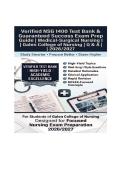
,Verified NSG 1400 Test Bank & Guaranteed Success
Exam Prep Guide | Medical-Surgical Nursing I |
Galen College of Nursing | Q & A | 2026/2027
1. A patient with heart failure is prescribed furosemide. Which laboratory value should the
nurse monitor most closely?
A) Hemoglobin
B) Platelet count
C) Potassium level
D) Blood glucose
Correct Answer: C) Potassium level
Rationale: Furosemide is a loop diuretic that can cause significant potassium loss, leading to
hypokalemia. Hypokalemia can cause cardiac arrhythmias, especially in patients with heart
failure who may also be on digoxin. Potassium levels should be monitored closely.
2. Which finding indicates a complication in a patient with a new colostomy?
A) Pink, moist stoma
B) Dusky-colored stoma
C) Small amount of gas passed
D) Mild discomfort at stoma site
,Correct Answer: B) Dusky-colored stoma
Rationale: A dusky or blue-colored stoma indicates poor blood flow, which is a surgical
emergency requiring immediate provider notification. A healthy stoma is pink, moist, and beefy
red. Small amounts of gas and mild discomfort are expected.
3. A nurse is caring for a patient with COPD who has thick secretions. What is the best nursing
action?
A) Restrict fluid intake
B) Encourage bed rest
C) Limit coughing
D) Increase fluid intake
Correct Answer: D) Increase fluid intake
Rationale: Increased hydration helps thin secretions, making them easier to expectorate.
Restricting fluids, encouraging bed rest, and limiting coughing would worsen secretion retention
and increase the risk of respiratory complications.
4. Which intervention is priority for a patient at risk for aspiration?
A) Encourage large bites
B) Position in high Fowler's during meals
C) Provide a straw for liquids
, D) Feed quickly
Correct Answer: B) Position in high Fowler's during meals
Rationale: Upright positioning (high Fowler's) reduces the risk of aspiration during swallowing.
Large bites, straw use, and rapid feeding increase aspiration risk.
5. A patient reports calf pain and swelling after surgery. Which is the priority nursing action?
A) Massage the calf
B) Apply warm compress
C) Measure calf circumference and notify provider
D) Encourage ambulation
Correct Answer: C) Measure calf circumference and notify provider
Rationale: Unilateral calf pain and swelling are signs of deep vein thrombosis (DVT). Massaging
the calf could dislodge a clot, leading to pulmonary embolism. The provider should be notified
immediately.
6. Which action should the nurse take first when caring for a patient experiencing shortness of
breath?
A) Notify the healthcare provider
B) Administer prescribed bronchodilator
Exam Prep Guide | Medical-Surgical Nursing I |
Galen College of Nursing | Q & A | 2026/2027
1. A patient with heart failure is prescribed furosemide. Which laboratory value should the
nurse monitor most closely?
A) Hemoglobin
B) Platelet count
C) Potassium level
D) Blood glucose
Correct Answer: C) Potassium level
Rationale: Furosemide is a loop diuretic that can cause significant potassium loss, leading to
hypokalemia. Hypokalemia can cause cardiac arrhythmias, especially in patients with heart
failure who may also be on digoxin. Potassium levels should be monitored closely.
2. Which finding indicates a complication in a patient with a new colostomy?
A) Pink, moist stoma
B) Dusky-colored stoma
C) Small amount of gas passed
D) Mild discomfort at stoma site
,Correct Answer: B) Dusky-colored stoma
Rationale: A dusky or blue-colored stoma indicates poor blood flow, which is a surgical
emergency requiring immediate provider notification. A healthy stoma is pink, moist, and beefy
red. Small amounts of gas and mild discomfort are expected.
3. A nurse is caring for a patient with COPD who has thick secretions. What is the best nursing
action?
A) Restrict fluid intake
B) Encourage bed rest
C) Limit coughing
D) Increase fluid intake
Correct Answer: D) Increase fluid intake
Rationale: Increased hydration helps thin secretions, making them easier to expectorate.
Restricting fluids, encouraging bed rest, and limiting coughing would worsen secretion retention
and increase the risk of respiratory complications.
4. Which intervention is priority for a patient at risk for aspiration?
A) Encourage large bites
B) Position in high Fowler's during meals
C) Provide a straw for liquids
, D) Feed quickly
Correct Answer: B) Position in high Fowler's during meals
Rationale: Upright positioning (high Fowler's) reduces the risk of aspiration during swallowing.
Large bites, straw use, and rapid feeding increase aspiration risk.
5. A patient reports calf pain and swelling after surgery. Which is the priority nursing action?
A) Massage the calf
B) Apply warm compress
C) Measure calf circumference and notify provider
D) Encourage ambulation
Correct Answer: C) Measure calf circumference and notify provider
Rationale: Unilateral calf pain and swelling are signs of deep vein thrombosis (DVT). Massaging
the calf could dislodge a clot, leading to pulmonary embolism. The provider should be notified
immediately.
6. Which action should the nurse take first when caring for a patient experiencing shortness of
breath?
A) Notify the healthcare provider
B) Administer prescribed bronchodilator


