
PHY S ICS VO ICE
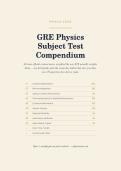
GRE Physics
Subject Test
Compendium
All nine official content areas, weighted the way ETS actually weights
them — one field guide, plus the exam-day habits that save you time
on a 70-question, five-choice exam.
01 Classical Me chanics 20%
02 Ele ctromagne tism 18%
03 O ptics & Wave Phe nome na 8%
04 The rmodynamics & Statistical Me chanics 10%
05 Q uantum Me chanics 13%
06 Atomic Physics 10%
07 Spe cial Re lativity 6%
08 Laboratory Me thods 6%
09 Spe cialize d Topics 9%
+ Exam-Day Toolkit
+ Full Formula Inde x
Notes I actually give my own students. — physicsvoice.com
, G R E PH Y S I C S — C O M PE N D I U M PH Y S I C S V O I C E
01 Classical Mechanics 20% of t he exam
dp
Newt on's second law F = ma =
dt
Lagrangian & Euler–Lagrange d ∂L ∂L
eq.
L =T −V − =0
dt ∂ q̇ ∂q
∂H ∂H
Hamilt onian & Hamilt on's eqs. H =T +V q̇ = , ṗ = −
∂p ∂q
Simple harmonic mot ion ω= k/m x(t) = A cos(ωt + φ)
Angular moment um L = Iω (conserved with zero net torque)
Kepler's t hird law T 2 ∝ a3
PR E P I NS I G HT
The GRE leans hard on Lagrangian and Hamiltonian mechanics — material that barely shows up
in an intro course. If your mechanics stopped at F=ma, this is the gap to close first.
PH Y S I CS VOI CE .COM PAGE 2
GRE Physics
Subject Test
Compendium
All nine official content areas, weighted the way ETS actually weights
them — one field guide, plus the exam-day habits that save you time
on a 70-question, five-choice exam.
01 Classical Me chanics 20%
02 Ele ctromagne tism 18%
03 O ptics & Wave Phe nome na 8%
04 The rmodynamics & Statistical Me chanics 10%
05 Q uantum Me chanics 13%
06 Atomic Physics 10%
07 Spe cial Re lativity 6%
08 Laboratory Me thods 6%
09 Spe cialize d Topics 9%
+ Exam-Day Toolkit
+ Full Formula Inde x
Notes I actually give my own students. — physicsvoice.com
, G R E PH Y S I C S — C O M PE N D I U M PH Y S I C S V O I C E
01 Classical Mechanics 20% of t he exam
dp
Newt on's second law F = ma =
dt
Lagrangian & Euler–Lagrange d ∂L ∂L
eq.
L =T −V − =0
dt ∂ q̇ ∂q
∂H ∂H
Hamilt onian & Hamilt on's eqs. H =T +V q̇ = , ṗ = −
∂p ∂q
Simple harmonic mot ion ω= k/m x(t) = A cos(ωt + φ)
Angular moment um L = Iω (conserved with zero net torque)
Kepler's t hird law T 2 ∝ a3
PR E P I NS I G HT
The GRE leans hard on Lagrangian and Hamiltonian mechanics — material that barely shows up
in an intro course. If your mechanics stopped at F=ma, this is the gap to close first.
PH Y S I CS VOI CE .COM PAGE 2


