
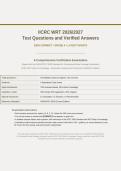
IICRC WRT 2026/2027
Test Questions and Verified Answers
100% CORRECT • GRADE A • LATEST UPDATE
A Comprehensive Certification Examination
Aligned with the ANSI/IICRC S500 Standard for Professional Water Damage Restoration
IICRC WRT Body of Knowledge • Restoration Industry Best Practices (2026/2027 Edition)
Total Questions: 100 Multiple Choice (4 Options, One Correct)
Sections: 9 Specialized Topic Areas
Style Distribution: 70% Scenario-Based, 30% Direct Knowledge
Cognitive Levels: 25% Recall, 50% Application, 25% Analysis
Special Inclusions: 15 Calculation, 15 Scenario, 10 Psychrometric
Reference Standard: ANSI/IICRC S500 (Current Edition)
Examination Instructions
• Each question presents four options (A, B, C, D). Select the ONE most correct answer.
• The correct answer is marked with [CORRECT] and appears in green text.
• A detailed rationale follows each question, with references to the IICRC S500 Standard and WRT Body of Knowledge.
• Calculations follow industry-standard formulas: water volume (cubic feet x 8.34 = gallons), air mover placement (1 per
50-70 sq ft for floor drying), and psychrometric relationships.
This study guide is designed for IICRC WRT certification exam preparation and is based on the ANSI/IICRC S500 Standard
for Professional Water Damage Restoration and the IICRC WRT Body of Knowledge. Always consult the current IICRC S500
Standard and IICRC official materials for authoritative guidance.
, Examination Overview
This comprehensive certification examination is structured to evaluate competency in all core
domains of the IICRC Water Damage Restoration Technician (WRT) certification. The
questions are organized into nine specialized sections that progressively build knowledge from
foundational concepts (water categories and classes) through applied psychrometry, moisture
detection, structural drying techniques, dehumidification methods, extraction techniques,
antimicrobial application and safety protocols, professional documentation standards, and
finally comprehensive case studies that integrate all knowledge areas into real-world
decision-making scenarios typical of professional restoration practice.
Section Distribution
# Section Title Questions
1 Water Damage Categories & Classes 15 (Q1-Q15)
2 Psychrometry & Drying Science 15 (Q16-Q30)
3 Moisture Detection & Equipment Use 12 (Q31-Q42)
4 Structural Drying Techniques & Air Mover Calculations 15 (Q43-Q57)
5 Dehumidification Methods (Refrigerant, LGR, Desiccant) 10 (Q58-Q67)
6 Extraction Techniques & Water Removal 8 (Q68-Q75)
7 Antimicrobials, Biocides, & Safety Protocols 10 (Q76-Q85)
8 Documentation Standards & Professional Practice 8 (Q86-Q93)
9 Comprehensive Case Studies & Scenario-Based Questions 7 (Q94-Q100)
TOTAL 100 Questions
Cognitive Level Distribution
Consistent with IICRC WRT examination standards, questions are distributed across cognitive
levels: 25% Recall (direct knowledge of definitions, classifications, and standard references);
50% Application (applying knowledge to specific restoration scenarios, equipment selection,
and procedural decisions); and 25% Analysis (multi-factor case studies requiring integration of
multiple knowledge domains, psychrometric calculations, and field decision-making).
,IICRC WRT 2026/2027 Certification Examination | 100% Correct | Grade A ANSI/IICRC S500 Standard
Special Content Inclusions
This examination includes 15 calculation-based questions covering dew point
determination, water volume (cubic feet x 8.34 = gallons), and air mover placement
calculations; 15 scenario-based questions addressing Category/Class determination,
safety decisions, and dispute resolution per IICRC S500; and 10 psychrometric
interpretation questions evaluating temperature/RH relationships and drying conditions
analysis.
IICRC WRT Certification Examination Preparation Page 3
, IICRC WRT 2026/2027 Certification Examination | 100% Correct | Grade A ANSI/IICRC S500 Standard
Section 1: Water Damage Categories & Classes
This section tests knowledge of Category 1, 2, and 3 water classifications and Class 1-4 damage levels
per IICRC S500, including sources, contamination levels, and appropriate restoration requirements.
Q1: According to ANSI/IICRC S500, which category of water originates from a clean and
sanitary source but poses no substantial risk to humans from dermal, ingestion, or
inhalation exposure?
A. Category 2 (Gray Water)
B. Category 3 (Black Water)
C. Category 1 (Clean Water) [CORRECT]
D. Category 4 (Sanitary Water)
Correct Answer: C — Category 1 (Clean Water)
Rationale: Category 1 water is defined by ANSI/IICRC S500 as water originating from a clean and
sanitary source such as broken supply lines, sink overflows with no contaminants, or appliance
malfunctions. Category 2 contains significant contamination, Category 3 contains grossly
unsanitary agents, and Category 4 is not a recognized IICRC classification.
Q2: A homeowner reports a toilet overflow containing urine but no feces. Under the IICRC
S500 standard, which water category applies to this loss?
A. Category 1, because urine is sterile when first excreted
B. Category 2, because the water contains contamination that may cause discomfort or
sickness [CORRECT]
C. Category 3, because any toilet backup is automatically classified as black water
D. Category 1 transitioning to Category 3 after 48 hours
Correct Answer: B — Category 2, because the water contains contamination that may cause
discomfort or sickness
Rationale: Toilet overflows containing urine (but no feces) are classified as Category 2 (Gray
Water) per IICRC S500 because the source contains contamination with the potential to cause
discomfort or sickness if ingested. Category 1 requires a sanitary source, Category 3 requires
gross contamination such as feces/sewage, and the 48-hour rule applies only to Category 1
degradation, not to gray water.
Q3: Which of the following scenarios is correctly classified as Category 3 (Black Water)?
A. A broken kitchen supply line under a sink
B. A washing machine discharge line overflow containing only rinse water
C. Sewage backup from a municipal main entering a basement [CORRECT]
IICRC WRT Certification Examination Preparation Page 4
Test Questions and Verified Answers
100% CORRECT • GRADE A • LATEST UPDATE
A Comprehensive Certification Examination
Aligned with the ANSI/IICRC S500 Standard for Professional Water Damage Restoration
IICRC WRT Body of Knowledge • Restoration Industry Best Practices (2026/2027 Edition)
Total Questions: 100 Multiple Choice (4 Options, One Correct)
Sections: 9 Specialized Topic Areas
Style Distribution: 70% Scenario-Based, 30% Direct Knowledge
Cognitive Levels: 25% Recall, 50% Application, 25% Analysis
Special Inclusions: 15 Calculation, 15 Scenario, 10 Psychrometric
Reference Standard: ANSI/IICRC S500 (Current Edition)
Examination Instructions
• Each question presents four options (A, B, C, D). Select the ONE most correct answer.
• The correct answer is marked with [CORRECT] and appears in green text.
• A detailed rationale follows each question, with references to the IICRC S500 Standard and WRT Body of Knowledge.
• Calculations follow industry-standard formulas: water volume (cubic feet x 8.34 = gallons), air mover placement (1 per
50-70 sq ft for floor drying), and psychrometric relationships.
This study guide is designed for IICRC WRT certification exam preparation and is based on the ANSI/IICRC S500 Standard
for Professional Water Damage Restoration and the IICRC WRT Body of Knowledge. Always consult the current IICRC S500
Standard and IICRC official materials for authoritative guidance.
, Examination Overview
This comprehensive certification examination is structured to evaluate competency in all core
domains of the IICRC Water Damage Restoration Technician (WRT) certification. The
questions are organized into nine specialized sections that progressively build knowledge from
foundational concepts (water categories and classes) through applied psychrometry, moisture
detection, structural drying techniques, dehumidification methods, extraction techniques,
antimicrobial application and safety protocols, professional documentation standards, and
finally comprehensive case studies that integrate all knowledge areas into real-world
decision-making scenarios typical of professional restoration practice.
Section Distribution
# Section Title Questions
1 Water Damage Categories & Classes 15 (Q1-Q15)
2 Psychrometry & Drying Science 15 (Q16-Q30)
3 Moisture Detection & Equipment Use 12 (Q31-Q42)
4 Structural Drying Techniques & Air Mover Calculations 15 (Q43-Q57)
5 Dehumidification Methods (Refrigerant, LGR, Desiccant) 10 (Q58-Q67)
6 Extraction Techniques & Water Removal 8 (Q68-Q75)
7 Antimicrobials, Biocides, & Safety Protocols 10 (Q76-Q85)
8 Documentation Standards & Professional Practice 8 (Q86-Q93)
9 Comprehensive Case Studies & Scenario-Based Questions 7 (Q94-Q100)
TOTAL 100 Questions
Cognitive Level Distribution
Consistent with IICRC WRT examination standards, questions are distributed across cognitive
levels: 25% Recall (direct knowledge of definitions, classifications, and standard references);
50% Application (applying knowledge to specific restoration scenarios, equipment selection,
and procedural decisions); and 25% Analysis (multi-factor case studies requiring integration of
multiple knowledge domains, psychrometric calculations, and field decision-making).
,IICRC WRT 2026/2027 Certification Examination | 100% Correct | Grade A ANSI/IICRC S500 Standard
Special Content Inclusions
This examination includes 15 calculation-based questions covering dew point
determination, water volume (cubic feet x 8.34 = gallons), and air mover placement
calculations; 15 scenario-based questions addressing Category/Class determination,
safety decisions, and dispute resolution per IICRC S500; and 10 psychrometric
interpretation questions evaluating temperature/RH relationships and drying conditions
analysis.
IICRC WRT Certification Examination Preparation Page 3
, IICRC WRT 2026/2027 Certification Examination | 100% Correct | Grade A ANSI/IICRC S500 Standard
Section 1: Water Damage Categories & Classes
This section tests knowledge of Category 1, 2, and 3 water classifications and Class 1-4 damage levels
per IICRC S500, including sources, contamination levels, and appropriate restoration requirements.
Q1: According to ANSI/IICRC S500, which category of water originates from a clean and
sanitary source but poses no substantial risk to humans from dermal, ingestion, or
inhalation exposure?
A. Category 2 (Gray Water)
B. Category 3 (Black Water)
C. Category 1 (Clean Water) [CORRECT]
D. Category 4 (Sanitary Water)
Correct Answer: C — Category 1 (Clean Water)
Rationale: Category 1 water is defined by ANSI/IICRC S500 as water originating from a clean and
sanitary source such as broken supply lines, sink overflows with no contaminants, or appliance
malfunctions. Category 2 contains significant contamination, Category 3 contains grossly
unsanitary agents, and Category 4 is not a recognized IICRC classification.
Q2: A homeowner reports a toilet overflow containing urine but no feces. Under the IICRC
S500 standard, which water category applies to this loss?
A. Category 1, because urine is sterile when first excreted
B. Category 2, because the water contains contamination that may cause discomfort or
sickness [CORRECT]
C. Category 3, because any toilet backup is automatically classified as black water
D. Category 1 transitioning to Category 3 after 48 hours
Correct Answer: B — Category 2, because the water contains contamination that may cause
discomfort or sickness
Rationale: Toilet overflows containing urine (but no feces) are classified as Category 2 (Gray
Water) per IICRC S500 because the source contains contamination with the potential to cause
discomfort or sickness if ingested. Category 1 requires a sanitary source, Category 3 requires
gross contamination such as feces/sewage, and the 48-hour rule applies only to Category 1
degradation, not to gray water.
Q3: Which of the following scenarios is correctly classified as Category 3 (Black Water)?
A. A broken kitchen supply line under a sink
B. A washing machine discharge line overflow containing only rinse water
C. Sewage backup from a municipal main entering a basement [CORRECT]
IICRC WRT Certification Examination Preparation Page 4


