
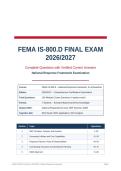
FEMA IS-800.D FINAL EXAM
2026/2027
Complete Questions with Verified Correct Answers
National Response Framework Examination
Course: FEMA IS-800.d – National Response Framework, An Introduction
Edition: 2026/2027 – Comprehensive Certification Examination
Total Questions: 100 Multiple-Choice Questions (4 options each)
Format: 7 Sections – Scenario-Based and Direct Knowledge
Aligned With: National Preparedness Goal, NRF Doctrine, NIMS
Cognitive Mix: 30% Recall | 50% Application | 20% Analysis
Section Topic Questions
1 NRF Principles, Purpose, and Doctrine 1–20
2 Community Lifelines and Core Capabilities 21–35
3 Response Partners: Roles & Responsibilities 36–55
4 Coordinating Structures and Operational Planning 56–70
5 NIMS Alignment 71–80
FEMA IS-800.d Final Exam 2026/2027 | National Response Framework Page 1
,FEMA IS-800.d – National Response Framework Exam 2026/2027 Edition
6 Stafford Act, Disaster Declaration, Federal Assistance 81–90
7 Comprehensive Case Studies and Applied Scenarios 91–100
Aligned with FEMA IS-800.d National Response Framework course objectives, the National Preparedness Goal, and
Emergency Management Core Competencies.
FEMA IS-800.d Final Exam 2026/2027 | National Response Framework Page 2
,FEMA IS-800.d – National Response Framework Exam 2026/2027 Edition
Examination Overview and Instructions
Purpose. This comprehensive certification examination assesses mastery of the Federal Emergency Management
Agency (FEMA) IS-800.d course, National Response Framework, An Introduction. The exam evaluates
understanding of the National Response Framework (NRF) doctrine, the seven Community Lifelines, the
Response Core Capabilities, the roles and responsibilities of response partners at every level of government and
across the private and non-profit sectors, the coordinating structures that synchronize operations, the alignment of
the NRF with the National Incident Management System (NIMS), and the Stafford Act disaster declaration
process that authorizes federal assistance.
Structure. The exam contains exactly 100 multiple-choice questions distributed across seven sections. Section 1
addresses NRF Principles, Purpose, and Doctrine (20 questions). Section 2 covers Community Lifelines and Core
Capabilities (15 questions). Section 3 examines Response Partners and their Roles and Responsibilities across
federal, state, local, tribal, private-sector, and non-governmental organizations (20 questions). Section 4 addresses
Coordinating Structures and Operational Planning (15 questions). Section 5 tests alignment with NIMS (10
questions). Section 6 addresses the Stafford Act, Disaster Declaration Process, and Federal Assistance (10
questions). Section 7 presents Comprehensive Case Studies and Applied Scenarios (10 questions).
Cognitive Mix. Question design reflects the cognitive distribution recommended for emergency management
certification examinations: approximately 30 percent recall of NRF/NIMS doctrine, 50 percent application of
doctrine to realistic scenarios, and 20 percent analysis of complex coordination problems and incident response
decision-making. Approximately 70 percent of questions are scenario-based, presenting realistic emergency
response situations that require the candidate to identify correct roles, coordinating structures, and decision points
consistent with NRF doctrine. The remaining 30 percent are direct knowledge questions assessing recall of
foundational concepts.
Format. Each question presents a stem followed by four options (A, B, C, D) with exactly one correct answer.
The correct answer is marked with *[CORRECT]*. A rationale follows each question, providing a brief
explanation of why the correct option is right and why the distractors are wrong, with references to FEMA
IS-800.d curriculum and NRF doctrine. Candidates preparing for the official FEMA IS-800.d examination should
review each rationale carefully to consolidate understanding of the underlying doctrine rather than memorizing
answers.
Alignment. This exam aligns with the FEMA IS-800.d course objectives, the National Preparedness Goal, and
Emergency Management Core Competencies. It is intended for emergency management professionals, first
responders, public-sector decision-makers, and students preparing for FEMA Independent Study certification.
Successful completion demonstrates a working understanding of how the nation responds to all types of disasters
and emergencies under the NRF.
FEMA IS-800.d Final Exam 2026/2027 | National Response Framework Page 3
, FEMA IS-800.d – National Response Framework Exam 2026/2027 Edition
SECTION 1: National Response Framework (NRF) Principles, Purpose,
and Doctrine
Q1: The National Response Framework (NRF) is built on scalable, flexible, and adaptable
concepts identified in which of the following?
A. The Stafford Act
B. The National Incident Management System (NIMS) *[CORRECT]*
C. The Post-Katrina Emergency Management Reform Act
D. The Homeland Security Act of 2002
Correct Answer: B
Rationale: The NRF is built on the scalable, flexible, and adaptable concepts identified in NIMS, which
provides the standardized approach to incident management. The Stafford Act (A) governs federal disaster
assistance, while the Post-Katrina Act (C) and Homeland Security Act (D) reorganized FEMA/DHS but do not
define the operational doctrine underpinning the NRF.
Q2: Which set of principles forms the foundation of the National Response Framework?
A. Engaged partnership, tiered response, scalable/flexible/adaptable operational capabilities, unity of
effort through unified command, and readiness to act *[CORRECT]*
B. Centralized command, federal primacy, sequential response, and standardized equipment
C. Military-led response, state deference to federal authority, and phased activation
D. Hierarchical command, single-agency leadership, and resource pooling
Correct Answer: A
Rationale: The five NRF guiding principles are engaged partnership, tiered response,
scalable/flexible/adaptable operational capabilities, unity of effort through unified command, and readiness to
act. Options B, C, and D introduce centralized or military models that contradict the NRF's whole-community,
tiered, and unified approach.
Q3: A severe ice storm strikes a mid-sized city. Local public works crews clear roads, but within
12 hours the mayor realizes additional resources are needed. Under the tiered response
principle, what should occur next?
A. The Mayor directly requests federal assistance from the President
B. The city surrenders command to the state National Guard
C. The city requests assistance through the county and state, keeping the incident managed at the
lowest practical level *[CORRECT]*
D. The Governor immediately declares a major disaster
Correct Answer: C
Rationale: Tiered response means incidents begin and end locally, and state and federal assistance
supplements—not replaces—local efforts, with most incidents managed at the lowest possible jurisdictional
level. Federal requests (A, D) skip required tiers, and surrendering command (B) violates the principle that
local authorities retain incident command.
FEMA IS-800.d Final Exam 2026/2027 | National Response Framework Page 4
2026/2027
Complete Questions with Verified Correct Answers
National Response Framework Examination
Course: FEMA IS-800.d – National Response Framework, An Introduction
Edition: 2026/2027 – Comprehensive Certification Examination
Total Questions: 100 Multiple-Choice Questions (4 options each)
Format: 7 Sections – Scenario-Based and Direct Knowledge
Aligned With: National Preparedness Goal, NRF Doctrine, NIMS
Cognitive Mix: 30% Recall | 50% Application | 20% Analysis
Section Topic Questions
1 NRF Principles, Purpose, and Doctrine 1–20
2 Community Lifelines and Core Capabilities 21–35
3 Response Partners: Roles & Responsibilities 36–55
4 Coordinating Structures and Operational Planning 56–70
5 NIMS Alignment 71–80
FEMA IS-800.d Final Exam 2026/2027 | National Response Framework Page 1
,FEMA IS-800.d – National Response Framework Exam 2026/2027 Edition
6 Stafford Act, Disaster Declaration, Federal Assistance 81–90
7 Comprehensive Case Studies and Applied Scenarios 91–100
Aligned with FEMA IS-800.d National Response Framework course objectives, the National Preparedness Goal, and
Emergency Management Core Competencies.
FEMA IS-800.d Final Exam 2026/2027 | National Response Framework Page 2
,FEMA IS-800.d – National Response Framework Exam 2026/2027 Edition
Examination Overview and Instructions
Purpose. This comprehensive certification examination assesses mastery of the Federal Emergency Management
Agency (FEMA) IS-800.d course, National Response Framework, An Introduction. The exam evaluates
understanding of the National Response Framework (NRF) doctrine, the seven Community Lifelines, the
Response Core Capabilities, the roles and responsibilities of response partners at every level of government and
across the private and non-profit sectors, the coordinating structures that synchronize operations, the alignment of
the NRF with the National Incident Management System (NIMS), and the Stafford Act disaster declaration
process that authorizes federal assistance.
Structure. The exam contains exactly 100 multiple-choice questions distributed across seven sections. Section 1
addresses NRF Principles, Purpose, and Doctrine (20 questions). Section 2 covers Community Lifelines and Core
Capabilities (15 questions). Section 3 examines Response Partners and their Roles and Responsibilities across
federal, state, local, tribal, private-sector, and non-governmental organizations (20 questions). Section 4 addresses
Coordinating Structures and Operational Planning (15 questions). Section 5 tests alignment with NIMS (10
questions). Section 6 addresses the Stafford Act, Disaster Declaration Process, and Federal Assistance (10
questions). Section 7 presents Comprehensive Case Studies and Applied Scenarios (10 questions).
Cognitive Mix. Question design reflects the cognitive distribution recommended for emergency management
certification examinations: approximately 30 percent recall of NRF/NIMS doctrine, 50 percent application of
doctrine to realistic scenarios, and 20 percent analysis of complex coordination problems and incident response
decision-making. Approximately 70 percent of questions are scenario-based, presenting realistic emergency
response situations that require the candidate to identify correct roles, coordinating structures, and decision points
consistent with NRF doctrine. The remaining 30 percent are direct knowledge questions assessing recall of
foundational concepts.
Format. Each question presents a stem followed by four options (A, B, C, D) with exactly one correct answer.
The correct answer is marked with *[CORRECT]*. A rationale follows each question, providing a brief
explanation of why the correct option is right and why the distractors are wrong, with references to FEMA
IS-800.d curriculum and NRF doctrine. Candidates preparing for the official FEMA IS-800.d examination should
review each rationale carefully to consolidate understanding of the underlying doctrine rather than memorizing
answers.
Alignment. This exam aligns with the FEMA IS-800.d course objectives, the National Preparedness Goal, and
Emergency Management Core Competencies. It is intended for emergency management professionals, first
responders, public-sector decision-makers, and students preparing for FEMA Independent Study certification.
Successful completion demonstrates a working understanding of how the nation responds to all types of disasters
and emergencies under the NRF.
FEMA IS-800.d Final Exam 2026/2027 | National Response Framework Page 3
, FEMA IS-800.d – National Response Framework Exam 2026/2027 Edition
SECTION 1: National Response Framework (NRF) Principles, Purpose,
and Doctrine
Q1: The National Response Framework (NRF) is built on scalable, flexible, and adaptable
concepts identified in which of the following?
A. The Stafford Act
B. The National Incident Management System (NIMS) *[CORRECT]*
C. The Post-Katrina Emergency Management Reform Act
D. The Homeland Security Act of 2002
Correct Answer: B
Rationale: The NRF is built on the scalable, flexible, and adaptable concepts identified in NIMS, which
provides the standardized approach to incident management. The Stafford Act (A) governs federal disaster
assistance, while the Post-Katrina Act (C) and Homeland Security Act (D) reorganized FEMA/DHS but do not
define the operational doctrine underpinning the NRF.
Q2: Which set of principles forms the foundation of the National Response Framework?
A. Engaged partnership, tiered response, scalable/flexible/adaptable operational capabilities, unity of
effort through unified command, and readiness to act *[CORRECT]*
B. Centralized command, federal primacy, sequential response, and standardized equipment
C. Military-led response, state deference to federal authority, and phased activation
D. Hierarchical command, single-agency leadership, and resource pooling
Correct Answer: A
Rationale: The five NRF guiding principles are engaged partnership, tiered response,
scalable/flexible/adaptable operational capabilities, unity of effort through unified command, and readiness to
act. Options B, C, and D introduce centralized or military models that contradict the NRF's whole-community,
tiered, and unified approach.
Q3: A severe ice storm strikes a mid-sized city. Local public works crews clear roads, but within
12 hours the mayor realizes additional resources are needed. Under the tiered response
principle, what should occur next?
A. The Mayor directly requests federal assistance from the President
B. The city surrenders command to the state National Guard
C. The city requests assistance through the county and state, keeping the incident managed at the
lowest practical level *[CORRECT]*
D. The Governor immediately declares a major disaster
Correct Answer: C
Rationale: Tiered response means incidents begin and end locally, and state and federal assistance
supplements—not replaces—local efforts, with most incidents managed at the lowest possible jurisdictional
level. Federal requests (A, D) skip required tiers, and surrendering command (B) violates the principle that
local authorities retain incident command.
FEMA IS-800.d Final Exam 2026/2027 | National Response Framework Page 4


