

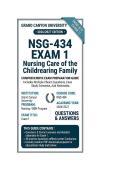
,NSG 434 Exam 1 Nursing Care of the Childrearing Family Questions
And Answers 2026/2027 Grand canyon university
Q1. Which approach best reflects family-centered pediatric nursing
care?
A) The nurse makes decisions independently to save time.
B) The family is treated as a partner in the child's care.
C) The child is excluded from age-appropriate discussions.
D) All families receive identical teaching regardless of their needs.
Correct Answer: B) The family is treated as a partner in the child's care
Rationale: Family-centered care recognizes the family as an important
partner and incorporates family knowledge, preferences, strengths, and
concerns into the child's care.
Q2. Which assessment technique should the nurse generally
perform first when evaluating a young child?
A) Deep abdominal palpation
B) Otoscopic examination
C) Auscultation of the heart
D) Observation
Correct Answer: D) Observation
Rationale: Observation can begin as soon as the nurse meets the child and
allows assessment of behavior, interaction, breathing, movement,
appearance, and developmental characteristics before potentially upsetting
procedures.
Q3. A toddler becomes frightened when the nurse approaches with a
stethoscope. Which action is most appropriate?
A) Allow the child to handle the equipment and proceed gradually.
B) Restrain the child immediately.
C) Perform the most invasive procedure first.
D) Ask the parent to leave the room.
Correct Answer: A) Allow the child to handle the equipment and proceed
gradually.
Rationale: Allowing a young child to explore equipment and proceed from
least threatening to more intrusive assessment techniques can reduce fear
and improve cooperation.
,Q4. Which behavior is most characteristic of a toddler during a
physical assessment?
A) Enjoying prolonged separation from parents
B) Preferring abstract explanations
C) Demonstrating stranger and separation anxiety
D) Understanding complex medical reasoning
Correct Answer: C) Demonstrating stranger and separation anxiety
Rationale: Toddlers commonly experience anxiety when separated from
caregivers and may fear unfamiliar people and procedures.
Q5. What is the most appropriate source of information when
assessing a nonverbal infant's health history?
A) A school report
B) The caregiver
C) The child's peer
D) The adolescent's partner
Correct Answer: B) The caregiver
Rationale: Caregivers provide essential information about the infant's
feeding, elimination, sleep, behavior, development, medical history, and
recent changes.
Q6. Which observation during a pediatric assessment is most useful
for evaluating respiratory distress?
A) Hair texture
B) Nail shape
C) Work of breathing
D) Appetite
Correct Answer: C) Work of breathing
Rationale: Nasal flaring, grunting, retractions, and increased respiratory
effort are important indicators of respiratory distress in children.
Q7. A nurse needs to obtain a blood pressure on an infant. Which
principle is most important?
A) Use a cuff appropriate for the child's arm size.
B) Use the largest adult cuff available.
, C) Place the cuff over clothing.
D) Measure blood pressure only when the child is crying.
Correct Answer: A) Use a cuff appropriate for the child's arm size.
Rationale: An appropriately sized cuff is necessary for an accurate pediatric
blood-pressure measurement. A cuff that is too large or too small can distort
the reading.
Q8. Which finding would most strongly suggest respiratory distress
in a child?
A) Calm breathing during sleep
B) Warm extremities
C) Normal appetite
D) Nasal flaring with intercostal retractions
Correct Answer: D) Nasal flaring with intercostal retractions
Rationale: Nasal flaring and retractions indicate increased respiratory effort
and may signal significant respiratory compromise.
Q9. Which pain-assessment method is most appropriate for a
school-age child who can reliably describe pain?
A) FLACC scale only
B) Numeric or developmentally appropriate self-report scale
C) Newborn behavioral scale
D) Parent's pain score only
Correct Answer: B) Numeric or developmentally appropriate self-report scale
Rationale: Children who can understand and communicate pain should
participate directly in pain assessment using an age-appropriate self-report
tool.
Q10. Which behavior is most expected from a hospitalized toddler?
A) Complete independence from caregivers
B) Increased need for familiar routines and caregivers
C) Preference for long explanations
D) Interest in abstract discussion
Correct Answer: B) Increased need for familiar routines and caregivers
Rationale: Hospitalization can increase separation anxiety and regression in
toddlers, making familiar people and routines particularly comforting.
And Answers 2026/2027 Grand canyon university
Q1. Which approach best reflects family-centered pediatric nursing
care?
A) The nurse makes decisions independently to save time.
B) The family is treated as a partner in the child's care.
C) The child is excluded from age-appropriate discussions.
D) All families receive identical teaching regardless of their needs.
Correct Answer: B) The family is treated as a partner in the child's care
Rationale: Family-centered care recognizes the family as an important
partner and incorporates family knowledge, preferences, strengths, and
concerns into the child's care.
Q2. Which assessment technique should the nurse generally
perform first when evaluating a young child?
A) Deep abdominal palpation
B) Otoscopic examination
C) Auscultation of the heart
D) Observation
Correct Answer: D) Observation
Rationale: Observation can begin as soon as the nurse meets the child and
allows assessment of behavior, interaction, breathing, movement,
appearance, and developmental characteristics before potentially upsetting
procedures.
Q3. A toddler becomes frightened when the nurse approaches with a
stethoscope. Which action is most appropriate?
A) Allow the child to handle the equipment and proceed gradually.
B) Restrain the child immediately.
C) Perform the most invasive procedure first.
D) Ask the parent to leave the room.
Correct Answer: A) Allow the child to handle the equipment and proceed
gradually.
Rationale: Allowing a young child to explore equipment and proceed from
least threatening to more intrusive assessment techniques can reduce fear
and improve cooperation.
,Q4. Which behavior is most characteristic of a toddler during a
physical assessment?
A) Enjoying prolonged separation from parents
B) Preferring abstract explanations
C) Demonstrating stranger and separation anxiety
D) Understanding complex medical reasoning
Correct Answer: C) Demonstrating stranger and separation anxiety
Rationale: Toddlers commonly experience anxiety when separated from
caregivers and may fear unfamiliar people and procedures.
Q5. What is the most appropriate source of information when
assessing a nonverbal infant's health history?
A) A school report
B) The caregiver
C) The child's peer
D) The adolescent's partner
Correct Answer: B) The caregiver
Rationale: Caregivers provide essential information about the infant's
feeding, elimination, sleep, behavior, development, medical history, and
recent changes.
Q6. Which observation during a pediatric assessment is most useful
for evaluating respiratory distress?
A) Hair texture
B) Nail shape
C) Work of breathing
D) Appetite
Correct Answer: C) Work of breathing
Rationale: Nasal flaring, grunting, retractions, and increased respiratory
effort are important indicators of respiratory distress in children.
Q7. A nurse needs to obtain a blood pressure on an infant. Which
principle is most important?
A) Use a cuff appropriate for the child's arm size.
B) Use the largest adult cuff available.
, C) Place the cuff over clothing.
D) Measure blood pressure only when the child is crying.
Correct Answer: A) Use a cuff appropriate for the child's arm size.
Rationale: An appropriately sized cuff is necessary for an accurate pediatric
blood-pressure measurement. A cuff that is too large or too small can distort
the reading.
Q8. Which finding would most strongly suggest respiratory distress
in a child?
A) Calm breathing during sleep
B) Warm extremities
C) Normal appetite
D) Nasal flaring with intercostal retractions
Correct Answer: D) Nasal flaring with intercostal retractions
Rationale: Nasal flaring and retractions indicate increased respiratory effort
and may signal significant respiratory compromise.
Q9. Which pain-assessment method is most appropriate for a
school-age child who can reliably describe pain?
A) FLACC scale only
B) Numeric or developmentally appropriate self-report scale
C) Newborn behavioral scale
D) Parent's pain score only
Correct Answer: B) Numeric or developmentally appropriate self-report scale
Rationale: Children who can understand and communicate pain should
participate directly in pain assessment using an age-appropriate self-report
tool.
Q10. Which behavior is most expected from a hospitalized toddler?
A) Complete independence from caregivers
B) Increased need for familiar routines and caregivers
C) Preference for long explanations
D) Interest in abstract discussion
Correct Answer: B) Increased need for familiar routines and caregivers
Rationale: Hospitalization can increase separation anxiety and regression in
toddlers, making familiar people and routines particularly comforting.


