

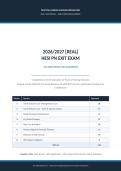
PRACTICAL NURSING LICENSURE PREPARATION
EDITION - HESI PN EXIT EXAM BLUEPRINT
2026/2027 [REAL]
HESI PN EXIT EXAM
110 QUESTIONS AND ANSWER(S)
Comprehensive Exit Examination for Practical Nursing Education
Aligned with the HESI PN Exit Exam Blueprint, NCLEX-PN Test Plan, and Practical Nursing Core
Competencies
Section Domain Questions
1 Safe & Effective Care - Management of Care 20
2 Safe & Effective Care - Safety & Infection Control 15
3 Health Promotion & Maintenance 15
4 Psychosocial Integrity 12
5 Basic Care & Comfort 18
6 Pharmacological & Parenteral Therapies 12
7 Reduction of Risk Potential 10
8 Physiological Adaptation 8
TOTAL 110
Cognitive Mix: 20% Recall - 50% Application - 30% Analysis (Priority & Critical Thinking)
For Educational Use - Practical Nursing Education & Licensure Preparation
, PRACTICAL NURSING LICENSURE PREPARATION
EDITION - HESI PN EXIT EXAM BLUEPRINT
Question Style: 75% Scenario-Based - 25% Direct Knowledge
Special Inclusions: 20 Priority-Setting Questions - 15 Pharmacology Questions - 15 Delegation (LPN vs.
UAP) Questions - 5 Integrated Case Studies
Format: Multiple Choice (4 options, one correct answer). Each question includes rationale with HESI PN Exit Exam
methodology and NCLEX-PN standards reference.
For Educational Use - Practical Nursing Education & Licensure Preparation
,2026/2027 [REAL] HESI PN EXIT EXAM - 110 QUESTIONS AND ANSWER(S) Aligned with HESI PN Blueprint & NCLEX-PN Test Plan
2026/2027 [REAL] HESI PN EXIT EXAM - 110 QUESTIONS AND ANSWER(S)
Aligned with HESI PN Exit Exam Blueprint and NCLEX-PN Test Plan (2026/2027 Edition)
Section 1: Safe & Effective Care Environment - Management of Care
Client rights, advocacy, legal/ethical issues, informed consent, advance directives, delegation (LPN scope vs. UAP), prioritization,
assignment, continuity of care, referrals, interdisciplinary collaboration, SBAR communication. 20 questions.
Q1: An LPN is caring for a 68-year-old client scheduled for a total hip replacement. The surgeon has explained
the procedure, risks, and benefits, but the client tells the LPN, "I'm not really sure I want to do this." Which
action by the LPN is MOST appropriate?
A. Witness the client's signature on the consent form and document the conversation
B. Notify the surgeon that the client has questions and may not be ready to sign the consent *[CORRECT]*
C. Explain the procedure again to the client using simpler language and answer questions
D. Encourage the client to sign the consent so the surgery can proceed as scheduled
Correct Answer: B
Rationale: Informed consent requires that the client fully understands the procedure, risks, benefits, and alternatives
before signing. The LPN's role is to advocate for the client by notifying the surgeon that the client has unresolved questions
or uncertainty. The surgeon, not the nurse, is responsible for obtaining informed consent and answering questions about the
procedure. Witnessing the consent or pressuring the client would be a violation of client rights under the Patient
Self-Determination Act.
Q2: The LPN is assigned to four clients. Which client should the LPN assess FIRST?
A. A 72-year-old client with pneumonia whose oxygen saturation is 92% on room air
B. A 48-year-old client who is 2 days post-op with a temperature of 100.8 F (38.2 C)
C. A 65-year-old client with heart failure reporting new-onset shortness of breath *[CORRECT]*
D. A 54-year-old client with diabetes whose fasting blood glucose is 145 mg/dL
Correct Answer: C
Rationale: Using the ABC (Airway, Breathing, Circulation) priority framework and the concept of acute change in
condition, the client with heart failure who is newly short of breath requires immediate assessment, as this may indicate
pulmonary edema or worsening heart failure. The other clients' findings are stable or expected for their conditions.
New-onset respiratory distress always takes priority over subacute or expected changes per NCLEX-PN prioritization
methodology.
Q3: Which document legally allows a competent adult to designate a healthcare proxy to make medical
decisions if they become incapacitated?
A. Living will
B. Durable power of attorney for health care *[CORRECT]*
C. Do-not-resuscitate (DNR) order
D. Informed consent form
Correct Answer: B
Rationale: The durable power of attorney for health care (also called healthcare proxy) is a legal document that designates
a surrogate decision-maker if the client becomes unable to make decisions. A living will specifies desired treatments in
specific situations but does not designate a person. A DNR order is a medical order regarding resuscitation. Informed
HESI PN Exit Exam Practice - 2026/2027 Edition Page 3
, 2026/2027 [REAL] HESI PN EXIT EXAM - 110 QUESTIONS AND ANSWER(S) Aligned with HESI PN Blueprint & NCLEX-PN Test Plan
consent is for specific procedures, not advance directives.
Q4: Case Study 1 (Part A): An LPN on a medical-surgical unit is working with one UAP. The team has four
clients: (1) a 78-year-old with pneumonia needing vitals every 4 hours; (2) a 45-year-old post-op day 1 from
appendectomy needing ambulation; (3) a 60-year-old with new-onset atrial fibrillation receiving IV heparin;
(4) a 32-year-old with a femoral fracture in Buck's traction needing perineal care. Which client should the LPN
care for directly?
A. Client 1 - obtaining vital signs
B. Client 2 - assisting with ambulation
C. Client 3 - monitoring for bleeding *[CORRECT]*
D. Client 4 - providing perineal care
Correct Answer: C
Rationale: The client with new-onset atrial fibrillation on IV heparin requires close nursing assessment for bleeding
complications, vital sign monitoring, and aPTT interpretation, which is within LPN scope but requires nursing judgment.
The other tasks (vital signs, ambulation of stable post-op client, perineal care) can be delegated to UAP with proper
direction and supervision. The LPN should retain clients requiring assessment, teaching, or unstable conditions per the five
rights of delegation.
Q5: Case Study 1 (Part B): Continuing the case above. Which task should the LPN delegate to the UAP?
A. Measuring the heparin infusion rate and documenting
B. Assessing the post-op client's incision site before ambulation
C. Ambulating the post-op appendectomy client for the first time post-op
D. Taking vital signs on the client with pneumonia *[CORRECT]*
Correct Answer: D
Rationale: UAP scope includes taking routine vital signs on stable clients. Measuring heparin infusion rates and
documenting on IV medications is the nurse's responsibility. Initial assessment before ambulation and first-time post-op
ambulation require nursing judgment. The UAP can take vitals on the stable pneumonia client and report any abnormal
values to the LPN. The LPN remains accountable for direction, supervision, and evaluation of delegated tasks.
Q6: An LPN receives four change-of-shift reports. Which client should the LPN see FIRST?
A. A client with COPD reporting increased cough and yellow sputum
B. A client with a new PICC line who has a temperature of 100.4 F (38 C)
C. A client with type 1 diabetes who received morning insulin but is refusing breakfast *[CORRECT]*
D. A client with chronic kidney disease whose potassium is 5.2 mEq/L
Correct Answer: C
Rationale: A client with type 1 diabetes who has received insulin but is refusing breakfast is at immediate risk for
hypoglycemia, which can rapidly become life-threatening. Using Maslow's hierarchy and the safety/risk reduction
framework, this client must be seen first to intervene quickly with oral carbohydrates or IV dextrose. The other clients need
prompt attention but their conditions are not as immediately dangerous as potential severe hypoglycemia.
Q7: While administering medications, the LPN realizes they gave the wrong dose of digoxin to a client. Which
action should the LPN take FIRST?
A. Complete an incident report and notify the charge nurse
B. Assess the client's vital signs and apical pulse *[CORRECT]*
HESI PN Exit Exam Practice - 2026/2027 Edition Page 4
EDITION - HESI PN EXIT EXAM BLUEPRINT
2026/2027 [REAL]
HESI PN EXIT EXAM
110 QUESTIONS AND ANSWER(S)
Comprehensive Exit Examination for Practical Nursing Education
Aligned with the HESI PN Exit Exam Blueprint, NCLEX-PN Test Plan, and Practical Nursing Core
Competencies
Section Domain Questions
1 Safe & Effective Care - Management of Care 20
2 Safe & Effective Care - Safety & Infection Control 15
3 Health Promotion & Maintenance 15
4 Psychosocial Integrity 12
5 Basic Care & Comfort 18
6 Pharmacological & Parenteral Therapies 12
7 Reduction of Risk Potential 10
8 Physiological Adaptation 8
TOTAL 110
Cognitive Mix: 20% Recall - 50% Application - 30% Analysis (Priority & Critical Thinking)
For Educational Use - Practical Nursing Education & Licensure Preparation
, PRACTICAL NURSING LICENSURE PREPARATION
EDITION - HESI PN EXIT EXAM BLUEPRINT
Question Style: 75% Scenario-Based - 25% Direct Knowledge
Special Inclusions: 20 Priority-Setting Questions - 15 Pharmacology Questions - 15 Delegation (LPN vs.
UAP) Questions - 5 Integrated Case Studies
Format: Multiple Choice (4 options, one correct answer). Each question includes rationale with HESI PN Exit Exam
methodology and NCLEX-PN standards reference.
For Educational Use - Practical Nursing Education & Licensure Preparation
,2026/2027 [REAL] HESI PN EXIT EXAM - 110 QUESTIONS AND ANSWER(S) Aligned with HESI PN Blueprint & NCLEX-PN Test Plan
2026/2027 [REAL] HESI PN EXIT EXAM - 110 QUESTIONS AND ANSWER(S)
Aligned with HESI PN Exit Exam Blueprint and NCLEX-PN Test Plan (2026/2027 Edition)
Section 1: Safe & Effective Care Environment - Management of Care
Client rights, advocacy, legal/ethical issues, informed consent, advance directives, delegation (LPN scope vs. UAP), prioritization,
assignment, continuity of care, referrals, interdisciplinary collaboration, SBAR communication. 20 questions.
Q1: An LPN is caring for a 68-year-old client scheduled for a total hip replacement. The surgeon has explained
the procedure, risks, and benefits, but the client tells the LPN, "I'm not really sure I want to do this." Which
action by the LPN is MOST appropriate?
A. Witness the client's signature on the consent form and document the conversation
B. Notify the surgeon that the client has questions and may not be ready to sign the consent *[CORRECT]*
C. Explain the procedure again to the client using simpler language and answer questions
D. Encourage the client to sign the consent so the surgery can proceed as scheduled
Correct Answer: B
Rationale: Informed consent requires that the client fully understands the procedure, risks, benefits, and alternatives
before signing. The LPN's role is to advocate for the client by notifying the surgeon that the client has unresolved questions
or uncertainty. The surgeon, not the nurse, is responsible for obtaining informed consent and answering questions about the
procedure. Witnessing the consent or pressuring the client would be a violation of client rights under the Patient
Self-Determination Act.
Q2: The LPN is assigned to four clients. Which client should the LPN assess FIRST?
A. A 72-year-old client with pneumonia whose oxygen saturation is 92% on room air
B. A 48-year-old client who is 2 days post-op with a temperature of 100.8 F (38.2 C)
C. A 65-year-old client with heart failure reporting new-onset shortness of breath *[CORRECT]*
D. A 54-year-old client with diabetes whose fasting blood glucose is 145 mg/dL
Correct Answer: C
Rationale: Using the ABC (Airway, Breathing, Circulation) priority framework and the concept of acute change in
condition, the client with heart failure who is newly short of breath requires immediate assessment, as this may indicate
pulmonary edema or worsening heart failure. The other clients' findings are stable or expected for their conditions.
New-onset respiratory distress always takes priority over subacute or expected changes per NCLEX-PN prioritization
methodology.
Q3: Which document legally allows a competent adult to designate a healthcare proxy to make medical
decisions if they become incapacitated?
A. Living will
B. Durable power of attorney for health care *[CORRECT]*
C. Do-not-resuscitate (DNR) order
D. Informed consent form
Correct Answer: B
Rationale: The durable power of attorney for health care (also called healthcare proxy) is a legal document that designates
a surrogate decision-maker if the client becomes unable to make decisions. A living will specifies desired treatments in
specific situations but does not designate a person. A DNR order is a medical order regarding resuscitation. Informed
HESI PN Exit Exam Practice - 2026/2027 Edition Page 3
, 2026/2027 [REAL] HESI PN EXIT EXAM - 110 QUESTIONS AND ANSWER(S) Aligned with HESI PN Blueprint & NCLEX-PN Test Plan
consent is for specific procedures, not advance directives.
Q4: Case Study 1 (Part A): An LPN on a medical-surgical unit is working with one UAP. The team has four
clients: (1) a 78-year-old with pneumonia needing vitals every 4 hours; (2) a 45-year-old post-op day 1 from
appendectomy needing ambulation; (3) a 60-year-old with new-onset atrial fibrillation receiving IV heparin;
(4) a 32-year-old with a femoral fracture in Buck's traction needing perineal care. Which client should the LPN
care for directly?
A. Client 1 - obtaining vital signs
B. Client 2 - assisting with ambulation
C. Client 3 - monitoring for bleeding *[CORRECT]*
D. Client 4 - providing perineal care
Correct Answer: C
Rationale: The client with new-onset atrial fibrillation on IV heparin requires close nursing assessment for bleeding
complications, vital sign monitoring, and aPTT interpretation, which is within LPN scope but requires nursing judgment.
The other tasks (vital signs, ambulation of stable post-op client, perineal care) can be delegated to UAP with proper
direction and supervision. The LPN should retain clients requiring assessment, teaching, or unstable conditions per the five
rights of delegation.
Q5: Case Study 1 (Part B): Continuing the case above. Which task should the LPN delegate to the UAP?
A. Measuring the heparin infusion rate and documenting
B. Assessing the post-op client's incision site before ambulation
C. Ambulating the post-op appendectomy client for the first time post-op
D. Taking vital signs on the client with pneumonia *[CORRECT]*
Correct Answer: D
Rationale: UAP scope includes taking routine vital signs on stable clients. Measuring heparin infusion rates and
documenting on IV medications is the nurse's responsibility. Initial assessment before ambulation and first-time post-op
ambulation require nursing judgment. The UAP can take vitals on the stable pneumonia client and report any abnormal
values to the LPN. The LPN remains accountable for direction, supervision, and evaluation of delegated tasks.
Q6: An LPN receives four change-of-shift reports. Which client should the LPN see FIRST?
A. A client with COPD reporting increased cough and yellow sputum
B. A client with a new PICC line who has a temperature of 100.4 F (38 C)
C. A client with type 1 diabetes who received morning insulin but is refusing breakfast *[CORRECT]*
D. A client with chronic kidney disease whose potassium is 5.2 mEq/L
Correct Answer: C
Rationale: A client with type 1 diabetes who has received insulin but is refusing breakfast is at immediate risk for
hypoglycemia, which can rapidly become life-threatening. Using Maslow's hierarchy and the safety/risk reduction
framework, this client must be seen first to intervene quickly with oral carbohydrates or IV dextrose. The other clients need
prompt attention but their conditions are not as immediately dangerous as potential severe hypoglycemia.
Q7: While administering medications, the LPN realizes they gave the wrong dose of digoxin to a client. Which
action should the LPN take FIRST?
A. Complete an incident report and notify the charge nurse
B. Assess the client's vital signs and apical pulse *[CORRECT]*
HESI PN Exit Exam Practice - 2026/2027 Edition Page 4


