CPNRE PREP YARDSTICK EXAM 2026 - MIDTERM
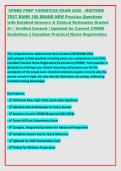
TEST BANK 180 BRAND NEW Practice Questions
with Detailed Answers & Clinical Rationales Graded
A+ | Verified Content | Updated for Current CPNRE
Guidelines || Canadian Practical Nurse Registration
This comprehensive midterm test bank contains 180 BRAND NEW
meticulously crafted questions covering every core competency area of the
Canadian Practical Nurse Registration Examination (CPNRE). Each question is
designed to challenge your clinical reasoning and prepare you for the
complexity of the actual exam. Detailed rationales explain not only why the
correct answer is right, but also why the distractors are wrong, reinforcing
essential nursing knowledge.
Key Features:
- ✅ 180 Brand New, High-Yield, Exam-Style Questions
- ✅ Detailed Clinical Rationales for Every Answer
- ✅ Based on Current CPNRE Blueprint (2022-2026)
- ✅ Covers All Core Competency Areas
- ✅ Complex, Integrated Questions for Advanced Preparation
- ✅ Complete Answer Key for Quick Reference
- ✅ Updated for 2026 Examination Cycle
- ✅ Perfect for Midterm Preparation
,PRACTICE MIDTERM EXAM
Question 1
A client with a history of chronic obstructive pulmonary disease (COPD) is
admitted with shortness of breath. The nurse notes the client is using pursed-
lip breathing. Which of the following is the priority nursing action?
A) Administer oxygen at 4 L/min via nasal cannula
B) Encourage the client to continue pursed-lip breathing
C) Place the client in a supine position
D) Prepare for immediate intubation
Correct Answer: B
Rationale: Pursed-lip breathing is an effective technique for clients with COPD
to prolong exhalation and prevent airway collapse. The nurse should
encourage the client to continue this technique as it is beneficial. High-flow
oxygen should be used with caution in COPD as it can depress the respiratory
drive. Supine position would worsen dyspnea. Intubation is not indicated
unless the client is in respiratory failure.
Question 2
,A client who is postoperative day 1 after abdominal surgery has a nasogastric
tube. Which of the following assessment findings would indicate a
complication?
A) Drainage of 50 mL of greenish fluid in the past 4 hours
B) Complaints of nausea
C) Absence of bowel sounds
D) Drainage of 500 mL of bright red blood
Correct Answer: D
Rationale: Drainage of bright red blood from a nasogastric tube indicates
active gastrointestinal bleeding, which is a serious complication. Drainage of
greenish fluid is normal gastric contents. Nausea and absent bowel sounds can
be expected postoperatively but should be monitored.
Question 3
A practical nurse is caring for a client who is receiving IV fluids via a peripheral
IV. Which of the following actions is most important to prevent infection?
A) Change the IV site every 72 hours
B) Use sterile technique during insertion
C) Flush the IV line with heparin
D) Apply a transparent dressing over the site
Correct Answer: B
, Rationale: Using sterile technique during IV insertion is the most important
action to prevent infection. IV sites should be changed when clinically
indicated, not routinely. Heparin flushes are used to maintain patency, not
prevent infection. Transparent dressings allow visualization of the site but do
not prevent infection.
Question 4
A client with diabetes mellitus is experiencing hypoglycemia. Which of the
following is the most appropriate initial intervention?
A) Administer glucagon intramuscularly
B) Provide 15 grams of fast-acting carbohydrates
C) Check blood glucose level
D) Administer IV dextrose
Correct Answer: C
Rationale: The priority is to check the client's blood glucose level to confirm
hypoglycemia before intervening. Providing carbohydrates, glucagon, or IV
dextrose should only be done after confirming the blood glucose level is low.
Question 5
TEST BANK 180 BRAND NEW Practice Questions
with Detailed Answers & Clinical Rationales Graded
A+ | Verified Content | Updated for Current CPNRE
Guidelines || Canadian Practical Nurse Registration
This comprehensive midterm test bank contains 180 BRAND NEW
meticulously crafted questions covering every core competency area of the
Canadian Practical Nurse Registration Examination (CPNRE). Each question is
designed to challenge your clinical reasoning and prepare you for the
complexity of the actual exam. Detailed rationales explain not only why the
correct answer is right, but also why the distractors are wrong, reinforcing
essential nursing knowledge.
Key Features:
- ✅ 180 Brand New, High-Yield, Exam-Style Questions
- ✅ Detailed Clinical Rationales for Every Answer
- ✅ Based on Current CPNRE Blueprint (2022-2026)
- ✅ Covers All Core Competency Areas
- ✅ Complex, Integrated Questions for Advanced Preparation
- ✅ Complete Answer Key for Quick Reference
- ✅ Updated for 2026 Examination Cycle
- ✅ Perfect for Midterm Preparation
,PRACTICE MIDTERM EXAM
Question 1
A client with a history of chronic obstructive pulmonary disease (COPD) is
admitted with shortness of breath. The nurse notes the client is using pursed-
lip breathing. Which of the following is the priority nursing action?
A) Administer oxygen at 4 L/min via nasal cannula
B) Encourage the client to continue pursed-lip breathing
C) Place the client in a supine position
D) Prepare for immediate intubation
Correct Answer: B
Rationale: Pursed-lip breathing is an effective technique for clients with COPD
to prolong exhalation and prevent airway collapse. The nurse should
encourage the client to continue this technique as it is beneficial. High-flow
oxygen should be used with caution in COPD as it can depress the respiratory
drive. Supine position would worsen dyspnea. Intubation is not indicated
unless the client is in respiratory failure.
Question 2
,A client who is postoperative day 1 after abdominal surgery has a nasogastric
tube. Which of the following assessment findings would indicate a
complication?
A) Drainage of 50 mL of greenish fluid in the past 4 hours
B) Complaints of nausea
C) Absence of bowel sounds
D) Drainage of 500 mL of bright red blood
Correct Answer: D
Rationale: Drainage of bright red blood from a nasogastric tube indicates
active gastrointestinal bleeding, which is a serious complication. Drainage of
greenish fluid is normal gastric contents. Nausea and absent bowel sounds can
be expected postoperatively but should be monitored.
Question 3
A practical nurse is caring for a client who is receiving IV fluids via a peripheral
IV. Which of the following actions is most important to prevent infection?
A) Change the IV site every 72 hours
B) Use sterile technique during insertion
C) Flush the IV line with heparin
D) Apply a transparent dressing over the site
Correct Answer: B
, Rationale: Using sterile technique during IV insertion is the most important
action to prevent infection. IV sites should be changed when clinically
indicated, not routinely. Heparin flushes are used to maintain patency, not
prevent infection. Transparent dressings allow visualization of the site but do
not prevent infection.
Question 4
A client with diabetes mellitus is experiencing hypoglycemia. Which of the
following is the most appropriate initial intervention?
A) Administer glucagon intramuscularly
B) Provide 15 grams of fast-acting carbohydrates
C) Check blood glucose level
D) Administer IV dextrose
Correct Answer: C
Rationale: The priority is to check the client's blood glucose level to confirm
hypoglycemia before intervening. Providing carbohydrates, glucagon, or IV
dextrose should only be done after confirming the blood glucose level is low.
Question 5