
Part 1
aim-Standard solution of 0.1M of sodium carbonate.
Context
I'm a chemist at chemicalequip analysing titration and colorimetry procedures .
Calibration is the action of making sure a measuring equipment is accurate so that its
readings match a known standard. Before the practical started me and my class calibrated
the balance, To ensure the measurements were accurate for the practical so that there will
be no errors/negative impacts to my results.
Method
To calibrate the balance I placed it onto a flat surface and made it balanced with a spirit
level. I then waited for the balance to stabilise for a few minutes.I also checked the balance
to ensure there weren't any substances that may have affected the result ,while I had gloves
on and using tweezers I placed a 200g weight on top of the scale and recorded the mass
this was repeated 3 times. My results are below.These results were in tolerance of the
equipment this means that the results have a difference of 0.1 or less which means the
balance was usable for the experiment .
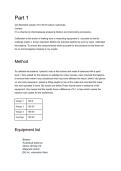
Weigh 1 199.9
Weigh 2 199.93
Weigh 3 199.94
average 199.92
Equipment list
-Beaker
-Analytical balance:
-Glass stirring rod
-Magnetic stirrer:
250 mL volumetric flask:
, -Distilled water:
-Funnel:
-Safety glasses:
-sodium carbonate
A standard solution refers to a solution that has a precise known concentration of a
recorded element.
A volumetric flask was used instead of a measuring cylinder because it provides
significantly higher accuracy due to its narrow neck and calibration mark.
Method for standard solution
Measure 2.65 grams of sodium carbonate.I used a spatula to ensure that the mass
reached exactly 2.65 grams
The weighing boat was rinsed with deionised water so that any debris or substances
get removed from the weighing boat.
Pour carefully into a beaker and dissolve in water.
Remove residue from the beaker to ensure that all of the sodium carbonate is in the
flask without it getting mixed.
Pour the solution into a volumetric flask until the solution fills up the line (250cm) so
that it can only be used for the sodium carbonate to dissolve with water.
Place a lid/stopper so that the solution can be mixed then the solution is labelled.
Calculating the moles
Volume =250/1000=0.250 dm3
moles=concentration x volume
Moles = 0.1x 0.250dm3
moles = 0.025
Finding the mr of Na2CO3
(23x2)+(16x3)+12
Mr of Na2Co3=106
Volume =250/1000=0.250 dm3
Mass = 0.1x106x0.250=2.65g
Health and safety implications
, Danger risk Prevention method In case of an
emergency
Sodium carbonate Serious eye Wearing goggles Washing the
irritation infected area and
informing a
teacher
glassware Cuts from broken Being careful with Clean it
glass beakers immediately
Sodium carbonate eye irritation Avoid contact from Use cold water to
being spilled skin and eyes wash it off and
inform a teacher
Distilled water Falling from spilled Being careful with inform a
water the water teacher,clean the
spilled water.
Risk assessment paragraph
The chemical substances were quite dangerous if they were caught in contact with
our skin and eyes. I counteracted this by wearing goggles to protect myself from
getting eye irritations and I also washed my hands if any of the substances came in
contact with my skin.I placed bags away from the floor so that i wouldn't trip/drop any
of the beakers and glass equipment and if anything extreme was to happen like
excessive skin burns from the chemical products i would inform a teacher.
Evaluation
On the calibration I believe it was done well because the results were in tolerance
0.1g of each other and i ensured the scales were balanced at spirit level however I
feel like when checking for any residue in the weighing scale I could've been more
thorough to ensure that it is more accurate and perhaps gain the exact same weight
in each recording also during the experiment i forgot to place the stopper and didn't
shake the solution as effectively which resulted in me re attempting the experiment
as this would’ve heavily affected how well the sodium carbonate solution dissolved.
I also ensured that I used a pipette to enhance my accuracy throughout the
experiment.
The experiment was repeated 3 times to show consistency in my results however
repeating the experiment 2 more times would’ve been better to show how consistent
the experiment was.
I believe that I was consistent with ensuring that the solution filled up to 250 cm3 and
remembered to remove the funnel after pouring to make sure any excess solution
does not get spilled which would ensure that my results were consistent.
aim-Standard solution of 0.1M of sodium carbonate.
Context
I'm a chemist at chemicalequip analysing titration and colorimetry procedures .
Calibration is the action of making sure a measuring equipment is accurate so that its
readings match a known standard. Before the practical started me and my class calibrated
the balance, To ensure the measurements were accurate for the practical so that there will
be no errors/negative impacts to my results.
Method
To calibrate the balance I placed it onto a flat surface and made it balanced with a spirit
level. I then waited for the balance to stabilise for a few minutes.I also checked the balance
to ensure there weren't any substances that may have affected the result ,while I had gloves
on and using tweezers I placed a 200g weight on top of the scale and recorded the mass
this was repeated 3 times. My results are below.These results were in tolerance of the
equipment this means that the results have a difference of 0.1 or less which means the
balance was usable for the experiment .
Weigh 1 199.9
Weigh 2 199.93
Weigh 3 199.94
average 199.92
Equipment list
-Beaker
-Analytical balance:
-Glass stirring rod
-Magnetic stirrer:
250 mL volumetric flask:
, -Distilled water:
-Funnel:
-Safety glasses:
-sodium carbonate
A standard solution refers to a solution that has a precise known concentration of a
recorded element.
A volumetric flask was used instead of a measuring cylinder because it provides
significantly higher accuracy due to its narrow neck and calibration mark.
Method for standard solution
Measure 2.65 grams of sodium carbonate.I used a spatula to ensure that the mass
reached exactly 2.65 grams
The weighing boat was rinsed with deionised water so that any debris or substances
get removed from the weighing boat.
Pour carefully into a beaker and dissolve in water.
Remove residue from the beaker to ensure that all of the sodium carbonate is in the
flask without it getting mixed.
Pour the solution into a volumetric flask until the solution fills up the line (250cm) so
that it can only be used for the sodium carbonate to dissolve with water.
Place a lid/stopper so that the solution can be mixed then the solution is labelled.
Calculating the moles
Volume =250/1000=0.250 dm3
moles=concentration x volume
Moles = 0.1x 0.250dm3
moles = 0.025
Finding the mr of Na2CO3
(23x2)+(16x3)+12
Mr of Na2Co3=106
Volume =250/1000=0.250 dm3
Mass = 0.1x106x0.250=2.65g
Health and safety implications
, Danger risk Prevention method In case of an
emergency
Sodium carbonate Serious eye Wearing goggles Washing the
irritation infected area and
informing a
teacher
glassware Cuts from broken Being careful with Clean it
glass beakers immediately
Sodium carbonate eye irritation Avoid contact from Use cold water to
being spilled skin and eyes wash it off and
inform a teacher
Distilled water Falling from spilled Being careful with inform a
water the water teacher,clean the
spilled water.
Risk assessment paragraph
The chemical substances were quite dangerous if they were caught in contact with
our skin and eyes. I counteracted this by wearing goggles to protect myself from
getting eye irritations and I also washed my hands if any of the substances came in
contact with my skin.I placed bags away from the floor so that i wouldn't trip/drop any
of the beakers and glass equipment and if anything extreme was to happen like
excessive skin burns from the chemical products i would inform a teacher.
Evaluation
On the calibration I believe it was done well because the results were in tolerance
0.1g of each other and i ensured the scales were balanced at spirit level however I
feel like when checking for any residue in the weighing scale I could've been more
thorough to ensure that it is more accurate and perhaps gain the exact same weight
in each recording also during the experiment i forgot to place the stopper and didn't
shake the solution as effectively which resulted in me re attempting the experiment
as this would’ve heavily affected how well the sodium carbonate solution dissolved.
I also ensured that I used a pipette to enhance my accuracy throughout the
experiment.
The experiment was repeated 3 times to show consistency in my results however
repeating the experiment 2 more times would’ve been better to show how consistent
the experiment was.
I believe that I was consistent with ensuring that the solution filled up to 250 cm3 and
remembered to remove the funnel after pouring to make sure any excess solution
does not get spilled which would ensure that my results were consistent.


