
ATI PN Fundamentals Proctored Exam | 2026/2027 Edition 70 Verified Questions
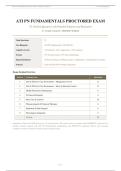
ATI PN FUNDAMENTALS PROCTORED EXAM
70 Verified Questions with Detailed Solutions and Rationales
A+ Grade Assured • 2026/2027 Edition
Total Questions 70
Test Blueprint ATI PN Fundamentals / NCLEX-PN
Cognitive Levels ~20% Recall / ~50% Application / ~30% Analysis
Format 75% Scenario-based, 25% Direct Knowledge
Special Inclusions 10 Priority-Setting • 8 Pharmacology • 8 Delegation • 3 Integrated Case Studies
Sections 8 (per NCLEX-PN Test Plan Categories)
Exam Section Overview
Section Content Area Questions
1 Safe & Effective Care Environment – Management of Care 12
2 Safe & Effective Care Environment – Safety & Infection Control 12
3 Health Promotion & Maintenance 8
4 Psychosocial Integrity 8
5 Basic Care & Comfort 10
6 Pharmacological & Parenteral Therapies 8
7 Reduction of Risk Potential 6
8 Physiological Adaptation 6
TOTAL 70
Instructions: Choose the ONE best answer for each question. The correct answer is marked with [CORRECT], followed by a
detailed rationale aligned with ATI PN Fundamentals methodology and NCLEX-PN standards. Review each rationale
carefully to reinforce clinical reasoning and test-taking strategy.
Page 1
,ATI PN Fundamentals Proctored Exam | 2026/2027 Edition 70 Verified Questions
Section 1: Safe & Effective Care Environment – Management of Care
Q1–Q12 (12 questions) — Client rights, advocacy, legal/ethical issues, informed consent, advance directives, delegation,
prioritization, LPN vs. UAP scope.
Q1: A 68-year-old client scheduled for a coronary angiogram tells the practical nurse (PN), "I changed
my mind; I don't want this procedure." Which action should the PN take first?
A. Notify the provider immediately so the procedure can be cancelled.
B. Remind the client that the consent form is already signed and legally binding.
C. Explore the client's concerns and reinforce that they have the right to refuse treatment.
*[CORRECT]*
D. Document the client's statement and continue preparing for the procedure.
Correct Answer: C (C. Explore the client's concerns and reinforce that they have the right to refuse
treatment.)
Rationale: Competent clients have the legal and ethical right to refuse any treatment, even after signing a consent
form. The PN must first explore the client's concerns to identify misunderstandings or fears, reinforce the right to
refuse, and then notify the provider. Option B is incorrect because a signed consent is not irreversible. Option A is
premature before assessing the client's understanding, and Option D ignores the client's stated wish.
Q2: A 16-year-old client presents to the clinic requesting treatment for a sexually transmitted infection
(STI) and asks the PN not to inform her parents. Which action is most appropriate?
A. Refuse treatment until parental consent is obtained.
B. Provide treatment because minors may consent to STI services without parental notification.
*[CORRECT]*
C. Treat the client but notify the parents afterward to ensure follow-up.
D. Refer the client to the emergency department for evaluation.
Correct Answer: B (B. Provide treatment because minors may consent to STI services without parental
notification.)
Rationale: In most jurisdictions, minors can consent to diagnosis and treatment of STIs without parental notification
under confidential adolescent care provisions. Option A would deny necessary care, Option C breaches confidentiality,
and Option D is an unnecessary referral. The PN should provide education, treatment per protocol, and encourage the
client to involve a trusted adult.
Q3: An alert, oriented 82-year-old client with end-stage COPD tells the PN she does not want intubation
or mechanical ventilation if she stops breathing. Which documentation is most appropriate?
A. Client states she wants no further treatment.
B. Client has a do-not-resuscitate order; no interventions needed.
C. Client expressed a desire to limit life-sustaining treatment; provider notified to discuss advance
directives. *[CORRECT]*
D. Client refuses care; family notified of the decision.
Correct Answer: C (C. Client expressed a desire to limit life-sustaining treatment; provider notified to
discuss advanc...)
Rationale: The PN's documentation should be factual and reflect the client's wishes regarding life-sustaining
treatment, as well as the action taken (notifying the provider to formalize an advance directive or DNR order). Option
Page 2
, ATI PN Fundamentals Proctored Exam | 2026/2027 Edition 70 Verified Questions
A is vague, Option B implies a DNR is already in place when one has not yet been ordered, and Option D inaccurately
states the client refuses all care and violates confidentiality by notifying family without consent.
Q4: Which of the following tasks is most appropriate for the PN to delegate to an unlicensed assistive
personnel (UAP)?
A. Reinforcing teaching about a low-sodium diet for a client with heart failure.
B. Ambulating a stable client 3 days postoperative from an appendectomy. *[CORRECT]*
C. Assessing a client's wound for signs of infection.
D. Administering an oral analgesic to a client with mild pain.
Correct Answer: B (B. Ambulating a stable client 3 days postoperative from an appendectomy.)
Rationale: UAP may perform routine tasks such as ambulation of stable clients. Option A requires nursing knowledge
(teaching is the nurse's responsibility), Option B involves assessment which is outside UAP scope, and Option D
involves medication administration which is a licensed nursing task. The PN retains responsibility for assessment,
teaching, and medication administration.
Q5: A charge nurse is making assignments for a medical unit. Which client should be assigned to an
LPN/LVN rather than an RN?
A. A client who received a blood transfusion 30 minutes ago and reports chills.
B. A client with a new colostomy who needs teaching on stoma care.
C. A stable client with a chronic non-infected pressure ulcer requiring a dressing change.
*[CORRECT]*
D. A client admitted 2 hours ago with acute exacerbation of heart failure.
Correct Answer: C (C. A stable client with a chronic non-infected pressure ulcer requiring a dressing
change.)
Rationale: LPNs/LVNs care for stable clients with predictable outcomes, including routine dressing changes for
chronic non-infected wounds. Options A, B, and D involve clients with unstable or complex needs requiring the RN's
assessment, teaching, and evaluation skills. The PN scope emphasizes maintenance care for clients with established
plans of care.
Q6: CASE STUDY (Part 1 of 3): A 74-year-old female is admitted to the medical unit with pneumonia,
heart failure, and type 2 diabetes. She is receiving IV antibiotics, oral furosemide, and sliding-scale
insulin. The PN is caring for four clients. Which client should the PN assess first?
A. The 74-year-old client with pneumonia whose pulse oximetry has dropped from 95% to 89% on
room air. *[CORRECT]*
B. A client 1 day post-op with an oral temperature of 99.5°F (37.5°C).
C. A client requesting pain medication for chronic arthritis rated at 5/10.
D. A client with a new colostomy who has questions about diet.
Correct Answer: A (A. The 74-year-old client with pneumonia whose pulse oximetry has dropped from
95% to 89% on room air.)
Rationale: Using the ABC (airway, breathing, circulation) priority framework, a drop in oxygen saturation to 89%
indicates hypoxemia and potential respiratory compromise requiring immediate assessment and intervention. The
other clients have stable or non-urgent needs. The PN should assess the hypoxic client first and notify the RN or
provider for oxygen therapy orders.
Page 3
ATI PN FUNDAMENTALS PROCTORED EXAM
70 Verified Questions with Detailed Solutions and Rationales
A+ Grade Assured • 2026/2027 Edition
Total Questions 70
Test Blueprint ATI PN Fundamentals / NCLEX-PN
Cognitive Levels ~20% Recall / ~50% Application / ~30% Analysis
Format 75% Scenario-based, 25% Direct Knowledge
Special Inclusions 10 Priority-Setting • 8 Pharmacology • 8 Delegation • 3 Integrated Case Studies
Sections 8 (per NCLEX-PN Test Plan Categories)
Exam Section Overview
Section Content Area Questions
1 Safe & Effective Care Environment – Management of Care 12
2 Safe & Effective Care Environment – Safety & Infection Control 12
3 Health Promotion & Maintenance 8
4 Psychosocial Integrity 8
5 Basic Care & Comfort 10
6 Pharmacological & Parenteral Therapies 8
7 Reduction of Risk Potential 6
8 Physiological Adaptation 6
TOTAL 70
Instructions: Choose the ONE best answer for each question. The correct answer is marked with [CORRECT], followed by a
detailed rationale aligned with ATI PN Fundamentals methodology and NCLEX-PN standards. Review each rationale
carefully to reinforce clinical reasoning and test-taking strategy.
Page 1
,ATI PN Fundamentals Proctored Exam | 2026/2027 Edition 70 Verified Questions
Section 1: Safe & Effective Care Environment – Management of Care
Q1–Q12 (12 questions) — Client rights, advocacy, legal/ethical issues, informed consent, advance directives, delegation,
prioritization, LPN vs. UAP scope.
Q1: A 68-year-old client scheduled for a coronary angiogram tells the practical nurse (PN), "I changed
my mind; I don't want this procedure." Which action should the PN take first?
A. Notify the provider immediately so the procedure can be cancelled.
B. Remind the client that the consent form is already signed and legally binding.
C. Explore the client's concerns and reinforce that they have the right to refuse treatment.
*[CORRECT]*
D. Document the client's statement and continue preparing for the procedure.
Correct Answer: C (C. Explore the client's concerns and reinforce that they have the right to refuse
treatment.)
Rationale: Competent clients have the legal and ethical right to refuse any treatment, even after signing a consent
form. The PN must first explore the client's concerns to identify misunderstandings or fears, reinforce the right to
refuse, and then notify the provider. Option B is incorrect because a signed consent is not irreversible. Option A is
premature before assessing the client's understanding, and Option D ignores the client's stated wish.
Q2: A 16-year-old client presents to the clinic requesting treatment for a sexually transmitted infection
(STI) and asks the PN not to inform her parents. Which action is most appropriate?
A. Refuse treatment until parental consent is obtained.
B. Provide treatment because minors may consent to STI services without parental notification.
*[CORRECT]*
C. Treat the client but notify the parents afterward to ensure follow-up.
D. Refer the client to the emergency department for evaluation.
Correct Answer: B (B. Provide treatment because minors may consent to STI services without parental
notification.)
Rationale: In most jurisdictions, minors can consent to diagnosis and treatment of STIs without parental notification
under confidential adolescent care provisions. Option A would deny necessary care, Option C breaches confidentiality,
and Option D is an unnecessary referral. The PN should provide education, treatment per protocol, and encourage the
client to involve a trusted adult.
Q3: An alert, oriented 82-year-old client with end-stage COPD tells the PN she does not want intubation
or mechanical ventilation if she stops breathing. Which documentation is most appropriate?
A. Client states she wants no further treatment.
B. Client has a do-not-resuscitate order; no interventions needed.
C. Client expressed a desire to limit life-sustaining treatment; provider notified to discuss advance
directives. *[CORRECT]*
D. Client refuses care; family notified of the decision.
Correct Answer: C (C. Client expressed a desire to limit life-sustaining treatment; provider notified to
discuss advanc...)
Rationale: The PN's documentation should be factual and reflect the client's wishes regarding life-sustaining
treatment, as well as the action taken (notifying the provider to formalize an advance directive or DNR order). Option
Page 2
, ATI PN Fundamentals Proctored Exam | 2026/2027 Edition 70 Verified Questions
A is vague, Option B implies a DNR is already in place when one has not yet been ordered, and Option D inaccurately
states the client refuses all care and violates confidentiality by notifying family without consent.
Q4: Which of the following tasks is most appropriate for the PN to delegate to an unlicensed assistive
personnel (UAP)?
A. Reinforcing teaching about a low-sodium diet for a client with heart failure.
B. Ambulating a stable client 3 days postoperative from an appendectomy. *[CORRECT]*
C. Assessing a client's wound for signs of infection.
D. Administering an oral analgesic to a client with mild pain.
Correct Answer: B (B. Ambulating a stable client 3 days postoperative from an appendectomy.)
Rationale: UAP may perform routine tasks such as ambulation of stable clients. Option A requires nursing knowledge
(teaching is the nurse's responsibility), Option B involves assessment which is outside UAP scope, and Option D
involves medication administration which is a licensed nursing task. The PN retains responsibility for assessment,
teaching, and medication administration.
Q5: A charge nurse is making assignments for a medical unit. Which client should be assigned to an
LPN/LVN rather than an RN?
A. A client who received a blood transfusion 30 minutes ago and reports chills.
B. A client with a new colostomy who needs teaching on stoma care.
C. A stable client with a chronic non-infected pressure ulcer requiring a dressing change.
*[CORRECT]*
D. A client admitted 2 hours ago with acute exacerbation of heart failure.
Correct Answer: C (C. A stable client with a chronic non-infected pressure ulcer requiring a dressing
change.)
Rationale: LPNs/LVNs care for stable clients with predictable outcomes, including routine dressing changes for
chronic non-infected wounds. Options A, B, and D involve clients with unstable or complex needs requiring the RN's
assessment, teaching, and evaluation skills. The PN scope emphasizes maintenance care for clients with established
plans of care.
Q6: CASE STUDY (Part 1 of 3): A 74-year-old female is admitted to the medical unit with pneumonia,
heart failure, and type 2 diabetes. She is receiving IV antibiotics, oral furosemide, and sliding-scale
insulin. The PN is caring for four clients. Which client should the PN assess first?
A. The 74-year-old client with pneumonia whose pulse oximetry has dropped from 95% to 89% on
room air. *[CORRECT]*
B. A client 1 day post-op with an oral temperature of 99.5°F (37.5°C).
C. A client requesting pain medication for chronic arthritis rated at 5/10.
D. A client with a new colostomy who has questions about diet.
Correct Answer: A (A. The 74-year-old client with pneumonia whose pulse oximetry has dropped from
95% to 89% on room air.)
Rationale: Using the ABC (airway, breathing, circulation) priority framework, a drop in oxygen saturation to 89%
indicates hypoxemia and potential respiratory compromise requiring immediate assessment and intervention. The
other clients have stable or non-urgent needs. The PN should assess the hypoxic client first and notify the RN or
provider for oxygen therapy orders.
Page 3


