
1|Page
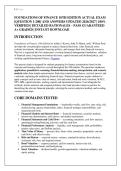
FOUNDATIONS OF FINANCE 10TH EDITION ACTUAL EXAM
[QUESTION 1-200] AND ANSWERS UPDATED 2026/2027 | 100%
VERIFIED | DETAILED RATIONALES – PASS GUARANTEED
A+ GRADED | INSTANT DOWNLOAD
INTRODUCTION
Foundations of Finance, 10th Edition by Arthur J. Keown, John D. Martin, and J. William Petty
develops the core principles required to analyze financial decisions, value financial assets,
evaluate investments, determine financing policies, and manage short-term financial resources.
The text is organized into five major parts covering financial-management foundations, valuation
of financial assets, long-term investment decisions, capital structure and dividend policy, and
working-capital/international finance. (Pearson)
This practice bank is designed for students preparing for finance examinations based on the
concepts and learning objectives covered throughout the 10th edition. The questions emphasize
application, quantitative reasoning, financial decision-making, interpretation, and scenario
analysis rather than simple memorization. Each item contains four choices, one best answer, and
a rationale explaining the underlying financial logic. Numerical questions require students to
apply concepts such as time value of money, risk and return, bond and stock valuation, WACC,
NPV, IRR, capital structure, working capital, and international finance. Used alongside the
textbook, lecture material, and assigned problems, this bank provides intensive practice for
identifying the relevant financial principle, selecting the correct analytical method, and avoiding
common exam traps.
CORE DOMAINS TESTED
1. Financial Management Foundations — shareholder wealth, cash flow, time value, risk,
market pricing, agency relationships, ethics, financial-manager responsibilities, and
organizational forms.
2. Financial Markets and Interest Rates — financial institutions, securities markets,
interest-rate determination, yield curves, and market mechanisms.
3. Financial Statements and Cash Flows — accounting statements, cash flow analysis,
operating/investing/financing activities, and free cash flow.
4. Financial Performance Analysis — liquidity, asset management, debt, profitability,
market-value ratios, and DuPont analysis.
5. Time Value of Money — present value, future value, annuities, perpetuities, uneven
cash flows, and effective rates.
6. Risk and Return — expected returns, variance, standard deviation, diversification,
systematic risk, beta, and required returns.
7. Bond Valuation — coupon payments, yield to maturity, interest-rate risk,
premium/discount bonds, and bond pricing.
8. Stock Valuation — dividend models, growth opportunities, valuation multiples, and
equity pricing.
,2|Page
9. Cost of Capital — component costs, capital structure weights, WACC, flotation costs,
and marginal cost of capital.
10. Capital Budgeting — NPV, IRR, payback, profitability index, mutually exclusive
projects, and investment decisions.
11. Capital-Budgeting Cash Flows — incremental cash flows, taxes, depreciation, working
capital, sunk costs, opportunity costs, and project termination.
12. Financing Mix — operating and financial leverage, capital structure, EBIT-EPS
analysis, and financial risk.
13. Dividend Policy and Internal Financing — dividend decisions, retention, payout
policy, stock dividends, and repurchases.
14. Short-Term Financial Planning — cash budgets, external financing requirements, and
forecasting.
15. Working-Capital Management — liquidity, working-capital policies, financing
strategies, and cash conversion cycles.
16. International Business Finance — exchange rates, transaction exposure, purchasing-
power relationships, and multinational financial decisions.
17. Cash, Receivables, and Inventory Management — collection policy, credit terms,
inventory decisions, and efficient management of current assets. (Pearson)
QUESTIONS 1-200
CHAPTER 1 — FOUNDATIONS OF FINANCIAL
MANAGEMENT
Q1: A firm's CFO is evaluating two projects with identical accounting profits. Project A
generates most of its cash immediately, while Project B generates the same accounting
profit but requires substantial cash expenditures before customers pay. Which principle
most directly explains why Project A may be financially preferable?
A) Risk requires a reward
B) Cash flow is what matters
C) Market prices are generally right
D) Conflicts of interest cause agency problems
Rationale: Project A is preferable because financial decisions ultimately depend on cash flows
and their timing rather than accounting profit alone. Option A concerns compensation for
uncertainty, not the distinction between profit and cash. Option C concerns market valuation.
Option D concerns conflicts between managers and owners.
Q2: A manager rejects a project because its expected return is below the return required
by investors for accepting its risk. Which foundational principle is being applied?
A) Cash flow is what matters
B) Money has a time value
C) Risk requires a reward
D) Market prices are generally right
Rationale: Investors require compensation for bearing risk, so a risky project must generate an
,3|Page
adequate expected return. Option A focuses on cash rather than risk-adjusted returns. Option B
concerns timing. Option D concerns the information content and efficiency of market prices.
Q3: A company reports record net income, but its stock price falls after investors learn that
most of the earnings came from noncash accounting adjustments. What does this best
demonstrate?
A) Profit maximization is always superior to wealth maximization
B) Cash flow is more directly relevant to financial value than accounting income
C) Higher accounting earnings automatically reduce required returns
D) Agency costs disappear when earnings increase
Rationale: Investors ultimately value the cash-generating ability of the firm. Noncash accounting
adjustments may increase reported income without creating equivalent economic value. The
other choices incorrectly equate accounting profit with shareholder wealth.
Q4: A corporation's managers undertake an expensive acquisition primarily because it
increases their personal prestige even though shareholders are unlikely to benefit. This is
an example of:
A) Systematic risk
B) Interest-rate risk
C) An agency problem
D) Market efficiency
Rationale: An agency problem arises when managers' interests diverge from those of
shareholders. The acquisition may serve managerial interests rather than shareholder wealth.
Options A and B describe financial risks, while D concerns market pricing.
Q5: An investor can receive €10,000 today or €10,000 five years from now. Assuming a
positive opportunity cost of capital, which should the investor prefer?
A) The future payment because inflation increases its nominal value
B) Either payment because the amounts are identical
C) The future payment because waiting eliminates risk
D) The payment today because money has time value
Rationale: Money available today can be invested and grow, so €10,000 today is economically
more valuable than the same nominal amount received later when the required return is positive.
The other choices ignore opportunity cost and time value.
Q6: A shareholder evaluates a proposed investment by considering its expected cash flows,
risk, and effect on the firm's market value. This approach is most consistent with:
A) Maximizing accounting income
B) Minimizing taxes regardless of consequences
C) Maximizing shareholder wealth
D) Maximizing the number of employees
Rationale: Modern financial management focuses on maximizing shareholder wealth by making
decisions that increase the value of owners' claims. The alternatives do not represent the central
financial objective.
, 4|Page
Q7: Which decision is primarily a financing decision?
A) Whether to purchase a new production machine
B) Whether to increase inventory
C) Whether to issue bonds or equity to fund expansion
D) Whether to extend credit to customers
Rationale: Financing decisions determine how investments are funded. Options A, B, and D
concern investment or working-capital decisions.
Q8: A corporation chooses a financing arrangement that lowers its borrowing cost but
significantly increases the probability of financial distress. Which principle requires
management to weigh this trade-off?
A) Market prices are generally right
B) Risk requires a reward
C) Cash flow is irrelevant
D) Accounting profit determines value
Rationale: Financing choices alter both expected returns and financial risk. A lower borrowing
cost may be accompanied by greater financial risk. The other statements do not appropriately
capture the trade-off.
Q9: An investor buys a security after concluding that its market price already incorporates
publicly available financial information. This behavior reflects the principle that:
A) Managers always maximize profits
B) Market prices are generally right
C) Debt is always superior to equity
D) Taxes have no effect on financing
Rationale: The principle recognizes that market prices generally incorporate available
information, making consistently identifying mispriced securities difficult. The other options
concern unrelated issues.
Q10: Which situation most clearly represents an ethical problem in financial management?
A) Choosing the project with the highest NPV
B) Refinancing debt when interest rates decline
C) Delaying disclosure of a material loss to support the stock price
D) Diversifying a company's product line
Rationale: Deliberately withholding material information to influence investors is unethical
because it compromises truthful financial reporting and informed decision-making. The other
activities can be legitimate financial decisions.
Q11: A sole proprietor wants limited personal liability but also wants pass-through
taxation. Which organizational form is generally more consistent with these objectives?
A) Traditional corporation only
B) Sole proprietorship
C) Limited liability company
D) General partnership without an agreement
Rationale: An LLC generally combines limited liability with pass-through tax treatment, subject
to applicable tax rules. Sole proprietorships and general partnerships generally expose owners
FOUNDATIONS OF FINANCE 10TH EDITION ACTUAL EXAM
[QUESTION 1-200] AND ANSWERS UPDATED 2026/2027 | 100%
VERIFIED | DETAILED RATIONALES – PASS GUARANTEED
A+ GRADED | INSTANT DOWNLOAD
INTRODUCTION
Foundations of Finance, 10th Edition by Arthur J. Keown, John D. Martin, and J. William Petty
develops the core principles required to analyze financial decisions, value financial assets,
evaluate investments, determine financing policies, and manage short-term financial resources.
The text is organized into five major parts covering financial-management foundations, valuation
of financial assets, long-term investment decisions, capital structure and dividend policy, and
working-capital/international finance. (Pearson)
This practice bank is designed for students preparing for finance examinations based on the
concepts and learning objectives covered throughout the 10th edition. The questions emphasize
application, quantitative reasoning, financial decision-making, interpretation, and scenario
analysis rather than simple memorization. Each item contains four choices, one best answer, and
a rationale explaining the underlying financial logic. Numerical questions require students to
apply concepts such as time value of money, risk and return, bond and stock valuation, WACC,
NPV, IRR, capital structure, working capital, and international finance. Used alongside the
textbook, lecture material, and assigned problems, this bank provides intensive practice for
identifying the relevant financial principle, selecting the correct analytical method, and avoiding
common exam traps.
CORE DOMAINS TESTED
1. Financial Management Foundations — shareholder wealth, cash flow, time value, risk,
market pricing, agency relationships, ethics, financial-manager responsibilities, and
organizational forms.
2. Financial Markets and Interest Rates — financial institutions, securities markets,
interest-rate determination, yield curves, and market mechanisms.
3. Financial Statements and Cash Flows — accounting statements, cash flow analysis,
operating/investing/financing activities, and free cash flow.
4. Financial Performance Analysis — liquidity, asset management, debt, profitability,
market-value ratios, and DuPont analysis.
5. Time Value of Money — present value, future value, annuities, perpetuities, uneven
cash flows, and effective rates.
6. Risk and Return — expected returns, variance, standard deviation, diversification,
systematic risk, beta, and required returns.
7. Bond Valuation — coupon payments, yield to maturity, interest-rate risk,
premium/discount bonds, and bond pricing.
8. Stock Valuation — dividend models, growth opportunities, valuation multiples, and
equity pricing.
,2|Page
9. Cost of Capital — component costs, capital structure weights, WACC, flotation costs,
and marginal cost of capital.
10. Capital Budgeting — NPV, IRR, payback, profitability index, mutually exclusive
projects, and investment decisions.
11. Capital-Budgeting Cash Flows — incremental cash flows, taxes, depreciation, working
capital, sunk costs, opportunity costs, and project termination.
12. Financing Mix — operating and financial leverage, capital structure, EBIT-EPS
analysis, and financial risk.
13. Dividend Policy and Internal Financing — dividend decisions, retention, payout
policy, stock dividends, and repurchases.
14. Short-Term Financial Planning — cash budgets, external financing requirements, and
forecasting.
15. Working-Capital Management — liquidity, working-capital policies, financing
strategies, and cash conversion cycles.
16. International Business Finance — exchange rates, transaction exposure, purchasing-
power relationships, and multinational financial decisions.
17. Cash, Receivables, and Inventory Management — collection policy, credit terms,
inventory decisions, and efficient management of current assets. (Pearson)
QUESTIONS 1-200
CHAPTER 1 — FOUNDATIONS OF FINANCIAL
MANAGEMENT
Q1: A firm's CFO is evaluating two projects with identical accounting profits. Project A
generates most of its cash immediately, while Project B generates the same accounting
profit but requires substantial cash expenditures before customers pay. Which principle
most directly explains why Project A may be financially preferable?
A) Risk requires a reward
B) Cash flow is what matters
C) Market prices are generally right
D) Conflicts of interest cause agency problems
Rationale: Project A is preferable because financial decisions ultimately depend on cash flows
and their timing rather than accounting profit alone. Option A concerns compensation for
uncertainty, not the distinction between profit and cash. Option C concerns market valuation.
Option D concerns conflicts between managers and owners.
Q2: A manager rejects a project because its expected return is below the return required
by investors for accepting its risk. Which foundational principle is being applied?
A) Cash flow is what matters
B) Money has a time value
C) Risk requires a reward
D) Market prices are generally right
Rationale: Investors require compensation for bearing risk, so a risky project must generate an
,3|Page
adequate expected return. Option A focuses on cash rather than risk-adjusted returns. Option B
concerns timing. Option D concerns the information content and efficiency of market prices.
Q3: A company reports record net income, but its stock price falls after investors learn that
most of the earnings came from noncash accounting adjustments. What does this best
demonstrate?
A) Profit maximization is always superior to wealth maximization
B) Cash flow is more directly relevant to financial value than accounting income
C) Higher accounting earnings automatically reduce required returns
D) Agency costs disappear when earnings increase
Rationale: Investors ultimately value the cash-generating ability of the firm. Noncash accounting
adjustments may increase reported income without creating equivalent economic value. The
other choices incorrectly equate accounting profit with shareholder wealth.
Q4: A corporation's managers undertake an expensive acquisition primarily because it
increases their personal prestige even though shareholders are unlikely to benefit. This is
an example of:
A) Systematic risk
B) Interest-rate risk
C) An agency problem
D) Market efficiency
Rationale: An agency problem arises when managers' interests diverge from those of
shareholders. The acquisition may serve managerial interests rather than shareholder wealth.
Options A and B describe financial risks, while D concerns market pricing.
Q5: An investor can receive €10,000 today or €10,000 five years from now. Assuming a
positive opportunity cost of capital, which should the investor prefer?
A) The future payment because inflation increases its nominal value
B) Either payment because the amounts are identical
C) The future payment because waiting eliminates risk
D) The payment today because money has time value
Rationale: Money available today can be invested and grow, so €10,000 today is economically
more valuable than the same nominal amount received later when the required return is positive.
The other choices ignore opportunity cost and time value.
Q6: A shareholder evaluates a proposed investment by considering its expected cash flows,
risk, and effect on the firm's market value. This approach is most consistent with:
A) Maximizing accounting income
B) Minimizing taxes regardless of consequences
C) Maximizing shareholder wealth
D) Maximizing the number of employees
Rationale: Modern financial management focuses on maximizing shareholder wealth by making
decisions that increase the value of owners' claims. The alternatives do not represent the central
financial objective.
, 4|Page
Q7: Which decision is primarily a financing decision?
A) Whether to purchase a new production machine
B) Whether to increase inventory
C) Whether to issue bonds or equity to fund expansion
D) Whether to extend credit to customers
Rationale: Financing decisions determine how investments are funded. Options A, B, and D
concern investment or working-capital decisions.
Q8: A corporation chooses a financing arrangement that lowers its borrowing cost but
significantly increases the probability of financial distress. Which principle requires
management to weigh this trade-off?
A) Market prices are generally right
B) Risk requires a reward
C) Cash flow is irrelevant
D) Accounting profit determines value
Rationale: Financing choices alter both expected returns and financial risk. A lower borrowing
cost may be accompanied by greater financial risk. The other statements do not appropriately
capture the trade-off.
Q9: An investor buys a security after concluding that its market price already incorporates
publicly available financial information. This behavior reflects the principle that:
A) Managers always maximize profits
B) Market prices are generally right
C) Debt is always superior to equity
D) Taxes have no effect on financing
Rationale: The principle recognizes that market prices generally incorporate available
information, making consistently identifying mispriced securities difficult. The other options
concern unrelated issues.
Q10: Which situation most clearly represents an ethical problem in financial management?
A) Choosing the project with the highest NPV
B) Refinancing debt when interest rates decline
C) Delaying disclosure of a material loss to support the stock price
D) Diversifying a company's product line
Rationale: Deliberately withholding material information to influence investors is unethical
because it compromises truthful financial reporting and informed decision-making. The other
activities can be legitimate financial decisions.
Q11: A sole proprietor wants limited personal liability but also wants pass-through
taxation. Which organizational form is generally more consistent with these objectives?
A) Traditional corporation only
B) Sole proprietorship
C) Limited liability company
D) General partnership without an agreement
Rationale: An LLC generally combines limited liability with pass-through tax treatment, subject
to applicable tax rules. Sole proprietorships and general partnerships generally expose owners


