
• Wrong document? Swap it for free
  • Written by students who passed
  • Immediately available after payment
  • Read online or as PDF
Sell
Where do you study
Your language
Document preview thumbnail
Preview 2 out of 6 pages
Exam (elaborations)

HESI A2 Anatomy and Physiology Questions and Answers | HESI A2 A&P, Histology, Tissues, Integumentary, Skeletal, Muscular, Nervous & Endocrine Systems | A+ Graded | Latest Updated 2026/2027 | Instant Download

Document preview thumbnail
Preview 2 out of 6 pages

# HESI A2 Anatomy and Physiology Questions and Answers | Latest Updated 2026/2027 Get focused preparation for the **HESI A2 Anatomy and Physiology** section with this comprehensive collection of **HESI A2 A&P Questions and Answers** covering major human body systems, tissues, organs, anatomical structures, physiology, hormones, muscles, bones, nerves, skin, and endocrine regulation. This resource is designed for students preparing for the **HESI A2, HESI Admission Assessment, nursing entrance exam, nursing school prerequisites, Anatomy & Physiology coursework, and healthcare program entrance assessments**. The supplied material provides concentrated review of foundational concepts that frequently matter when studying **human anatomy, human physiology, tissue organization, body systems, and physiological processes**. ## WHAT THIS HESI A2 A&P RESOURCE COVERS ### 1. Histology & Fundamental Tissues Review foundational tissue concepts, including: * Definition of histology * Study of tissues * Definition of tissue * Groups of cells performing specialized functions * Four fundamental tissue types * Epithelial tissue * Connective tissue * Muscle tissue * Nervous tissue * Neuroglia * Functions of epithelial cells * Protective epithelial layers * Connective tissue support and framework * Muscle tissue contraction * Voluntary and involuntary muscle tissue * Skeletal muscle * Smooth muscle * Cardiac muscle ### 2. Integumentary System & Skin Anatomy The material provides extensive review of the **skin and integumentary system**, including: * Epidermis * Dermis * Layers of the skin * Protective functions of the epidermis * Keratinized epithelial cells * Connective tissue of the dermis * Blood vessels * Nerve endings * Sensory receptors * Hair follicles * Skin glands * Melanin * Protection against solar radiation * Keratin * Hair * Skin * Sweat glands * Eccrine glands * Apocrine glands * Sebaceous glands * Sebum * Holocrine secretion * Body temperature regulation * Body odor * Skin lubrication * Skin protection ### 3. Epidermal Layers Review the organization and terminology associated with the epidermis, including: * Stratum corneum * Stratum lucidum * Stratum granulosum * Stratum basale * Stratum spinosum * Germinative layer * Keratinization * Epidermal organization * Melanin and skin protection ### 4. Skeletal System & Bone Anatomy The skeletal system section includes detailed review of: * Functions of the skeletal system * Support * Movement * Protection * Muscle attachment * Mineral storage * Blood cell formation * Bone tissue * Cartilage * Ligaments * Joints * Bone classification * Long bones * Short bones * Flat bones * Irregular bones * Sesamoid bones * Osteoblasts * Osteocytes * Bone matrix * Compact bone * Axial skeleton * Appendicular skeleton ### 5. Skull & Cranial Bones Study important skull anatomy, including: * Cranial bones * Facial bones * Frontal bone * Occipital bone * Ethmoid bone * Sphenoid bone * Parietal bones * Temporal bones * Nasal bones * Maxillary bones * Zygomatic bones * Mandible * Palatine bones * Vomer * Lacrimal bones * Inferior nasal conchae * Auditory ossicles * Malleus * Incus * Stapes ### 6. Vertebral Column Review the major sections and numbers of vertebrae: * Cervical vertebrae * Thoracic vertebrae * Lumbar vertebrae * Sacral vertebrae * Coccygeal region * Spinal column * Axial skeleton * Vertebral anatomy * Thoracic cage * Sternum * Ribs ### 7. Appendicular Skeleton The resource also covers the bones of the limbs and girdles: **Upper appendicular skeleton:** * Pectoral girdle * Clavicle * Scapula * Humerus * Radius * Ulna * Carpals * Metacarpals * Phalanges **Lower appendicular skeleton:** * Pelvic girdle * Os coxae * Ilium * Ischium * Pubis * Femur * Tibia * Fibula * Tarsals * Metatarsals * Phalanges ### 8. Muscular System & Muscle Physiology Review essential **HESI A2 muscular system** concepts, including: * Muscle tissue * Muscle cells * Muscle contraction * Skeletal muscle * Voluntary muscle * Myofibrils * Sarcomeres * Actin * Myosin * Sliding filament mechanism * Calcium ions * ATP * Sarcoplasmic reticulum * Nervous stimulation * Motor neurons * Acetylcholine * Cross-bridge formation * Prime movers * Antagonists * Synergists * Flexors * Extensors * Abductors * Adductors * Joint movement * Muscle coordination ### 9. Muscle Movement & Anatomical Terminology Important movement concepts include: * Flexion * Extension * Abduction * Adduction * Prime mover * Antagonist * Synergist * Conscious muscle control * Skeletal muscle movement * Muscle pairs * Joint angle * Movement terminology ### 10. Nervous System The nervous system section covers: * Brain * Spinal cord * Peripheral nerves * Neurons * Functional units of the nervous system * Cell body * Dendrites * Axons * Sensory neurons * Afferent neurons * Motor neurons * Efferent neurons * Central nervous system (CNS) * Peripheral nervous system (PNS) * Neural impulses * Effector organs * Muscles * Glands * Simple spinal reflexes * Spinal cord pathways ### 11. Brain Anatomy & Functions Review the major brain structures and their functions: * Cerebrum * Cerebellum * Medulla oblongata * Movement * Sensory input * Muscular coordination * Respiration * Heart rate * Vital functions * Brain organization ### 12. Spinal Cord & Spinal Nerves The supplied material includes review of: * Spinal cord anatomy * Length and location of the spinal cord * Base of the skull * Vertebral landmarks * Spinal nerves * 31 pairs of spinal nerves * Spinal reflexes * Reflex pathways * CNS and PNS relationships ### 13. Endocrine System Review the **HESI A2 endocrine system**, including: * Endocrine system functions * Homeostasis * Hormonal communication * Sexual maturation * Hormonal regulation * Hypothalamus * Pituitary gland * Feedback mechanisms * Endocrine vs nervous system * Long-lasting hormonal effects * Chemical messengers * Cell growth * Cell differentiation * Cell metabolism ### 14. Hormones & Hormonal Classification Important hormone concepts include: * Steroid hormones * Nonsteroid hormones * Protein hormones * Tropic hormones * Second messengers * Cyclic AMP * Direct effects on DNA * Protein synthesis * Hormonal signaling * Cell-surface receptors * Intracellular receptors ### 15. Pituitary Gland Review the pituitary gland as an important endocrine structure: * Master gland * Hypothalamus * Infundibulum * Anterior pituitary * Adenohypophysis * Posterior pituitary * Neurohypophysis * Tropic hormones * Growth hormone * GH * STH * ACTH * TSH * FSH * LH * Oxytocin * ADH * Antidiuretic hormone ### 16. High-Yield Pituitary Hormones The material specifically includes: * **GH/STH — Growth Hormone** * **ACTH — Adrenocorticotropic Hormone** * **TSH — Thyroid-Stimulating Hormone** * **FSH — Follicle-Stimulating Hormone** * **LH — Luteinizing Hormone** * **Oxytocin — Labor-related hormone** * **ADH — Antidiuretic Hormone** It also reviews why adenohypophysis hormones are called **tropic hormones** and their relationship with other endocrine glands. ## KEY HESI A2 A&P CONCEPTS This study resource concentrates on foundational concepts such as: **Histology • Tissues • Epithelial Tissue • Connective Tissue • Muscle Tissue • Nervous Tissue • Neuroglia • Skin Anatomy • Epidermis • Dermis • Keratin • Melanin • Sweat Glands • Sebaceous Glands • Skeletal System • Axial Skeleton • Appendicular Skeleton • Skull • Cranial Bones • Facial Bones • Vertebral Column • Upper Extremities • Lower Extremities • Muscle Contraction • Actin • Myosin • Sarcomeres • Myofibrils • Calcium • ATP • Nervous System • Neurons • Dendrites • Axons • CNS • PNS • Cerebrum • Cerebellum • Medulla Oblongata • Spinal Cord • Spinal Nerves • Endocrine System • Hypothalamus • Pituitary Gland • Hormones • Tropic Hormones • Steroid Hormones • Protein Hormones • cAMP • GH • ACTH • TSH • FSH • LH • Oxytocin • ADH** ## WHO CAN BENEFIT FROM THIS RESOURCE? This HESI A2 Anatomy & Physiology material is useful for: * HESI A2 test preparation * HESI Admission Assessment preparation * Nursing entrance exam preparation * Nursing school applicants * Pre-nursing students * Anatomy & Physiology students * Allied health students * Healthcare program applicants * Nursing prerequisite students * HESI A2 science review * HESI A2 A&P review * Human anatomy review * Human physiology review * Biology students * Healthcare entrance exam preparation ## WHY CHOOSE THIS HESI A2 A&P STUDY MATERIAL? This resource organizes major **anatomy and physiology concepts** into a convenient question-and-answer study format. It can help students review terminology, memorize anatomical structures, understand physiological processes, and identify important relationships among tissues, organs, body systems, and hormones. Use it to reinforce your understanding of **HESI A2 Anatomy and Physiology**, especially the skeletal, muscular, nervous, endocrine, and integumentary systems. ### INSTANT DOWNLOAD Get immediate access to this **HESI A2 Anatomy and Physiology Questions and Answers** study resource for convenient review on your computer, tablet, or other supported device.

Content preview

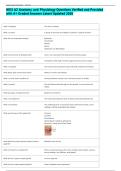
Grand Canyon University BIO 201


HESI A2 Anatomy and Physiology Questions Verified and Provided
with A+ Graded Answers Latest Updated 2026


What is histology? The study of tissues


What is a tissue? A group of cells that act together to perform a specific function.


What are the fundamental tissues? Epithelial
Connective
Muscle
Nerve
(Elephants Can Make News)


What is the function of epithelial cells? Cover, line, and protect the body and the internal organs.


What is the function of connective tissue? Framework of the body. Provides support and structure to organs.


What is neuroglia? The neurons and connective tissue cells that compose nerve tissue.


What ability does muscle tissue have? Ability to contract and shorten.


What is muscle tissue classified as? Voluntary(skeletal muscles) and involuntary(smooth & cardiac)


What is meiosis? The cell division that takes place in the gonads, i.e. the ovaries and
testes.


What two layers compose the skin? Epidermis and dermis.


What is the epidermis? The outermost protective layer of dead keratinized epithelial cells.


What is the dermis? The underlying layer of connective tissue with blood vessels, nerve
endings, and the associated skin tissues.


What are the layers of the epidermis? Corneum
Lucidum
Granulosum
Germivatum ( basale & spinosum)
Mnemonic: Candy Lions Growl Great.


What does the protein pigment melanin protect Radiation from the Sun
against?


What is the dermis composed of? Fibrous connective tissue with nerve endings, blood vessels, sensory
nerve endings, hair follicles, and glands.


What are the 2 types of sweat glands? ecrine & apocrine


What do ecrine sweat glands produce? Sweat. Regulate body temperature.

, What do apocrine sweat glands produce? Secretions contain bits of cytoplasm from cells, attracting bacteria that
produces body odor.


What do sebaceous glands secrete? They secrete sebum through the hair follicles, which lubricates the skin
and prevents drying.


What secretion produces oil? Holocrine secretion.


What are sebaceous glands prone to during Becoming clogged and attracting bacteria.
adolescence?


What protein composes the hair and skin? Keratin


What makes the body's framework? Bone, cartilage, ligaments & joints.


What are the functions of the skeletal system? Support, movement, blood cell formation, protection of internal organs,
detoxification, muscle attachment, mineral storage. A MIME BATHED
SEALS SINGING "MY PONY"


How are bones classified? By shape.
Long
Short
flat
irregular
sesamoid
LEMURS SING SALSA FOR INDIANS


What is the name for the cells that compose Osteoblasts
compact bone?


What occurs to osteoblasts when they become They stop dividing but continue to maintain body tissues as osteocytes.
fixed in the dense bone matrix?


How many bones make up the axial skeleton? 28 bones of the skull. 14-facial, 14-cranium.


How many bones make the facial skeleton? 2 nasal bones
2 maxillary bones
2 zygomatic bones
1 mandible
2 palatine bones
1 vomer
2 lacrimal bones
2 inferior nasal bones


Document information

Uploaded on
September 6, 2026
Number of pages
6
Written in
2026/2027
Type
Exam (elaborations)
Contains
Questions & answers
$15.99

Wrong document? Swap it for free Within 14 days of purchase and before downloading, you can choose a different document. You can simply spend the amount again.
Written by students who passed
Immediately available after payment
Read online or as PDF

Seller avatar
Reputation scores are based on the amount of documents a seller has sold for a fee and the reviews they have received for those documents. There are three levels: Bronze, Silver and Gold. The better the reputation, the more your can rely on the quality of the sellers work.
LectDan
4.0
(48)
Sold
221
Followers
157
Items
8505
Last sold
5 months ago


Why students choose Stuvia

Created by fellow students, verified by reviews

Quality you can trust: written by students who passed their tests and reviewed by others who've used these notes.

Didn't get what you expected? Choose another document

No worries! You can instantly pick a different document that better fits what you're looking for.

Pay as you like, start learning right away

No subscription, no commitments. Pay the way you're used to via credit card and download your PDF document instantly.

Student with book image

“Bought, downloaded, and aced it. It really can be that simple.”

Alisha Student

Working on your references?

Create accurate citations in APA, MLA and Harvard with our free citation generator.

Working on your references?

Frequently asked questions
