
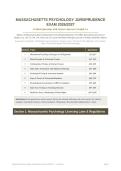
MASSACHUSETTS PSYCHOLOGY JURISPRUDENCE
EXAM 2026/2027
Verified Questions with Correct Answers | Graded A+
Aligned with Massachusetts Board of Registration of Psychologists Regulations (252 CMR), Massachusetts General Laws
Chapters 112, 119, 123, 19A, 19C, 201D, and 233, and the APA Ethical Principles and Code of Conduct (2026/2027 Edition).
Examination Composition: 100 Multiple-Choice Questions | Cognitive Levels: 30% Recall, 50% Application, 20% Analysis |
Style: 75% Scenario-Based, 25% Direct Knowledge
Section Topic Questions
1 Massachusetts Psychology Licensing Laws & Regulations Q1–Q20
2 Ethical Principles & Professional Conduct Q21–Q35
3 Confidentiality, Privilege, & Informed Consent Q36–Q50
4 Child, Elder, & Dependent Adult Mandatory Reporting Q51–Q60
5 Psychological Testing & Assessment Standards Q61–Q68
6 Scope of Practice & Professional Boundaries Q69–Q78
7 Recordkeeping, Documentation, & HIPAA Compliance Q79–Q86
8 Supervision, Training, & Continuing Education Q87–Q92
9 Health Care Proxy, Guardianship, & Patient Rights Q93–Q100
Instructions: Each question has one best answer. Review the rationale following each correct answer for statutory,
regulatory, and ethical references. Total examination: 100 questions. Recommended administration: 3 hours.
Section 1: Massachusetts Psychology Licensing Laws & Regulations
Massachusetts Psychology Jurisprudence Exam 2026/2027 — Graded A+ Page 1
,MA Psychology Jurisprudence Exam 2026/2027 | Verified Questions | Graded A+
Q1: A doctoral-level psychologist licensed in Connecticut wishes to provide telepsychology services to a
patient who resides year-round in Boston. Under Massachusetts Board of Registration of Psychologists
regulations and PSYPACT, which statement is MOST accurate?
A. The psychologist may treat the Massachusetts patient indefinitely because Connecticut is a PSYPACT party
state.
B. The psychologist must obtain a full Massachusetts psychology license OR practice under PSYPACT's
Interjurisdictional Practice (IPC) certificate, limited to 30 days per calendar year absent full licensure.
[CORRECT]
C. The psychologist only needs an EPPP score transfer; no Massachusetts-specific authorization is required.
D. The psychologist may practice in Massachusetts indefinitely as long as supervision is provided by a
Massachusetts-licensed psychologist.
Correct Answer: B
Rationale: Under 252 CMR 2.00 et seq. and PSYPACT, out-of-state psychologists may practice in Massachusetts via the
Interjurisdictional Practice Certificate (IPC) for up to 30 days per calendar year, or must obtain full Massachusetts licensure
for ongoing practice. MGL c. 112, § 118-129 and Board regulations define unauthorized practice as a disciplinary offense.
Options A and D overstate privileges; option C misstates the role of the EPPP, which is required for licensure but does not
itself authorize practice.
Q2: Which entity serves as the disciplinary body for licensed psychologists in Massachusetts, and what is
its statutory authority?
A. The APA Ethics Committee, under the APA Code of Conduct.
B. The Massachusetts Department of Mental Health, under MGL c. 19.
C. The Board of Registration of Psychologists, under MGL c. 112, §§ 118-129 and 252 CMR 1.00 et seq.
[CORRECT]
D. The Massachusetts Psychological Association ethics panel, under its bylaws.
Correct Answer: C
Rationale: The Massachusetts Board of Registration of Psychologists, established under MGL c. 112, §§ 118-129 and
operating through 252 CMR 1.00-5.00, has sole statutory authority to license, regulate, and discipline psychologists. The APA
Ethics Committee (A) can sanction APA members but cannot revoke state licensure. The DMH (B) operates facilities and
oversees certain commitments but does not regulate the profession. MPA (D) is a professional association without statutory
disciplinary power.
Q3: A candidate has completed a doctoral degree in clinical psychology from a regionally accredited
program, accrued 2,000 hours of postdoctoral supervised experience, and passed the EPPP with a scaled
score of 500. To obtain Massachusetts licensure, the candidate must ADDITIONALLY:
A. Complete only a jurisprudence examination administered by the Board.
B. Pass the Massachusetts Jurisprudence Examination, complete a criminal background check (CORI),
and submit verification of pre-doctoral internship consistent with 252 CMR 3.00. [CORRECT]
C. Complete a second 2,000 hours of postdoctoral experience in a hospital setting.
D. Publish at least one peer-reviewed article in a psychology journal.
Correct Answer: B
Rationale: Per 252 CMR 3.00, Massachusetts licensure requires: a doctoral degree from a regionally accredited program
meeting APA accreditation or equivalent; 3,200 total supervised hours (1,500 pre-doctoral internship + 1,700 postdoctoral);
EPPP passage; the Massachusetts Jurisprudence Exam; and a CORI background check. The jurisprudence exam alone (A) is
insufficient, additional hospital hours (C) are not required, and a publication (D) is not a licensure criterion.
Massachusetts Psychology Jurisprudence Exam 2026/2027 — Graded A+ Page 2
,MA Psychology Jurisprudence Exam 2026/2027 | Verified Questions | Graded A+
Q4: A psychologist holds a Massachusetts license but relocates to New Hampshire and lets her
Massachusetts license lapse for 4 years. She now wishes to return to practice in Massachusetts. What is the
CORRECT procedure to reinstate her license?
A. She may resume practice immediately upon notifying the Board of her new address.
B. She must apply for license reinstatement through the Board, pay all accrued renewal fees, and
demonstrate completion of continuing education hours required for the lapsed period under 252 CMR
4.00. [CORRECT]
C. She must re-take the EPPP and the Massachusetts Jurisprudence Exam from scratch.
D. She may practice under a temporary license while reinstatement is pending.
Correct Answer: B
Rationale: Under 252 CMR 4.06, a lapsed license may be reinstated upon application to the Board, payment of all accrued
renewal fees, and demonstration of compliance with CE requirements for the lapsed period. Re-taking the EPPP (C) is
generally not required unless the lapse is prolonged or the Board finds cause. Immediate resumption (A) and temporary
practice (D) constitute unlicensed practice and violate MGL c. 112, § 121.
Q5: Which of the following is a GROUND for disciplinary action against a Massachusetts-licensed
psychologist under MGL c. 112, § 129 and 252 CMR 5.00?
A. Charging a fee that is higher than the average fee charged by peers in the same geographic area.
B. Engaging in conduct that is a breach of professional ethics as defined by the APA Ethics Code, fraud,
negligence, incompetence, or conviction of a felony related to practice. [CORRECT]
C. Declining to accept a patient because the patient's insurance carrier reimburses at a below-market rate.
D. Refusing to provide pro bono services to indigent clients on a regular basis.
Correct Answer: B
Rationale: MGL c. 112, § 129 and 252 CMR 5.04 enumerate grounds for discipline, including fraud, negligence,
incompetence, conviction of a relevant felony, and breach of the APA Ethics Code as incorporated by reference. Fees above
average (A) are not per se grounds absent fraud or exploitation. Declining insurance-based cases (C) and declining pro bono
(D) are not statutory grounds unless they reflect discriminatory conduct in violation of civil rights law.
Q6: A 'psychological associate' in Massachusetts may perform psychological services under which of the
following conditions?
A. Independently, with full billing privileges and unsupervised practice.
B. Only under the supervision of a licensed psychologist pursuant to a written supervision agreement, with
the supervisor retaining professional responsibility for all services rendered. [CORRECT]
C. Only within hospital settings operated by the Department of Mental Health.
D. Only after passing the Massachusetts Jurisprudence Examination and completing 5 years of practice.
Correct Answer: B
Rationale: Under 252 CMR 2.05, a psychological associate must practice under the supervision of a licensed psychologist
pursuant to a written supervision agreement that specifies the supervisor's responsibility for services rendered. Independent
practice (A) is not authorized. Hospital settings (C) do not change this requirement, and there is no 5-year jurisprudence
requirement (D).
Massachusetts Psychology Jurisprudence Exam 2026/2027 — Graded A+ Page 3
, MA Psychology Jurisprudence Exam 2026/2027 | Verified Questions | Graded A+
Q7: A licensed psychologist wishes to advertise her services on a consumer-facing website. Under 252
CMR 5.06 and APA Ethics Code Standard 5 (Advertising and Public Statements), which of the following
statements would be PERMISSIBLE?
A. "Guaranteed cure for anxiety and depression in 6 sessions or your money back."
B. "Specializing in cognitive-behavioral treatment of anxiety disorders. Sliding-scale fees available. Please
call for a consultation." [CORRECT]
C. "Voted Best Psychologist in Boston 2025 by an online poll."
D. "Board-certified in Clinical Psychology by the American Board of Professional Psychology (when no such
certification has been granted)."
Correct Answer: B
Rationale: Standard 5.01 of the APA Ethics Code prohibits false, deceptive, or fraudulent public statements, including
guarantees of outcome (A), unsubstantiated testimonials or polls (C), and false credentials (D). Option B is factual,
non-deceptive, and discloses services accurately, consistent with 252 CMR 5.06 and Standard 5.01-5.05.
Q8: Under Massachusetts law and Board regulations, when must a psychologist report a change of
practice address to the Board?
A. Within 90 days of the change.
B. Within 10 business days, and in any event prior to the next renewal cycle.
C. Within 30 days of the change. [CORRECT]
D. Only if the practice moves to a different county within Massachusetts.
Correct Answer: C
Rationale: 252 CMR 4.05 requires licensees to notify the Board in writing within 30 days of any change in practice address,
name, or contact information. Failure to do so may result in disciplinary action for failure to maintain current information
with the Board. The 30-day rule supersedes the alternatives listed.
Q9: What is the MINIMUM doctoral degree requirement for licensure as a psychologist in Massachusetts?
A. A Psy.D. from any institution, including unaccredited distance-learning programs.
B. A doctoral degree (Ph.D., Psy.D., or Ed.D.) in psychology from a regionally accredited institution, with
a program of study that meets the substantive requirements of 252 CMR 3.02, including coursework in
diagnosis, assessment, intervention, ethics, biological bases of behavior, and diversity. [CORRECT]
C. A Ph.D. only; Psy.D. degrees are not accepted.
D. Any doctoral degree as long as the candidate has completed 5 years of clinical practice.
Correct Answer: B
Rationale: 252 CMR 3.02 requires a doctoral degree in psychology from a regionally accredited institution, with a curriculum
covering specified content domains. APA accreditation is preferred but not strictly required if the program meets substantive
equivalency. Psy.D., Ph.D., and Ed.D. degrees are all acceptable if they meet these requirements. Distance-learning programs
may qualify if regionally accredited and substantively compliant.
Massachusetts Psychology Jurisprudence Exam 2026/2027 — Graded A+ Page 4
EXAM 2026/2027
Verified Questions with Correct Answers | Graded A+
Aligned with Massachusetts Board of Registration of Psychologists Regulations (252 CMR), Massachusetts General Laws
Chapters 112, 119, 123, 19A, 19C, 201D, and 233, and the APA Ethical Principles and Code of Conduct (2026/2027 Edition).
Examination Composition: 100 Multiple-Choice Questions | Cognitive Levels: 30% Recall, 50% Application, 20% Analysis |
Style: 75% Scenario-Based, 25% Direct Knowledge
Section Topic Questions
1 Massachusetts Psychology Licensing Laws & Regulations Q1–Q20
2 Ethical Principles & Professional Conduct Q21–Q35
3 Confidentiality, Privilege, & Informed Consent Q36–Q50
4 Child, Elder, & Dependent Adult Mandatory Reporting Q51–Q60
5 Psychological Testing & Assessment Standards Q61–Q68
6 Scope of Practice & Professional Boundaries Q69–Q78
7 Recordkeeping, Documentation, & HIPAA Compliance Q79–Q86
8 Supervision, Training, & Continuing Education Q87–Q92
9 Health Care Proxy, Guardianship, & Patient Rights Q93–Q100
Instructions: Each question has one best answer. Review the rationale following each correct answer for statutory,
regulatory, and ethical references. Total examination: 100 questions. Recommended administration: 3 hours.
Section 1: Massachusetts Psychology Licensing Laws & Regulations
Massachusetts Psychology Jurisprudence Exam 2026/2027 — Graded A+ Page 1
,MA Psychology Jurisprudence Exam 2026/2027 | Verified Questions | Graded A+
Q1: A doctoral-level psychologist licensed in Connecticut wishes to provide telepsychology services to a
patient who resides year-round in Boston. Under Massachusetts Board of Registration of Psychologists
regulations and PSYPACT, which statement is MOST accurate?
A. The psychologist may treat the Massachusetts patient indefinitely because Connecticut is a PSYPACT party
state.
B. The psychologist must obtain a full Massachusetts psychology license OR practice under PSYPACT's
Interjurisdictional Practice (IPC) certificate, limited to 30 days per calendar year absent full licensure.
[CORRECT]
C. The psychologist only needs an EPPP score transfer; no Massachusetts-specific authorization is required.
D. The psychologist may practice in Massachusetts indefinitely as long as supervision is provided by a
Massachusetts-licensed psychologist.
Correct Answer: B
Rationale: Under 252 CMR 2.00 et seq. and PSYPACT, out-of-state psychologists may practice in Massachusetts via the
Interjurisdictional Practice Certificate (IPC) for up to 30 days per calendar year, or must obtain full Massachusetts licensure
for ongoing practice. MGL c. 112, § 118-129 and Board regulations define unauthorized practice as a disciplinary offense.
Options A and D overstate privileges; option C misstates the role of the EPPP, which is required for licensure but does not
itself authorize practice.
Q2: Which entity serves as the disciplinary body for licensed psychologists in Massachusetts, and what is
its statutory authority?
A. The APA Ethics Committee, under the APA Code of Conduct.
B. The Massachusetts Department of Mental Health, under MGL c. 19.
C. The Board of Registration of Psychologists, under MGL c. 112, §§ 118-129 and 252 CMR 1.00 et seq.
[CORRECT]
D. The Massachusetts Psychological Association ethics panel, under its bylaws.
Correct Answer: C
Rationale: The Massachusetts Board of Registration of Psychologists, established under MGL c. 112, §§ 118-129 and
operating through 252 CMR 1.00-5.00, has sole statutory authority to license, regulate, and discipline psychologists. The APA
Ethics Committee (A) can sanction APA members but cannot revoke state licensure. The DMH (B) operates facilities and
oversees certain commitments but does not regulate the profession. MPA (D) is a professional association without statutory
disciplinary power.
Q3: A candidate has completed a doctoral degree in clinical psychology from a regionally accredited
program, accrued 2,000 hours of postdoctoral supervised experience, and passed the EPPP with a scaled
score of 500. To obtain Massachusetts licensure, the candidate must ADDITIONALLY:
A. Complete only a jurisprudence examination administered by the Board.
B. Pass the Massachusetts Jurisprudence Examination, complete a criminal background check (CORI),
and submit verification of pre-doctoral internship consistent with 252 CMR 3.00. [CORRECT]
C. Complete a second 2,000 hours of postdoctoral experience in a hospital setting.
D. Publish at least one peer-reviewed article in a psychology journal.
Correct Answer: B
Rationale: Per 252 CMR 3.00, Massachusetts licensure requires: a doctoral degree from a regionally accredited program
meeting APA accreditation or equivalent; 3,200 total supervised hours (1,500 pre-doctoral internship + 1,700 postdoctoral);
EPPP passage; the Massachusetts Jurisprudence Exam; and a CORI background check. The jurisprudence exam alone (A) is
insufficient, additional hospital hours (C) are not required, and a publication (D) is not a licensure criterion.
Massachusetts Psychology Jurisprudence Exam 2026/2027 — Graded A+ Page 2
,MA Psychology Jurisprudence Exam 2026/2027 | Verified Questions | Graded A+
Q4: A psychologist holds a Massachusetts license but relocates to New Hampshire and lets her
Massachusetts license lapse for 4 years. She now wishes to return to practice in Massachusetts. What is the
CORRECT procedure to reinstate her license?
A. She may resume practice immediately upon notifying the Board of her new address.
B. She must apply for license reinstatement through the Board, pay all accrued renewal fees, and
demonstrate completion of continuing education hours required for the lapsed period under 252 CMR
4.00. [CORRECT]
C. She must re-take the EPPP and the Massachusetts Jurisprudence Exam from scratch.
D. She may practice under a temporary license while reinstatement is pending.
Correct Answer: B
Rationale: Under 252 CMR 4.06, a lapsed license may be reinstated upon application to the Board, payment of all accrued
renewal fees, and demonstration of compliance with CE requirements for the lapsed period. Re-taking the EPPP (C) is
generally not required unless the lapse is prolonged or the Board finds cause. Immediate resumption (A) and temporary
practice (D) constitute unlicensed practice and violate MGL c. 112, § 121.
Q5: Which of the following is a GROUND for disciplinary action against a Massachusetts-licensed
psychologist under MGL c. 112, § 129 and 252 CMR 5.00?
A. Charging a fee that is higher than the average fee charged by peers in the same geographic area.
B. Engaging in conduct that is a breach of professional ethics as defined by the APA Ethics Code, fraud,
negligence, incompetence, or conviction of a felony related to practice. [CORRECT]
C. Declining to accept a patient because the patient's insurance carrier reimburses at a below-market rate.
D. Refusing to provide pro bono services to indigent clients on a regular basis.
Correct Answer: B
Rationale: MGL c. 112, § 129 and 252 CMR 5.04 enumerate grounds for discipline, including fraud, negligence,
incompetence, conviction of a relevant felony, and breach of the APA Ethics Code as incorporated by reference. Fees above
average (A) are not per se grounds absent fraud or exploitation. Declining insurance-based cases (C) and declining pro bono
(D) are not statutory grounds unless they reflect discriminatory conduct in violation of civil rights law.
Q6: A 'psychological associate' in Massachusetts may perform psychological services under which of the
following conditions?
A. Independently, with full billing privileges and unsupervised practice.
B. Only under the supervision of a licensed psychologist pursuant to a written supervision agreement, with
the supervisor retaining professional responsibility for all services rendered. [CORRECT]
C. Only within hospital settings operated by the Department of Mental Health.
D. Only after passing the Massachusetts Jurisprudence Examination and completing 5 years of practice.
Correct Answer: B
Rationale: Under 252 CMR 2.05, a psychological associate must practice under the supervision of a licensed psychologist
pursuant to a written supervision agreement that specifies the supervisor's responsibility for services rendered. Independent
practice (A) is not authorized. Hospital settings (C) do not change this requirement, and there is no 5-year jurisprudence
requirement (D).
Massachusetts Psychology Jurisprudence Exam 2026/2027 — Graded A+ Page 3
, MA Psychology Jurisprudence Exam 2026/2027 | Verified Questions | Graded A+
Q7: A licensed psychologist wishes to advertise her services on a consumer-facing website. Under 252
CMR 5.06 and APA Ethics Code Standard 5 (Advertising and Public Statements), which of the following
statements would be PERMISSIBLE?
A. "Guaranteed cure for anxiety and depression in 6 sessions or your money back."
B. "Specializing in cognitive-behavioral treatment of anxiety disorders. Sliding-scale fees available. Please
call for a consultation." [CORRECT]
C. "Voted Best Psychologist in Boston 2025 by an online poll."
D. "Board-certified in Clinical Psychology by the American Board of Professional Psychology (when no such
certification has been granted)."
Correct Answer: B
Rationale: Standard 5.01 of the APA Ethics Code prohibits false, deceptive, or fraudulent public statements, including
guarantees of outcome (A), unsubstantiated testimonials or polls (C), and false credentials (D). Option B is factual,
non-deceptive, and discloses services accurately, consistent with 252 CMR 5.06 and Standard 5.01-5.05.
Q8: Under Massachusetts law and Board regulations, when must a psychologist report a change of
practice address to the Board?
A. Within 90 days of the change.
B. Within 10 business days, and in any event prior to the next renewal cycle.
C. Within 30 days of the change. [CORRECT]
D. Only if the practice moves to a different county within Massachusetts.
Correct Answer: C
Rationale: 252 CMR 4.05 requires licensees to notify the Board in writing within 30 days of any change in practice address,
name, or contact information. Failure to do so may result in disciplinary action for failure to maintain current information
with the Board. The 30-day rule supersedes the alternatives listed.
Q9: What is the MINIMUM doctoral degree requirement for licensure as a psychologist in Massachusetts?
A. A Psy.D. from any institution, including unaccredited distance-learning programs.
B. A doctoral degree (Ph.D., Psy.D., or Ed.D.) in psychology from a regionally accredited institution, with
a program of study that meets the substantive requirements of 252 CMR 3.02, including coursework in
diagnosis, assessment, intervention, ethics, biological bases of behavior, and diversity. [CORRECT]
C. A Ph.D. only; Psy.D. degrees are not accepted.
D. Any doctoral degree as long as the candidate has completed 5 years of clinical practice.
Correct Answer: B
Rationale: 252 CMR 3.02 requires a doctoral degree in psychology from a regionally accredited institution, with a curriculum
covering specified content domains. APA accreditation is preferred but not strictly required if the program meets substantive
equivalency. Psy.D., Ph.D., and Ed.D. degrees are all acceptable if they meet these requirements. Distance-learning programs
may qualify if regionally accredited and substantively compliant.
Massachusetts Psychology Jurisprudence Exam 2026/2027 — Graded A+ Page 4


