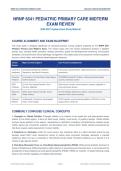
NRNP 6541 PEDIATRIC PRIMARY CARE 2026-2027 UPDATE EXAM REVIEW
NRNP 6541 PEDIATRIC PRIMARY CARE MIDTERM
EXAM REVIEW
2026-2027 Update Exam Study Material
COURSE ALIGNMENT AND EXAM BLUEPRINT
This study guide is designed specifically for advanced practice nursing students preparing for the NRNP 6541
Pediatric Primary Care Midterm Exam. The content aligns with core clinical competency domains in pediatric
primary care, including health promotion, disease prevention, growth and developmental monitoring, immunization
schedules, and acute/chronic clinical pathology management. Key subject areas are structured to reinforce academic
success, clinical safety, and evidence-based diagnostic reasoning.
Clinical Major Covered Chapters Core Practical Competencies
Domain
Growth & D Developmental Milestones, Milestone Pincer grasp, sit/walk timelines, toddler play behaviors, school-readiness
evelopment Regressions, Age-Specific Screening assessments
Preventive Immunizations, Car Seat Safety, Sleep Hygiene, DTaP/MMR/Varicella/IPV timelines, catching up behind-schedule
Pediatrics Nutrition Guidance vaccines, solid foods, bruxism
EENT Ear Pain, Eye Redness/Deviation, Sinus Otitis externa vs media, corneal abrasions, hyphema, epiglottitis vs
Pathology Infections, Epiglottitis croup, peritonsillar abscess
Behavioral ADHD, Autism Spectrum Disorder, School First-line therapies (behavioral vs pharm), screening indicators,
Health Phobia, Bullying diagnostic criteria, family counseling
Adolescent Confidentiality, Drug Misuse, Gynecological PCOS indicators, annual screening guidelines, UDS ethics, Tanner
Medicine Health, Tanner Staging staging criteria, suicidal risk
COMMONLY CONFUSED CLINICAL CONCEPTS
1. Preseptal vs. Orbital Cellulitis: Preseptal cellulitis is an infection of the eyelid skin and subcutaneous tissue
anterior to the orbital septum. It does not affect ocular mobility, visual acuity, or pupillary reaction. Orbital cellulitis
involves tissues posterior to the septum, representing an ophthalmic emergency characterized by impaired ocular
motility, painful eye movements, proptosis, and decreased vision. Clinical action: Eyelid swelling accompanied by
high fever requires careful assessment of ocular mobility.
2. Esophoria vs. Esotropia: Under the cover-uncover test, esophoria refers to a latent deviation where the eye
deviates inward ONLY when covered but returns to midline when uncovered. Esotropia represents a manifest
strabismus where one eye is constantly or intermittently turned inward. Persistent strabismus at or beyond 4 to 6
months of age requires referral.
3. Post-Strep Rheumatic Fever vs. Post-Strep Glomerulonephritis (PSGN): While prompt antibiotic treatment of
Group A Streptococcus (GAS) pharyngitis is highly effective in preventing acute rheumatic fever, it cannot prevent the
development of post-streptococcal acute glomerulonephritis (PSGN). PSGN can manifest 1-3 weeks following a strep
throat or skin infection regardless of antibiotic administration.
Professional Study Companion Page 1 Grounded in Clinical Practice Guidelines
,NRNP 6541 PEDIATRIC PRIMARY CARE 2026-2027 UPDATE EXAM REVIEW
4. Immunization Catch-Up Bottlenecks (Hib & DTaP): The Haemophilus influenzae Type B (Hib) vaccine is not
routinely administered to children aged 5 years or older because the risk of invasive Hib disease drops dramatically
after age 5. In contrast, the DTaP vaccine series is for children younger than 7 years of age; older individuals catch
up with Tdap.
CLINICAL EXAMINATION AND DIAGNOSTIC PROCEDURES
• Fluorescein Staining: Utilizing fluorescein dye strips followed by examination under a cobalt blue light is the
standard diagnostic procedure to rule out corneal abrasion. Abrasions will appear bright green under the blue light.
• Cerumen Removal: For toddlers (such as a 15-month-old), a safe and effective clinical method to clear obstructing
cerumen is gentle irrigation of the canal using lukewarm water administered via a soft bulb syringe.
• Acanthosis Nigricans and Metabolic Screening: Acanthosis nigricans (velvety, hyperpigmented skin on the neck,
axillae, or groin) is a classic cutaneous marker of insulin resistance in obese pediatric patients. Appropriate screening
includes checking a fasting plasma glucose level to identify impaired fasting glucose.
• Tanner Sexual Maturity Rating (SMR): SMR staging guides primary care providers in tracking normal pubertal
progression. SMR Stage 2 (Tanner II) in males is marked by scrotal and testicular enlargement, reddening of the
scrotal skin, and initial changes in pubic hair texture, without penile elongation. SMR Stage 3 (Tanner III) in females is
the peak phase for height velocity (peak height velocity).
Professional Study Companion Page 2 Grounded in Clinical Practice Guidelines
,NRNP 6541 PEDIATRIC PRIMARY CARE 2026-2027 UPDATE EXAM REVIEW
COMPREHENSIVE PRACTICE EXAM TEST BANK
This test bank consists of 100 highly educational practice questions designed to mimic Walden University's course
competencies and the NRNP 6541 Midterm Exam curriculum. Every question contains detailed, evidence-based
rationales explaining the correct path and debunking common clinical pitfalls.
Question 1: Which of the following statements regarding adolescent substance use in primary care is true?
A. Tobacco is the most commonly abused substance during adolescence.
B. Hallucinogens represent the highest rate of substance-related emergency department admissions.
C. Heroin is the primary gateway substance leading to adolescent tobacco addiction.
D. Alcohol is the most commonly used substance among high school students, but tobacco represents significant and
rising risk via electronic delivery systems.
ANSWER ■: A — Tobacco is the most commonly abused substance during adolescence.
Explanation: According to course materials and historical pediatric guidelines, tobacco (including modern vaping
formulations) remains the most commonly abused substance during adolescence. While alcohol use is extremely
prevalent and represents the most common substance used in middle and high schools, tobacco products are
traditionally classified as the most commonly abused substance when analyzing longitudinal adolescent abuse metrics.
Options B, C, and D contain incorrect comparative claims.
Question 2: A 4-year-old child presents for a well-child visit. His immunization record shows he has received
4 DTaP, 3 IPV, 1 MMR, 1 Varicella, and 2 Hepatitis B vaccines. What vaccines should be ordered today?
A. No vaccines are indicated today as he is fully immunized for his age group.
B. DTaP and IPV only, postponing live vaccines until age six.
C. Hep B, DTaP, and MMR only.
D. DTaP, IPV, MMR, and Varivax (Varicella)
ANSWER ■: D — DTaP, IPV, MMR, and Varivax
Explanation: At the 4-year-old well-child visit, children are due for their pre-kindergarten booster series. This series
consists of the 5th dose of DTaP, the 4th dose of IPV, the 2nd dose of MMR, and the 2nd dose of Varicella (Varivax).
Since the child has only received 4 DTaP, 3 IPV, 1 MMR, and 1 Varicella previously, today's order should include DTaP,
IPV, MMR, and Varivax to complete his primary pediatric vaccine series.
Professional Study Companion Page 3 Grounded in Clinical Practice Guidelines
, NRNP 6541 PEDIATRIC PRIMARY CARE 2026-2027 UPDATE EXAM REVIEW
Question 3: The parents of a 7-year-old boy are concerned because their son has developed a strong
resistance to school attendance. Which of the following historical findings is NOT typically associated with
school phobia?
A. Chronic medical illness
B. Physical symptoms such as headaches or stomachaches on school mornings
C. Deep-seated separation anxiety regarding the primary caregiver
D. Fear of social evaluation or bullying by peers
ANSWER ■: A — Chronic medical illness
Explanation: School phobia (or school avoidance) is primarily a psychological/behavioral disorder characterized by
severe anxiety about attending school, often presenting as somatic complaints (headaches, abdominal pain) that
disappear on weekends or when the child is allowed to stay home. It is frequently associated with separation anxiety,
family dynamics, or social stressors, but is NOT usually associated with an actual chronic medical illness. Somatic
complaints in school phobia must be differentiated from organic chronic disease.
Question 4: Chelsea, age 8, presents with the complaint that she feels as if 'something is stuck' in her ear.
Otoscopic examination reveals a foreign body of organic origin (a bean) in the ear canal. Which of the
following actions is contraindicated?
A. Utilizing forceps under direct visualization to retrieve the object
B. Flushing the ear with water
C. Referring the patient to an ENT specialist if the object is tightly wedged
D. Applying mineral oil to suffocate an insect prior to removal
ANSWER ■: B — Flushing the ear with water
Explanation: Flushing the ear canal with water is strictly contraindicated when an organic foreign body (such as a bean,
seed, or insect) is present. Water will cause organic material to swell, which increases pain, tightly wedges the object,
and complicates mechanical removal. Flushing is also contraindicated if there is any suspicion of a ruptured tympanic
membrane or if the foreign body is a battery.
Question 5: A 7-year-old boy is brought to the clinic with complaints of persistent bedwetting ('having
accidents at night'). Physical examination, history, urinalysis, urine culture, and urine specific gravity are all
normal. His parents ask about the best initial management. What is the most appropriate response?
A. Immediately prescribe imipramine to prevent enuresis.
B. Initiate high-dose oral desmopressin before bed.
C. Implement fluid restriction after dinner and ensure the child voids immediately prior to bedtime.
D. Reassure the parents that the child should be punished to discourage the behavior.
ANSWER ■: C — Fluid restriction and voiding prior to the night may be effective.
Explanation: For primary nocturnal enuresis with completely normal laboratory and physical findings, initial
management should focus on non-pharmacological behavioral modifications. This includes fluid restriction in the
evening, ensuring the child voids immediately before going to bed, and using positive reinforcement (e.g., bedwetting
alarms). Pharmacotherapy is reserved for older children or when behavioral strategies fail. Punishment is never
appropriate and worsens anxiety.
Professional Study Companion Page 4 Grounded in Clinical Practice Guidelines
NRNP 6541 PEDIATRIC PRIMARY CARE MIDTERM
EXAM REVIEW
2026-2027 Update Exam Study Material
COURSE ALIGNMENT AND EXAM BLUEPRINT
This study guide is designed specifically for advanced practice nursing students preparing for the NRNP 6541
Pediatric Primary Care Midterm Exam. The content aligns with core clinical competency domains in pediatric
primary care, including health promotion, disease prevention, growth and developmental monitoring, immunization
schedules, and acute/chronic clinical pathology management. Key subject areas are structured to reinforce academic
success, clinical safety, and evidence-based diagnostic reasoning.
Clinical Major Covered Chapters Core Practical Competencies
Domain
Growth & D Developmental Milestones, Milestone Pincer grasp, sit/walk timelines, toddler play behaviors, school-readiness
evelopment Regressions, Age-Specific Screening assessments
Preventive Immunizations, Car Seat Safety, Sleep Hygiene, DTaP/MMR/Varicella/IPV timelines, catching up behind-schedule
Pediatrics Nutrition Guidance vaccines, solid foods, bruxism
EENT Ear Pain, Eye Redness/Deviation, Sinus Otitis externa vs media, corneal abrasions, hyphema, epiglottitis vs
Pathology Infections, Epiglottitis croup, peritonsillar abscess
Behavioral ADHD, Autism Spectrum Disorder, School First-line therapies (behavioral vs pharm), screening indicators,
Health Phobia, Bullying diagnostic criteria, family counseling
Adolescent Confidentiality, Drug Misuse, Gynecological PCOS indicators, annual screening guidelines, UDS ethics, Tanner
Medicine Health, Tanner Staging staging criteria, suicidal risk
COMMONLY CONFUSED CLINICAL CONCEPTS
1. Preseptal vs. Orbital Cellulitis: Preseptal cellulitis is an infection of the eyelid skin and subcutaneous tissue
anterior to the orbital septum. It does not affect ocular mobility, visual acuity, or pupillary reaction. Orbital cellulitis
involves tissues posterior to the septum, representing an ophthalmic emergency characterized by impaired ocular
motility, painful eye movements, proptosis, and decreased vision. Clinical action: Eyelid swelling accompanied by
high fever requires careful assessment of ocular mobility.
2. Esophoria vs. Esotropia: Under the cover-uncover test, esophoria refers to a latent deviation where the eye
deviates inward ONLY when covered but returns to midline when uncovered. Esotropia represents a manifest
strabismus where one eye is constantly or intermittently turned inward. Persistent strabismus at or beyond 4 to 6
months of age requires referral.
3. Post-Strep Rheumatic Fever vs. Post-Strep Glomerulonephritis (PSGN): While prompt antibiotic treatment of
Group A Streptococcus (GAS) pharyngitis is highly effective in preventing acute rheumatic fever, it cannot prevent the
development of post-streptococcal acute glomerulonephritis (PSGN). PSGN can manifest 1-3 weeks following a strep
throat or skin infection regardless of antibiotic administration.
Professional Study Companion Page 1 Grounded in Clinical Practice Guidelines
,NRNP 6541 PEDIATRIC PRIMARY CARE 2026-2027 UPDATE EXAM REVIEW
4. Immunization Catch-Up Bottlenecks (Hib & DTaP): The Haemophilus influenzae Type B (Hib) vaccine is not
routinely administered to children aged 5 years or older because the risk of invasive Hib disease drops dramatically
after age 5. In contrast, the DTaP vaccine series is for children younger than 7 years of age; older individuals catch
up with Tdap.
CLINICAL EXAMINATION AND DIAGNOSTIC PROCEDURES
• Fluorescein Staining: Utilizing fluorescein dye strips followed by examination under a cobalt blue light is the
standard diagnostic procedure to rule out corneal abrasion. Abrasions will appear bright green under the blue light.
• Cerumen Removal: For toddlers (such as a 15-month-old), a safe and effective clinical method to clear obstructing
cerumen is gentle irrigation of the canal using lukewarm water administered via a soft bulb syringe.
• Acanthosis Nigricans and Metabolic Screening: Acanthosis nigricans (velvety, hyperpigmented skin on the neck,
axillae, or groin) is a classic cutaneous marker of insulin resistance in obese pediatric patients. Appropriate screening
includes checking a fasting plasma glucose level to identify impaired fasting glucose.
• Tanner Sexual Maturity Rating (SMR): SMR staging guides primary care providers in tracking normal pubertal
progression. SMR Stage 2 (Tanner II) in males is marked by scrotal and testicular enlargement, reddening of the
scrotal skin, and initial changes in pubic hair texture, without penile elongation. SMR Stage 3 (Tanner III) in females is
the peak phase for height velocity (peak height velocity).
Professional Study Companion Page 2 Grounded in Clinical Practice Guidelines
,NRNP 6541 PEDIATRIC PRIMARY CARE 2026-2027 UPDATE EXAM REVIEW
COMPREHENSIVE PRACTICE EXAM TEST BANK
This test bank consists of 100 highly educational practice questions designed to mimic Walden University's course
competencies and the NRNP 6541 Midterm Exam curriculum. Every question contains detailed, evidence-based
rationales explaining the correct path and debunking common clinical pitfalls.
Question 1: Which of the following statements regarding adolescent substance use in primary care is true?
A. Tobacco is the most commonly abused substance during adolescence.
B. Hallucinogens represent the highest rate of substance-related emergency department admissions.
C. Heroin is the primary gateway substance leading to adolescent tobacco addiction.
D. Alcohol is the most commonly used substance among high school students, but tobacco represents significant and
rising risk via electronic delivery systems.
ANSWER ■: A — Tobacco is the most commonly abused substance during adolescence.
Explanation: According to course materials and historical pediatric guidelines, tobacco (including modern vaping
formulations) remains the most commonly abused substance during adolescence. While alcohol use is extremely
prevalent and represents the most common substance used in middle and high schools, tobacco products are
traditionally classified as the most commonly abused substance when analyzing longitudinal adolescent abuse metrics.
Options B, C, and D contain incorrect comparative claims.
Question 2: A 4-year-old child presents for a well-child visit. His immunization record shows he has received
4 DTaP, 3 IPV, 1 MMR, 1 Varicella, and 2 Hepatitis B vaccines. What vaccines should be ordered today?
A. No vaccines are indicated today as he is fully immunized for his age group.
B. DTaP and IPV only, postponing live vaccines until age six.
C. Hep B, DTaP, and MMR only.
D. DTaP, IPV, MMR, and Varivax (Varicella)
ANSWER ■: D — DTaP, IPV, MMR, and Varivax
Explanation: At the 4-year-old well-child visit, children are due for their pre-kindergarten booster series. This series
consists of the 5th dose of DTaP, the 4th dose of IPV, the 2nd dose of MMR, and the 2nd dose of Varicella (Varivax).
Since the child has only received 4 DTaP, 3 IPV, 1 MMR, and 1 Varicella previously, today's order should include DTaP,
IPV, MMR, and Varivax to complete his primary pediatric vaccine series.
Professional Study Companion Page 3 Grounded in Clinical Practice Guidelines
, NRNP 6541 PEDIATRIC PRIMARY CARE 2026-2027 UPDATE EXAM REVIEW
Question 3: The parents of a 7-year-old boy are concerned because their son has developed a strong
resistance to school attendance. Which of the following historical findings is NOT typically associated with
school phobia?
A. Chronic medical illness
B. Physical symptoms such as headaches or stomachaches on school mornings
C. Deep-seated separation anxiety regarding the primary caregiver
D. Fear of social evaluation or bullying by peers
ANSWER ■: A — Chronic medical illness
Explanation: School phobia (or school avoidance) is primarily a psychological/behavioral disorder characterized by
severe anxiety about attending school, often presenting as somatic complaints (headaches, abdominal pain) that
disappear on weekends or when the child is allowed to stay home. It is frequently associated with separation anxiety,
family dynamics, or social stressors, but is NOT usually associated with an actual chronic medical illness. Somatic
complaints in school phobia must be differentiated from organic chronic disease.
Question 4: Chelsea, age 8, presents with the complaint that she feels as if 'something is stuck' in her ear.
Otoscopic examination reveals a foreign body of organic origin (a bean) in the ear canal. Which of the
following actions is contraindicated?
A. Utilizing forceps under direct visualization to retrieve the object
B. Flushing the ear with water
C. Referring the patient to an ENT specialist if the object is tightly wedged
D. Applying mineral oil to suffocate an insect prior to removal
ANSWER ■: B — Flushing the ear with water
Explanation: Flushing the ear canal with water is strictly contraindicated when an organic foreign body (such as a bean,
seed, or insect) is present. Water will cause organic material to swell, which increases pain, tightly wedges the object,
and complicates mechanical removal. Flushing is also contraindicated if there is any suspicion of a ruptured tympanic
membrane or if the foreign body is a battery.
Question 5: A 7-year-old boy is brought to the clinic with complaints of persistent bedwetting ('having
accidents at night'). Physical examination, history, urinalysis, urine culture, and urine specific gravity are all
normal. His parents ask about the best initial management. What is the most appropriate response?
A. Immediately prescribe imipramine to prevent enuresis.
B. Initiate high-dose oral desmopressin before bed.
C. Implement fluid restriction after dinner and ensure the child voids immediately prior to bedtime.
D. Reassure the parents that the child should be punished to discourage the behavior.
ANSWER ■: C — Fluid restriction and voiding prior to the night may be effective.
Explanation: For primary nocturnal enuresis with completely normal laboratory and physical findings, initial
management should focus on non-pharmacological behavioral modifications. This includes fluid restriction in the
evening, ensuring the child voids immediately before going to bed, and using positive reinforcement (e.g., bedwetting
alarms). Pharmacotherapy is reserved for older children or when behavioral strategies fail. Punishment is never
appropriate and worsens anxiety.
Professional Study Companion Page 4 Grounded in Clinical Practice Guidelines