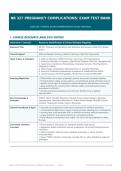
NR 327 PREGNANCY COMPLICATIONS: EXAM TEST BANK
2026-2027 UPDATE EXAM COMPREHENSIVE STUDY MATERIAL
I. COURSE RESOURCE ANALYSIS MATRIX
Dimension / Concept Resource Identification & Clinical Syllabus Mapping
Resource Title NR 327 Pregnancy Complications Quiz Questions and Answers (2026-2027 Update
Exam)
Clinical Subject Maternal-Newborn Nursing / Obstetric Nursing & High-Risk Pregnancies
Major Topics & Subtopics 1. Maternal Infections (TORCH Acronym, Gonorrhea, HIV Transmissions)
2. Endocrine Disorders in Pregnancy (Gestational Diabetes, IDM Care, Hypoglycemia)
3. Hypertensive Conditions (Preeclampsia, Eclampsia Seizures, HELLP Syndrome,
Magnesium Sulfate)
4. Hemorrhagic Complications (Placenta Previa vs. Abruptio Placentae)
5. Severe GI Conditions (Hyperemesis Gravidarum & Fluid/Electrolyte Shifts)
6. Isoimmunization (Rh Incompatibility, Rho(D) Immune Globulin/RhoGAM)
Learning Objectives • Differentiate clinical signs of painless (previa) and painful (abruptio) bleeding.
• Prioritize patient safety, airway patency, and positioning during eclamptic seizures.
• Identify clinical signs of magnesium sulfate therapeutic effectiveness and toxicity.
• Apply guidelines for maternal-fetal infectious safety (contraindicated invasive
procedures in HIV/HSV).
• Identify prophylactic guidelines and timing for Rho(D) immune globulin
administration.
Key Terminology & TORCH, HELLP, Abruptio Placentae, Placenta Previa, Hyperinsulinism, Neonatal
Concepts Hypoglycemia, Ophthalmia Neonatorum, Active Genital Herpes, RhoGAM, Indirect
Coombs', Magnesium Sulfate, Calcium Gluconate.
Clinical Procedures & Apps • Neonatal eye prophylaxis (erythromycin ointment) for maternal gonorrhea.
• Contraindicated digital pelvic exams in third-trimester bleeding prior to ultrasound.
• Avoiding fetal scalp electrodes (FSE) in HIV/HSV to prevent vertical transmission.
• Airway protection and lateral positioning in eclampsia seizures.
• Renal clearance monitoring (urine output >30 mL/hr) during magnesium sulfate
therapy.
Commonly Confused • Previa (painless, soft uterus) vs. Abruption (painful, rigid uterus).
Concepts • Magnesium Sulfate indications (seizure prophylaxis, not primarily blood pressure
reduction).
• Indirect Coombs' (maternal serum antibody screening) vs. Direct Coombs'
(neonatal RBCs).
• Classic TORCH Infections (classically excludes HIV) vs. other bloodborne maternal
pathogens.
Subject: Maternal-Newborn Nursing / Obstetric Complications Page 1 2026-2027 Update Exam Test Bank
,NR 327 PREGNANCY COMPLICATIONS EXAM TEST BANK 2026-2027 UPDATE EXAM
II. 2026-2027 UPDATE EXAM TEST BANK (50 QUESTIONS & DETAILED
RATIONALES)
Question 1: Which of these is not considered a T.O.R.C.H. infection?
A. Rubella
B. Herpes
C. Cytomegalovirus
D. HIV
ANSWER : D — HIV
Explanation: The T.O.R.C.H. acronym stands for Toxoplasmosis, Other infections (such as hepatitis, syphilis,
varicella, and parvovirus B19), Rubella, Cytomegalovirus (CMV), and Herpes Simplex Virus (HSV). Classic
nursing curricula separate Human Immunodeficiency Virus (HIV) from the core T.O.R.C.H. list, although it is a
critical bloodborne maternal infection that requires separate management protocols (such as avoiding
invasive procedures like fetal scalp electrodes to prevent vertical transmission).
Question 2: A client with diabetes mellitus gives birth to a 9-lb, 10-oz (4375 g) neonate at
38 weeks. What is the nurse's priority action after the stabilization of the neonate?
A. Assess the neonate's blood glucose level.
B. Assess the neonate's bilirubin level.
C. Assess the neonate's blood type.
D. Assess for neonate's hearing acuity.
ANSWER : A — Assess the neonate's blood glucose level.
Explanation: An infant weighing 9 lb, 10 oz is macrosomic (large for gestational age), which is a common
consequence of maternal diabetes. In utero, the fetus is exposed to high maternal glucose levels, prompting
the fetal pancreas to hyper-produce insulin (hyperinsulinism). Once the umbilical cord is cut, the glucose
supply is suddenly terminated, but the neonate's elevated insulin levels persist, causing a rapid drop in blood
sugar. Assessing the neonate's blood glucose immediately is the highest priority to detect and treat
hypoglycemia. Bilirubin, blood type, and hearing are assessed later as routine screens.
Question 3: A client with eclampsia begins to experience a seizure. Which intervention
should the nurse do immediately?
A. Maintain a patent airway.
B. Pad the side rails.
C. Insert a padded tongue blade into the mouth.
D. Place a pillow under the left buttock.
ANSWER : A — Maintain a patent airway.
Explanation: During an eclamptic seizure, the absolute primary objective is to maintain a patent airway to
prevent maternal and fetal hypoxia. The nurse should immediately turn the client onto her side to prevent
aspiration of oral secretions and administer oxygen. Inserting objects like padded tongue blades is strictly
contraindicated as it can cause airway obstruction, laryngeal spasm, or dental injury. Padding the rails is a
secondary safety action. Positioning a pillow under the hip is done during pregnancy to prevent supine
hypotensive syndrome but is not an immediate action during an active seizure.
Subject: Maternal-Newborn Nursing / Obstetric Complications Page 2 2026-2027 Update Exam Test Bank
, NR 327 PREGNANCY COMPLICATIONS EXAM TEST BANK 2026-2027 UPDATE EXAM
Question 4: A nurse is assessing a pregnant client in the 2nd trimester of pregnancy who
was admitted to the maternity unit with a suspected diagnosis of abruptio placentae.
Which of the following assessment findings would the nurse expect to note if this
condition is present?
A. Absence of abdominal pain
B. A soft abdomen
C. Uterine tenderness/pain
D. Painless, bright red vaginal bleeding
ANSWER : C — Uterine tenderness/pain
Explanation: Abruptio placentae is the premature separation of a normally implanted placenta from the
uterine wall. Classic assessment findings include severe localized abdominal pain, uterine tenderness, and
uterine rigidity ('board-like' abdomen). Painless, bright red vaginal bleeding and a soft, non-tender abdomen
are characteristic of placenta previa, not abruptio placentae.
Question 5: The nurse is caring for a client in labor who has tested positive for gonorrhea.
Which of the following will the nurse include in the client’s plan of care?
A. Monitor the fetal heart tones every 4 hours
B. Apply an internal fetal scalp electrode
C. Administer erythromycin eye drops to the infant after birth
D. Plan for a cesarean birth
ANSWER : C — Administer erythromycin eye drops to the infant after birth
Explanation: Gonorrhea can be transmitted to the newborn during vaginal delivery, leading to ophthalmia
neonatorum, which can cause neonatal blindness. Prophylactic administration of ophthalmic erythromycin
ointment (0.5%) to the infant's eyes is standard and mandatory after birth. Gonorrhea is not a primary
indication for a cesarean birth. Internal fetal scalp electrodes should be avoided to prevent introducing
infection to the fetus. Fetal heart tones are typically monitored more frequently than every 4 hours during
active labor.
Question 6: Which of the following matches the definition: abnormal placenta
development covering the cervix?
A. Placenta Previa
B. Abruptio Placentae
C. Multigravida
D. Proliferative phase
ANSWER : A — Placenta Previa
Explanation: Placenta previa occurs when the placenta implants abnormally in the lower uterine segment,
partially or completely covering the internal cervical os. Abruptio placentae is premature separation of a
normally implanted placenta. Multigravida refers to a woman who has been pregnant multiple times, and the
proliferative phase is a phase of the menstrual cycle.
Subject: Maternal-Newborn Nursing / Obstetric Complications Page 3 2026-2027 Update Exam Test Bank
2026-2027 UPDATE EXAM COMPREHENSIVE STUDY MATERIAL
I. COURSE RESOURCE ANALYSIS MATRIX
Dimension / Concept Resource Identification & Clinical Syllabus Mapping
Resource Title NR 327 Pregnancy Complications Quiz Questions and Answers (2026-2027 Update
Exam)
Clinical Subject Maternal-Newborn Nursing / Obstetric Nursing & High-Risk Pregnancies
Major Topics & Subtopics 1. Maternal Infections (TORCH Acronym, Gonorrhea, HIV Transmissions)
2. Endocrine Disorders in Pregnancy (Gestational Diabetes, IDM Care, Hypoglycemia)
3. Hypertensive Conditions (Preeclampsia, Eclampsia Seizures, HELLP Syndrome,
Magnesium Sulfate)
4. Hemorrhagic Complications (Placenta Previa vs. Abruptio Placentae)
5. Severe GI Conditions (Hyperemesis Gravidarum & Fluid/Electrolyte Shifts)
6. Isoimmunization (Rh Incompatibility, Rho(D) Immune Globulin/RhoGAM)
Learning Objectives • Differentiate clinical signs of painless (previa) and painful (abruptio) bleeding.
• Prioritize patient safety, airway patency, and positioning during eclamptic seizures.
• Identify clinical signs of magnesium sulfate therapeutic effectiveness and toxicity.
• Apply guidelines for maternal-fetal infectious safety (contraindicated invasive
procedures in HIV/HSV).
• Identify prophylactic guidelines and timing for Rho(D) immune globulin
administration.
Key Terminology & TORCH, HELLP, Abruptio Placentae, Placenta Previa, Hyperinsulinism, Neonatal
Concepts Hypoglycemia, Ophthalmia Neonatorum, Active Genital Herpes, RhoGAM, Indirect
Coombs', Magnesium Sulfate, Calcium Gluconate.
Clinical Procedures & Apps • Neonatal eye prophylaxis (erythromycin ointment) for maternal gonorrhea.
• Contraindicated digital pelvic exams in third-trimester bleeding prior to ultrasound.
• Avoiding fetal scalp electrodes (FSE) in HIV/HSV to prevent vertical transmission.
• Airway protection and lateral positioning in eclampsia seizures.
• Renal clearance monitoring (urine output >30 mL/hr) during magnesium sulfate
therapy.
Commonly Confused • Previa (painless, soft uterus) vs. Abruption (painful, rigid uterus).
Concepts • Magnesium Sulfate indications (seizure prophylaxis, not primarily blood pressure
reduction).
• Indirect Coombs' (maternal serum antibody screening) vs. Direct Coombs'
(neonatal RBCs).
• Classic TORCH Infections (classically excludes HIV) vs. other bloodborne maternal
pathogens.
Subject: Maternal-Newborn Nursing / Obstetric Complications Page 1 2026-2027 Update Exam Test Bank
,NR 327 PREGNANCY COMPLICATIONS EXAM TEST BANK 2026-2027 UPDATE EXAM
II. 2026-2027 UPDATE EXAM TEST BANK (50 QUESTIONS & DETAILED
RATIONALES)
Question 1: Which of these is not considered a T.O.R.C.H. infection?
A. Rubella
B. Herpes
C. Cytomegalovirus
D. HIV
ANSWER : D — HIV
Explanation: The T.O.R.C.H. acronym stands for Toxoplasmosis, Other infections (such as hepatitis, syphilis,
varicella, and parvovirus B19), Rubella, Cytomegalovirus (CMV), and Herpes Simplex Virus (HSV). Classic
nursing curricula separate Human Immunodeficiency Virus (HIV) from the core T.O.R.C.H. list, although it is a
critical bloodborne maternal infection that requires separate management protocols (such as avoiding
invasive procedures like fetal scalp electrodes to prevent vertical transmission).
Question 2: A client with diabetes mellitus gives birth to a 9-lb, 10-oz (4375 g) neonate at
38 weeks. What is the nurse's priority action after the stabilization of the neonate?
A. Assess the neonate's blood glucose level.
B. Assess the neonate's bilirubin level.
C. Assess the neonate's blood type.
D. Assess for neonate's hearing acuity.
ANSWER : A — Assess the neonate's blood glucose level.
Explanation: An infant weighing 9 lb, 10 oz is macrosomic (large for gestational age), which is a common
consequence of maternal diabetes. In utero, the fetus is exposed to high maternal glucose levels, prompting
the fetal pancreas to hyper-produce insulin (hyperinsulinism). Once the umbilical cord is cut, the glucose
supply is suddenly terminated, but the neonate's elevated insulin levels persist, causing a rapid drop in blood
sugar. Assessing the neonate's blood glucose immediately is the highest priority to detect and treat
hypoglycemia. Bilirubin, blood type, and hearing are assessed later as routine screens.
Question 3: A client with eclampsia begins to experience a seizure. Which intervention
should the nurse do immediately?
A. Maintain a patent airway.
B. Pad the side rails.
C. Insert a padded tongue blade into the mouth.
D. Place a pillow under the left buttock.
ANSWER : A — Maintain a patent airway.
Explanation: During an eclamptic seizure, the absolute primary objective is to maintain a patent airway to
prevent maternal and fetal hypoxia. The nurse should immediately turn the client onto her side to prevent
aspiration of oral secretions and administer oxygen. Inserting objects like padded tongue blades is strictly
contraindicated as it can cause airway obstruction, laryngeal spasm, or dental injury. Padding the rails is a
secondary safety action. Positioning a pillow under the hip is done during pregnancy to prevent supine
hypotensive syndrome but is not an immediate action during an active seizure.
Subject: Maternal-Newborn Nursing / Obstetric Complications Page 2 2026-2027 Update Exam Test Bank
, NR 327 PREGNANCY COMPLICATIONS EXAM TEST BANK 2026-2027 UPDATE EXAM
Question 4: A nurse is assessing a pregnant client in the 2nd trimester of pregnancy who
was admitted to the maternity unit with a suspected diagnosis of abruptio placentae.
Which of the following assessment findings would the nurse expect to note if this
condition is present?
A. Absence of abdominal pain
B. A soft abdomen
C. Uterine tenderness/pain
D. Painless, bright red vaginal bleeding
ANSWER : C — Uterine tenderness/pain
Explanation: Abruptio placentae is the premature separation of a normally implanted placenta from the
uterine wall. Classic assessment findings include severe localized abdominal pain, uterine tenderness, and
uterine rigidity ('board-like' abdomen). Painless, bright red vaginal bleeding and a soft, non-tender abdomen
are characteristic of placenta previa, not abruptio placentae.
Question 5: The nurse is caring for a client in labor who has tested positive for gonorrhea.
Which of the following will the nurse include in the client’s plan of care?
A. Monitor the fetal heart tones every 4 hours
B. Apply an internal fetal scalp electrode
C. Administer erythromycin eye drops to the infant after birth
D. Plan for a cesarean birth
ANSWER : C — Administer erythromycin eye drops to the infant after birth
Explanation: Gonorrhea can be transmitted to the newborn during vaginal delivery, leading to ophthalmia
neonatorum, which can cause neonatal blindness. Prophylactic administration of ophthalmic erythromycin
ointment (0.5%) to the infant's eyes is standard and mandatory after birth. Gonorrhea is not a primary
indication for a cesarean birth. Internal fetal scalp electrodes should be avoided to prevent introducing
infection to the fetus. Fetal heart tones are typically monitored more frequently than every 4 hours during
active labor.
Question 6: Which of the following matches the definition: abnormal placenta
development covering the cervix?
A. Placenta Previa
B. Abruptio Placentae
C. Multigravida
D. Proliferative phase
ANSWER : A — Placenta Previa
Explanation: Placenta previa occurs when the placenta implants abnormally in the lower uterine segment,
partially or completely covering the internal cervical os. Abruptio placentae is premature separation of a
normally implanted placenta. Multigravida refers to a woman who has been pregnant multiple times, and the
proliferative phase is a phase of the menstrual cycle.
Subject: Maternal-Newborn Nursing / Obstetric Complications Page 3 2026-2027 Update Exam Test Bank