NR 222 EXAM 1 HEALTH PROMOTION — 2026-2027 UPDATE EXAM
NR 222 Exam 1 Health Promotion 2026-2027
Update Exam
Comprehensive Exam Study Guide & High-Yield Test Bank
Exam Blueprints & Core Curricular Frameworks
This exam study companion is specifically designed to align with official nursing education blueprints,
covering critical concepts in health promotion, developmental milestones, and clinical assessment
frameworks. Questions are systematically distributed across the major chapters according to their
curricular weight to ensure comprehensive mastery.
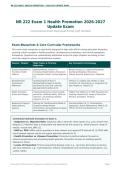
Domain / Chapter Major Topics & Terminal Key Concepts & Terminology
Objectives
Nursing Assessment & Applying Marjory Gordon's 11 Marjory Gordon [1]; Cognitive-Perceptual;
Functional Health Functional Health Patterns framework Nutritional-Metabolic; Elimination;
Patterns to systematic holistic nursing diagnosis Activity-Exercise; Subjective vs. Objective.
[1].
Developmental Synthesizing Erik Erikson's Intimacy vs. Isolation [3]; Identity vs. Role
Psychosocial developmental stages to identify Confusion [3]; Generativity vs. Stagnation [3];
Milestones psychosocial crises and customize Ego Integrity vs. Despair [3].
age-appropriate guidance [3].
Health Promotion Implementing family-centered health Toddler Pool Safety [4, 5]; SIDS Prevention [5];
Across the Lifespan promotion, childhood safety, SIDS risk Smoking Cessation [6]; Levels of Prevention
reduction, and smoking cessation (Primary, Secondary, Tertiary).
programs [4, 5, 6].
Behavioral Change & Utilizing the Transtheoretical Model of Precontemplation [6, 7]; Contemplation;
Health Delivery Change to design lifestyle Preparation; Action; Maintenance; HMO [8, 9];
Systems interventions, and navigating managed PPO [8, 9]; ACO Coordinated Care [7, 8].
care networks [6, 7, 8].
Commonly Confused Concepts on Exam 1:
• Subjective vs. Objective Data: Subjective data is what the client reports (e.g., pain, leisure time,
fatigue) [1]. Objective data is measurable and observed by the nurse (e.g., blood pressure, range of
motion, muscle tone, BMI) [1].
• HMO vs. PPO: HMOs restrict providers to their network and require PCP referrals [8, 9]. PPOs offer
out-of-network options and do not require specialist referrals [8, 9].
• Health Promotion vs. Disease Prevention: Promotion is positive behavior focused on
enhancing well-being and actualizing health potential. Prevention focuses on avoiding specific
diseases or illness.
• Levels of Prevention: Primary (preventing disease onset, e.g., vaccines); Secondary (screening
and early detection, e.g., mammograms); Tertiary (rehabilitation and minimizing complications, e.g.,
cardiac rehab).
Grounded in Official Course Frameworks & Health Promotion Blueprints Page 1
,NR 222 EXAM 1 HEALTH PROMOTION — 2026-2027 UPDATE EXAM
Comprehensive High-Yield Test Bank
The following 50 multiple-choice questions represent a meticulous coverage of the core curriculum.
Complete each question and review the detailed scientific rationales to reinforce your theoretical and
clinical knowledge.
Question 1: Which theorist authored the framework that provides the systematic
foundation for nursing assessment and diagnosis using functional health patterns?
A. Erik Erikson
B. Marjory Gordon
C. Betty Neuman
D. Florence Nightingale
ANSWER ✔: B — Marjory Gordon
Explanation: Marjory Gordon formulated the 11 Functional Health Patterns framework, which
outlines a holistic, systematic approach to nursing assessment and diagnosis [1]. Erikson focused
on psychosocial development stages [3], Neuman developed systems-based nursing theory, and
Nightingale pioneered environmental nursing theory.
Question 2: When conducting an assessment of a client's activity-exercise pattern, which
subjective finding has direct implications for planning nursing health promotion
interventions?
A. A patient's decreased muscle tone observed in physical examination.
B. A patient's reported amount of leisure time.
C. A patient's decreased range of motion in the joints.
D. A patient's reliance on a cane for ambulation.
ANSWER ✔: B — A patient's reported amount of leisure time.
Explanation: Subjective findings represent what the client reports about themselves (such as
leisure time) during history taking [1]. Decreased muscle tone, range of motion, and use of a cane
are objective findings because they are observed or obtained by the nurse through physical
examination [1]. Leisure time helps the nurse understand patterns of physical activity and lifestyle
choices to tailor health promotion programs [1].
Grounded in Official Course Frameworks & Health Promotion Blueprints Page 2
, NR 222 EXAM 1 HEALTH PROMOTION — 2026-2027 UPDATE EXAM
Question 3: During a comprehensive health history, a patient reports sleeping only 5 hours
per night. What is the most appropriate initial nursing action?
A. Instruct the patient that they are sleep-deprived and require sleeping medication.
B. Determine that the patient is receiving adequate sleep and document the finding.
C. Identify the environmental location where the patient sleeps.
D. Ask additional questions to determine the patient's individual sleep adequacy and quality.
ANSWER ✔: D — The nurse must ask additional questions.
Explanation: Sleep requirements are highly individual. A single report of 5 hours of sleep does not
automatically indicate sleep deprivation or adequacy; the nurse must gather additional assessment
data regarding sleep quality, daytime fatigue, and the patient's personal sense of restfulness before
formulating a diagnosis or intervention [2].
Question 4: A nurse is counseling an adult client with a history of a dysfunctional sleep
pattern. Which evidence-based recommendation should the nurse include in the client's
teaching plan?
A. Read an engaging novel in bed until falling asleep.
B. Avoid or restrict fluid intake after 7 PM in the evening.
C. Perform high-intensity aerobic exercise right before bedtime.
D. Watch television in a comfortable recliner to wind down in the evening.
ANSWER ✔: B — Avoid fluids after 7 PM.
Explanation: Avoiding fluids late in the evening helps prevent nocturia (nighttime urination),
which interrupts sleep cycles [2, 3]. Reading in bed, exercising immediately before bed, and
watching TV are poor sleep hygiene behaviors that stimulate the central nervous system, hindering
physiological sleep onset [2].
Question 5: A young adult couple is deciding whether they should get married and start a
family. According to Erik Erikson's theory of psychosocial development, which life stage is
this couple navigating?
A. Identity vs. Role Confusion
B. Intimacy vs. Isolation
C. Generativity vs. Stagnation
D. Ego Integrity vs. Despair
ANSWER ✔: B — Intimacy vs. isolation
Explanation: The Intimacy vs. Isolation stage is the central psychosocial milestone of young
adulthood, during which individuals focus on forming deep, committed relationships, marriage, and
family planning [3]. Identity vs. Role Confusion is the adolescent stage [3]; Generativity vs.
Stagnation is middle adulthood [3]; and Ego Integrity vs. Despair is late adulthood [3].
Grounded in Official Course Frameworks & Health Promotion Blueprints Page 3
NR 222 Exam 1 Health Promotion 2026-2027
Update Exam
Comprehensive Exam Study Guide & High-Yield Test Bank
Exam Blueprints & Core Curricular Frameworks
This exam study companion is specifically designed to align with official nursing education blueprints,
covering critical concepts in health promotion, developmental milestones, and clinical assessment
frameworks. Questions are systematically distributed across the major chapters according to their
curricular weight to ensure comprehensive mastery.
Domain / Chapter Major Topics & Terminal Key Concepts & Terminology
Objectives
Nursing Assessment & Applying Marjory Gordon's 11 Marjory Gordon [1]; Cognitive-Perceptual;
Functional Health Functional Health Patterns framework Nutritional-Metabolic; Elimination;
Patterns to systematic holistic nursing diagnosis Activity-Exercise; Subjective vs. Objective.
[1].
Developmental Synthesizing Erik Erikson's Intimacy vs. Isolation [3]; Identity vs. Role
Psychosocial developmental stages to identify Confusion [3]; Generativity vs. Stagnation [3];
Milestones psychosocial crises and customize Ego Integrity vs. Despair [3].
age-appropriate guidance [3].
Health Promotion Implementing family-centered health Toddler Pool Safety [4, 5]; SIDS Prevention [5];
Across the Lifespan promotion, childhood safety, SIDS risk Smoking Cessation [6]; Levels of Prevention
reduction, and smoking cessation (Primary, Secondary, Tertiary).
programs [4, 5, 6].
Behavioral Change & Utilizing the Transtheoretical Model of Precontemplation [6, 7]; Contemplation;
Health Delivery Change to design lifestyle Preparation; Action; Maintenance; HMO [8, 9];
Systems interventions, and navigating managed PPO [8, 9]; ACO Coordinated Care [7, 8].
care networks [6, 7, 8].
Commonly Confused Concepts on Exam 1:
• Subjective vs. Objective Data: Subjective data is what the client reports (e.g., pain, leisure time,
fatigue) [1]. Objective data is measurable and observed by the nurse (e.g., blood pressure, range of
motion, muscle tone, BMI) [1].
• HMO vs. PPO: HMOs restrict providers to their network and require PCP referrals [8, 9]. PPOs offer
out-of-network options and do not require specialist referrals [8, 9].
• Health Promotion vs. Disease Prevention: Promotion is positive behavior focused on
enhancing well-being and actualizing health potential. Prevention focuses on avoiding specific
diseases or illness.
• Levels of Prevention: Primary (preventing disease onset, e.g., vaccines); Secondary (screening
and early detection, e.g., mammograms); Tertiary (rehabilitation and minimizing complications, e.g.,
cardiac rehab).
Grounded in Official Course Frameworks & Health Promotion Blueprints Page 1
,NR 222 EXAM 1 HEALTH PROMOTION — 2026-2027 UPDATE EXAM
Comprehensive High-Yield Test Bank
The following 50 multiple-choice questions represent a meticulous coverage of the core curriculum.
Complete each question and review the detailed scientific rationales to reinforce your theoretical and
clinical knowledge.
Question 1: Which theorist authored the framework that provides the systematic
foundation for nursing assessment and diagnosis using functional health patterns?
A. Erik Erikson
B. Marjory Gordon
C. Betty Neuman
D. Florence Nightingale
ANSWER ✔: B — Marjory Gordon
Explanation: Marjory Gordon formulated the 11 Functional Health Patterns framework, which
outlines a holistic, systematic approach to nursing assessment and diagnosis [1]. Erikson focused
on psychosocial development stages [3], Neuman developed systems-based nursing theory, and
Nightingale pioneered environmental nursing theory.
Question 2: When conducting an assessment of a client's activity-exercise pattern, which
subjective finding has direct implications for planning nursing health promotion
interventions?
A. A patient's decreased muscle tone observed in physical examination.
B. A patient's reported amount of leisure time.
C. A patient's decreased range of motion in the joints.
D. A patient's reliance on a cane for ambulation.
ANSWER ✔: B — A patient's reported amount of leisure time.
Explanation: Subjective findings represent what the client reports about themselves (such as
leisure time) during history taking [1]. Decreased muscle tone, range of motion, and use of a cane
are objective findings because they are observed or obtained by the nurse through physical
examination [1]. Leisure time helps the nurse understand patterns of physical activity and lifestyle
choices to tailor health promotion programs [1].
Grounded in Official Course Frameworks & Health Promotion Blueprints Page 2
, NR 222 EXAM 1 HEALTH PROMOTION — 2026-2027 UPDATE EXAM
Question 3: During a comprehensive health history, a patient reports sleeping only 5 hours
per night. What is the most appropriate initial nursing action?
A. Instruct the patient that they are sleep-deprived and require sleeping medication.
B. Determine that the patient is receiving adequate sleep and document the finding.
C. Identify the environmental location where the patient sleeps.
D. Ask additional questions to determine the patient's individual sleep adequacy and quality.
ANSWER ✔: D — The nurse must ask additional questions.
Explanation: Sleep requirements are highly individual. A single report of 5 hours of sleep does not
automatically indicate sleep deprivation or adequacy; the nurse must gather additional assessment
data regarding sleep quality, daytime fatigue, and the patient's personal sense of restfulness before
formulating a diagnosis or intervention [2].
Question 4: A nurse is counseling an adult client with a history of a dysfunctional sleep
pattern. Which evidence-based recommendation should the nurse include in the client's
teaching plan?
A. Read an engaging novel in bed until falling asleep.
B. Avoid or restrict fluid intake after 7 PM in the evening.
C. Perform high-intensity aerobic exercise right before bedtime.
D. Watch television in a comfortable recliner to wind down in the evening.
ANSWER ✔: B — Avoid fluids after 7 PM.
Explanation: Avoiding fluids late in the evening helps prevent nocturia (nighttime urination),
which interrupts sleep cycles [2, 3]. Reading in bed, exercising immediately before bed, and
watching TV are poor sleep hygiene behaviors that stimulate the central nervous system, hindering
physiological sleep onset [2].
Question 5: A young adult couple is deciding whether they should get married and start a
family. According to Erik Erikson's theory of psychosocial development, which life stage is
this couple navigating?
A. Identity vs. Role Confusion
B. Intimacy vs. Isolation
C. Generativity vs. Stagnation
D. Ego Integrity vs. Despair
ANSWER ✔: B — Intimacy vs. isolation
Explanation: The Intimacy vs. Isolation stage is the central psychosocial milestone of young
adulthood, during which individuals focus on forming deep, committed relationships, marriage, and
family planning [3]. Identity vs. Role Confusion is the adolescent stage [3]; Generativity vs.
Stagnation is middle adulthood [3]; and Ego Integrity vs. Despair is late adulthood [3].
Grounded in Official Course Frameworks & Health Promotion Blueprints Page 3