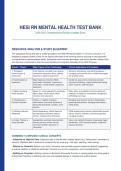
HESI RN MENTAL HEALTH TEST BANK
2026-2027 Comprehensive Review & Update Exam
RESOURCE ANALYSIS & STUDY BLUEPRINT
This specialized clinical test bank is strictly grounded in the HESI RN Mental Health V1-V3 exam curriculum. It is
designed to prepare student nurses for the rigorous demands of the licensing exam by focusing on key psychiatric
nursing domains, pharmacological safety, therapeutic communication techniques, and clinical decision-making. Each
item has been constructed to meet the exact formatting and cognitive standards of the HESI RN exam.
Domain / Chapter Major Topics & Core Terminology Clinical Applications & Procedures
1. Therapeutic Active listening, nonverbal cues, defense Admission interviewing, note-taking boundaries,
Communication & mechanisms (projection, denial, splitting, managing environmental stimuli, establishing rapport
Assessment regression), cognitive assessment. with guarded clients.
2. Mood Disorders & Major Depressive Disorder (MDD), Suicide risk assessments, behavioral activation
Depression psychomotor retardation, hypersomnia, (structured schedules), cognitive behavioral therapy
amotivation, suicidal ideation, postpartum (CBT) outcomes, SSRI education.
depression.
3. Bipolar Disorder & Bipolar I/II, manic hyperactivity, grandiosity, Milieu safety, de-escalation of intrusive behaviors,
Manic Episodes flight of ideas, lithium toxicity, lithium medication compliance, fluid balance management,
excretion (renal clearance). withholding toxic drugs.
4. Schizophrenia & Positive vs. negative symptoms, Managing acute dystonic reactions (benztropine),
Psychotic Disorders hallucinations (command), delusions of bypassing food paranoia, managing hallucinations,
persecution/grandiosity, echolalia, acute reality testing.
dystonia.
5. Substance Abuse & Alcohol dependency, alcohol tolerance, CAGE questionnaire screening, detoxification protocol
Withdrawal benzodiazepine withdrawal, delirium (Ativan, thiamine, hydration), preventing aspiration,
tremens, cardiotoxicity of stimulants. managing overdose.
6. Anxiety, Phobias, & Agoraphobia, systematic desensitization, Caloric and nutritional therapies, binge-purge trigger
Eating Disorders anorexia nervosa, bulimia nervosa, identification, OCD ritual de-escalation, systematic
conversion disorder, obsession vs. exposure protocols.
compulsion.
COMMONLY CONFUSED CLINICAL CONCEPTS
• Subjective vs. Objective Data: Subjective data is what the client verbally reports (e.g., feeling warm, nauseated, or
nervous). Objective data is observed or measured by the nurse (e.g., vital signs, sweating, motor pacing).
• Delirium vs. Dementia: Delirium is an acute, fluctuating, and reversible cognitive impairment typically triggered by
a medical condition or substance withdrawal. Dementia is a chronic, progressive, and irreversible decline.
• Splitting vs. Projection: Splitting (common in Borderline Personality Disorder) is viewing people as entirely good or
entirely bad. Projection is attributing one's own unacceptable feelings or impulses onto another person.
,HESI RN MENTAL HEALTH TEST BANK (2026-2027) PRACTICE EXAM & STUDY GUIDE
• Antipsychotic Discontinuation & Cogentin: Benztropine (Cogentin) is given to prevent extrapyramidal symptoms
(EPS) of antipsychotics. If the antipsychotic is stopped, the prophylactic benztropine must be discontinued to prevent
anticholinergic toxicity.
Page 2
, HESI RN MENTAL HEALTH TEST BANK (2026-2027) PRACTICE EXAM & STUDY GUIDE
HESI RN MENTAL HEALTH PRACTICE EXAM & UPDATE
Directions: Answer the following multiple-choice questions. Select the single best option that represents the priority
nursing intervention or assessment.
Question 1: During an admission assessment, a female client requests that her husband be allowed to
remain in the room. The RN notes a distinct discrepancy between the client's verbal statements and her
nonverbal communication. What action should the RN take?
A. Ignore the nonverbal behavior and focus strictly on the client's verbal messages.
B. Ask the client's husband to interpret the discrepancy.
C. Pay close attention to and document only the nonverbal messages.
D. Integrate the verbal and nonverbal messages and interpret them as one.
ANSWER ■: D — Integrate the verbal and nonverbal messages and interpret them as one.
Explanation: Nonverbal cues provide significant context to verbal communication and are often more reflective of a
client's true emotional state. The nurse must integrate both aspects of communication to form an accurate clinical
picture and assess the situation effectively. Splitting them or ignoring one part can lead to incorrect assessments.
Question 2: A male client approaches the nurse with an angry facial expression and says, 'My roommate is
the most selfish, self-centered, angry person I have ever met. If he loses his temper one more time, I am
going to punch him out!' The nurse recognizes that the client is demonstrating which defense mechanism?
A. Denial
B. Projection
C. Rationalization
D. Splitting
ANSWER ■: B — Projection
Explanation: Projection involves attributing one's own unacceptable feelings, impulses, or thoughts to another person.
Here, the client is expressing extreme anger and threatening violence while accusing his roommate of being an angry
and aggressive individual, thereby projecting his own hostile impulses onto the roommate.
Question 3: An older client presents with multiple bruises in various stages of healing across her legs, arms,
back, and gluteal areas. She avoids eye contact, and the RN suspects elder abuse. What action should the
RN take first?
A. Measure and document the size, shape, and color of the bruised areas.
B. Ask the client specific, direct questions in a private setting about someone causing the bruising.
C. Question the family members and caregiver about how the bruising occurred.
D. Report the family conversations and any visible anger immediately to social services.
ANSWER ■: B — Ask the client specific, direct questions in a private setting about someone causing the
bruising.
Explanation: When abuse is suspected, the nurse's first priority is to ensure safety and gather direct information.
Talking to the client privately and asking direct questions about potential abuse allows her to speak safely without fear of
immediate retaliation. Documentation of bruises is critical but must follow or accompany immediate safety assessments.
Page 3
2026-2027 Comprehensive Review & Update Exam
RESOURCE ANALYSIS & STUDY BLUEPRINT
This specialized clinical test bank is strictly grounded in the HESI RN Mental Health V1-V3 exam curriculum. It is
designed to prepare student nurses for the rigorous demands of the licensing exam by focusing on key psychiatric
nursing domains, pharmacological safety, therapeutic communication techniques, and clinical decision-making. Each
item has been constructed to meet the exact formatting and cognitive standards of the HESI RN exam.
Domain / Chapter Major Topics & Core Terminology Clinical Applications & Procedures
1. Therapeutic Active listening, nonverbal cues, defense Admission interviewing, note-taking boundaries,
Communication & mechanisms (projection, denial, splitting, managing environmental stimuli, establishing rapport
Assessment regression), cognitive assessment. with guarded clients.
2. Mood Disorders & Major Depressive Disorder (MDD), Suicide risk assessments, behavioral activation
Depression psychomotor retardation, hypersomnia, (structured schedules), cognitive behavioral therapy
amotivation, suicidal ideation, postpartum (CBT) outcomes, SSRI education.
depression.
3. Bipolar Disorder & Bipolar I/II, manic hyperactivity, grandiosity, Milieu safety, de-escalation of intrusive behaviors,
Manic Episodes flight of ideas, lithium toxicity, lithium medication compliance, fluid balance management,
excretion (renal clearance). withholding toxic drugs.
4. Schizophrenia & Positive vs. negative symptoms, Managing acute dystonic reactions (benztropine),
Psychotic Disorders hallucinations (command), delusions of bypassing food paranoia, managing hallucinations,
persecution/grandiosity, echolalia, acute reality testing.
dystonia.
5. Substance Abuse & Alcohol dependency, alcohol tolerance, CAGE questionnaire screening, detoxification protocol
Withdrawal benzodiazepine withdrawal, delirium (Ativan, thiamine, hydration), preventing aspiration,
tremens, cardiotoxicity of stimulants. managing overdose.
6. Anxiety, Phobias, & Agoraphobia, systematic desensitization, Caloric and nutritional therapies, binge-purge trigger
Eating Disorders anorexia nervosa, bulimia nervosa, identification, OCD ritual de-escalation, systematic
conversion disorder, obsession vs. exposure protocols.
compulsion.
COMMONLY CONFUSED CLINICAL CONCEPTS
• Subjective vs. Objective Data: Subjective data is what the client verbally reports (e.g., feeling warm, nauseated, or
nervous). Objective data is observed or measured by the nurse (e.g., vital signs, sweating, motor pacing).
• Delirium vs. Dementia: Delirium is an acute, fluctuating, and reversible cognitive impairment typically triggered by
a medical condition or substance withdrawal. Dementia is a chronic, progressive, and irreversible decline.
• Splitting vs. Projection: Splitting (common in Borderline Personality Disorder) is viewing people as entirely good or
entirely bad. Projection is attributing one's own unacceptable feelings or impulses onto another person.
,HESI RN MENTAL HEALTH TEST BANK (2026-2027) PRACTICE EXAM & STUDY GUIDE
• Antipsychotic Discontinuation & Cogentin: Benztropine (Cogentin) is given to prevent extrapyramidal symptoms
(EPS) of antipsychotics. If the antipsychotic is stopped, the prophylactic benztropine must be discontinued to prevent
anticholinergic toxicity.
Page 2
, HESI RN MENTAL HEALTH TEST BANK (2026-2027) PRACTICE EXAM & STUDY GUIDE
HESI RN MENTAL HEALTH PRACTICE EXAM & UPDATE
Directions: Answer the following multiple-choice questions. Select the single best option that represents the priority
nursing intervention or assessment.
Question 1: During an admission assessment, a female client requests that her husband be allowed to
remain in the room. The RN notes a distinct discrepancy between the client's verbal statements and her
nonverbal communication. What action should the RN take?
A. Ignore the nonverbal behavior and focus strictly on the client's verbal messages.
B. Ask the client's husband to interpret the discrepancy.
C. Pay close attention to and document only the nonverbal messages.
D. Integrate the verbal and nonverbal messages and interpret them as one.
ANSWER ■: D — Integrate the verbal and nonverbal messages and interpret them as one.
Explanation: Nonverbal cues provide significant context to verbal communication and are often more reflective of a
client's true emotional state. The nurse must integrate both aspects of communication to form an accurate clinical
picture and assess the situation effectively. Splitting them or ignoring one part can lead to incorrect assessments.
Question 2: A male client approaches the nurse with an angry facial expression and says, 'My roommate is
the most selfish, self-centered, angry person I have ever met. If he loses his temper one more time, I am
going to punch him out!' The nurse recognizes that the client is demonstrating which defense mechanism?
A. Denial
B. Projection
C. Rationalization
D. Splitting
ANSWER ■: B — Projection
Explanation: Projection involves attributing one's own unacceptable feelings, impulses, or thoughts to another person.
Here, the client is expressing extreme anger and threatening violence while accusing his roommate of being an angry
and aggressive individual, thereby projecting his own hostile impulses onto the roommate.
Question 3: An older client presents with multiple bruises in various stages of healing across her legs, arms,
back, and gluteal areas. She avoids eye contact, and the RN suspects elder abuse. What action should the
RN take first?
A. Measure and document the size, shape, and color of the bruised areas.
B. Ask the client specific, direct questions in a private setting about someone causing the bruising.
C. Question the family members and caregiver about how the bruising occurred.
D. Report the family conversations and any visible anger immediately to social services.
ANSWER ■: B — Ask the client specific, direct questions in a private setting about someone causing the
bruising.
Explanation: When abuse is suspected, the nurse's first priority is to ensure safety and gather direct information.
Talking to the client privately and asking direct questions about potential abuse allows her to speak safely without fear of
immediate retaliation. Documentation of bruises is critical but must follow or accompany immediate safety assessments.
Page 3