ATI TEAS All Sections Prep for Anatomy &
Physiology
2026-2027 UPDATE EXAM STUDY BOOKLET & 100-QUESTION PRACTICE TEST BANK
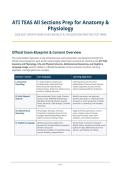
Official Exam Blueprint & Content Overview
This study booklet represents a fully comprehensive exam preparation tool designed directly from
official course blueprints. Each section covers highly-tested topics essential for mastering the ATI TEAS
Anatomy and Physiology, Life and Physical Sciences, Mathematical Reasoning, and English &
Language Usage sections. Below is a detailed breakdown of the curriculum structure, learning
objectives, and high-yield core concepts.
Domain / Section Core Subtopics Learning Objectives
I. Anatomy & 11 Organ Systems: Respiratory, Understand structure-function
Physiology Cardiovascular, Gastrointestinal, relationships of human organ systems,
Neuromuscular, Reproductive, cellular organelles, tissues, and cell
Integumentary, Endocrine, Genitourinary, division pathways (Mitosis & Meiosis).
Immune, Skeletal, Muscular.
II. Life & Physical Macromolecules (Carbs, Lipids, Proteins, Identify monomers and polymers,
Sciences Nucleic Acids), DNA/RNA biochemistry, genetic ratios (9:3:3:1), chemical bonds
Mendelian & Non-Mendelian Genetics, (covalent vs. ionic), properties of matter
Atomic Structure, State changes, Scientific (intensive vs. extensive), and variables.
reasoning.
III. Mathematical Percentages, Decimals, Fractions, Apply arithmetic operations, convert
Reasoning Proportions, Geometry (Area of circle, units, compute rates of change
triangle), Mean/Median/Mode, Metric (decrease/increase), solve word
system conversions (King Henry). problems, and interpret statistics.
IV. English & Language Spelling, Grammar (Subject-verb Demonstrate command of standard
agreement), Homophones/Homographs, English syntax, recognize narrative voices
Sentence structures (points of view), differentiate fact from
(Compound-complex), Primary/Secondary opinion, and identify root affixes.
sources, Reading comprehension.
Page 1
, HIGH-YIELD COMMONLY CONFUSED CONCEPTS
• Cytology vs. Histology: Cytology is the microscopic study of cells (organelles, membranes), while
histology is the study of tissues (groups of similar cells functioning together).
• Osteoblasts vs. Osteoclasts: Osteoblasts are bone-forming cells that synthesize the bone matrix,
while osteoclasts are bone-resorbing cells that break down bone tissue for remodeling. An imbalance
leads to demineralization (osteoporosis).
• Active vs. Passive Immunity: Active immunity occurs when the body's B-cells are challenged by
antigens (directly or via vaccine), establishing long-lived immunological memory. Passive immunity is
the direct transfer of antibodies (e.g., mother-to-child or rabies antivenom), providing immediate but
temporary protection without memory.
• Homophones vs. Homographs: Homophones sound identical but have different spellings and
meanings (e.g., altar/alter). Homographs share the exact same spelling but have different meanings
and pronunciations (e.g., bat, bow).
Practice Test Instructions
The following section contains exactly 100 comprehensive practice questions meticulously structured
according to the official ATI TEAS examination format. Review each question carefully, choose the best
option, and consult the subsequent in-depth rationale for a complete conceptual reinforcement.
Page 2
,ATI TEAS STUDY COMPANION SERIES 2026-2027 EXAM UPDATE EDITION
ANATOMY AND PHYSIOLOGY PRACTICE QUESTIONS
Question 1: Which of the following represents the smallest living structural and functional unit of
an organism?
A. Atom
B. Molecule
C. Organelle
D. Cell
ANSWER : D — Cell
Explanation: A cell is the basic structural unit of an organism from which living things are created. It is the
smallest unit of life that can exist independently. An atom is the most basic complete unit of an element, and a
molecule is a group of bonded atoms; both are non-living. Organelles are functional parts within a cell but are
not independent living units.
Question 2: According to the physiological hierarchy outlined in the study materials, which of the
following is defined as the most basic complete unit of an element?
A. Molecule
B. Atom
C. Organelle
D. Cell
ANSWER : B — Atom
Explanation: An atom is defined as the most basic complete unit of an element. A molecule represents a
group of atoms bonded together, forming the smallest fundamental unit of a chemical compound. Cells are
the basic structural unit of living organisms, and organelles function within cells.
Page 3
, ATI TEAS STUDY COMPANION SERIES 2026-2027 EXAM UPDATE EDITION
Question 3: A clinical researcher is utilizing electron microscopy to analyze the structures of a cell
membrane, mitochondria, and lysosomes. Which of the following disciplines is this study classified
under?
A. Histology
B. Gross Anatomy
C. Cytology
D. Physiology
ANSWER : C — Cytology
Explanation: Cytology is the study of cells and their microscopic structures. Histology is the study of tissues
(groups of similar cells functioning together). Gross anatomy focuses on structures visible to the naked eye,
and physiology is the study of the functions of anatomical structures.
Question 4: Which of the following descriptions accurately defines a tissue in human physiology?
A. A group of cells with similar structure that functions together as a unit, but at a lower level than
organs
B. A cell part that performs specific functions within an individual cell
C. A self-contained part of an organism that performs specific functions and is formed by two or more
similar organ systems
D. The most basic complete unit of a chemical compound
ANSWER : A — A group of cells with similar structure that functions together as a unit, but at a
lower level than organs
Explanation: A tissue is defined as a group of cells with similar structure that functions together as a unit, but
at a lower level of hierarchy than organs. Cell parts are organelles. Organs are formed by two or more similar
tissues. Molecules are the basic units of chemical compounds.
Page 4
Physiology
2026-2027 UPDATE EXAM STUDY BOOKLET & 100-QUESTION PRACTICE TEST BANK
Official Exam Blueprint & Content Overview
This study booklet represents a fully comprehensive exam preparation tool designed directly from
official course blueprints. Each section covers highly-tested topics essential for mastering the ATI TEAS
Anatomy and Physiology, Life and Physical Sciences, Mathematical Reasoning, and English &
Language Usage sections. Below is a detailed breakdown of the curriculum structure, learning
objectives, and high-yield core concepts.
Domain / Section Core Subtopics Learning Objectives
I. Anatomy & 11 Organ Systems: Respiratory, Understand structure-function
Physiology Cardiovascular, Gastrointestinal, relationships of human organ systems,
Neuromuscular, Reproductive, cellular organelles, tissues, and cell
Integumentary, Endocrine, Genitourinary, division pathways (Mitosis & Meiosis).
Immune, Skeletal, Muscular.
II. Life & Physical Macromolecules (Carbs, Lipids, Proteins, Identify monomers and polymers,
Sciences Nucleic Acids), DNA/RNA biochemistry, genetic ratios (9:3:3:1), chemical bonds
Mendelian & Non-Mendelian Genetics, (covalent vs. ionic), properties of matter
Atomic Structure, State changes, Scientific (intensive vs. extensive), and variables.
reasoning.
III. Mathematical Percentages, Decimals, Fractions, Apply arithmetic operations, convert
Reasoning Proportions, Geometry (Area of circle, units, compute rates of change
triangle), Mean/Median/Mode, Metric (decrease/increase), solve word
system conversions (King Henry). problems, and interpret statistics.
IV. English & Language Spelling, Grammar (Subject-verb Demonstrate command of standard
agreement), Homophones/Homographs, English syntax, recognize narrative voices
Sentence structures (points of view), differentiate fact from
(Compound-complex), Primary/Secondary opinion, and identify root affixes.
sources, Reading comprehension.
Page 1
, HIGH-YIELD COMMONLY CONFUSED CONCEPTS
• Cytology vs. Histology: Cytology is the microscopic study of cells (organelles, membranes), while
histology is the study of tissues (groups of similar cells functioning together).
• Osteoblasts vs. Osteoclasts: Osteoblasts are bone-forming cells that synthesize the bone matrix,
while osteoclasts are bone-resorbing cells that break down bone tissue for remodeling. An imbalance
leads to demineralization (osteoporosis).
• Active vs. Passive Immunity: Active immunity occurs when the body's B-cells are challenged by
antigens (directly or via vaccine), establishing long-lived immunological memory. Passive immunity is
the direct transfer of antibodies (e.g., mother-to-child or rabies antivenom), providing immediate but
temporary protection without memory.
• Homophones vs. Homographs: Homophones sound identical but have different spellings and
meanings (e.g., altar/alter). Homographs share the exact same spelling but have different meanings
and pronunciations (e.g., bat, bow).
Practice Test Instructions
The following section contains exactly 100 comprehensive practice questions meticulously structured
according to the official ATI TEAS examination format. Review each question carefully, choose the best
option, and consult the subsequent in-depth rationale for a complete conceptual reinforcement.
Page 2
,ATI TEAS STUDY COMPANION SERIES 2026-2027 EXAM UPDATE EDITION
ANATOMY AND PHYSIOLOGY PRACTICE QUESTIONS
Question 1: Which of the following represents the smallest living structural and functional unit of
an organism?
A. Atom
B. Molecule
C. Organelle
D. Cell
ANSWER : D — Cell
Explanation: A cell is the basic structural unit of an organism from which living things are created. It is the
smallest unit of life that can exist independently. An atom is the most basic complete unit of an element, and a
molecule is a group of bonded atoms; both are non-living. Organelles are functional parts within a cell but are
not independent living units.
Question 2: According to the physiological hierarchy outlined in the study materials, which of the
following is defined as the most basic complete unit of an element?
A. Molecule
B. Atom
C. Organelle
D. Cell
ANSWER : B — Atom
Explanation: An atom is defined as the most basic complete unit of an element. A molecule represents a
group of atoms bonded together, forming the smallest fundamental unit of a chemical compound. Cells are
the basic structural unit of living organisms, and organelles function within cells.
Page 3
, ATI TEAS STUDY COMPANION SERIES 2026-2027 EXAM UPDATE EDITION
Question 3: A clinical researcher is utilizing electron microscopy to analyze the structures of a cell
membrane, mitochondria, and lysosomes. Which of the following disciplines is this study classified
under?
A. Histology
B. Gross Anatomy
C. Cytology
D. Physiology
ANSWER : C — Cytology
Explanation: Cytology is the study of cells and their microscopic structures. Histology is the study of tissues
(groups of similar cells functioning together). Gross anatomy focuses on structures visible to the naked eye,
and physiology is the study of the functions of anatomical structures.
Question 4: Which of the following descriptions accurately defines a tissue in human physiology?
A. A group of cells with similar structure that functions together as a unit, but at a lower level than
organs
B. A cell part that performs specific functions within an individual cell
C. A self-contained part of an organism that performs specific functions and is formed by two or more
similar organ systems
D. The most basic complete unit of a chemical compound
ANSWER : A — A group of cells with similar structure that functions together as a unit, but at a
lower level than organs
Explanation: A tissue is defined as a group of cells with similar structure that functions together as a unit, but
at a lower level of hierarchy than organs. Cell parts are organelles. Organs are formed by two or more similar
tissues. Molecules are the basic units of chemical compounds.
Page 4