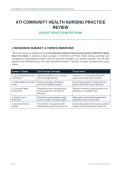
ATI COMMUNITY HEALTH NURSING PRACTICE REVIEW: 2026-2027 UPDATE EXAM
ATI COMMUNITY HEALTH NURSING PRACTICE
REVIEW
2026-2027 UPDATE EXAM TEST BANK
I. RESOURCE SUBJECT & TOPICS IDENTIFIER
This study resource is designed for the ATI Community Health Nursing Practice Review: 2026-2027 Update
Exam Test Bank. It addresses critical concepts in Community and Public Health Nursing, including case
management, epidemiological models, multi-level prevention strategies, and disaster response. The test bank
questions are distributed across five major specialized domains of practice to ensure comprehensive course
review.
Domain / Chapter Core Concept Coverage Focus Areas
1. Case Management & Care Referrals, Negotiator and Coordinator Transition care, cost-containment, home
Coordination roles, discharge planning. safety, and provider HMO structures.
2. Public Health & Prevention Primary, Secondary, and Tertiary Immunization programs, health screening
Levels prevention, Distributive Justice. design, and ethical resource allocation.
3. Community Health Windshield surveys, secondary data, Ethnicity, boundaries, physical barriers, and
Assessments Needs assessment, key informant qualitative vs. quantitative data.
interviews.
4. Disaster Prep & Prevention, response phases, triage Blast injuries, shock, anthrax/ciprofloxacin
Bioterrorism scoring, Category A biological agents. prophylaxis, and community drills.
5. Specialized Nursing School health, Occupational health, Koplik spots, physical work hazards, caregiver
Settings Faith/parish nursing, and Hospice care. burden, and cultural American Indian care.
Page 1 Professional Study Companion
,ATI COMMUNITY HEALTH NURSING PRACTICE REVIEW: 2026-2027 UPDATE EXAM
II. COMPREHENSIVE EXAM TEST BANK
1. CASE MANAGEMENT, REFERRAL PROCESSES, AND CARE
COORDINATION
1. A case management nurse at an acute care facility is conducting an initial visit with a client
to identify needs prior to discharge home. After developing a working relationship with the
client, the nurse is engaging in the referral process. Which of the following actions should the
nurse take first?
A. Contact local home health agencies to check their availability
B. Obtain consent from the client's family members
C. Identify referrals that the client needs
D. Review the client's financial records for insurance eligibility
ANSWER : C — Identify referrals that the client needs
Explanation: According to the nurse's referral process guidelines in case management, the first action
when engaging in referrals is always assessment—specifically, identifying the exact referrals that the client
needs. This ensures the plan of care is tailored to the client's specific physical, social, and psychological
requirements prior to discharge.
2. A case manager in a rehabilitation facility is discussing discharge plans with a client who
has a pressure injury and requires a special bed at home. Which of the following statements
should the nurse make first?
A. "A school worker can help you with the cost of supplies."
B. "You will need to pay out-of-pocket for any specialized home medical equipment."
C. "I will order the bed immediately from our primary medical vendor."
D. "Your family must receive training on how to assemble the bed before discharge."
ANSWER : A — "A school worker can help you with the cost of supplies."
Explanation: The official protocol notes that the case manager's first statement regarding resource and cost
assistance for a client needing specialized home care supplies (such as a special bed for a pressure injury)
is to inform them that a school worker can assist with the cost of supplies. This initiates the financial and
material resource allocation process.
Page 2 Professional Study Companion
, ATI COMMUNITY HEALTH NURSING PRACTICE REVIEW: 2026-2027 UPDATE EXAM
3. A case manager is caring for a client who is being discharged following total hip
arthroplasty. Which of the following actions is an example of the nurse functioning in the
Negotiator role?
A. Teaching the client safe transfer techniques using a walker
B. Coordinating the delivery of a raised toilet seat to the client's home
C. Discuss payment options with various pharmacies
D. Checking the client's surgical incision site for signs of infection
ANSWER : B — Discuss payment options with various pharmacies
Explanation: Discussing payment options with various pharmacies is a prime example of the case manager
functioning in the Negotiator role. In this role, the nurse advocates for the client's financial and care interests
by negotiating terms, costs, and payment options with external healthcare and pharmaceutical providers.
4. A case manager is performing discharge planning for a client who experienced a traumatic
leg amputation and has a new prosthesis. Which of the following assessments should the
nurse identify as the priority?
A. Evaluate the client's home environment.
B. Assess the client's ability to perform deep breathing exercises.
C. Determine the client's dietary preferences and caloric intake.
D. Check the client's blood pressure in both arms.
ANSWER : A — Evaluate the client's home environment.
Explanation: For a client returning home with a new prosthesis following a traumatic amputation, evaluating
the home environment is the priority assessment. This allows the case manager to identify potential
architectural barriers, safety hazards, and adjustments needed to facilitate safe mobility and prevent falls.
5. A case manager is planning home health care for a client who has a major burn injury.
Which of the following interventions should the case manager plan to make?
A. Design an aerobic exercise program for the client's recovery
B. Assess the client's need for wound care supplies.
C. Administer intravenous antibiotics at every home visit
D. Provide deep tissue massage to reduce scar formation
ANSWER : B — Assess the client's need for wound care supplies.
Explanation: Planning home health care for a client recovering from a major burn injury requires a
comprehensive assessment of physical needs. The case manager must plan to assess the client's need for
wound care supplies to ensure continuity of care and proper infection prevention at home.
Page 3 Professional Study Companion
ATI COMMUNITY HEALTH NURSING PRACTICE
REVIEW
2026-2027 UPDATE EXAM TEST BANK
I. RESOURCE SUBJECT & TOPICS IDENTIFIER
This study resource is designed for the ATI Community Health Nursing Practice Review: 2026-2027 Update
Exam Test Bank. It addresses critical concepts in Community and Public Health Nursing, including case
management, epidemiological models, multi-level prevention strategies, and disaster response. The test bank
questions are distributed across five major specialized domains of practice to ensure comprehensive course
review.
Domain / Chapter Core Concept Coverage Focus Areas
1. Case Management & Care Referrals, Negotiator and Coordinator Transition care, cost-containment, home
Coordination roles, discharge planning. safety, and provider HMO structures.
2. Public Health & Prevention Primary, Secondary, and Tertiary Immunization programs, health screening
Levels prevention, Distributive Justice. design, and ethical resource allocation.
3. Community Health Windshield surveys, secondary data, Ethnicity, boundaries, physical barriers, and
Assessments Needs assessment, key informant qualitative vs. quantitative data.
interviews.
4. Disaster Prep & Prevention, response phases, triage Blast injuries, shock, anthrax/ciprofloxacin
Bioterrorism scoring, Category A biological agents. prophylaxis, and community drills.
5. Specialized Nursing School health, Occupational health, Koplik spots, physical work hazards, caregiver
Settings Faith/parish nursing, and Hospice care. burden, and cultural American Indian care.
Page 1 Professional Study Companion
,ATI COMMUNITY HEALTH NURSING PRACTICE REVIEW: 2026-2027 UPDATE EXAM
II. COMPREHENSIVE EXAM TEST BANK
1. CASE MANAGEMENT, REFERRAL PROCESSES, AND CARE
COORDINATION
1. A case management nurse at an acute care facility is conducting an initial visit with a client
to identify needs prior to discharge home. After developing a working relationship with the
client, the nurse is engaging in the referral process. Which of the following actions should the
nurse take first?
A. Contact local home health agencies to check their availability
B. Obtain consent from the client's family members
C. Identify referrals that the client needs
D. Review the client's financial records for insurance eligibility
ANSWER : C — Identify referrals that the client needs
Explanation: According to the nurse's referral process guidelines in case management, the first action
when engaging in referrals is always assessment—specifically, identifying the exact referrals that the client
needs. This ensures the plan of care is tailored to the client's specific physical, social, and psychological
requirements prior to discharge.
2. A case manager in a rehabilitation facility is discussing discharge plans with a client who
has a pressure injury and requires a special bed at home. Which of the following statements
should the nurse make first?
A. "A school worker can help you with the cost of supplies."
B. "You will need to pay out-of-pocket for any specialized home medical equipment."
C. "I will order the bed immediately from our primary medical vendor."
D. "Your family must receive training on how to assemble the bed before discharge."
ANSWER : A — "A school worker can help you with the cost of supplies."
Explanation: The official protocol notes that the case manager's first statement regarding resource and cost
assistance for a client needing specialized home care supplies (such as a special bed for a pressure injury)
is to inform them that a school worker can assist with the cost of supplies. This initiates the financial and
material resource allocation process.
Page 2 Professional Study Companion
, ATI COMMUNITY HEALTH NURSING PRACTICE REVIEW: 2026-2027 UPDATE EXAM
3. A case manager is caring for a client who is being discharged following total hip
arthroplasty. Which of the following actions is an example of the nurse functioning in the
Negotiator role?
A. Teaching the client safe transfer techniques using a walker
B. Coordinating the delivery of a raised toilet seat to the client's home
C. Discuss payment options with various pharmacies
D. Checking the client's surgical incision site for signs of infection
ANSWER : B — Discuss payment options with various pharmacies
Explanation: Discussing payment options with various pharmacies is a prime example of the case manager
functioning in the Negotiator role. In this role, the nurse advocates for the client's financial and care interests
by negotiating terms, costs, and payment options with external healthcare and pharmaceutical providers.
4. A case manager is performing discharge planning for a client who experienced a traumatic
leg amputation and has a new prosthesis. Which of the following assessments should the
nurse identify as the priority?
A. Evaluate the client's home environment.
B. Assess the client's ability to perform deep breathing exercises.
C. Determine the client's dietary preferences and caloric intake.
D. Check the client's blood pressure in both arms.
ANSWER : A — Evaluate the client's home environment.
Explanation: For a client returning home with a new prosthesis following a traumatic amputation, evaluating
the home environment is the priority assessment. This allows the case manager to identify potential
architectural barriers, safety hazards, and adjustments needed to facilitate safe mobility and prevent falls.
5. A case manager is planning home health care for a client who has a major burn injury.
Which of the following interventions should the case manager plan to make?
A. Design an aerobic exercise program for the client's recovery
B. Assess the client's need for wound care supplies.
C. Administer intravenous antibiotics at every home visit
D. Provide deep tissue massage to reduce scar formation
ANSWER : B — Assess the client's need for wound care supplies.
Explanation: Planning home health care for a client recovering from a major burn injury requires a
comprehensive assessment of physical needs. The case manager must plan to assess the client's need for
wound care supplies to ensure continuity of care and proper infection prevention at home.
Page 3 Professional Study Companion