
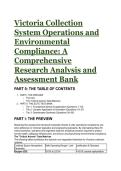
Victoria Collection
System Operations and
Environmental
Compliance: A
Comprehensive
Research Analysis and
Assessment Bank
PART 0: THE TABLE OF CONTENTS
1. PART I: THE PREVIEW
○ The Intro
○ The "Critical Axioms" Data Matrices
2. PART II: THE ELITE TEST BANK
○ Tier 1: Foundational Syntax & Application (Questions 1–18)
○ Tier 2: Complex Application & Simulation (Questions 19–37)
○ Tier 3: Grandmaster Synthesis (Questions 38–55)
PART I: THE PREVIEW
Mastering this assessment framework translates directly to elite operational competence and
strict adherence to Victorian legislative and engineering standards. By internalizing these 55
critical scenarios, operators and engineers forge the analytical precision required to protect
human health, safeguard infrastructure, and ensure uncompromising environmental compliance.
The "Critical Axioms" Data Matrices
The following tables synthesize the absolute non-negotiable thresholds for Victorian collection
systems.
Confined Space Atmospheric Safe Operating Range / Limit Justification & Standard
Parameter
Oxygen (O2) 19.5% to 23.5% <19.5% causes asphyxiation;
,Confined Space Atmospheric Safe Operating Range / Limit Justification & Standard
Parameter
>23.5% causes extreme fire
risk.
Lower Explosive Limit (LEL) < 5% (Hot Work strictly 0%) >5% requires evacuation; LEL
sensors require O2 to function.
Hydrogen Sulfide (H2S) < 20 ppm (TWA) Highly toxic, heavier than air,
deadens olfactory nerves.
Carbon Monoxide (CO) < 50 ppm (TWA) Odourless byproduct of
combustion, restricts blood
oxygen.
Gravity Sewer Hydraulic Minimum Value Justification & Standard
Parameter
Self-Cleansing Velocity 0.7 m/s (2.0 ft/s) Prevents sediment and slime
accumulation (WSAA WSA 02).
Minimum Slope 1.04% (~1/DN rule) Maintains velocity in residential
(DN150/6-inch) reticulation.
Minimum Slope 0.40% - 0.50% Base minimum for larger
(DN200/8-inch) branch sewers.
Minimum Slope 0.22% - 0.33% Flatter slopes permitted as
(DN300/12-inch) hydraulic radius increases.
EPA Victoria Permissions Tier Risk Profile Example Activity (Schedule 1)
Operating Licence High Complexity / High Risk Landfills >5,000 people; large
sewage treatment.
Permit Medium Risk / Low Complexity Municipal landfills <5,000
people; temporary storage.
Registration Low Risk E-waste <500 tonnes;
commercial dry-cleaning.
PART II: THE ELITE TEST BANK
Tier 1 - Foundational Syntax & Application
Q1: Under the Victorian Environment Protection Act 2017, a collection system operator
responds to a minor sewage overflow. Based on the General Environmental Duty (GED), which
mindset is FIRST required? A) Wait for actual environmental harm to occur before taking
corrective action. B) Proactively identify and minimize the risk of harm so far as reasonably
practicable. C) Rely entirely on reactive remedial measures once the EPA issues a formal
notice. D) Focus strictly on eliminating risks to employee health and safety under OH&S laws.
● Answer: B (Proactively identify and minimize the risk of harm so far as reasonably
practicable.)
● Distractor Analysis:
○ A is incorrect: The GED is risk-based, not outcome-based; waiting for actual harm
violates the duty.
○ C is incorrect: The 2017 Act shifts the regulatory framework entirely from reactive to
, prevention-based management.
○ D is incorrect: OH&S laws eliminate risks to employees, whereas the GED
minimizes risks to human health and the broader environment.
The Mentor's Analysis: The core underlying principle of the new EP Act is prevention. When
facing an operational hazard, the immediate priority is risk mitigation before harm materializes.
By utilizing the General Environmental Duty, the operator bypasses the common trap of reactive
compliance. Professional Intuition: Treat environmental risk with the same proactive
zero-tolerance as occupational safety.
Q2: A maintenance crew prepares to enter a dry well at a pump station. Atmospheric testing
reveals an oxygen concentration of 18.5%. Based on WorkSafe Victoria regulations, what is the
MOST APPROPRIATE action? A) Proceed with entry as the level is below the 23.5% maximum
limit. B) Ventilate the space using pure oxygen from a compressed cylinder to rapidly increase
the levels. C) Prohibit entry, as the atmosphere is oxygen-deficient and poses a life-threatening
asphyxiation risk. D) Enter the space for a maximum of 15 minutes before mandating a re-test.
● Answer: C (Prohibit entry, as the atmosphere is oxygen-deficient and poses a
life-threatening asphyxiation risk.)
● Distractor Analysis:
○ A is incorrect: While the atmosphere is below the maximum, it fundamentally
breaches the minimum safe threshold of 19.5%.
○ B is incorrect: Introducing pure oxygen into a confined space creates an extreme,
explosive fire hazard and is strictly forbidden.
○ D is incorrect: Entry into an oxygen-deficient atmosphere (<19.5%) without supplied
air is strictly prohibited regardless of duration.
The Mentor's Analysis: Confined space atmospheres are unforgiving and binary. When facing
abnormal gas readings, the immediate priority is atmospheric correction or physical isolation. By
utilizing mechanical ventilation (ambient air), the crew bypasses the common trap of
asphyxiation. Professional Intuition: 19.5% to 23.5% Oxygen is the absolute Hard Deck;
accept no deviations.
Q3: When designing or inspecting a new DN200 gravity sewer line per WSAA WSA 02
standards, which slope is the MINIMUM required to maintain self-cleansing velocity? A) 0.25%
B) 0.33% C) 0.50% D) 1.00%
● Answer: C (0.50%)
● Distractor Analysis:
○ A is incorrect: A slope of 0.25% is the minimum acceptable gradient for a larger
DN400 pipe, not a DN200 pipe.
○ B is incorrect: A slope of 0.33% is the standard minimum slope for a DN300 pipe.
○ D is incorrect: While 1.00% is acceptable and provides excellent velocity, it is
excessively steep and not the mathematical minimum.
The Mentor's Analysis: Gravity systems rely on specific mathematical gradients to transport
suspended solids. When facing pipe sizing calculations, the immediate priority is achieving at
least 0.7 m/s flow velocity. By utilizing the 1/DN rule, the engineer bypasses the common trap of
sediment accumulation and subsequent blockages. Professional Intuition: Divide 1 by the
nominal diameter (DN) in millimeters to find the exact percentage for minimum slope.
Q4: An operator observes an accumulation of air in a newly constructed sewer force main,
leading to flow stoppage and increased pump cycles. Which component must be FIRST
evaluated for failure? A) The boundary trap located on the residential property connection. B)
The air release valve situated at the pipeline's localized high point. C) The grease interceptor
discharging from a commercial kitchen. D) The Parshall flume located at the downstream
System Operations and
Environmental
Compliance: A
Comprehensive
Research Analysis and
Assessment Bank
PART 0: THE TABLE OF CONTENTS
1. PART I: THE PREVIEW
○ The Intro
○ The "Critical Axioms" Data Matrices
2. PART II: THE ELITE TEST BANK
○ Tier 1: Foundational Syntax & Application (Questions 1–18)
○ Tier 2: Complex Application & Simulation (Questions 19–37)
○ Tier 3: Grandmaster Synthesis (Questions 38–55)
PART I: THE PREVIEW
Mastering this assessment framework translates directly to elite operational competence and
strict adherence to Victorian legislative and engineering standards. By internalizing these 55
critical scenarios, operators and engineers forge the analytical precision required to protect
human health, safeguard infrastructure, and ensure uncompromising environmental compliance.
The "Critical Axioms" Data Matrices
The following tables synthesize the absolute non-negotiable thresholds for Victorian collection
systems.
Confined Space Atmospheric Safe Operating Range / Limit Justification & Standard
Parameter
Oxygen (O2) 19.5% to 23.5% <19.5% causes asphyxiation;
,Confined Space Atmospheric Safe Operating Range / Limit Justification & Standard
Parameter
>23.5% causes extreme fire
risk.
Lower Explosive Limit (LEL) < 5% (Hot Work strictly 0%) >5% requires evacuation; LEL
sensors require O2 to function.
Hydrogen Sulfide (H2S) < 20 ppm (TWA) Highly toxic, heavier than air,
deadens olfactory nerves.
Carbon Monoxide (CO) < 50 ppm (TWA) Odourless byproduct of
combustion, restricts blood
oxygen.
Gravity Sewer Hydraulic Minimum Value Justification & Standard
Parameter
Self-Cleansing Velocity 0.7 m/s (2.0 ft/s) Prevents sediment and slime
accumulation (WSAA WSA 02).
Minimum Slope 1.04% (~1/DN rule) Maintains velocity in residential
(DN150/6-inch) reticulation.
Minimum Slope 0.40% - 0.50% Base minimum for larger
(DN200/8-inch) branch sewers.
Minimum Slope 0.22% - 0.33% Flatter slopes permitted as
(DN300/12-inch) hydraulic radius increases.
EPA Victoria Permissions Tier Risk Profile Example Activity (Schedule 1)
Operating Licence High Complexity / High Risk Landfills >5,000 people; large
sewage treatment.
Permit Medium Risk / Low Complexity Municipal landfills <5,000
people; temporary storage.
Registration Low Risk E-waste <500 tonnes;
commercial dry-cleaning.
PART II: THE ELITE TEST BANK
Tier 1 - Foundational Syntax & Application
Q1: Under the Victorian Environment Protection Act 2017, a collection system operator
responds to a minor sewage overflow. Based on the General Environmental Duty (GED), which
mindset is FIRST required? A) Wait for actual environmental harm to occur before taking
corrective action. B) Proactively identify and minimize the risk of harm so far as reasonably
practicable. C) Rely entirely on reactive remedial measures once the EPA issues a formal
notice. D) Focus strictly on eliminating risks to employee health and safety under OH&S laws.
● Answer: B (Proactively identify and minimize the risk of harm so far as reasonably
practicable.)
● Distractor Analysis:
○ A is incorrect: The GED is risk-based, not outcome-based; waiting for actual harm
violates the duty.
○ C is incorrect: The 2017 Act shifts the regulatory framework entirely from reactive to
, prevention-based management.
○ D is incorrect: OH&S laws eliminate risks to employees, whereas the GED
minimizes risks to human health and the broader environment.
The Mentor's Analysis: The core underlying principle of the new EP Act is prevention. When
facing an operational hazard, the immediate priority is risk mitigation before harm materializes.
By utilizing the General Environmental Duty, the operator bypasses the common trap of reactive
compliance. Professional Intuition: Treat environmental risk with the same proactive
zero-tolerance as occupational safety.
Q2: A maintenance crew prepares to enter a dry well at a pump station. Atmospheric testing
reveals an oxygen concentration of 18.5%. Based on WorkSafe Victoria regulations, what is the
MOST APPROPRIATE action? A) Proceed with entry as the level is below the 23.5% maximum
limit. B) Ventilate the space using pure oxygen from a compressed cylinder to rapidly increase
the levels. C) Prohibit entry, as the atmosphere is oxygen-deficient and poses a life-threatening
asphyxiation risk. D) Enter the space for a maximum of 15 minutes before mandating a re-test.
● Answer: C (Prohibit entry, as the atmosphere is oxygen-deficient and poses a
life-threatening asphyxiation risk.)
● Distractor Analysis:
○ A is incorrect: While the atmosphere is below the maximum, it fundamentally
breaches the minimum safe threshold of 19.5%.
○ B is incorrect: Introducing pure oxygen into a confined space creates an extreme,
explosive fire hazard and is strictly forbidden.
○ D is incorrect: Entry into an oxygen-deficient atmosphere (<19.5%) without supplied
air is strictly prohibited regardless of duration.
The Mentor's Analysis: Confined space atmospheres are unforgiving and binary. When facing
abnormal gas readings, the immediate priority is atmospheric correction or physical isolation. By
utilizing mechanical ventilation (ambient air), the crew bypasses the common trap of
asphyxiation. Professional Intuition: 19.5% to 23.5% Oxygen is the absolute Hard Deck;
accept no deviations.
Q3: When designing or inspecting a new DN200 gravity sewer line per WSAA WSA 02
standards, which slope is the MINIMUM required to maintain self-cleansing velocity? A) 0.25%
B) 0.33% C) 0.50% D) 1.00%
● Answer: C (0.50%)
● Distractor Analysis:
○ A is incorrect: A slope of 0.25% is the minimum acceptable gradient for a larger
DN400 pipe, not a DN200 pipe.
○ B is incorrect: A slope of 0.33% is the standard minimum slope for a DN300 pipe.
○ D is incorrect: While 1.00% is acceptable and provides excellent velocity, it is
excessively steep and not the mathematical minimum.
The Mentor's Analysis: Gravity systems rely on specific mathematical gradients to transport
suspended solids. When facing pipe sizing calculations, the immediate priority is achieving at
least 0.7 m/s flow velocity. By utilizing the 1/DN rule, the engineer bypasses the common trap of
sediment accumulation and subsequent blockages. Professional Intuition: Divide 1 by the
nominal diameter (DN) in millimeters to find the exact percentage for minimum slope.
Q4: An operator observes an accumulation of air in a newly constructed sewer force main,
leading to flow stoppage and increased pump cycles. Which component must be FIRST
evaluated for failure? A) The boundary trap located on the residential property connection. B)
The air release valve situated at the pipeline's localized high point. C) The grease interceptor
discharging from a commercial kitchen. D) The Parshall flume located at the downstream


