

Written by students who passed Immediately available after payment Read online or as PDF Wrong document? Swap it for free 4.6 TrustPilot
logo-home
Document preview thumbnail
Preview 2 out of 13 pages
Exam (elaborations)

Pathophysiology HESI Questions & Answers Updated 2026/2027 – HESI Pathophysiology Exam, Cellular Injury, Homeostasis, Genetics, Cancer, Immunology, Infection, Cardiovascular, Respiratory, Renal, Endocrine, GI & Hematology – Instant Download

Document preview thumbnail
Preview 2 out of 13 pages

**Pathophysiology HESI Questions & Answers Updated 2026/2027 – Instant Download** Get focused preparation for **Pathophysiology HESI** with this comprehensive exam-focused study resource based on the supplied **Samuel Merritt University NURSG 125 Health Assessment 1** material. This resource covers major pathophysiology concepts across cellular function, disease processes, genetics, oncology, infection, immunity, cardiovascular disorders, respiratory disease, renal disorders, endocrine conditions, gastrointestinal disorders, hematology, neurological disorders, musculoskeletal disease, and related nursing concepts. The material is designed for students who want to strengthen recognition of important **pathophysiology concepts, mechanisms of disease, clinical manifestations, risk factors, laboratory findings, and nursing-focused disease processes**. ### Major Topics Covered **Homeostasis, Cellular Function & Cellular Injury** * Homeostasis * Positive feedback * Negative feedback * Disease processes * Cellular adaptation * Atrophy * Hypertrophy * Hyperplasia * Metaplasia * Dysplasia * Cellular hypoxia * Cellular injury * Sodium-potassium pump * Cell membrane transport * Diffusion * Anabolic metabolism * Protein synthesis * Transcription * DNA and RNA * Cellular metabolism * Ischemia * Tissue injury * Pressure-related tissue injury * Decubitus ulcers * Burns and inflammatory response * Decompression sickness * Gas emboli * Free radicals **Aging & Development** * Aging physiology * Elderly health changes * Thirst perception in older adults * Temperature sensation * Cardiovascular aging * Hematologic differences * Neonatal period * First two months of life * Age-related physiological changes **Genetics & Genetic Disorders** * Genetics * Recessive traits * Dominant and recessive genotypes * Chromosomal abnormalities * Down syndrome * Chromosomal translocation * Hemophilia * Factor VIII deficiency * Genetic disease * Inherited disorders * BRCA1 * Cancer genetics * Tumor suppressor genes * Oncogenes **Cancer & Oncology Pathophysiology** * Cancer development * Tumor biology * Tumor suppressor genes * BRCA1 * Cancer prognosis * Early cancer detection * Tumor grading * Tumor staging * TNM classification * Cachexia * Cancer metabolism * Angiogenesis * Malignancy * Histologic characteristics * Five-year survival * Cancer treatment * Cancer progression **Infection & Microbiology** * Bacterial classification * Bacterial shape * Oxygen requirements * Gram staining and bacterial staining * Normal flora * Opportunistic infection * Antibiotic resistance * Antibiotic adherence * Infection prevention * Shift to the left * Bandemia * White blood cell response * Viral infections * Epstein-Barr virus * HIV-1 * HIV-2 * Infection-related disease processes **Immune System & Immunologic Disorders** * Immune response * Lymphocytes * Neutrophils * Monocytes * Macrophages * Hypersensitivity * Type I hypersensitivity * Anaphylaxis * Autoimmunity * Systemic lupus erythematosus * SLE pathophysiology * Immunodeficiency * HIV/AIDS * Anergy * TB testing * Active immunity * Vaccination * Passive immunity * Transplantation * Allogenic transplant * Immune response to transplantation **Hematology & Blood Disorders** * Hemoglobin * Hematocrit * Red blood cells * Polycythemia * Anemia * Macrocytic anemia * Pernicious anemia * Iron deficiency anemia * Anemia of chronic disease * Erythropoietin * Aplastic anemia * Pancytopenia * Sickle cell anemia * Factor VII * Factor VIII * Hemophilia * von Willebrand disease * Thrombocytopenia * Platelet disorders * Whole blood transfusion * Blood loss * Erythropoiesis * Vitamin B12 * Folate * Vitamin C * Oxyhemoglobin dissociation curve **Cardiovascular Pathophysiology** * Frank-Starling law * Preload * Cardiac contraction * Stroke volume * Hypovolemia * Tachycardia * Hypotension * Shock * Stable angina * Chest pain * Myocardial ischemia * Peripheral artery disease * Arterial occlusion * Atherosclerosis * Foam cells * Left-sided heart failure * Pulmonary edema * Hydrostatic pressure * Fluid movement * Abdominal aortic aneurysm * AAA rupture * Hemorrhagic shock **Respiratory Pathophysiology** * COPD * Chronic obstructive pulmonary disease * Asthma * Chronic airway disease * Mucus production * Airway inflammation * Alveolar destruction * Macrophage activity * ARDS * Acute respiratory distress syndrome * Hypoxia * Respiratory disease mechanisms * Oxygenation * Gas exchange **Renal & Urinary Pathophysiology** * Acute renal failure * Acute kidney injury * Serum potassium * BUN * Creatinine * Glomerulus * Renal filtration * Kidney function * Benign prostatic hypertrophy * BPH * Urethral compression * Urinary symptoms * Renal disease * Electrolyte abnormalities **Endocrine & Metabolic Disorders** * Diabetes mellitus * Hyperglycemia * Microvascular damage * Diabetic end-organ disease * DKA * Diabetic ketoacidosis * HHS * Hyperosmolar hyperglycemic state * Ketones * Hyperglycemia symptoms * Insulin * Glucagon * Cortisol * Stress response * Addison's disease * Steroid stress dosing * Exophthalmos * Thyroid-related eye disease **Gastrointestinal & Hepatic Pathophysiology** * Pancreatitis * Serum lipase * Serum amylase * Gastric cancer * Gastric cancer risk factors * Helicobacter pylori * Cured meats * Gastrointestinal disease * Liver disease * Protein metabolism * Nitrogenous waste * Protein restriction * Hepatitis A * Contaminated water * Amoebic dysentery **Neurological Pathophysiology** * Increased intracranial pressure * ICP * Projectile vomiting * Altered mental status * Decerebrate positioning * Bradycardia * Neurological deterioration * ALS * Amyotrophic lateral sclerosis * Motor neuron destruction * Progressive muscle weakness * Neurotransmitters * Serotonin * Depression **Musculoskeletal Disorders** * Osteoporosis * Bone resorption * Demineralization * Osteoporosis risk factors * Low BMI * Smoking * Rheumatoid arthritis * Antigen-antibody activity * Joint inflammation * Gout * Articular cartilage * Osteoarthritis ### High-Yield Clinical Concepts This study resource also includes questions involving **cellular adaptation, disease mechanisms, inflammatory responses, immune disorders, cancer classification, infectious disease, cardiovascular perfusion, respiratory dysfunction, renal failure, endocrine disorders, hematologic abnormalities, neurological disease, and gastrointestinal pathology**. Students can review concepts such as: * Positive feedback mechanisms * Homeostatic imbalance * Cellular adaptation * Cellular hypoxia * Sodium-potassium pump dysfunction * Atrophy from immobility * Dysplasia and cancer risk * Genetic mutations * Tumor grading and staging * TNM classification * Cancer cachexia * Opportunistic infections * Antibiotic resistance * Active versus passive immunity * Hypersensitivity reactions * Autoimmune disease * Transplant terminology * Multiple myeloma * Hodgkin lymphoma * Bence Jones proteins * HIV infection and transmission * Hydrostatic pressure * Heart failure * Compartment syndrome * Increased intracranial pressure * Hyperglycemia * COPD * Pregnancy hormone physiology * Peripheral arterial disease * Hypovolemia * Stable angina * Gastric cancer * Pancreatitis * Diabetes complications * Glaucoma * ARDS * Leukemia * BPH * Acute renal failure * Burn-related edema * Pressure injuries * Osteoporosis * Addison's disease * DKA and HHS * Erythropoiesis * Anemia ### Ideal For This resource can be useful for: * Pathophysiology HESI preparation * HESI nursing exam review * HESI pathophysiology study * NURSG 125 review * Health Assessment 1 students * Nursing students * BSN students * Pre-licensure nursing students * Pathophysiology course review * Nursing disease-process review * Clinical reasoning preparation * Nursing exam preparation **Course:** NURSG 125 **Institution:** Samuel Merritt University **Subject:** Health Assessment 1 / Pathophysiology **Edition:** Updated 2026/2027 **Format:** Digital study resource **Delivery:** Instant Download **Disclaimer:** This is an independent study resource based on the supplied educational material. It is not an official Samuel Merritt University, HESI, Elsevier, or testing-agency publication and does not guarantee specific questions or outcomes on any future examination.

Content preview

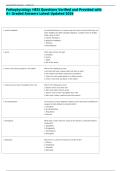
Samuel Merritt University NURSG 125


Pathophysiology HESI Questions Verified and Provided with
A+ Graded Answers Latest Updated 2026


a. positive feedback An initial disturbance in a system sets off a chain of events that does not
favor stability and often abruptly displaces a system from its steady
state: what is that?
a.Positive Feedback
b. Negative Feedback
c. Disease
d. Homeostasis


b. gums What organ shrinks with age?
a. Prostate
b. Gums
c. Heart
d. All of the above


d. there is less thirst perception in the elderly Which of the following is true?
a.An infant will have a slower heart rate than an adult
b.The elderly have better temperature sensations
c.There are more sweat glands in an elderly person
d.There is less thirst perception in the elderly


c. Women have a lower hemoglobin than men Which of the following is true?
a.Women snore more than men
b. Men have higher calcium levels
c. Women have a lower hemoglobin than men
d. Men have a lower creatinine level than women


b. Acclimatization An increase in normal adaptive response to the decreased availability of
oxygen at high altitude is termed which?
a.Circadian
b.Acclimatization
c. Population
d. Diurnal


d. Iatrogenic What does it mean when the cause of the disease is unwanted medical
treatment?
a. Idiopathic
b. Ecogenetic
c. Genotypical
d. Iatrogenic


d. Neonatal Which term is used for the first two months of life?
a. Infancy
b. Childhood
c. Prenatal
d. Neonatal

, d. Sign Which is an objectively identifiable aberration of the disease?
a.Symptom
b. Syndrome
c. Stage
d. Sign


c. They include epinephrine and norepinephrine Which of the following is true regarding catecholamines?
a.They are from the parasympathetic nervous system
b.They cross the blood brain barrier
c.They include epinephrine and norepinephrine
d.They cause of decrease in heart rate


b. Endorphins increase with stress, resulting in a Which of the following is a true statement?
decrease in pain perception a.Antidiuretic hormone is not important for blood volume regulation
b. Endorphins increase with stress, resulting in a decrease in pain
perception
c. Epinephrine and cortisol act very differently
d. Cortisol negates epinephrine's activity


d. They cross by diffusion By what mechanism do lipid molecules cross cell membranes?
a.They use channel proteins as a membrane transport system
b.They are transported across the plasma membrane by
endocytosis and exocytosis
c.They use voltage-gated ion channels
d.They cross by diffusion


a. Protein synthesis Which of the following metabolic processes is a component of anabolic
metabolism?
a.Protein synthesis
b. Glycolysis
c. Citric acid cycle
d. Oxidative phosphorylation


c. The sodium-potassium pump Which of the following electrochemical mechanism is responsible for
maintaining cell volume?
a.The calcium pump
b. Glucose transporters
c.The sodium-potassium pump
d.ATP-binding cassette (ABC) transporters


d. Failure of the sodium-potassium pump Cellular hypoxia results in:
a.Enhanced ATP activity
b. Loss of intracellular calcium
c. Increased pH
d. Failure of the sodium-potassium pump


a. Atrophy of her leg muscles A 75 yo woman develops weakness in her lower extremities after a
prolonged period of bed rest. This is most likely caused by:
a.Atrophy of her leg muscles
b. Dysplasia of her leg muscles
c. Hypertrophy of her leg muscles
d. Hyperplasia of her leg muscles


Document information

Uploaded on
September 6, 2026
Number of pages
13
Written in
2026/2027
Type
Exam (elaborations)
Contains
Questions & answers
$15.99

Wrong document? Swap it for free Within 14 days of purchase and before downloading, you can choose a different document. You can simply spend the amount again.
Written by students who passed
Immediately available after payment
Read online or as PDF

Seller avatar
Reputation scores are based on the amount of documents a seller has sold for a fee and the reviews they have received for those documents. There are three levels: Bronze, Silver and Gold. The better the reputation, the more your can rely on the quality of the sellers work.
LectDeniz
5.0
(1)
Sold
21
Followers
16
Items
5281
Last sold
10 months ago


Why students choose Stuvia

Created by fellow students, verified by reviews

Quality you can trust: written by students who passed their tests and reviewed by others who've used these notes.

Didn't get what you expected? Choose another document

No worries! You can instantly pick a different document that better fits what you're looking for.

Pay as you like, start learning right away

No subscription, no commitments. Pay the way you're used to via credit card and download your PDF document instantly.

Student with book image

“Bought, downloaded, and aced it. It really can be that simple.”

Alisha Student

Working on your references?

Create accurate citations in APA, MLA and Harvard with our free citation generator.

Working on your references?

Frequently asked questions
