

Page 1 of 166
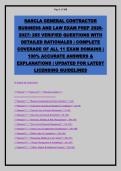
NASCLA GENERAL CONTRACTOR
2027: 265 VERIFIED QUESTIONS WITH
DETAILED RATIONALES | COMPLETE
COVERAGE OF ALL 11 EXAM DOMAINS |
100% ACCURATE ANSWERS &
EXPLANATIONS | UPDATED FOR LATEST
## TABLE OF CONTENTS
| **Domain** | **Topic Area** | **Question Numbers** |
|------------|----------------|---------------------|----------|
| **Domain 1** | **Business Organization & Entity Selection** | 1–25 |
| **Domain 2** | **Contractor Licensing & Regulatory Compliance** | 26–50 |
| **Domain 3** | **Contract Law & Project Documents** | 51–80 |
| **Domain 4** | **Lien Laws & Payment Protection** | 81–105 |
| **Domain 5** | **Insurance, Bonding & Risk Management** | 106–130 |
| **Domain 6** | **Tax Laws & Financial Management** | 131–155 |
| **Domain 7** | **Labor Laws & Employment Classification** | 156–180 |
| **Domain 8** | **OSHA Safety & Compliance** | 181–205 |
| **Domain 9** | **Estimating, Bidding & Cost Control** | 206–225 |
| **Domain 10** | **Project Management & Scheduling** | 226–245 |
| **Domain 11** | **Ethics, Dispute Resolution & Closeout** | 246–265 |
, Page 2 of 166
# DOMAIN 1: BUSINESS ORGANIZATION & ENTITY SELECTION
### Question 1
A general contractor is launching a new construction business and wants to minimize personal
liability while avoiding double taxation. Which business structure would best achieve these
objectives?
A) Sole Proprietorship
B) General Partnership
C) C Corporation
D) S Corporation
**Correct Answer: D**
**Rationale:** An S Corporation provides limited liability protection (separating personal
assets from business debts) while allowing profits to pass through to owners' personal tax
returns, avoiding the double taxation that C Corporations face. Sole proprietorships and general
partnerships offer no liability protection. C Corporations provide liability protection but are
subject to double taxation at both the corporate and individual levels.
---
### Question 2
Which of the following is NOT a primary element required for a valid contract?
A) Offer
B) Acceptance
C) Notarization
D) Consideration
, Page 3 of 166
**Correct Answer: C**
**Rationale:** The essential elements of a valid contract are offer, acceptance,
consideration, competent parties, and legal purpose. Notarization is not required for a contract to
be legally binding; it only serves as evidence of authenticity for certain documents. A contract
can be fully enforceable without notarization if all essential elements are present.
---
### Question 3
A contractor operating as a sole proprietorship suffers a significant loss on a project. The
contractor's personal assets are:
A) Fully protected from business creditors
B) Protected up to $500,000 under state law
C) Exposed to business debts and liabilities
D) Only exposed if the contractor signed a personal guarantee
**Correct Answer: C**
**Rationale:** In a sole proprietorship, there is no legal distinction between the owner and
the business. The owner has unlimited personal liability for all business debts, judgments, and
obligations. Personal assets such as the owner's home, vehicles, and bank accounts can be seized
to satisfy business debts. This is the primary disadvantage of the sole proprietorship structure.
---
, Page 4 of 166
### Question 4
Which business entity requires the filing of articles of organization with the state and provides
limited liability while offering pass-through taxation?
A) Sole Proprietorship
B) Limited Liability Company (LLC)
C) C Corporation
D) General Partnership
**Correct Answer: B**
**Rationale:** A Limited Liability Company (LLC) is formed by filing articles of
organization with the state. It offers members limited liability protection (personal assets are
protected from business debts) while allowing pass-through taxation (profits and losses flow
through to members' personal tax returns). C Corporations require articles of incorporation but
are subject to double taxation. Sole proprietorships and general partnerships do not require
formal filing but offer no liability protection.
---
### Question 5
A contractor and a non-contractor form a business together. The non-contractor will provide
capital but will not participate in management. Which business structure should they consider to
limit the non-contractor's liability while allowing the contractor to manage daily operations?
A) Limited Partnership (LP)
B) General Partnership
C) C Corporation
D) Sole Proprietorship
NASCLA GENERAL CONTRACTOR
2027: 265 VERIFIED QUESTIONS WITH
DETAILED RATIONALES | COMPLETE
COVERAGE OF ALL 11 EXAM DOMAINS |
100% ACCURATE ANSWERS &
EXPLANATIONS | UPDATED FOR LATEST
## TABLE OF CONTENTS
| **Domain** | **Topic Area** | **Question Numbers** |
|------------|----------------|---------------------|----------|
| **Domain 1** | **Business Organization & Entity Selection** | 1–25 |
| **Domain 2** | **Contractor Licensing & Regulatory Compliance** | 26–50 |
| **Domain 3** | **Contract Law & Project Documents** | 51–80 |
| **Domain 4** | **Lien Laws & Payment Protection** | 81–105 |
| **Domain 5** | **Insurance, Bonding & Risk Management** | 106–130 |
| **Domain 6** | **Tax Laws & Financial Management** | 131–155 |
| **Domain 7** | **Labor Laws & Employment Classification** | 156–180 |
| **Domain 8** | **OSHA Safety & Compliance** | 181–205 |
| **Domain 9** | **Estimating, Bidding & Cost Control** | 206–225 |
| **Domain 10** | **Project Management & Scheduling** | 226–245 |
| **Domain 11** | **Ethics, Dispute Resolution & Closeout** | 246–265 |
, Page 2 of 166
# DOMAIN 1: BUSINESS ORGANIZATION & ENTITY SELECTION
### Question 1
A general contractor is launching a new construction business and wants to minimize personal
liability while avoiding double taxation. Which business structure would best achieve these
objectives?
A) Sole Proprietorship
B) General Partnership
C) C Corporation
D) S Corporation
**Correct Answer: D**
**Rationale:** An S Corporation provides limited liability protection (separating personal
assets from business debts) while allowing profits to pass through to owners' personal tax
returns, avoiding the double taxation that C Corporations face. Sole proprietorships and general
partnerships offer no liability protection. C Corporations provide liability protection but are
subject to double taxation at both the corporate and individual levels.
---
### Question 2
Which of the following is NOT a primary element required for a valid contract?
A) Offer
B) Acceptance
C) Notarization
D) Consideration
, Page 3 of 166
**Correct Answer: C**
**Rationale:** The essential elements of a valid contract are offer, acceptance,
consideration, competent parties, and legal purpose. Notarization is not required for a contract to
be legally binding; it only serves as evidence of authenticity for certain documents. A contract
can be fully enforceable without notarization if all essential elements are present.
---
### Question 3
A contractor operating as a sole proprietorship suffers a significant loss on a project. The
contractor's personal assets are:
A) Fully protected from business creditors
B) Protected up to $500,000 under state law
C) Exposed to business debts and liabilities
D) Only exposed if the contractor signed a personal guarantee
**Correct Answer: C**
**Rationale:** In a sole proprietorship, there is no legal distinction between the owner and
the business. The owner has unlimited personal liability for all business debts, judgments, and
obligations. Personal assets such as the owner's home, vehicles, and bank accounts can be seized
to satisfy business debts. This is the primary disadvantage of the sole proprietorship structure.
---
, Page 4 of 166
### Question 4
Which business entity requires the filing of articles of organization with the state and provides
limited liability while offering pass-through taxation?
A) Sole Proprietorship
B) Limited Liability Company (LLC)
C) C Corporation
D) General Partnership
**Correct Answer: B**
**Rationale:** A Limited Liability Company (LLC) is formed by filing articles of
organization with the state. It offers members limited liability protection (personal assets are
protected from business debts) while allowing pass-through taxation (profits and losses flow
through to members' personal tax returns). C Corporations require articles of incorporation but
are subject to double taxation. Sole proprietorships and general partnerships do not require
formal filing but offer no liability protection.
---
### Question 5
A contractor and a non-contractor form a business together. The non-contractor will provide
capital but will not participate in management. Which business structure should they consider to
limit the non-contractor's liability while allowing the contractor to manage daily operations?
A) Limited Partnership (LP)
B) General Partnership
C) C Corporation
D) Sole Proprietorship


