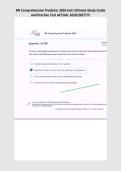
RN Comprehensive Predictor 2026 Exit Ultimate Study Guide
and Practice Test ACTUAL 2026\2027!!!!
,RN Comprehensive Predictor 2026 Exit Ultimate Study Guide
and Practice Test ACTUAL 2026\2027!!!!
,RN Comprehensive Predictor 2026 Exit Ultimate Study Guide
and Practice Test ACTUAL 2026\2027!!!!
, RN Comprehensive Predictor 2026 Exit Ultimate Study Guide
and Practice Test ACTUAL 2026\2027!!!!
Question 1
A nurse is caring for a client who is 2 hours postoperative following a thyroidectomy. The client reports
difficulty breathing and the nurse notes stridor. Which of the following actions should the nurse take
first?
A. Administer oxygen via nasal cannula
B. Call the provider immediately
C. Elevate the head of the bed
D. Assess the surgical dressing
ANSWER: B. Call the provider immediately
Rationale:
Option A - Administer oxygen via nasal cannula: This is incorrect as the first action. While oxygen
administration may be helpful, stridor following thyroidectomy indicates potential airway obstruction
from hemorrhage or edema, which is a medical emergency requiring immediate provider notification.
Oxygen alone will not address the underlying cause.
Option B - Call the provider immediately: This is correct. Stridor after thyroidectomy is a life-threatening
emergency that can indicate hemorrhage, hematoma formation, or laryngeal edema causing airway
compromise. The provider must be notified immediately as the client may need emergency intervention
including return to surgery, calcium administration, or intubation.
Option C - Elevate the head of the bed: This is incorrect as the priority action. While elevating the head
of the bed can help with breathing and reduce edema, it is not the first action when stridor is present.
The immediate threat to airway requires provider notification before positioning interventions.
Option D - Assess the surgical dressing: This is incorrect as the first action. While assessing the dressing
for bleeding is important, the presence of stridor indicates an active airway emergency that takes
priority over assessment. The ABCs (Airway, Breathing, Circulation) guide that airway compromise
requires immediate intervention.
Question 2
A nurse is reinforcing teaching with a client who has a new prescription for warfarin. Which of the
following statements by the client indicates an understanding of the teaching?
A. "I will take ibuprofen for headaches while on this medication."
B. "I need to have my blood drawn regularly for lab tests."
C. "I should increase my intake of leafy green vegetables."
D. "I can stop taking this medication when I feel better."
ANSWER: B. "I need to have my blood drawn regularly for lab tests."
and Practice Test ACTUAL 2026\2027!!!!
,RN Comprehensive Predictor 2026 Exit Ultimate Study Guide
and Practice Test ACTUAL 2026\2027!!!!
,RN Comprehensive Predictor 2026 Exit Ultimate Study Guide
and Practice Test ACTUAL 2026\2027!!!!
, RN Comprehensive Predictor 2026 Exit Ultimate Study Guide
and Practice Test ACTUAL 2026\2027!!!!
Question 1
A nurse is caring for a client who is 2 hours postoperative following a thyroidectomy. The client reports
difficulty breathing and the nurse notes stridor. Which of the following actions should the nurse take
first?
A. Administer oxygen via nasal cannula
B. Call the provider immediately
C. Elevate the head of the bed
D. Assess the surgical dressing
ANSWER: B. Call the provider immediately
Rationale:
Option A - Administer oxygen via nasal cannula: This is incorrect as the first action. While oxygen
administration may be helpful, stridor following thyroidectomy indicates potential airway obstruction
from hemorrhage or edema, which is a medical emergency requiring immediate provider notification.
Oxygen alone will not address the underlying cause.
Option B - Call the provider immediately: This is correct. Stridor after thyroidectomy is a life-threatening
emergency that can indicate hemorrhage, hematoma formation, or laryngeal edema causing airway
compromise. The provider must be notified immediately as the client may need emergency intervention
including return to surgery, calcium administration, or intubation.
Option C - Elevate the head of the bed: This is incorrect as the priority action. While elevating the head
of the bed can help with breathing and reduce edema, it is not the first action when stridor is present.
The immediate threat to airway requires provider notification before positioning interventions.
Option D - Assess the surgical dressing: This is incorrect as the first action. While assessing the dressing
for bleeding is important, the presence of stridor indicates an active airway emergency that takes
priority over assessment. The ABCs (Airway, Breathing, Circulation) guide that airway compromise
requires immediate intervention.
Question 2
A nurse is reinforcing teaching with a client who has a new prescription for warfarin. Which of the
following statements by the client indicates an understanding of the teaching?
A. "I will take ibuprofen for headaches while on this medication."
B. "I need to have my blood drawn regularly for lab tests."
C. "I should increase my intake of leafy green vegetables."
D. "I can stop taking this medication when I feel better."
ANSWER: B. "I need to have my blood drawn regularly for lab tests."