
TCEQ CLASS C WATER LICENSE EXAM / APPROVED TEXAS
COMMISSION ON ENVIRONMENTAL QUALITY (TCEQ) EXAM
ACTUAL 2026 /2027 PRACTICE QUESTIONS AND STUDY GUIDE
COMPLETE ACCURATE EXAM REAL QUESTIONS AND CORRECT
VERIFIED ANSWERS WITH DETAILED RATIONALES (RELIABLE
ANSWERS) CURRENTLY UPDATED VERSION 2026 EDITION
|GUARANTEED PASS A+ |JUST RELEASED
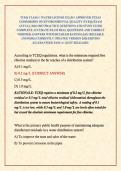
According to TCEQ regulations, what is the minimum required free
chlorine residual in the far reaches of a distribution system?
A) 0.1 mg/L
B) 0.2 mg/L (CORRECT ANSWER)
C) 0.5 mg/L
D) 1.0 mg/L
RATIONALE: TCEQ requires a minimum of 0.2 mg/L free chlorine
residual or 0.5 mg/L total chlorine residual (chloramine) throughout the
distribution system to ensure bacteriological safety. A reading of 0.1
mg/L is too low, while 0.5 mg/L and 1.0 mg/L are levels often tested for
but exceed the absolute minimum requirement for free chlorine.
What is the primary public health purpose of maintaining adequate
disinfectant residuals in a water distribution system?
A) To improve the taste and odor of the water
B) To prevent corrosion in the pipes
,C) To control the growth of pathogenic bacteria in the pipes
(CORRECT ANSWER)
D) To soften the water hardness
RATIONALE: The primary goal of a disinfectant residual (like chlorine)
is to provide ongoing protection against microbial contamination and
biofilm growth as water travels through miles of piping. While chlorine
might affect taste or oxidation, its main function is pathogen inactivation.
According to TCEQ rules, who is legally responsible for the
operation of a public water system?
A) The certified operator with the highest license
B) The mayor or city manager
C) The governing body or owner of the system (CORRECT
ANSWER)
D) The TCEQ regional investigator
RATIONALE: While a certified operator is responsible for the day-to-
day operational decisions, TCEQ rules state ultimate legal responsibility
for compliance rests with the owner or governing body (e.g., City Council,
Board of Directors, or private owner).
A public water system must notify TCEQ if a water sample tests
positive for total coliform bacteria. Within what time frame must this
notification occur?
A) By the end of the fiscal year
,B) Within 30 days
C) Within 24 hours (CORRECT ANSWER)
D) Within 7 days
RATIONALE: TCEQ requires immediate notification (within 24 hours)
of any total coliform positive sample. This triggers repeat sampling and
potential public notification to address acute health risks quickly.
Which type of water main valve is specifically designed to allow for
the easy insertion of a flow meter or for installing a new branch line
without shutting down the entire system?
A) Gate valve
B) Butterfly valve
C) Corporation stop
D) Tapping sleeve and valve (CORRECT ANSWER)
RATIONALE: A tapping sleeve and valve are used to "hot tap" a
pressurized main. The sleeve wraps around the main, and a valve is
attached to control the flow once the main is drilled, allowing connections
without service interruption. A corporation stop is the valve at the service
connection, but the sleeve is the device enabling the tap.
What is the primary cause of "blue baby syndrome"
(methemoglobinemia) in infants who consume contaminated water?
A) Lead
B) Nitrate (CORRECT ANSWER)
, C) Fluoride
D) Chlorine
RATIONALE: High levels of nitrate in drinking water interfere with the
blood's ability to carry oxygen in infants under six months old. The
condition turns the baby's skin bluish-gray due to lack of oxygen
(methemoglobinemia).
When collecting a bacteriological sample from a dedicated sampling
tap, what is the first step the operator should take?
A) Fill the bottle to the very top
B) Remove the aerator and flush the tap for several minutes
(CORRECT ANSWER)
C) Add a chlorine neutralizer tablet to the sample
D) Flame sterilize the outside of the tap
RATIONALE: You must remove any attachments (aerators, screens) and
flush the line long enough to ensure the sample represents the water in the
main, not water that has been sitting in the service line. Neutralizer is
already in the bottle; adding one manually is not standard procedure.
Which of the following best describes the term "tuberculation" in a
distribution system?
A) The growth of algae on top of open reservoirs
B) The build-up of rust and mineral deposits on the inside of iron
pipes (CORRECT ANSWER)


