
• Wrong document? Swap it for free
  • Written by students who passed
  • Immediately available after payment
  • Read online or as PDF
Sell
Where do you study
Your language
Document preview thumbnail
Preview 1 out of 3 pages
Exam (elaborations)

RBT Exam Scenarios Questions & Answers Updated 2026/2027, ABA, FBA, Data Collection, Reinforcement – Instant Download

Document preview thumbnail
Preview 1 out of 3 pages

**RBT Exam Scenarios Questions & Answers Updated 2026/2027 – Registered Behavior Technician, ABA, Functional Assessment, Data Collection, Reinforcement, Prompting, Chaining & Skill Acquisition | Instant Download** Prepare for your **Registered Behavior Technician (RBT) exam** with this comprehensive scenario-based study resource covering important **Applied Behavior Analysis (ABA)** concepts, behavioral measurement, functional assessment, preference assessments, reinforcement schedules, behavior interventions, prompting, chaining, skill acquisition, and behavior functions. This resource is organized around the RBT/ABA scenario material supplied and is designed to help learners review how core ABA concepts are applied to realistic situations. ### RBT DATA COLLECTION & MEASUREMENT Review practical scenarios involving: * Frequency recording * Duration recording * Latency recording * Permanent product recording * Partial-interval recording * Whole-interval recording * Momentary time sampling * Continuous measurement * Discontinuous measurement * Behavioral measurement dimensions * Tally counters * Timers and stopwatches * Accurate data collection * Behavior rate * Measuring duration of behavior * Measuring response latency * Measuring completed products ### FUNCTIONAL ASSESSMENT & FUNCTIONAL ANALYSIS The scenarios cover important distinctions between functional assessment and functional analysis, including: * Functional Behavior Assessment (FBA) * Functional assessment * Functional analysis * ABC data * Antecedent recording * Consequence recording * Escape function * Tangible function * Attention function * Automatic/sensory function * Functional analysis conditions * Control condition * Escape condition * Tangible condition * Function-based assessment * Interpreting functional analysis graphs ### PREFERENCE ASSESSMENTS Review common preference-assessment scenarios, including: * Single-stimulus preference assessment * Paired-choice preference assessment * Forced-choice assessment * Presenting one item at a time * Presenting two items simultaneously * Observing approach behavior * Identifying preferred items * Preference assessment procedures * Selecting potential reinforcers ### BEHAVIOR FUNCTIONS & INTERVENTIONS Practice identifying function-based interventions involving: * Escape-maintained behavior * Tangible-maintained behavior * Attention-maintained behavior * Automatic reinforcement * Demand-related problem behavior * Environmental arrangement * Antecedent interventions * Function-based treatment * Replacement behavior * Behavior reduction ### NONCONTINGENT REINFORCEMENT Review scenarios involving **noncontingent reinforcement (NCR)**, including: * Noncontingent attention * Scheduled attention * Time-based reinforcement * Delivering attention independent of behavior * Antecedent-based interventions * Reducing motivation for problem behavior ### DIFFERENTIAL REINFORCEMENT The resource includes scenarios covering: * Differential Reinforcement of Other Behavior (DRO) * Differential Reinforcement of Alternative Behavior (DRA) * Reinforcement of appropriate behavior * Reinforcement schedules * Replacement behaviors * Reducing problem behavior * Timer-based DRO procedures * Reinforcement following periods without problem behavior ### ANTECEDENT INTERVENTIONS Review practical applications of antecedent strategies, including: * Environmental restructuring * Environmental arrangement * Demand fading * Modifying task demands * Gradually increasing demands * Reducing opportunities for problem behavior * Arranging the environment * Escape-maintained behavior interventions * Peer-related antecedent interventions ### PROMPTING PROCEDURES Important prompting concepts include: * Response prompts * Physical prompts * Partial physical prompts * Hand-over-hand prompting * Gestural prompts * Visual prompts * Extra-stimulus prompts * Prompt fading * Prompt hierarchy * Independence * Reducing prompt dependence * Natural cues ### TASK ANALYSIS & CHAINING Review skill-acquisition scenarios involving: * Task analysis * Forward chaining * Backward chaining * Total-task chaining * Teaching multistep skills * Shoe-tying * Daily living skills * Breaking tasks into smaller steps * Teaching task sequences * Reinforcement during skill acquisition * Promoting independent responding ### INCIDENTAL & NATURALISTIC TEACHING The material includes scenarios involving: * Incidental teaching * Naturalistic teaching * Learner motivation * Naturally occurring opportunities * Using preferred stimuli * Teaching in the natural environment * Embedding instruction into daily routines * Capturing naturally occurring learning opportunities ### REINFORCEMENT SCHEDULES Review important schedule-of-reinforcement scenarios: * Fixed Ratio (FR) * Variable Ratio (VR) * Fixed Interval (FI) * Variable Interval (VI) * Continuous reinforcement * Ratio schedules * Interval schedules * FR3 * VI5 * Response-based reinforcement * Time-based reinforcement ### CONDITIONED & GENERALIZED REINFORCERS Study scenarios involving: * Conditioned reinforcers * Generalized conditioned reinforcers * Token economies * Tokens as conditioned reinforcers * Backup reinforcers * Multiple sources of reinforcement * Token exchange systems * Preferred edibles * Social reinforcement ### ABA SKILL ACQUISITION Review scenarios involving: * Skill acquisition * Teaching new behaviors * Independent responding * Prompting * Prompt fading * Reinforcement * Chaining * Incidental teaching * Generalization * Maintenance * Behavioral skills * Functional skills ### BEHAVIORAL SCENARIO IDENTIFICATION This resource helps learners practice identifying the correct ABA terminology from realistic examples, such as: * Counting aggressive responses → frequency * Measuring time before problem behavior → latency * Measuring how long behavior occurs → duration * Counting products left after behavior → permanent product * Checking behavior at timed moments → momentary time sampling * Checking whether behavior occurred throughout an entire interval → whole-interval recording * Presenting paired items → paired-choice preference assessment * Presenting one item → single-stimulus preference assessment * Removing demands following problem behavior → escape condition * Delivering a preferred item following aggression → tangible condition * Providing scheduled attention → noncontingent attention * Reinforcing periods without problem behavior → DRO * Gradually reintroducing demands → demand fading * Teaching the first step of a chain → forward chaining * Adding an informative picture to a stimulus → extra-stimulus prompt * Teaching through naturally occurring motivation → incidental teaching * Reinforcing every third response → FR3 * Reinforcing after an average amount of time → VI * Exchanging tokens for different backup items → generalized conditioned reinforcement ### EXAM REVIEW TOPICS Key concepts covered include: RBT exam scenarios Registered Behavior Technician concepts Applied Behavior Analysis Functional assessment Functional analysis ABC data Frequency Duration Latency Permanent product Partial-interval recording Whole-interval recording Momentary time sampling Preference assessments Escape and tangible functions Noncontingent reinforcement DRO Environmental restructuring Demand fading Prompting Task analysis Forward chaining Incidental teaching Reinforcement schedules Token economy Generalized conditioned reinforcers ### IDEAL FOR RBT & ABA STUDENTS This resource can be useful for: * RBT exam candidates * Registered Behavior Technician students * ABA students * Applied Behavior Analysis learners * Behavior analysis students * Psychology students * Special education students * Learners reviewing behavioral measurement * Students studying functional assessment * Learners preparing for ABA-related assessments **Instant Download** makes the material convenient for focused revision, scenario identification, terminology review, and last-minute RBT/ABA exam preparation. **Educational study-resource disclaimer:** This is an independent educational resource based on the supplied material. It is not an official BACB examination, BACB publication, or BACB-endorsed product, and no guarantee is made that it reproduces questions from any current examination.

Content preview

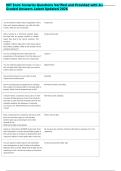
RBT Exam Scenarios Questions Verified and Provided with A+
Graded Answers Latest Updated 2026


You are asked to collect data on aggression. Every Frequency
time your learner agresses, you click the tally
counter. What are you measuring?


When looking at a functional analysis graph, Escape and Access
the data path for escape condition is reliably
higher than that of the control condition. The
access to
tangibles condition data path is also always above
the control condition. What is the function of the
problem behavior?

You are recording the time it takes from the Latency
presentation of the demand to the first instance of
problem behavior. What are you measuring?


You are collecting partial interval data. You have a Watch/Timer
pen and data sheet. What else might you need to
collect data accurately?


How long the behavior occurs refers to what Duration
measurement deminsion?


John is recording data on aggression by counting Permanent Product recording
the number of scratches left on his body after a
session. What kind of measurement is this?


A teacher wears a motivator during class. In order Momentary time sampling
to record off-task behavior of one of her students ,
she looks up each time the motivator goes off and
indicates whether the behavior is currently
occurring or not. What dimension of measurement
is this?


Mary is taking data on screaming. She has a timer. Whole interval data
Each time the timer goes off, she indicates
whether josh was screaming for the entire
interval of not.
What kind of data is she taking?

Angela is conducting a VB-MAPP assessment. Each No, because she could be reinforcing therefore a response not in the
time the learner is correct she provides praise. Is repertoire
this correct way to conduct an assessment and
measure a learner's current skills? Why or why not?


You are asked to collect data on the antecedent Functional Assessment:ABC data
and consequence to each instance of problem
behavior that occurred. What kind of data are you
collecting? Is this a functional analysis or functional
assessment?


Document information

Uploaded on
September 5, 2026
Number of pages
3
Written in
2026/2027
Type
Exam (elaborations)
Contains
Questions & answers
$16.98

Wrong document? Swap it for free Within 14 days of purchase and before downloading, you can choose a different document. You can simply spend the amount again.
Written by students who passed
Immediately available after payment
Read online or as PDF

Seller avatar
Reputation scores are based on the amount of documents a seller has sold for a fee and the reviews they have received for those documents. There are three levels: Bronze, Silver and Gold. The better the reputation, the more your can rely on the quality of the sellers work.
Sold
450
Followers
310
Items
9042
Last sold
1 week ago


Why students choose Stuvia

Created by fellow students, verified by reviews

Quality you can trust: written by students who passed their tests and reviewed by others who've used these notes.

Didn't get what you expected? Choose another document

No worries! You can instantly pick a different document that better fits what you're looking for.

Pay as you like, start learning right away

No subscription, no commitments. Pay the way you're used to via credit card and download your PDF document instantly.

Student with book image

“Bought, downloaded, and aced it. It really can be that simple.”

Alisha Student

Working on your references?

Create accurate citations in APA, MLA and Harvard with our free citation generator.

Working on your references?

Frequently asked questions
