
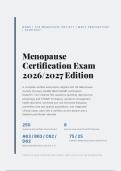
NA M S | T HE M ENO PA US E S O CIET Y | M S CP P R EPA R AT IO N
| 20 26/ 20 27
Menopause
Certification Exam
2026/2027 Edition
A complete verified examination aligned with the Menopause
Society (formerly NAMS) MSCP/NCMP certification
blueprint. Two hundred fifty questions spanning reproductive
physiology and STRAW+10 staging, symptom management,
health disorders, hormonal and non-hormonal therapies,
preventive care and special populations, and integrated
clinical cases, each with a verified correct answer and a
detailed practitioner rationale.
250 6
Questions with verified correct answers Sections covering all five MSCP domains
A63 / B63 / C62 /
D62 Scenario-based versus direct recall format
Balanced answer key across A, B, C, D
COM P LE TE QUE STI ONS A ND SOLUTI ONS | M SCP CE RTI F I CATI ON P RE PA RATI ON
, NAMS Menopause Certification Exam
2026/2027 Edition | Complete Questions and Solutions | The Menopause Society MSCP/NCMP
Examination Preparation
250 Questions | 6 Content Sections aligned with the MSCP examination blueprint (Physiology 19% | Symptom Management
20% | Health Disorders 21% | Treatment 16% | Preventive Care and Special Populations 24% | Comprehensive Cases) |
Complete answer key with menopause-practitioner rationales | Format: 75% scenario-based, 25% direct recall; cognitive mix
25% recall, 50% application, 25% analysis | Balanced answer key: A63 / B63 / C62 / D62 | For clinician self-assessment and
MSCP certification preparation
Section 1: Reproductive Physiology and
Menopause Staging: STRAW+10, Ovarian Aging, Questions 1-48 19% of exam
Hormonal Changes, Menopause Definitions, and
POI
Q1: A menopause practitioner is counseling a 50-year-old woman who asks what the term
climacteric actually means. Which definition should the practitioner provide?
A. The permanent cessation of ovarian follicular activity measured by two elevated FSH
values
B. The 12-month period of amenorrhea required to confirm natural menopause
retrospectively
C. The period of endocrinologic, somatic, and transitory psychologic changes occurring
around the time of menopause [CORRECT]
D. The interval from the final menstrual period until the end of life
Correct Answer: C
Rationale: The climacteric is the broad transitional phase of endocrinologic, somatic, and transitory
psychologic changes that occur around the time of menopause, and it encompasses perimenopause and the
menopause transition. The 12-month amenorrhea definition describes natural menopause itself rather than
the surrounding phase, the FSH criterion describes biochemical confirmation of ovarian insufficiency, and
the interval after the final menstrual period defines postmenopause. Distinguishing the climacteric as a phase
rather than a single event is a fundamental staging concept tested on the MSCP examination.
NAMS Menopause Certification Exam | 2026/2027 | Complete Questions and Solutions 1
,NAMS Menopause Certification Exam 2026/2027 - Complete Questions and Solutions - Menopause Society MSCP Preparation
Q2: A 52-year-old woman reports her last menstrual period was 14 months ago. Pregnancy has
been excluded and no other pathologic or physiologic cause for amenorrhea is identified. How
should her clinician document her menopausal status?
A. Natural menopause, because it is defined retrospectively after 12 consecutive months
of amenorrhea without other cause [CORRECT]
B. Probable perimenopause, because menopause can never be confirmed without an FSH
level above 25 IU/L
C. Induced menopause, because documentation requires biochemical confirmation by the
clinician
D. Late menopausal transition, because she remains within the potential bleeding window
for one additional year
Correct Answer: A
Rationale: Natural menopause is a retrospective clinical diagnosis made after 12 consecutive months of
amenorrhea in the absence of other pathologic or physiologic causes, and it does not require hormonal
confirmation in a woman of this age. Requiring an FSH level is incorrect because menopause remains a
clinical diagnosis and FSH can fluctuate during the transition; biochemical testing is reserved for specific
situations such as suspected POI or altered cycles from contraception. The final menstrual period has clearly
passed, so she is no longer in the menopausal transition, and no surgical or iatrogenic removal of ovarian
function occurred that would make the menopause induced.
Q3: A 44-year-old woman presents for follow-up. Her last menstrual period occurred 16
months ago, pregnancy is excluded, and she has no explanatory medical condition or surgical
history. How should this presentation be classified according to menopause terminology?
A. Primary ovarian insufficiency, because her final menstrual period occurred before age
45
B. Early menopause, because her final menstrual period occurred before age 45
[CORRECT]
C. Late menopause, because her final menstrual period occurred after age 40
D. Normal age-related menopause, because she is within two years of the median age at
menopause
Correct Answer: B
Rationale: Early menopause is defined as a final menstrual period occurring before age 45, and this patient
qualifies because she is 44 with 16 months of amenorrhea and no other cause. Primary ovarian insufficiency
requires menopause before age 40, so that label does not apply to a 44-year-old. Late menopause refers to a
final menstrual period after age 54, and the median age at natural menopause is approximately 51, so a
menopause at 44 is early rather than normal. Recognizing the age cutoffs of 40, 45, and 54 is essential for
correct staging on the certification examination.
NAMS Menopause Certification Exam | 2026/2027 | Complete Questions and Solutions 2
, NAMS Menopause Certification Exam 2026/2027 - Complete Questions and Solutions - Menopause Society MSCP Preparation
Q4: A 56-year-old woman has just completed 12 consecutive months of amenorrhea with no
identifiable cause. According to standard menopause nomenclature, her menopause is best
described as:
A. Early menopause, because the final menstrual period occurred before age 55
B. Late menopause, because the final menstrual period occurred after age 54
[CORRECT]
C. Primary ovarian insufficiency, because menopause occurred after the age of 54
D. Induced menopause, because biochemical confirmation was obtained after age 54
Correct Answer: B
Rationale: Late menopause is defined as a final menstrual period occurring after age 54, and this
56-year-old woman meets that definition. Early menopause is a final menstrual period before age 45, not
before 55, so that option misstates the cutoff. Primary ovarian insufficiency applies only to menopause
before age 40, and induced menopause refers to iatrogenic cessation of ovarian function such as bilateral
oophorectomy or gonadotoxic therapy, neither of which applies here. These age-based definitions are
high-yield recall items because they anchor staging and risk counseling decisions.
Q5: A 49-year-old woman undergoes a total abdominal hysterectomy with bilateral
salpingo-oophorectomy for symptomatic fibroids. Postoperatively she develops severe hot
flashes within weeks. Which statement about her expected menopausal course is most
accurate?
A. She has natural menopause, and her symptoms will follow the typical multi-year
perimenopausal trajectory
B. She has induced menopause, and symptoms are often more abrupt and severe than after
natural menopause because ovarian steroid production ceases suddenly [CORRECT]
C. She has induced menopause, and vasomotor symptoms will be milder than natural
menopause because estrogen falls gradually
D. She does not qualify as menopausal until she completes 12 months of amenorrhea after
surgery
Correct Answer: B
Rationale: Bilateral oophorectomy produces induced menopause, in which ovarian estradiol production
stops abruptly, and vasomotor symptoms are characteristically more sudden and more severe than in natural
menopause. Natural menopause involves a gradual multi-year transition and cannot be assigned to a woman
whose ovaries were removed. The gradual-decline option reverses the symptom pattern, because the abrupt
estrogen withdrawal after surgery is precisely what intensifies symptoms rather than cushioning them. The
12-month retrospective rule applies to natural menopause and is not required to diagnose menopause after
bilateral oophorectomy, where the date of surgery defines the final menstrual period.
NAMS Menopause Certification Exam | 2026/2027 | Complete Questions and Solutions 3
| 20 26/ 20 27
Menopause
Certification Exam
2026/2027 Edition
A complete verified examination aligned with the Menopause
Society (formerly NAMS) MSCP/NCMP certification
blueprint. Two hundred fifty questions spanning reproductive
physiology and STRAW+10 staging, symptom management,
health disorders, hormonal and non-hormonal therapies,
preventive care and special populations, and integrated
clinical cases, each with a verified correct answer and a
detailed practitioner rationale.
250 6
Questions with verified correct answers Sections covering all five MSCP domains
A63 / B63 / C62 /
D62 Scenario-based versus direct recall format
Balanced answer key across A, B, C, D
COM P LE TE QUE STI ONS A ND SOLUTI ONS | M SCP CE RTI F I CATI ON P RE PA RATI ON
, NAMS Menopause Certification Exam
2026/2027 Edition | Complete Questions and Solutions | The Menopause Society MSCP/NCMP
Examination Preparation
250 Questions | 6 Content Sections aligned with the MSCP examination blueprint (Physiology 19% | Symptom Management
20% | Health Disorders 21% | Treatment 16% | Preventive Care and Special Populations 24% | Comprehensive Cases) |
Complete answer key with menopause-practitioner rationales | Format: 75% scenario-based, 25% direct recall; cognitive mix
25% recall, 50% application, 25% analysis | Balanced answer key: A63 / B63 / C62 / D62 | For clinician self-assessment and
MSCP certification preparation
Section 1: Reproductive Physiology and
Menopause Staging: STRAW+10, Ovarian Aging, Questions 1-48 19% of exam
Hormonal Changes, Menopause Definitions, and
POI
Q1: A menopause practitioner is counseling a 50-year-old woman who asks what the term
climacteric actually means. Which definition should the practitioner provide?
A. The permanent cessation of ovarian follicular activity measured by two elevated FSH
values
B. The 12-month period of amenorrhea required to confirm natural menopause
retrospectively
C. The period of endocrinologic, somatic, and transitory psychologic changes occurring
around the time of menopause [CORRECT]
D. The interval from the final menstrual period until the end of life
Correct Answer: C
Rationale: The climacteric is the broad transitional phase of endocrinologic, somatic, and transitory
psychologic changes that occur around the time of menopause, and it encompasses perimenopause and the
menopause transition. The 12-month amenorrhea definition describes natural menopause itself rather than
the surrounding phase, the FSH criterion describes biochemical confirmation of ovarian insufficiency, and
the interval after the final menstrual period defines postmenopause. Distinguishing the climacteric as a phase
rather than a single event is a fundamental staging concept tested on the MSCP examination.
NAMS Menopause Certification Exam | 2026/2027 | Complete Questions and Solutions 1
,NAMS Menopause Certification Exam 2026/2027 - Complete Questions and Solutions - Menopause Society MSCP Preparation
Q2: A 52-year-old woman reports her last menstrual period was 14 months ago. Pregnancy has
been excluded and no other pathologic or physiologic cause for amenorrhea is identified. How
should her clinician document her menopausal status?
A. Natural menopause, because it is defined retrospectively after 12 consecutive months
of amenorrhea without other cause [CORRECT]
B. Probable perimenopause, because menopause can never be confirmed without an FSH
level above 25 IU/L
C. Induced menopause, because documentation requires biochemical confirmation by the
clinician
D. Late menopausal transition, because she remains within the potential bleeding window
for one additional year
Correct Answer: A
Rationale: Natural menopause is a retrospective clinical diagnosis made after 12 consecutive months of
amenorrhea in the absence of other pathologic or physiologic causes, and it does not require hormonal
confirmation in a woman of this age. Requiring an FSH level is incorrect because menopause remains a
clinical diagnosis and FSH can fluctuate during the transition; biochemical testing is reserved for specific
situations such as suspected POI or altered cycles from contraception. The final menstrual period has clearly
passed, so she is no longer in the menopausal transition, and no surgical or iatrogenic removal of ovarian
function occurred that would make the menopause induced.
Q3: A 44-year-old woman presents for follow-up. Her last menstrual period occurred 16
months ago, pregnancy is excluded, and she has no explanatory medical condition or surgical
history. How should this presentation be classified according to menopause terminology?
A. Primary ovarian insufficiency, because her final menstrual period occurred before age
45
B. Early menopause, because her final menstrual period occurred before age 45
[CORRECT]
C. Late menopause, because her final menstrual period occurred after age 40
D. Normal age-related menopause, because she is within two years of the median age at
menopause
Correct Answer: B
Rationale: Early menopause is defined as a final menstrual period occurring before age 45, and this patient
qualifies because she is 44 with 16 months of amenorrhea and no other cause. Primary ovarian insufficiency
requires menopause before age 40, so that label does not apply to a 44-year-old. Late menopause refers to a
final menstrual period after age 54, and the median age at natural menopause is approximately 51, so a
menopause at 44 is early rather than normal. Recognizing the age cutoffs of 40, 45, and 54 is essential for
correct staging on the certification examination.
NAMS Menopause Certification Exam | 2026/2027 | Complete Questions and Solutions 2
, NAMS Menopause Certification Exam 2026/2027 - Complete Questions and Solutions - Menopause Society MSCP Preparation
Q4: A 56-year-old woman has just completed 12 consecutive months of amenorrhea with no
identifiable cause. According to standard menopause nomenclature, her menopause is best
described as:
A. Early menopause, because the final menstrual period occurred before age 55
B. Late menopause, because the final menstrual period occurred after age 54
[CORRECT]
C. Primary ovarian insufficiency, because menopause occurred after the age of 54
D. Induced menopause, because biochemical confirmation was obtained after age 54
Correct Answer: B
Rationale: Late menopause is defined as a final menstrual period occurring after age 54, and this
56-year-old woman meets that definition. Early menopause is a final menstrual period before age 45, not
before 55, so that option misstates the cutoff. Primary ovarian insufficiency applies only to menopause
before age 40, and induced menopause refers to iatrogenic cessation of ovarian function such as bilateral
oophorectomy or gonadotoxic therapy, neither of which applies here. These age-based definitions are
high-yield recall items because they anchor staging and risk counseling decisions.
Q5: A 49-year-old woman undergoes a total abdominal hysterectomy with bilateral
salpingo-oophorectomy for symptomatic fibroids. Postoperatively she develops severe hot
flashes within weeks. Which statement about her expected menopausal course is most
accurate?
A. She has natural menopause, and her symptoms will follow the typical multi-year
perimenopausal trajectory
B. She has induced menopause, and symptoms are often more abrupt and severe than after
natural menopause because ovarian steroid production ceases suddenly [CORRECT]
C. She has induced menopause, and vasomotor symptoms will be milder than natural
menopause because estrogen falls gradually
D. She does not qualify as menopausal until she completes 12 months of amenorrhea after
surgery
Correct Answer: B
Rationale: Bilateral oophorectomy produces induced menopause, in which ovarian estradiol production
stops abruptly, and vasomotor symptoms are characteristically more sudden and more severe than in natural
menopause. Natural menopause involves a gradual multi-year transition and cannot be assigned to a woman
whose ovaries were removed. The gradual-decline option reverses the symptom pattern, because the abrupt
estrogen withdrawal after surgery is precisely what intensifies symptoms rather than cushioning them. The
12-month retrospective rule applies to natural menopause and is not required to diagnose menopause after
bilateral oophorectomy, where the date of surgery defines the final menstrual period.
NAMS Menopause Certification Exam | 2026/2027 | Complete Questions and Solutions 3


