

EXS 411 EXAM 2 UPDATED ACTUAL QUESTIONS AND
CORRECT ANSWERS
Question:
1. What is the principal role of the American College of Sports Medicine (ACSM) Certified Exercise
Physiologist (EP-C)
Answer:
Provide the development and maintenance of cardiorespiratory fitness (CRF) to the clientele
Question:
2. Cardiorespiratory Fitness
Answer:
The ability of the circulatory and respiratory systems to supply oxygen to the muscles to perform dynamic
physical activity
Question:
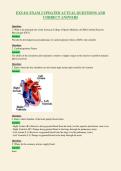
3. Know where the four chambers are left atrium right atrium right ventricle left ventricle
Answer:
Question:
4. Know which chamber of the heart pumps blood where
Answer:
- Right Atrium (RA) Receives deoxygenated blood from the body (via the superior and inferior vena cava).
- Right Ventricle (RV) Pumps deoxygenated blood to the lungs through the pulmonary artery.
- Left Atrium (LA) Receives oxygenated blood from the lungs (via the pulmonary veins).
- Left Ventricle (LV) Pumps oxygenated blood to the body through the aorta.
Question:
5. Where do the coronary arteries supply blood
Answer:
heart
,Question:
6. What are the only arteries that supply oxygen to the blood
Answer:
Coronary Arteries
Question:
7. cardiovascular system parts
Answer:
Veins, venules, capillaries, arterioles, arteries
Question:
8. What is the cardiovascular system responsible for
Answer:
- The delivery of oxygenated blood and nutrients to the cell
- the removal of "waste:" from the cell
Question:
9. Why does the cell need oxygen?
Answer:
02 is required to creared ATP via oxidative energy system
Question:
10. What are the 3 systems that muscle fibers can produce ATP?
Answer:
1.) Oxidized Phosphorylation
2.) ATP- Creatine Phosphate (CP)
3.) Anaerobic glycolysis
Question:
11. Anaerobic glycolysis
Answer:
- Degeneration of glucose to pyruvate
-Net energy yield= 2 or 3 ATP
- Anaerobic, but can be considered the first step in aerobic energy production
- * primary system during medium-duration, intense exercise, such as the 200-m and 400-m sprint events
or any exercise of an intensity that cannot be continued for more than approximately 90 seconds
Question:
12. Oxidized Phosphorylation
Answer:
Two metabolic pathways- the Krebs cycle and the electron transport chain Mitochondria, "powerhouse of
the cell." Fuel Source-
- Carb, fat, or protein
- Net product: Carbohydrate: 38 or 39 ATP + H2O Fat: varies
- 6- carbon fatty acid such as palmitate, yields 129 ATP
- intensities for more than 90 seconds
, Question:
13. Metabolic Response to Exercise
Answer:
The fuel system and source vary with exercise intensity and durations
Question:
14. VO2
Answer:
an index of the body's efficiency at producing work, expressed in millilitres of oxygen consumed
perminute, and adjusted for body weight in kilograms: ml/kg/min
Question:
15. VO2max
Answer:
the maximum amount of oxygen the body can utilize during a specified period of usually intense exercise
Question:
16. Steady State
Answer:
The point at which VO2 plateaus during submaximal aerobic exercise, and energy production via the
aerobic energy system is equal to the energy required to perform the set intensity of work
Question:
17. What influences the duration of time required to reach a steady state?
Answer:
- Training State
- The magnitude of the increase in exercise intensity Typically takes 1-4 minutes
Question:
18. Fick Equation
Answer:
- Used to determine VO2 Max
- VO2 max = (HRmax) x (SV Max) x (a-VO2 diff max)
- looking at cardiac output and arterio-venous side
Question:
19. What happens in stroke volume in trained and untrained individuals?
Answer:
begins to plateau
Question:
20. Oxygen Uptake during GXT
Answer:
- VO2 increases slowly within the first few minutes of exercise
- eventually reaches a steady state at each submaximal exercise intensity
CORRECT ANSWERS
Question:
1. What is the principal role of the American College of Sports Medicine (ACSM) Certified Exercise
Physiologist (EP-C)
Answer:
Provide the development and maintenance of cardiorespiratory fitness (CRF) to the clientele
Question:
2. Cardiorespiratory Fitness
Answer:
The ability of the circulatory and respiratory systems to supply oxygen to the muscles to perform dynamic
physical activity
Question:
3. Know where the four chambers are left atrium right atrium right ventricle left ventricle
Answer:
Question:
4. Know which chamber of the heart pumps blood where
Answer:
- Right Atrium (RA) Receives deoxygenated blood from the body (via the superior and inferior vena cava).
- Right Ventricle (RV) Pumps deoxygenated blood to the lungs through the pulmonary artery.
- Left Atrium (LA) Receives oxygenated blood from the lungs (via the pulmonary veins).
- Left Ventricle (LV) Pumps oxygenated blood to the body through the aorta.
Question:
5. Where do the coronary arteries supply blood
Answer:
heart
,Question:
6. What are the only arteries that supply oxygen to the blood
Answer:
Coronary Arteries
Question:
7. cardiovascular system parts
Answer:
Veins, venules, capillaries, arterioles, arteries
Question:
8. What is the cardiovascular system responsible for
Answer:
- The delivery of oxygenated blood and nutrients to the cell
- the removal of "waste:" from the cell
Question:
9. Why does the cell need oxygen?
Answer:
02 is required to creared ATP via oxidative energy system
Question:
10. What are the 3 systems that muscle fibers can produce ATP?
Answer:
1.) Oxidized Phosphorylation
2.) ATP- Creatine Phosphate (CP)
3.) Anaerobic glycolysis
Question:
11. Anaerobic glycolysis
Answer:
- Degeneration of glucose to pyruvate
-Net energy yield= 2 or 3 ATP
- Anaerobic, but can be considered the first step in aerobic energy production
- * primary system during medium-duration, intense exercise, such as the 200-m and 400-m sprint events
or any exercise of an intensity that cannot be continued for more than approximately 90 seconds
Question:
12. Oxidized Phosphorylation
Answer:
Two metabolic pathways- the Krebs cycle and the electron transport chain Mitochondria, "powerhouse of
the cell." Fuel Source-
- Carb, fat, or protein
- Net product: Carbohydrate: 38 or 39 ATP + H2O Fat: varies
- 6- carbon fatty acid such as palmitate, yields 129 ATP
- intensities for more than 90 seconds
, Question:
13. Metabolic Response to Exercise
Answer:
The fuel system and source vary with exercise intensity and durations
Question:
14. VO2
Answer:
an index of the body's efficiency at producing work, expressed in millilitres of oxygen consumed
perminute, and adjusted for body weight in kilograms: ml/kg/min
Question:
15. VO2max
Answer:
the maximum amount of oxygen the body can utilize during a specified period of usually intense exercise
Question:
16. Steady State
Answer:
The point at which VO2 plateaus during submaximal aerobic exercise, and energy production via the
aerobic energy system is equal to the energy required to perform the set intensity of work
Question:
17. What influences the duration of time required to reach a steady state?
Answer:
- Training State
- The magnitude of the increase in exercise intensity Typically takes 1-4 minutes
Question:
18. Fick Equation
Answer:
- Used to determine VO2 Max
- VO2 max = (HRmax) x (SV Max) x (a-VO2 diff max)
- looking at cardiac output and arterio-venous side
Question:
19. What happens in stroke volume in trained and untrained individuals?
Answer:
begins to plateau
Question:
20. Oxygen Uptake during GXT
Answer:
- VO2 increases slowly within the first few minutes of exercise
- eventually reaches a steady state at each submaximal exercise intensity


